|

Seeing is believing?, or...
Invisible Invaders (1959)
Written by Samuel Newman
Directed by Edward L. Cahn
Details at the IMDB, US.IMDB
I walk unseen
On the dry smooth-shaven green,
To behold the wandering moon
Riding near her highest noon....
- John Milton (1608–1674)
Guess this movie. Aliens with an unconvincing flying saucer use reanimated corpses as part of a plot to take over the world. No, it's not Plan 9 From Outer Space.
OK, try this. A mixed group of people are trapped by a horde of slow-moving living dead. They bicker among themselves, and that puts them in greater danger. No, it's not Night of the Living Dead.
Of course, we're talking about this article's feature attraction, Invisible Invaders. It's not as famous as the other two. Let's find out why.
Contents
The Plot
The Thing on the Doorstep
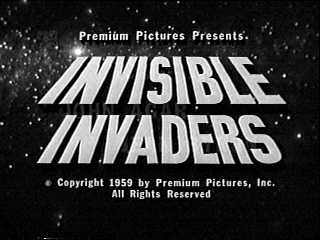
After opening credits (white on star field), cut to a stock footage montage of nuclear science. A narrator tells about the race for atomic supremacy and the push for results. This could lead to disaster. The footage montage ends at a laboratory with a man in a lab coat. Here, intones the narrator, is Dr. Karol Noymann (John Carradine). The good doctor strikes a pose behind a bench. And then there's an explosion. Fade to a newspaper headline about the doctor's demise. (Wow! Ol' Long John sure found a quick way out of this picture.)
 |
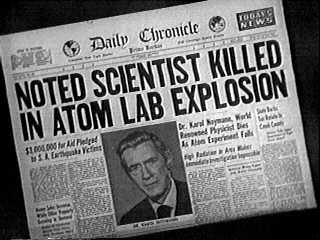 |
| Science teachers beware. This is not an educational film about microbes. | Slow news day. |
Go to aerial footage of the pentagon. The narrator tells us that "serious talks" about nuclear research followed. (Serious talks as opposed to, what? Pleasant platitudes? Silly soliloquies?) In an office, Dr. Adam Penner (Philip Tonge) explains to Lt. General Stone (Paul Langton) that atomic research has gotten too dangerous and should be stopped. The general's not buying the idea. Dr. Penner cites various problems: The area around Dr. Noymann's lab is now uninhabitable due to the radiation, atomic testing has been polluting the air, and fallout in the upper atmosphere will eventually drop to earth. The principled physicist concludes his personal presentation with his resignation. He's flying home for Dr. Noymann's funeral.
At the funeral, Dr. Penner delivers the eulogy. Also present are his daughter Phyllis (Jean Byron) and prospective son-in-law Dr. John Lamont (Robert Hutton). None of these people notice growling, raspy breathing. Nearby, a pair of scaly white legs shuffle along, but fade away. Furrows made by invisible, dragging footsteps lengthen in the loose topsoil. (Actually, it's more like "furrows made by someone pulling something under the dirt." Hereafter, we'll be referring to this fine cinematic illusion as Footsie Furrows™.)
Night, after the funeral, a pair of bushes part to the tune of raspy breathing. A couple of Footsie Furrows™ approach Dr Noymann's grave. An unseen force pushes away the memorial flowers. (OK, maybe it's Invisible Graveyard Caretakers.)
At the Penner home, the downcast doctor answers a knock at the door. It's Noymann. (Guy's in pretty good shape after apparently blowing up. He's sill kind of still and corpse like, but hey, it's Carradine.) Penner freaks. Noymann speaks. He announces that this is the body of an earthman inhabited by a member of a race from another galaxy. Oh, and the earth has twenty-four hours to surrender.
Details. His race took over the Moon from the natives about twenty thousand years ago and built a base. You can't see it because it's invisible. Penner asks why they want Earth. The Noymann puppet says there have been several recent advances in space and nuclear engineering, so it's time for them to add us to their collection of subjugated worlds. And they'll do it by sending down more aliens to inhabit dead bodies and wipe out all civilized life on Earth. You can't win, declares the alien ventriloquist. Surrender, or else. Tell your friends.
Penner is still skeptical. (Well, why not? Just because a talking corpse shows up on your doorstep, that doesn't mean you should believe what he says.) The necrological Noymann asks the perplexed Penner to hold out his hand, and when the compliant physicist does so, the alien automaton slaps his palm with a ruler. Nah, just kidding; this isn't Invisible Parochial School Teachers. The virtual Noymann drops something into Penner's hand, but it's invisible. Then he holds his hand over Penner's. There's a humming noise. A chunk of metal appears in Penner's palm. This, says the cats-paw corpse, is what their space ships are made of. They're invisible, too.
After taking the metal sample back from Penner, the embalmed emissary reminds the perplexed physicist that the deadline for Earth's surrender is in twenty-four hours. He leaves.
Later, John (not the Carradine one, but the prospective son-in-law one)
and Phyllis arrive outside at Penner's. Penner has called them about
seeing the cadaverous colleague. Before going inside, they talk
about how the death of Noymann and his resignation must've been a strain
on him. They go in. Penner's a wreck on the couch. John
tells him he must've imagined it, but the antagonized atom-smasher
maintains that it happened and we're all in trouble. Although he
doesn't believe it, and he's afraid of looking silly, John agrees to relay
Penner's story to the higher-ups in D.C.
And go to a montage of newspapers headlines ridiculing Penner and his
claims of invisible invaders.
Back at the Penner place, John and Phyllis enter. The jaded junior
scientist is pretty miffed for looking silly, but the dutiful daughter is
convinced her father didn't imagine the unusual interview. Penner
insists they need to do something; twenty-four hours is nearly up.
John asks for more proof. Penner proposes they could try the cemetery,
then whips out a shotgun and wastes them both. Nah, just
kidding. They go to the cemetery as live ones.
At the cemetery, they go to Noymann's grave. (A few signs of tampering might've looked promising, but no go.) Penner tries to summon an audience by shouting for the visitors to come. (John's probably sizing up Penner for an I-love-me jacket. You know -- the kind that latches in the back.) Fortunately (for Penner), everyone at the gravesite can hear raspy breathing. A few bushes part, and two pairs of Footsie Furrows™ form in their direction. One of the aliens (via Carradine's booming voice) tells Penner that he failed. (Well, duh.) Penner asks for more time. The alien declares that there will be one more warning.
After a short time, our heroes figure the troublemakers are gone
because they can't hear them. Oh, and John's convinced. They
wonder what the warning will be.
Dead Alive
Later, the narrator tells us there was an air crash near Syracuse, and the movie shows us footage of an air crash. (Rather, it's footage of a test crash; you can clearly see a big white X on the side of the mountain where the thing crashes.) The narrator tells us that the pilot is dead. We see a dead pilot. Then the narrator tells us that one of the invaders possessed the body. We see Footsie Furrows™ heading for the pilot, who convulses, gets up and goes for a walk. (Gee, thanks, Mr. Narrator. We couldn't have figured this out without you.)
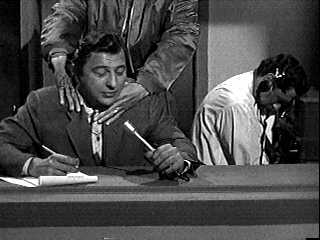
The pilot puppet, who has some surprisingly graphic head injuries, goes to a stock footage hockey game. (Must be a serious Rangers fan.) He strangles a newscaster (Chuck Niles), turns on the PA system, and tells the audience that this is their final warning. The crowd at the game freaks and runs. (Huh? We leave it to you, the intelligent reader, to figure out what is wrong with this picture.) Afterwards, says the movie's narrator, the invader abandoned the body and moved on. We see the dead pilot on the ground while a door to the press booth opens and closes. (Gee, thanks again Mr. Narrator. How would we have figured this out without you?)
In California, there's another stock footage crash, this time with a car. The reanimated driver goes to a stock footage sports event and announces that this is the final warning. (What? The final warning at the hockey game was just a penultimate warning?) Go to a montage of newspaper headlines and stock footage newscasts about the ensuing panic. (Darn straight there'd be panic. Can't run a world without uninterrupted sports events. Next thing you know, these jokers will send parasailing corpses into the Super Bowl.)
However, the nations of the Earth do not surrender. (Why should they? So far as we can tell, the out-of-towners have only messed with an old scientist and a couple of professional sports events in the United States. Were there other "final warnings?" Maybe not. If there were, the narrator would've told us, right?)
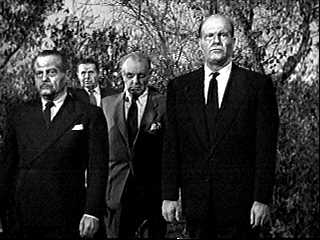
So the aliens declare war on Earth. Everywhere, horrifying armies of the dead begin destroying industrial centers and dams. (Or rather, some shots of a bunch of slow moving white guys in business suits are intercut with stock footage of various disasters. This time we do kind of need the narrator's help on this one.)
 |
 |
| In his early career, Howard Cosell's critics were more demonstrative. | They
come a runnin' Just as fast as they can, 'Cause every ghoul's crazy 'Bout a sharp dressed man. |
Penner and Phyllis watch the invasion on TV. There's an announcement that Penner will be working on a method for dealing with the interplanetary interlopers. (Heh, that's a plan. Always let the opposition know what you are working on.) John enters and says they're packed.
A jeep arrives. The driver is Air Force Major Bruce Jay, who is looking all spiffy in a flight suit. (It's John Agar. Damn, he's late coming into this movie. Must've been sleeping one off.) The narrator tells us he was sent to take them to a secret bunker. (Y'know, if the movie actually shows us this event, I think we could call that announcement redundant.) They grab their light luggage and hop into the jeep. Off they go.
The narrator tells us Major Jay was sent to protect them. (Uh, sure. Department of Redundancy Department, here we come.) Then the narrator tells us that the walking dead are everywhere. We are shown a farmer (Hal Torey) standing in the road with a shotgun. (Funny, he doesn't look all that dead.) He's blocking the path of the jeep. They stop. The "farmer in the hell" tells them that he wants their jeep. Jay tells the others to get out of the jeep. Then the farmer tells Jay he's going to make him squeal like a pig. No, wait, that was another movie with troublesome locals. A pair of Footsie Furrows™ distract the hick highwayman. Jay takes advantage of the moment by quick-drawing his .45 and putting a slug into the farmer's forehead. (Nice shot for about twenty yards. No big, messy exit wound. Either this guy's got a thick skull or this is a movie in from late 1950's)
The civilians are a bit miffed with Jay. He tells them to get into the jeep now! They do so. (Hey, he's the one with the gun.) Off they go again. After they're gone, the Footsie Furrows™ approach the fallen farmer. He convulses and gets up.
Our heroes tool around in a valley for a while until they they come to a cave. (Hey, it's Bronson Canyon. Last time we saw Agar drive a jeep to a cave around here, he ran into an evil space brain.) They drive into the cave. It's a garage. They get out of the jeep. Jay manipulates a few controls, and a pair of doors close at the entrance. He tells the others that the laboratory here has everything. (And as you'll see, in terms of what just happens to be lying around, this place almost puts Operation Wildfire in The Andromeda Strain (1971) to shame.) Then Jay handles a few more controls. Soon, he's on the radio to headquarters.
At headquarters, a WAAF sergeant (Eden Hartford) tells Lt. General Stone that Major Jay is calling. The general tells the major that negotiating with the aliens isn't working, and the military is losing.
But Jay has to put the general on hold because an alarm goes off. He runs over to another set of controls, the others in tow. It's radiation. They close the vents. It probably wasn't a bomb. The radiation is pulsing. (Again, last time something like this happened to Agar, it was an evil space brain. Anytime now, we expect Gor to jump out from behind a rock and yell "Boo!") They figure that some radioactive sources are passing by the sensors. Jay turns on the cameras outside. White guy zombies in business suits are shuffling about smartly. Oh, look! There's the farmer. Aside from that deathlike pallor and nasty zit on his forehead, he seems to have recovered nicely. (He looks out of place in his denims. Maybe he should've gone home and put on his nice Sunday clothes like the rest of the zombies.)
The narrator informs us that the invaders are looking for them. (Well, gee, who'd know?) Back in the still-kind-of-secret bunker, the general tells Jay that they're on their own. They have to find a weapon to use against the aliens.
About this time, John (the prospective son-in-law one, not the Agar
one) starts to freak out because he doesn't feel that he can work under
these conditions. Phyllis get upset because she thinks they're
working for a homicidal maniac. The maniac, er, major tells them to
calm down and get busy. Penner backs him up.
Fun With Acrylics
Elsewhere, the narrator tells us about how the zombies are practicing more sabotage. They blow up a communications center (which looks remarkably like stock footage of a burning train depot) and a munitions depot (which looks like stock footage of a burning bridge).
The general calls the bunker and says they can't hold out much longer. They've noticed that the invaders aren't bringing their own weapons. (Come to think of it, they aren't even bringing their own bodies. What a bunch of cheap aliens.) He suggests that the aliens may be doing this because their bodies and technology may have a weakness in Earth's atmosphere. Then the aliens all die from the common cold. The end. Nah, just kidding. There's more movie.
Dialogue time. Jay asks Penner how he feels about nuclear testing now. Penner says if the human race survives this, we may all just get along. Phyllis talks to Jay about the farmer he shot in cold blood. She keeps seeing his face. (Maybe if she didn't look at the monitor tied to the outside cameras....) Jay says the guy's face haunts him, too. Then he says that he was a bomber pilot and probably killed a lot of men in Korea. But he never saw their faces.
As for what he did to the farmer, he justifies his action by explaining that it was either him or them, and in a split second, he chose in favor of them. (In just about any other movie like this, such a heartfelt disclosure would be a sure sign that the major was about to get whacked by the monster.) Phyllis is impressed by Jay's justification and starts warming up to him. (Damn, the lady's fickle. Does this mean John -- the prospective son-in-law one -- is going to have to waste a few people to get her full affections again?)
Penner announces that he's got a couple of ideas, but someone's going to have to go outside with the zombies to make it work. He explains. First, he remembered when the ersatz Noymann showed him the hunk of metal. There was a humming noise when it turned visible. Therefore, the meat puppet must've used a device that changed either the light spectrum or the molecular properties of the metal. He doesn't know which one, and that's what they need to find out.
Second, to test this idea, they're going to have to catch one of the invaders and run some tests on it. (Maybe the aliens should've gone to that Geneva Convention.) They have some acrylic sealant in the bunker. He wants Jay to rig a foam sprayer to dispense sealant. Why? Because Penner reckons the aliens get into the corpses through the pores of the skin. Coat one of those zombies with the sealant, and the alien will be trapped inside. (Fine. This also assumes that the zombie is too wimpy to break the acrylic seal. They've been strong enough to dig up corpses, you know.)
John (the used to be prospective son-in-law one) does not like the idea of one of those in there with them. (No surprise that this up-and-coming, image conscious scientist is an elitist.) On the other hand, Phyllis seems to be OK with the idea. (Maybe she checked with Jay first.)
More stock footage of disasters. The omnipresent narrator tells us that the Earth was close to total defeat.
Jay has finished modifying the foam dispenser to shoot acrylic sealant. (It looks like a big fire extinguisher. We're not sure how this works, but we'll give it the benefit of the doubt.) Then the major puts on a radiation suit (the kind that looks like you'd wear it while fighting fires). After strapping the tank for the foam dispenser onto his back, outside he goes. The others watch him on TV. (As with many closed circuit television systems in movies, theirs has an automatic technical director. It picks angles for them and selects close-ups.)
The Geiger counter announces the presence of a zombie. Jay lays in for an ambush. When well-tailored death passes him, Jay sprays the cadaverous commando with the acrylic. (Not only does the foam dispenser look like a fire extinguisher, but the acrylic spray looks like a blast of CO2.) The thing goes down, but Jay wasn't able to completely coat it. An invisible force pulls the sprayer away from Jay. (Or rather, someone with a thin line pulls the silly contraption off Jay.) While the major looks around in surprise, he suddenly clutches his throat. After he drops to the ground, the half-coated zombie convulses, gets up, and staggers away fast. After a moment, Jay gets up.
Back in bunker, Jay explains that the spray gun isn't fast enough. However, the acrylic is good idea. He knows it's a good idea because the invader ran from it. John (the used to be prospective son-in-law type, not the Agar type) disagrees. But Jay maintains that they must be close to something important because the aliens are worried and will probably be working harder to stop them.
So our heroes try it again, only this time with variation. They load up a truck with all their drums of sealant. John (not the Agar type) and Jay (who is wearing his radiation suit again) take it on the road. They choose a likely spot and stop. Jay tells John not to get out of the truck. (Never get out of the truck. Absolutely for sure. Never get out of the truck, unless you're going all the way. Oops, sorry. Distracted.) John, who has a Geiger counter, is to honk the horn when an alien approaches.
Jay gets out of the truck in his rad suit and grabs a shovel. The narrator tells us that Jay is going to dig a hole. (Well, duh!) After digging a pit about three deep and six wide, he pumps some sealant into the hole. The narrator tells us that Jay put the sealant into the hole. (Are you sure?) Finally, Jay takes some rope and puts a big slip-noose inside the pool of sealant. This, according to the narrator, would be a trap for one of the invaders. Suddenly, Jay whips out his sidearm and shoots the narrator in the forehead. Nah, just kidding; this ain't an episode of Rocky and Bullwinkle. Not really.
While Jay is finishing up the trap, John looks down at the Geiger counter. It's registering something. He honks the horn. Jay checks around for one of the zombies, and wouldn't you know it, it's farmer zombie. He whips out his sidearm and puts a few slugs into his chest. Naturally, this doesn't seem to hurt him, but it does get his attention. He staggers after Jay. The major has no problems outpacing him. He has even fewer problems tricking it into walking onto a pile of leaves. Into the pit of sealant he goes the zombie. (Superior race my eye.) Jay hooks the free end of the rope to the truck. John pulls forward. This drags the thing out of the sealant. (Not only has this stuff instantly solidified, but the result looks like a plaster coated mannequin about three-quarters the size you'd expect for a fully clothed man who didn't look like he'd missed many meals.)
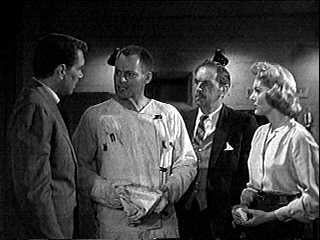 |
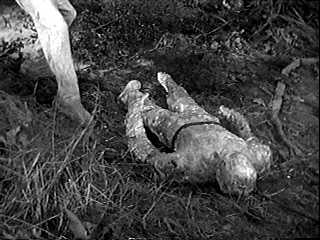 |
| Jay is the sporty center of attention at any party in his Seersucker Straitjacket by Frabizi. (Available at a Men's Wearhouse near you.) | When aliens get plastered. |
Back at the bunker, they take the, uh, stiff to a pressure
chamber. Penner jacks up the pressure in the room until the acrylic
cracks. While the humans watch through a window, farmer zombie gets
up and shakes it off. Then he goes down. A chair in the pressure
chamber rolls over to a desk with a microphone. The vacated alien
(who also talks like Carradine) tells the humans that they can't possibly
win because the war is already over. Jay tells him he lies. If
they give up now, says the amazing transparent Carradine, they might be
shown some mercy. The major tells him "Nuts." (Well,
no, but he might as well.)
The Sound and the Fury
Elsewhere, the movie shows us more stock footage of fires. The narrator tells us this is the third day.
John (not the Agar one nor the Carradine one, but the very unlikely to be a prospective son-in-law one) wants to surrender. Jay says no way. Penner says they've tried everything on the alien, but nothing seems to be hurting it. But Jay reminds them that they must be close to something. This doesn't matter to John; he wants to let the critter out of the pressure chamber. (Dang it, first it's "Don't want one of those foreigners in here!" and now it's "Let's be chummy with the new guy.")
John starts to let it out. Jay stops him. It's a scuffle followed by fisticuffs. (Heh, bet you thought John was just a social climbing wimp.) The two-fisted scientist decks the major about three times. Then he throws a bottle at him. It misses and goes into a control panel. This causes lots of arcs and sparks, followed by spontaneous chain explosions among the rest of the equipment in the room. Alarms go off. Phyllis looks through the window into the pressure chamber. The farmer's body is convulsing.
The major turns off the alarm. Penner's got the answer: It's sound.
Earlier, when he saw the metal in hand, it was the humming sound itself
that made it visible by altering it's molecular structure into a state of
resonance. (Uh,
sure. Why not.) However, our heroes now have a new
deadline. That fire took out the air conditioning. In about an
hour and a half, they'll be out of breathable air. John apologizes.
Jay tells him to forget it. (And amazingly enough, the major will
later turn his back on the high-strung civilian. Ah, well.
Maybe the monster will get John next.)
The scientists kit bash a couple of rifle sized ray gun thingies.
Penner straps an electronic case onto his back and carries the odd weapon
over to the pressure chamber. He opens a small port into the
pressure chamber and puts the business end of the weapon into it.
(My, wasn't that convenient.)
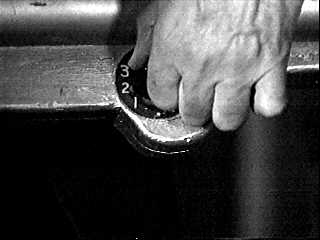
Instead of a trigger, this thing has a dial. Penner turns it up. The gadget puts out a humming noise. The body of the farmer is superimposed with sound waves. (Wow, this contraption makes visible sound.) It doesn't seem to be working. Penner cranks it up. Now it makes horrible screeching noises. A semi-transparent humanoid form rises from the body of the farmer. (It's the ghost of It! The Terror from Beyond Space.) The alien staggers around a little, then falls to the floor and turns into a blob of smoking white stuff.
 |
 |
| The dial trigger on the sonic rifle. ("This one goes to eleven.") | Where are they now? After his initial fame in Ghostbusters, the Sta-Puft Marshmallow Man became destitute. |
Convinced that they've found their weapon, they radio headquarters. However, in mid-conversation, their signal is cut off by loud, oscillating static. Elsewhere, a blurry flying saucer sits on the ground. Jay tells the others they've been jammed. He says they need to track it to the source and destroy it before they can send the information to headquarters.
John (not the Agar one, but the one who you'd figure for dead meat about now) and Phyllis get into a van with a big loop on the roof. Obviously, this a tracker for radio signals. Jay puts on his rad suit again and climbs on top with one of those funky sound guns. Penner's got the other gun. He opens the garage door for them, and off they go.
As soon as they get outside, they run into about three wandering unfriendlies. Jay takes them out fast. We see at least one do that "semi-transparent alien death scene" again. Our heroes continue on the road while trying to track the source of the jamming signal. The narrator tells us that their van has equipment for tracking the source of the jamming signal. (Oh, thank you, master of the obvious.)
Elsewhere, the blurry flying saucer vanishes. (We don't know why it had to be visible earlier. And at this point, we don't really care.) A squad of well dressed zombies stagger out from behind some trees. Jay dismounts and takes them on. He serves up some deadly white noise on the group, dropping several of the slow moving adversaries. (Well, pshaw. These easily beatable wimps aren't carrying any weapons.) One of the zombies holds up a revolver and drops Jay. (Uh, never mind.) Jay manages to tag him with his funky gun. He gets up. The saucer is visible again. (Like I said. We don't know, and we don't care enough to ask anymore.) The major zaps it, and it explodes (in a poorly conceived superimposed shot of another explosion.)
The radio works for Penner now. He radios headquarters. Back in the field, Phyllis helps the wounded Jay out of his rad suit. (Yeah, she's not wearing a radiation suit. What's your point?)
Denouement. Stock footage of the UN. Our four heroes are official thanked for stopping the invaders, or so the narrator tells us. He also tells us that after fighting a dictatorship from outer space, the nations of the world learned to work together. The end. Run end credits.
The Good Stuff
Good Storytelling
To this story's credit, events parade through the runtime the at a good pace. We immediately jump into the story with a scientist dying, another scientist resigning, and the dead scientist's weird resurrection. After these events, the plot keeps busy with one unusual turn after another. This is not to say that the movie has no padding to fill its runtime, because it does. However, most of the padding has some entertainment value, too.
Director Cahn had a good eye for visual composition. Items in the
frame are well arranged, and there's usually a nice balance between light
and dark components. He wasn't up there with the mise en scène masters
like Jean Renoir and Buster Keaton, but his work on Invisible Invaders
and other films is above average in this respect.
Some Originality
There were a few things in this movie that were decidedly different when compared to the bulk of science fiction movies from the 1950's. For example, the walking dead. There had been several zombie movies before, but stories with a crowds of reanimated corpses wouldn't be common until a few years later. Also, there is an unstated idea here, that the aliens could've been the ghosts of mythology; however, this was a few years before Erich von Däniken's Chariots of the Gods?, so this concept might have been too unusual in 1959 to have worked in the dialogue.
As another example, there are military vs. intellectualists
diatribes. During the 1950's, these dialogue debates were decidedly
one-sided in favor of the military; in the late 1960's, the intellectuals
were given the more decisive lines. In this story, both sides have
their points, even though the presentation lacks. Jay shoots a man,
but he later justifies that action and admits that thinking about it
horrifies him, too. (It might've been nice if Jay freaks when he
realizes he's got to "kill" the same man again, but no
go.) Penner got out of the nuclear arms race for
ethical reasons, but when confronted with the need for better weapons, he
explains that he just wanted people to get along. Until the end
narration, this keeps the movie from being neatly categorized as another
Red Menace allegory.
Avoiding Clichés
John hates working for Jay, continually whines, insists on surrendering, and then creates a minor disaster while grappling with Jay. In just about any other movie, John's cowardly death in the last reel would be assured. But not in this movie; he continues to be functional and useful, despite his dangerous character flaws. It's questionable that the other characters still trust him, but there you go.
How many times have you seen this? Characters are trying to dispose of a monster, so they come up with a plan. They try the plan, but due to some minor problem, it doesn't work. Despite the fact that the plan might've worked otherwise, they don't try again. This happens so often in movies that Ken Begg has defined it as the Monster Deathtrap Proviso. Fortunately, Invisible Invaders avoids this plot cliché. When the acrylic sealant trick doesn't work the first time, the characters try it again, only they make it bigger. The result may look as goofy as something in a Warner Brothers cartoon, but it's somehow more satisfying than the previously mentioned alternative.
And while we're on the subject of things Ken and others have defined, please note that the reanimated corpses are not fast movers. But you might expect a scene where a character runs from one of these things, yet it still manages to overtake him. That doesn't happen here. The movie avoids the Offscreen Teleportation cliché. And since the walking dead are never shown sneaking up on someone, the story also avoids a variant of the Stealth Monster Rule. Never mind that they're quiet. Just think in terms of how horrible they might smell. Noisome, not noisy. It's unlikely that one's going to be grabbing anyone from behind -- as long as the victim is not upwind.
This doesn't mean that the story avoids all clichés. The plot concept (aliens invade Earth, and scientists try to find a way to stop them) is a cliché unto itself. But the writer should get points for the ones he avoided, don't you think?
The Bad Stuff
Cheap Shows
Despite the creative story and Cahn's skill at telling a story with pictures, it's not enough to cover the movie's lack of budget. Consider: The events of the story have worldwide implications. These are very significant events (or so we are constantly reminded). But the audience is seeing all this in a cheap, rushed package. Incredulity is not suspended.
This is not to say that it couldn't be done. Documentaries are
relatively inexpensive to produce, and they can be very profound.
But most documentaries don't go for cheap special effects and goofy
methods of monster disposal. And using massive amounts of
stock footage doesn't make this a documentary, either. It just makes
it look cheaper.
Narration Aberration
And while on the subject of documentaries, there is an attempt to make Invisible Invaders feel like a documentary. This is done through the omnipresent narrator. Narration in a story should serve one of two purposes -- it should either be the basis for the story with pictures added to support the story, or it should be there to establish setting and go away. The former is used in documentaries; the latter, dramatizations.
When the narrator is still hanging around to tell you what is happening
when you can clearly see for yourself what is being told with pictures,
then the only thing the narration is good for is relating the story to blind people. It's
not likely the goal here was to make a movie for the sight impaired, so
what we get is another technique to make the shoddy events onscreen seem
more significant. As noted above on stock footage, it also makes the finished product seem
cheaper.
Showing Nothing
A good rule of thumb for making a cheap monster movie is don't show your cheap monster too early in the story. Let the audience dwell on a fear of the unknown for a while before letting them see it. Invisible monsters should be a natural for this rule, right?
Wrong. "Showing" an invisible monster means showing it
moving things around so you can perceive its invisibility. If cheap
effects are used to convey this, then it's the equivalent of showing a
cheap monster. For example, very early in Invisible Invaders,
we see what is supposed to be the effect of an alien dragging his
transparent feet on the ground, which the plot description derisively
calls Footsie Furrows™. If the movie showed it once in the
beginning, it might have seemed like an inventive effect. When the
movie shows it several times, the audience is more likely to be impressed
by the cheesiness of the effect than creeped out by the alien's invisibility.
Alien Plotholes
A nagging question while watching this movie is, "Why do these aliens have to use corpses to do things?" In a few scenes, they seem physically capable enough to achieve their goals without the hindrance of rigor mortis, and you'd think invisibility would have more tactical value than looking creepy. Although the dialogue touches on the obvious answer -- they are vulnerable to loud noises, so they need used bodies to protect them -- the fundamental question is never plainly asked in the dialogue, and the answer is never clearly stated. Besides, you'd think an intergalactic race with a history of subjugating client states would've acquired something like sound-proof suits for getting around noisy environments.
Come to think of it, if these guys can enter a dead body through the pores of the skin, then wouldn't it make more sense for them to use that ability to get into places? If the secret lab bunker had ventilation, wouldn't it follow that several of them could get inside through the ventilation system? Compared to pores in the skin, filters should be child's play. And why can't they use the skin pore trick on live people?
And why do they all talk like John Carradine? When the first alien shows up, you expect him to sound like Carradine because it is Carradine. And then, throughout the rest of the story, when aliens speak, it's Carradine again. Maybe when Noymann showed up at Penner's, the dead physicist didn't sound like Carradine because he was played by Carradine, but because all the aliens sound like Carradine. Imagine that. An alien race where everyone, including the women, talk like John Carradine. Whatever would their dinnertime conversations be like?
The Who Cares Stuff
Notes on the Cast and Crew
Edward L. Cahn (director) did various comedy, educational, and historical shorts during the 1930's and 1940's, including several Our Gang stories. By the 1950's - The Golden Age of B Movies - he was cranking out B features at a phenomenal rate. He did some film noir crime melodramas and troubled teen flicks, but he's most likely to be associated with the creature features he did during that time, a list that includes The She-Creature (1956), It! The Terror from Beyond Space (1958), and Invasion of the Saucer Men (1957).
Samuel Newman (writer) penned a few adventure scripts during the 1950's. Most of his stories were adventures in exotic locales, usually jungles. However, his most memorable (?) work was probably The Giant Claw (1957). (On the day this article was published, Ken Begg -- our keeper on the web -- noticed that both Giant Claw and Invisible Invaders have a character called "Dr. Karol Noymann." Newman... Noymann... hmm....)
If you know for bad movies, you know John Agar (Major Bruce Jay). It's not that he was a bad actor, because he was usually at least competent. Shoot, sometimes he was pretty good. It's just that he appeared in so many B movies. He first became famous as Mr. Shirley Temple in 1945. Four years later and it was "good/bad news" for Agar. The good news was that he began to appear in several John Wayne movies like She Wore a Yellow Ribbon and The Sands of Iwo Jima. The bad news was his divorce, followed by his inability to land good parts in good movies.
Throughout the 50's, Agar appeared in several westerns, but he's more likely to be remembered for the monster movies he did for Universal. He dropped out of the studio system and did several B westerns and creature features. He probably hit bottom for a working actor by appearing in several Larry Buchannan Z movies in the '60's. However, he has picked up some cult status. B movie King? You decide.
Jean Byron (Phyllis Penner) later played the mother on The Patty Duke Show (1963 - 1966).
Philip Tonge (Dr. Adam Penner) had small supporting roles in Miracle on 34th Street (1947), House of Wax (1953), and Witness for the Prosecution (1957).
Robert Hutton (Dr. John Lamont) got into movies in the early 1940's. You can see him as "The Kid" in Destination Tokyo (1943). Often working as a male model, he later appeared in various comedy and science fiction films throughout the 1950's and '60's. Of the latter genre, he was usually cast as professional men, like Dr. Lutens in The Vulture (1966) and Dr. Temple in They Came From Beyond Space (1967). He also tried his hand at directing; unfortunately, that would be The Slime People (1962).
John Carradine (Dr. Karol Noymann) is legendary. We don't need to tell you who he was. So we won't.
Paul Langton (Lt. General Stone ) usually played in dramas plus a few war stories. He picked up a some good supporting parts in They Were Expendable (1945) and To Hell and Back (1955). You can also see him as the brother of The Incredible Shrinking Man (1957). Later in his career, he was a regular on the Peyton Place series.
Eden Hartford (WAAF Sergeant) was Groucho Marx's third wife. Her sister Dee was the third wife of Howard Hawks. Hmmm....
Chuck Niles (Hockey Game Announcer) has a star on the Hollywood Walk of Fame. We suspect this was for his long career as a Jazz DJ in Los Angeles and not for his association with Jerry Warren. Niles had a recurring role as a newscaster in Warren's US repackagings of Mexican horror films and played Ivan the zombie in Teenage Zombies (1959).
Robert E. Kent (producer) worked as a screenwriter from the late 1930's onwards. He covered a variety of genres, including dramas, adventures, musicals, and horror, but most of his work was in westerns. During the late 1950's, he added B movie producer to his resume and in 1958, he began to working exclusively with Edward L. Cahn. That team made over thirty movies in a five year period. (Sidenote: This is not the same Robert Kent who played tough guys in B movies and sometimes did work under the name Douglas Blackley, Jr.)
Many of the crew worked with the Cahn/Kent team on other projects. This includes Maury Gertsman (cinematographer). He also lensed a few movies for Universal in the 1940's, plus several westerns where he showed a fine hand for filming outdoors. His most memorable work was probably in To Hell and Back.
Paul Dunlap (composer) wrote a relatively memorable (albeit infinitely looped) motif for Invisible Invaders, and he did the same for Shock Corridor (1963), The Naked Kiss (1964), and Angry Red Planet (1959).
William Glasgow (art director) also worked on a few cult worthy features like Kiss Me Deadly (1955) and Whatever Happened to Baby Jane? (1962). In 1965, he picked up an Academy Award nomination for "Best Art Direction-Set Decoration, Black-and-White" for his work on Hush... Hush, Sweet Charlotte (1964).
Morris Hoffman (set decoration) was another regular at team Cahn/Kent. He also worked on From Hell It Came (1957) and Madmen of Mandoras (1963, later recut as They Saved Hitler's Brain). (Hmmm. And both Invisible Invaders and They Saved Hitler's Brain used crash footage from Thunder Road (1958). Coincidence?) Hoffman later did his job on better movies, like In Harm's Way (1965) and Blazing Saddles (1974).
Einar Bourman (costumes) also worked on Shock Corridor, The Naked Kiss, and Madmen of Mandoras.
Phillip Scheer (makeup) was in the monster making business. He did the makeup for AIP's teen monster trilogy (I Was a Teenage Werewolf (1957), I Was a Teenage Frankenstein (1957), and How to Make a Monster (1958)). He also did the wild hair-do and eyes for the hypnotized girl turned vampire in Blood of Dracula (1957) and another couple of corpses reanimated by aliens in Cape Canaveral Monsters (1960).
Last but
not least (except maybe in terms of physical height) was Paul Blaisdell
(alien suit (uncredited)). He built some of the most recognizable
monsters in B movie history, including the crustacean She-Creature (1956),
the carrotish Venusian in It Conquered the World (1956), and the
Tabanga in From Hell it Came (1957). As noted in the plot
description, Invisible Invaders recycles his monster suit from It!
Terror From Beyond Space. You can see a little bit more of It!
when It! was in better shape over at Stomp
Tokyo.
Roots, Shoots, and Other Compares
"Nope. Can't See It" - Invisibility from 1950 to 1966
During the 1950's and continuing on into the early 1960's, there were various other stories involving invisibility. Many of them were variants on The Invisible Man, but there were also a few instances of invisible aliens and such. (Note: Although supernatural beings would be alien to us, ghost and demon stories from this period have been omitted for the sake of clarity.)
Abbott and Costello Meet the Invisible Man (1951) - The end of Universal's variants on their The Invisible Man (1933) franchise. A boxer has been accused of murder. Fortunately, he has access to the invisibility formula. He takes it to escape the police and must now use his newly acquired transparency to prove his innocence. Unfortunately, his closest allies are you-know-who.
Phantom from Space (1953) - Alien prangs his spaceship in southern California and goes for a walk in his space suit. When some locals see him, they freak out and attack him. Afterwards, the alien gets out of uniform; he's invisible.
Tomei Ningen (1954, a.k.a. The Invisible Man, Invisible Avenger, and Transparent Human) - Toho flick with invisible gangsters. Cf. Die Unsichtbaren Krallen des Dr. Mabuse below.
Forbidden Planet (1956) - Classic science fiction variant on The Tempest. After the crewmen of a space ship encounter a secluded scientist and his daughter, the visitors are attacked by an invisible monster.
Manhunt in Space (1956) - Edited from episodes of Rocky Jones, Space Ranger (1954). One of the gadgets is a ray that can make objects invisible.
El Hombre que Logró ser Invisible (1957) - Mexican/Venezuelan retelling of The Invisible Man, but as in Abbott and Costello Meet the Invisible Man above, invisibility is used to escape imprisonment while proving innocence.
The Invisible Boy (1957) - Average kid gets zapped by an evil super computer and become a genius. He now has the ability to beat the crap out of his father at chess, resurrect Robby the Robot from Forbidden Planet, and make himself invisible.
Fiend Without a Face (1958) - Weird, invisible critters with a taste for nervous systems attack. See review at Badmovies.org.
The Invisible Man (1958-1960) - Brit TV series about a scientist who accidentally becomes invisible and doesn't care for it. He divides his time between trying to reverse the process and doing a few jobs for the government. Cf. The Invisible Man (1975 - 1976).
The Cosmic Man (1959) - Simplified remake of The Day the Earth Stood Still (1951). John Carradine plays a semi-transparent alien emissary. (Heh, given Invisible Invaders, 1959 must've been the year for Carradine playing this highly specialized character type.)
The Amazing Transparent Man (1960) - Military backed mad scientist needs more radioactive materials for his invisibility experiments. He turns a professional thief invisible and sends him to get some. Unfortunately, the enhanced thief decides to pick up a few other things....
The Fantastic Four by Stan Lee et. al. (1961 - 1996) - Comic book about four people exposed to radiation, but instead of dying from cancer, they develop super powers analogous to the classic four elements - earth, air, fire, and water. The air component of the group is The Invisible Girl, who can will herself into transparency, make invisible force fields, and cause other objects to be invisible. Made into about three cartoon series of questionable merit and, in 1994, a movie of even more questionable merit. Regarding that, uh, movie, see review at Opposable Thumb Films.
The Phantom Planet (1961) - Space opera variant on the "lost civilization" theme. Astronaut encounters an invisible asteroid that contains the fleeing survivors of an alien race. (Uh, this would be the easy part to explain.) Cf. Fire Maidens of Outer Space (1956).
Die Unsichtbaren Krallen des Dr. Mabuse (1962, a.k.a. The Invisible Horror and The Invisible Dr. Mabuse (1965)) - What if Germany's greatest fictional über villain had the secret to invisibility? And why are FBI agents being sent to Germany to find out? One of the post-Fritz Lang entries in the series.
El Sonido Prehistórico (1964, a.k.a. The Sound of Horror) - Isolated group is stalked by an invisible dinosaur. Surprisingly gory for the time. (The invisible attack sequences creeped out yours truly when he was a small boy back when. Does it stand the test of time? Probably not. See review at Badmovies.org.)
Where's Everett? (1966) - Half hour pilot episode for a proposed sitcom. The network that produced it ran it one evening to see if there was an interested audience, but no go. The plot? OK, if you insist. Invisible alien lands in suburbia and abandons its invisible baby on the doorstep of a typical sitcom couple. Transparent hi-jinks follow.
Matchless (1966) - Cold War spy comedy and a sign of the attitudes to follow throughout the rest of the 1960's and into the 1970's. Journalist is captured in Communist Asia and accused of being a spy. A dying fellow prisoner gives him a magic ring that can turn the wearer invisible for ten minutes at a time. But instead of being quested to throw the thing into the Crack of Doom, our hero has a few stealthy adventures while being pursued by agents on both sides of the Cold War, plus a few independents, who want the ring. Cf. The President's Analyst (1967).
Night of the Invaders from Outer Space
As noted in the introduction, plot
elements in Invisible Invaders may remind cult movie fans of other
movies. For this reason, we include the following table for
side-by-side comparisons...
| Movie | Plan
9 From Outer Space (1958) |
Invisible
Invaders (1959) |
Night
of the Living Dead (1968) |
| Budget | Non-existent | Minimal | Nah |
| Colors | Black & White | Black & White | Black & White |
| Actors | One face familiar to those outside of Hollywood (back then) | A couple of familiar faces | Nobody familiar (back then) |
| Stock Footage | Lots | Lots | Don't think so |
| Rationale | Alien agents use remote control on corpses as part of a terror plan. | Aliens directly possess corpses as part of an invasion plan. | Corpses get up and eat the living, possibly due to radiation from a returning space probe. (No plan) |
| Time of Day | Night (maybe) | Day | Night (mostly) |
| Zombies | Three (four if you count the chiropractor separately) | A bunch of white guys in business suits | A whole crowd, mixed |
| Stop Zombies By | Remote control | Shooting them with white noise | Aiming for the head |
| Military | Trying to cover up the existence of aliens | Trying to stop the aliens and ill mannered civilians | Some guard troops, but mostly good ol' boy militia |
| Protagonists | A pilot and his wife, living next to a graveyard (unless you count the aliens as protagonists) | Two scientists, a military man, and a woman, trapped in a secret lab | A random group of average people, trapped in a farmhouse |
| Drama | Some human vs. alien bickering until the alien agents die | Some bickering among the protagonists until they work out their differences and save the day | Major bickering among the protagonists until they die |
| Cult Value | Notorious for its bad acting, bad dialogue, bad sets, bad special effects, etc. | Very little; a merely mediocre mixed bag of competence and badness | Renowned for its effective minimalist drama, subtle social perspective, and gory (for the time) cannibalism |
The Bottom Line
Transparent aliens use dead bodies to take over the world. Good story telling and fairly original for a B movie, yet handicapped by a constant reminders of its tiny production values. Massive stock footage, followed by annoying overuse of narration. Multiple plotholes regarding the aliens. Recommended for fans of B grade atomic age ghost stories.
Originally published on 7 April 2001
 |
   |
A
Proud Annex of....
|
|