|

All the President's Wolfen, or…
[The] Werewolf of Washington (1973)
Information at the IMDB, US.IMDB
and that man is by nature a political animal.
Aristotle (384 BC-322 BC)
One of the most emotional events of the last generation was the resignation of President Richard M. Nixon on August 9, 1974. To this day, the rhetoric from both sides of the issue remains, and there is very little can be found that does not take a side to some degree.
One of the by-products of that time was remarkably disposable comedy. For example, comedian Rich Little, who'd already been making a name for himself with his impressions of Nixon, made a movie called A Fine Mess. The premise was, retell the Watergate break-in with Laurel and Hardy. If you've never heard about it, don't worry. During an interview, Little referred to this film as a fine mess.
But there were others comedies that were even more disposable….
Contents
- The Plot
- Even a Man Who is Pure at Heart
- And Says His Prayers by Night
- May Become a Wolf When the Wolfsbane Blooms
- And the Moon is Full and Bright
- The Good Stuff
- The Bad Stuff
- The Who Cares Stuff
- Notes on the Cast and Crew
- Roots, Shoots, and Other Compares
- "Does Your Conscience Bother You? (Now Tell Me True.)"
- The Bottom Line
The Plot
Even a Man Who is Pure at Heart
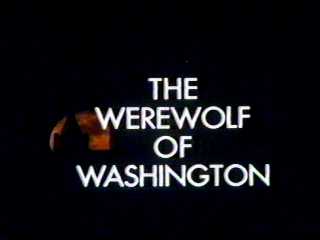
We open with a long, slow shot of a moonrise with superimposed credits. Jack Whittier (Dean Stockwell) introduces himself in a voiceover. He says he was a fast rising star of the Washington press corps, but he had to leave town fast. He was doing it with the President's daughter, decided to break it off, and took an assignment to Budapest. The President didn't know about Jack by-lining his girl; he thought the reporter had been banished for his views, and offered him a job as a White House press aide. And so Jack was on his way back to Washington.Cut to Jack looking at the head of a cane. It's shaped like a
wolf's head. He asks, "What's if for?" Giselle (Katalin Kallay),
who is his little bit on the side in Budapest says, "You mean you don't
know?" Fade to black (FTB). (Note, throughout the following
sequence, FTB will be used several times for scene transitions. The
darkness between scenes lasts for more than a second. We suspect
they are intended as dramatic pauses. However, the individual scenes
are amateurish, so the repetitive FTB's feel like padding.)
 |
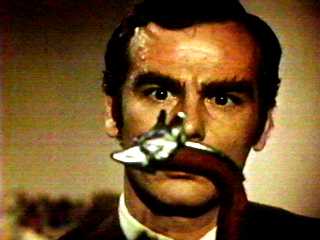 |
| Where's Mulder and Scully when you need them? | "What's it made of?"
"Dogwood." [rimshot!] |
Fade to Jack talking to Giselle. He offers to pull some strings to get her a job in the United States. She's not interested. (FTB) Go to Jack driving. He nearly hits a man on a motorcycle and runs off the road. Jack freaks on him. He's in a hurry to get to the airport. His car won't start. Jack tries to get the man to help. (FTB) At a gypsy camp, Jack tries to get help, but the clan mother (Despo) tells them they must leave. Jack is still freaking about missing his flight while the gypsies immediately break camp and leave. (FTB) Jack decides to walk for help and takes Giselle back to the car. He asks her to wait inside. (FTB)
Jack tries to talk to a local about where the nearest gas station is. The local is not able to help him. He goes inside and shuts the door. (FTB) Jack goes back to the car, but Giselle is not there. (FTB) Elsewhere, Giselle is facing down a wolf. (They both seem disinterested in the scene.) Jack arrives and beats the wolf (who is on the other side of a tree from the camera) with his new cane. He checks out a gash on own chest, and looks down. One of the gypsies is on the ground. (FTB)
At a police station, Jack is trying to explain all this (minus the gratuitous use of FTB's) to a policeman. The Budapest bobby tells Jack it must've been an accident, and that he shouldn't worry about it. Jack tries to do the right thing by insisting they're letting him off too easily. The policeman tells him to go; no one is missing and no corpse has been found.
Outside, Jack and Giselle encounter the gypsy clan mother. He
asks the Romany mommy if that was her son. It was. She says
her son wanted to die. Jack, being a reporter, suspects it was for
political reasons. She says it was because of the sign of the pentagram.
"Ah!" exclaims Jack. "The Pentagon is behind this!" (Savor
that one, folks; it's the funniest line in the whole comedy, and they've
used it already.) The clan mother explains about the pentagram, the
mark of the beast, and that her son was a werewolf. Jack still thinks
this is all some conspiracy. The clan mother gives Jack a charm and
tells him to wear it over his heart. Then she explains the basics,
including silver bullets and sticks with silver handles. Fade to
you know what.
And Says His Prayers by Night
This time, the black screen is broken by a POV shot from inside a toilet. (And what an apropos shot it is.) Jack lifts up the lid, drops the charm into the water, and flushes. Cut to an establishing shot of Jack wearing a tuxedo in an ornate bathroom. He exits to a formal party. He passes by Martha Captree (Nancy Andrews), who is a bit drunk and ranting a few political views that would be embarrassing for her husband, Judge Captree.Jack enters another room and meets with the President (Biff McGuire). (Just as Chevy Chase would later play a president without trying to look like Ford, this actor is not trying to look like Nixon. Is this a bold move or a wimp out? You decide.) The President tells Jack that the Attorney General is too honest, so Jack will be working as the Attorney General's press aide. He also wants Jack to work on Martha Mitchell, er, Captree. She's been saying some things that might hamper Judge Captree's appointment to the Supreme Court. Then they finish it up with some small talk about the President's daughter and the Naval psychologist she's been dating.
Back at the party, Martha continues to shoot off her mouth while wounding her husband's appointment. Jack is introduced to her. She gets cutesy with him. And then the President's daughter Marion (Jane House) enters. Martha asks if he was banished to Siberia because of her. Jack ignores it.
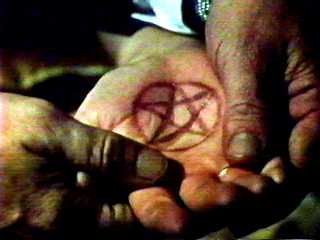
Cut to an exterior night shot, and then back to the party. (Huh?) Jack is talking to Marion. She breaks it to him that she's engaged to Commander Salmon. In some footage elsewhere, the moon is rising. Jack goes back to Martha. He notices a crudely done jump fade shot of a pentagram on her hand. He takes her hand for a better look, which seems to be agreeable to Martha. The Naval psychologist Commander Salmon (Beeson Carroll) enters, introduces himself to Jack, and invites him over for a talk sometime. (Nitpicker's note: Salmon's rank is actually Lieutenant Commander. However, it is acceptable during conversation to refer to people with that rank as "Commander.")
Later, we assume after the party, Martha staggers alone past some storefronts. (Those of you who are familiar with the crime rate in the District of Columbia back then will know how unlikely this is.) There are some growling noises, and it probably isn't the avenging ghost of Checkers the dog. Martha screams.
The next morning, the Attorney General (Clifton James) talks to Jack about a commentator on a television program. He's upset because the commentator has been saying derogatory things about the President, and he wants to win back the hearts and minds of the people. (This is would be Nixon rhetoric. Oh, ha ha.) Then they shift to a speech, which Jack is helping him write. Jack looks over the draft, and accidentally suggests the word "impudence." The Attorney General likes the word and wants to use it. (Agnew rhetoric. Oh, ha ha.) The phone rings. The generic Attorney General takes the call, and tells Jack that Martha has been found dead with her guts ripped out. Cut to a shot of Martha with a throat injury.
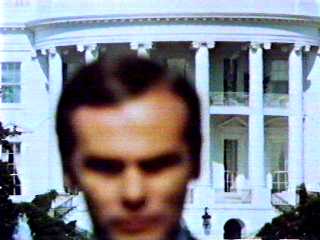
Later Jack goes to the White House. (Actually, he is seen in the same shot as the White House; both elements are not in focus together.) Inside, Jack runs into Marion. He says he hasn't been in the White House for a long time. (He's there now?) Jack goes to the Oval Office (or something like it). The President is talking to a news publisher (Jacqueline Brooks). He tells her he really wants Judge Captree's appointment, that it's necessary to avoid national anarchy, and that he'd appreciate some help on this. (Somehow, I don't recall anything in the Constitution about press publishers voting on Supreme Court appointments.) When she says she'll do what she can, the President offers to cut her a favor on an FCC matter. (I don't seem to recall this feature about the FCC, either. You sure do learn a lot about the federal government from this movie.) While she's leaving, the President makes a comment about her decision to banish Jack to Budapest. She explains that Jack wasn't banished. (Nothing is made of this clarification.) Jack glances at her hand and sees a pentagram.
Jack runs down the hallway. Marion tries to stop him for some cutesy small talk. Jack evades her and shuts himself behind a door. She goes to the door and asks what's wrong. He pleads with her to run, but his line is cut off by a howl. (Strange. It was daylight in the last scene…)
Cut to the publisher arriving at a gas station at night. She's
not aware that a werewolf (hereafter referred to as Wolfman Jack) is on
the roof of her car. (And we're not aware of how no one has noticed
a car with a wolf man on the roof.) She waits for an attendant.
(This was back when gas stations didn't mess with self-serve pumps.)
She gets out of the car, sees Wolfman Jack, and beats feet. Needless
to say, she doesn't get very far, and a sudden shift to slow motion seems
to handicap her even more.
 |
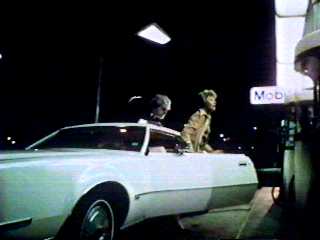 |
| Mrs. Captree would later regret slapping Ozzy Osbourne. | Unlike Exxon's "Put a Tiger in Your Tank," Mobil's new slogan ("Put a Werewolf on Your Roof") never caught on. |
The next morning, the gas station is swarming with investigators. Jack, Commander Salmon, and the Attorney General are also there. A hippie couple (Thurmon Scott and Barbara Spiegel) is being held for questioning. Salmon suggests the kid did it for odd psychological reasons. They ask the couple some questions. Since the hippie guy is black, the questioning turns into a racial thing. The hippie girl says it was a wolf. The Attorney General shouts "Panthers!" (Subversive comedy. Oh, ha ha.) Jack takes a look at the girl's palm. He tells them they are either going to be locked up or given an FBI agent to watch them. (Who knew a White House press aide had such raw power? There's also a question of jurisdiction, but let's not go there.) Meanwhile, a black reporter (Tom Scott) questions the Attorney General, who takes the opportunity to freak out about the subversive elements at work here. (At least something is working here.)
Back at the White House (or something like that), Jack goes to a lavatory and picks up a pair of shoes from the ground. (We assume this is the room he ran into a few scenes ago. This is not clearly presented in the story.) While he's examining the shoes, voices approach. Jack runs into a stall and shuts the door. Enter the President and an astronaut. They're making small talk about the space program while the President checks out the detail on a model of the lunar lander. (The moon program would open interesting possibilities for the timing of Jack's transformations. Unfortunately, this is never explored.) The astronaut tries to open the stall Jack is in, but the door is not budging. While the astronaut goes to the next stall, the President tries to pull open the door on Jack's hiding place. We are treated to an overhead shot, showing the Jack holding the door shut while the President tries to open the door while an astronaut urinates in the next stall. (Sophisticated comedy. Oh, ha ha.) The President and the astronaut leave. Jack sneaks out of the stall to pick up the shoes, but runs wildly back into the stall just as the President returns to retrieve his model of the lunar lander. (Near miss comedy. Oh, ha ha.)
Later, Jack tries to talk to the President about the shoes. The
President has no idea what he is talking about. Jack says it's about the
murders. The President tells him not to worry, as they've already
got those two hippies locked up and a guard on them. Jack says he
wants a guard on himself. During this, the President turns up the
volume on the TV because he's trying to follow a game. (Sports humor.
Oh, ha ha.) Jack (along with most of the audience at this point)
gives up.
May Become a Wolf When the Wolfsbane Blooms
At a restaurant, Jack talks to Salmon about his werewolf thing. The psychologist is not buying it. Jack tells him about the pentagram. Salmon tells him it's natural to see conspiracies in everyday life. Jack asks what conspiracy, and Salmon says the Pentagon. (Sorry, guys. Unless it's meant to be a running gag, you're only allowed one use of a good line.) Jack drags Salmon to the restroom. He takes off his shirt and shows Salmon a simple red star on his chest. (It's another missed opportunity; they could've broken some new ground with jokes about a Kremlin conspiracy, but they don't.) The psychologist tells Jack he needs help. (Activity time: Who else associated with this feature needed help and why?) Jack asks Salmon to lock him up right away, but Salmon merely tells him to calm down.Cut to Jack scratching his chest as he walks along the street. He goes inside a building, and the word "Watergate" is clearly seen. (Topical humor. Oh, ha ha.) In his apartment, Jack makes a phone call to someone who can put him into contact with Giselle. Meanwhile, night falls on some footage of Washington, D.C. Marion calls and asks if he's spoken to Salmon. ("He talks to the fishes now….") Jack has calmed down enough to decide that he's not a werewolf; he's been brainwashed. Then Marion suggests he should play a little solitaire. No, wait, wrong movie. Marion asks if she could come over. Jack does some cutesy small talk with her, but is interrupted when he starts to wolf out. (Some guys just have no restraint.) He drops the phone and falls backward into a chair. Then he transforms via fade cuts. After he's finished, Wolfman Jack runs around the apartment on all fours, exploring things with his nose and mouth. (We'd like to think that he also lifted a leg on the people responsible for this film, but then, we'd like to think that world peace could happen, too.)
Later, somewhere among some footage of Washington landmarks, the hippie couple is out walking. An FBI agent named Murphy (Randy Phillips) is escorting them. The girl asks Murphy for a little privacy; she'd like to use the phone. She goes down to a phone booth, calls information, and gets Murphy's home phone number. Then she makes a prank phone call to Murphy's wife. (Of all the Murphy's in the phone book, figure the odds she'd get the right one. So much for Murphy's law….)
The hippie guy comes down and interrupts her call, but Wolfman Jack suddenly arrives, too. Wolfman Jack takes down the hippie guy while the guy is taking pictures of him. (Did this photographic evidence disappear due to a government conspiracy or a script fumble? You decide.) The girl shuts the door on the booth. Wolfman Jack tries to get to her, but knocks over the booth. He can't find a way in, so he jumps up on top of the booth. Scary music plays. Shot of the girl panicking. The same scary music plays again. Shot of Wolfman Jack slavering. The same scary music plays again. Finally, agent Murphy arrives, shooting at Wolfman Jack. The wound-up werewolf runs away, and, thank God, that blasted infinite scary music loop ends.
The next day, Jack is seen walking to the White House. (Or, rather, Jack is seen walking along the fence.) Inside (or something like that), the President is reading a prepared statement for the press corps. It rambles from topic to topic without making a point on any topic. (We can't tell. Does this mean that Jack prepared the statement and his work is suffering? Does it mean the writer's thought that Nixon's speeches did the same thing? (Ben Stein deserves a piece of that one.) At this point, maybe we should go with the more obvious observation that the the same person who wrote the script wrote this press statement, too)
The President opens the floor for questions, and selects the black reporter (from the gas station scene earlier). He asks about the investigation, and notes that the couple who was being held was attacked last night. (Held? Huh?) The President deflects the question by saying he meant to take a question from the reporter behind the black reporter. The other reporter asks about the Vice President's speech. The President says, "Let me make one thing perfectly clear. The Vice President does not clear his speeches with me." (Wow. Nixon and Agnew humor in the same line. Where will it all end? Oh, ha ha.)
Later, the President talks to Jack while bowling. (A popular bit of White House trivia from the time was the two-lane bowling alley in the White House.) Jack is trying to tell the President about his latent lycanthropy. The President, who is really getting into his game, pauses to tell Jack there's no such thing as werewolves. The ball return doesn't work, so the President heads down the lane to get it. Jack follows him, but the President is stomping along the side channels. He tells Jack that he has to get into the gutter with him. (Sophisticated visual humor. Will it all end? Oh, ha ha.)
After retrieving the ball from the machinery and returning to the head of the lanes, the President encourages Jack to roll a few frames with him. Jack puts his fingers in the holes of a ball, but, because of digital swelling due to his mystical condition, his fingers get stuck. The President excitedly asks Jack why he hasn't bowled his frame yet. Jack tells the exasperated executive his fingers are stuck, so the President helps him pull the ball off. (Slapstick sports humor. For the love of God, please let it all end!)
In the next scene, Jack and the President go to a meeting in a war room. Instead of an establishing shot, they put the camera in the middle of the table and let it spin around. (Some may become ill from watching this effect. Motion sickness or motion picture sickness? You decide.) There are several high-ranking officers in attendance. (Some of them almost have correct uniforms.) They talk about their military woes. The ever-present Attorney General is also there, pushing for martial law. There's also a bald guy (James Tolkan) wearing rectangular sunglasses. He's taking pictures with a small spy camera. (Don't ask. You won't get an answer.)
The President announces that he'd like to get the troops out of South East Asia as soon as possible. (What? Out of South Korea and Japan as well?) The one of the military types uses some jargon gibberish to suggest broadening the war. The President likes the sound of it, so he goes along with it. (We'd like to hear the double-talk it took to get this movie made.) Then the President says, "Now about my plan to recognize Red China…." All the military types laugh, and the President laughs along with them. (Heh. The joke was on somebody, but I can't tell if it was the screenwriter or Taipei.)
During all this, Jack has been wolfing out. He hides his fuzzy hands and excuses himself quickly. In the next shot, he's completed his transformation to Wolfman Jack and is wandering through a factory (?). Cut back to the meeting he'd left, while the President makes excuses for his press aide's sudden departure. (We'd also like to hear excuses for why the Joint Chiefs are meeting in a factory, but that doesn't happen.)
A guard shoots Wolfman Jack with a submachine gun. This is, of
course, ineffective, and da' Wolfman savages the guard. Afterwards,
Wolfman Jack wanders around the factory for a few more shots and stops
at what looks like an open mad scientist's lab. There's a body on
a slab wearing big, corrective shoes. The diminutive Dr. Kiss (Michael
Dunn) is working on it. He looks up and sees Wolfman Jack.
The wandering werewolf drops on all fours, putting his face next to the
miniature mad scientist. Dr. Kiss leans closer for a better look.
Wolfman Jack snorts a few times, then starts sniffing Dr. Kiss. "Are
you real?" asks Dr. Kiss in amazement. Then Wolfman Jack starts licking
Dr. Kiss' face while the short scientist tries to hold him still for a
better look. However, Wolfman Jack senses something elsewhere, and
runs off. Dr. Kiss shouts for him to wait and come back. (Damn straight.
That was the only funny scene in this whole comedy. Bring it back!)
 |
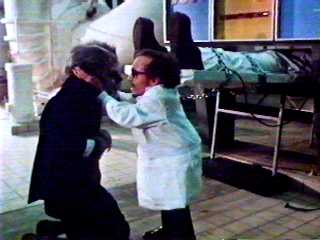 |
| Every administration is accused of fuzzy headed thinking. | Fortunately, Wolfman Jack didn't try to hump Dr. Kiss' leg. |
And the Moon is Full and Bright
The next morning, Jack is waking up in a cemetery. He checks out the front of his shirt. There's a straight line of perfectly round holes. (We could complain about this, but the physics of bullet impacts on werewolves is a matter of some debate.) Later, he's on the phone trying to negotiate for some silver bullets.Back at the factory (or whatever the heck it was supposed to be), the President, Dr. Kiss, and the bald guy with the rectangular sunglasses are watching a tape from a security camera. The President suggests a tank or a flame-thrower might stop it. Dr. Kissenger, er, Dr. Strangelove, er, Kiss says he wants it taken alive for his program. The President asks about the details of the program. Dr. Kiss declines to answer. He and the one with the dark glasses walk away. The President follows them into a restroom. (My, the obsessions with toilet humor in this movie….) Dr. Kiss and "Dark Glasses" get into a stall and close the door. The President opens the door. Naturally, they're gone. Dr. Kiss and Dark Glasses are seen in the next shot, walking down a hall. (Presumably out of the movie. Gee, what a smart move.)
Elsewhere, Jack is mapping out the attacks that have happened already. He's showing this to the Attorney General and Commander Salmon. Then he draws lines connecting the four points. It resembles a five pointed star with one point missing. Jack draws in the fifth point. It's at the Watergate, where his apartment is. (I'm glad they, uh, pointed this out. Normally, you only get three consecutive nights of the full moon. Assuming there have been no monthly jumps in the story, then last night was the fifth consecutive night with a full moon.) Jack shows them the shirt and explains about the shoes. The psychologist and the Attorney General buy it. (Uh, sure. A madman draws a mystical symbol on a map and shows you some perfectly round holes that were supposed to be caused by bullets. You'd buy it, wouldn't you?) They get to work to keep this out of the press.
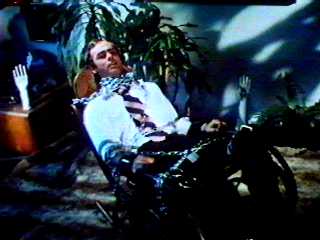
Later, Salmon is setting up a camera in Jack's apartment. (It's another missed opportunity, because a Cuban plumber does not assist Salmon.) Salmon says the President will want a copy for his new library. (OK, checkpoint met. Oh, ha ha.) Jack has been chained to his couch. (Apparently, they are expecting an even more unprecedented sixth consecutive night of the full moon.) He asks Salmon to turn on the TV so he can watch the President's scheduled address on relations with China. Salmon leaves, saying he'll be back after the address. Jack begs him to stay and kill him with the silver handled stick. (Actually, Jack begs somebody called "Captain" to kill him, but since there's only a lieutenant commander in the room, no one does this. Now is probably a good time to point out that this Navy psychologist does not wear the medical corps insignia nor a line officer's star; it's the Coast Guard shield that adorns his sleeve.)
After a long waiting period, Marion enters. She starts unlocking him. Jack yells at her to stop. She says, "Quit barking at me." (Almost funny, but it's too little too late.) She says she's going to spend the night there. Jack tells her to get the gun. It has a silver bullet in it. She needs to keep it for her protection. She picks up the revolver but won't have anything to do with it. (Marion is obviously a sensible girl. The proper tool for a single bullet would be either a break action target pistol or a semiautomatic. Russian roulette with werewolves, anyone?) She leans over Jack and starts kissing him. The phone rings. It's the President. The press secretary is sick and needs Jack at the address.
The next scene, Jack is getting into a helicopter. (And, of course, Jack's decision is not explained.) The President and a remarkably youthful Prime Minister of an unspecified militaristic East Asian country are also in the cabin. While they're taking off, the PM asks the President about the werewolf attacks. In flight, the President tries to get Jack into the conversation, but Jack is busy wolfing out. Unfortunately, the President can't see this. However, the PM can. He starts to freak out about Jack, but the President has no idea what he's yelling about, particularly since it's in Cantonese. After playing out this scene for a very long time (presumably because the filmmakers figured the audience would be driven to hysterical laughter at this point), Jack's stop motion transformation stops. He jumps up.
"Jack!" exclaims the President. "It is you!" While Wolfman
Jack dispatches the PM, the President yells for him to sit, heel, etc.
(It's a lot funnier on paper than it is as presented.) The President
opens the cabin door. The helicopter is not far from the ground,
near the assembled press corps and such. Wolfman Jack grabs the President
and they both fall. After the sound of gunfire, Wolfman Jack runs
away. (We assume the Secret Service would've taken a bite for the
Commander in Chief, but it doesn't seem to work that way here.)
 |
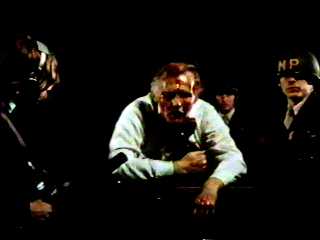 |
| "But I could not shut my glazzies, and even if I tried to move my glazballs about, I still not get out of the line of fire of this picture." | "Although I shall not be present at this historic summit meeting, I present this in the hope that our great nations may learn to live in peace..." (presses button on cassette player) |
Back at Jack's place, Marion is setting up a romantic dinner. She walks out of the room to get something, so we are treated to twenty seconds of nothing happening. (Mind you, they're almost a pleasant twenty seconds….) Marion returns. While she's lighting some candles, Wolfman Jack silently enters in the background. She sees him, screams, and runs. She gets to the living room and picks up the revolver. He gets real close. Suddenly, the scene goes dark, and Marion shoots him in slow motion. (Helpful hint to filmmakers number 498: When you want a single shot go to slow motion, be sure to use a "fast" film and adequate lighting.)
Enter the Attorney General, Salmon, and Dark Glasses. Wolfman Jack does the obligatory revert to Jack bit. Marion freaks out. Some extras help her out of the room. The others start to work on the cover-up. The story will be that Jack got in the way of a sniper's bullet that was intended for the President's daughter. The black reporter from before arrives. The Attorney General tells him, "Well, you won't have Jack Whittier to kick around any more." (Ah, but we will have this movie…) The End.
Roll end credits over the White House at night. In a voiceover,
the President is giving a speech about the death of some of his opponents
and the need to tighten law enforcement to prevent anarchy. Then
he starts to wolf out. This immediate exposure to scandal may have
been funny back then. Who can tell anymore? All we know now,
twenty-five years later, is this: If should be revealed that the current
President was a werewolf, he'd probably continue to soar in the polls.
The Good Stuff
Paying their Dues
As described at the beginning, the set up parodies The Wolf Man (1941). It's not very good as parody or filmmaking, but it does show some respect for its source material. The silver cane with a wolf's head, the gypsy son, the mother explaining it, the magic charm, they're all there. The only element missing is the poem. Although the pace and staging are remarkably lame, it shows some promise for what will follow.All bets are off, though, once it shifts to the feeble comedy in Washington.
Wolfman Jack
Stanton's portrayal of a wolfman is pretty good. He's very quick and agile on all fours, and he puts a lot of creative energy into his body language. This works extremely well during the scene with Michael Dunn's character. Stanton's excitable dog act frolics along with Dunn's childlike wonder, making it one of the best played sight gags I've seen.They also did a good job on the make up. The transformation scenes
are not very good, but a werewolf in a business suit is an interesting
image. Furthermore, it's a werewolf with white fur. That might've
been intended as a social commentary, as later attempted with a black Dr.
Jekyll type that turning into a homicidal white Mr. Hyde in Dr. Black,
Mr. Hyde (1976). Perhaps the makers of this film should've scrapped
the Washington thing and made something called The Werewolf of Wall
Street instead.
The Bad Stuff
My God, where to begin?Poor Political Humor…
I suspect, very sincerely, that the screenwriter's knowledge of the Nixon administration was limited to comedic impressions of Nixon by David Frye and Rich Little. And that's giving it the benefit of the doubt; he may not have even bothered with Frye. Aside from the prized Pentagon pun, there are no political jokes here you would not have heard elsewhere. And they were done better in their "elsewhere" origins, too.For example, there are jokes about Vice President Spiro Agnew's speeches. This was a routine Little did sometimes, and Frye did often. However, the flimmakers put the Agnew jokes into the mouth of the Attorney General. Did they decide against casting (and paying for) another actor to play the Vice President? Here's a more likely scenario. At about the time this film was made, Agnew resigned, and they couldn't bring themselves to scrap the dialogue.
As noted in the plot description, there were several missed opportunities for doing something original, something beyond Frye and Little. Here's an easy example. The Secretary of Agriculture was Earl Butz. Needless to say, a surname like that was prone to ridicule. (Shoot if that was my name, I'd expect it; to deny its presence would almost be an insult.) This was a veritable comedy gold mine for those looking for easy laughs. Impressionists like Frye and Little pretty much left it alone. (They were working for their laughs.) Rather than break new ground with almost original material, the writer for this movie replays the same few jokes over and over.
To be fair, this was a time when the word "Nixon" alone was a punchline. For those who weren't around for it, I'll explain. Richard Nixon was Presidential; that is, his demeanor was very proper and formal, in a manner becoming the President of the United States. It may have been a poor choice for the time. Given the general attitude of the late '60's and early '70's, the image he created for himself seemed pretentious. He became a parody magnet.
Of course, we've now outgrown the simple minded expectation of cheap
laughs from the mere presence of Nixon. At least that's my theory.
On the other hand, anyone who has seen Dick (1999) may wish to test
that theory.
…With Poorly Delivered Punchlines…
There are two particularly long, subjective moments in most people's lives. One is the time between accidentally falling from several feet and hitting the ground. The other is the period time a filmmaker waits for the audience to laugh at a lame joke before moving on. They both can be surreally horrible.It's the thing that makes this one so hard to watch. It's not hard to visualize a filmmaker thinking that the President saying "Let me make on thing perfectly clear" is a stroke of comic genius. And then he pauses five seconds to allow for the anticipated screams of laughter to pass. And then he thinks it's such a great idea, he does it twice.
It's a sad visualization. Let's not dwell on it.
…In a Poor Piece of Film
This is technically poor filmmaking in of itself. Normally that would be bad enough, but it gets worse.There's the attempt to convince us this is happening in Washington. Sorry, but putting Stanton in frame with a shot of the White House only emphasizes how far this is removed from the target, especially when you can't keep both in focus. The same could be said about the overuse of footage from Washington D.C. And then there's the military presence. As with any humor based on prejudice, we ask, why do people who don't know anything about the military decide it's their mission in life to make fun of it?
While watching this, variations on the Watergate speculations came to mind. Did they know they had a turkey? If any of them knew they had a turkey, which ones? Did they tell the director they had a turkey? When did the director really know they had a turkey? Is it the director's fault this was a turkey? Did they try to keep it quiet that they had a turkey? Did they have to pay anyone off to keep others from finding out they had a turkey? How many lies did they have to tell to keep the investors from finding out they had a turkey?
However, we should consider the possibility of a conspiracy associated
with this movie, deeper than any could suspect. Someone might have
been running a variation on the scam in The Producers (1968).
Follow. If you wanted to make your opposition look foolish, wouldn't
it make sense to secretly back a turkey that satirizes you?
The Who Cares Stuff
Notes on the Cast and Crew
Dean Stockwell (Jack) was a child actor in the mid '40's, playing the crippled child in the first movie version of The Secret Garden (1949) as well as the title character in The Boy with Green Hair (1948). He later appeared in an eclectic mixes of movies and TV shows as a wide variety of characters. In 1962, his performance in Long Day's Journey Into Night, as the dying son of the dysfunctional family, earned him critical recognition. During the '70's, he tended to play bad guys, like Wilbur Whateley in The Dunwich Horror (1970) and the psychotic GED candidate in The Failing of Raymond (1971). He won an Oscar for Best Supporting Actor for his portrayal of Tony "The Tiger" Russo in Married to the Mob (1988). People are most likely to remember him as the tightly wrapped Yueh in Dune (1984) and the loosely bound Al in Quantum Leap (1989-1993).What Michael Dunn (Dr. Kiss) didn't have in height, he made up in talent. He started out as a concert pianist, but after his arms were crippled by his medical condition, he turned to acting. Early in his movie career, he picked up an Oscar nomination for Best Supporting Actor as the philosophical narrator in Ship of Fools (1965). He's most likely to be remembered as the evil genius Dr. Miguelito Loveless in The Wild, Wild West (1965-1970) and as the immortal doormat Alexander in an episode of Star Trek (1966-1969). (Irony Alert: Dunn reportedly had an IQ in the high 170's.) After this, the novelty of a dwarf that could act faded, and he was, well, typecast. In the last year of his life, Dunn was in this movie, plus Frankenstein's Castle of Freaks, and The Mutations.
Native New Yorker Clifton James (Attorney General) started out in movies playing general authority figures, but found his niche playing stereotypical Southern authority figures. He did Carr (the one who thought "The Box" was the ultimate attitude adjuster) in Cool Hand Luke (1967) and a recurring comic role as Sgt. Pepper in the Bond films Live and Let Die (1973) and The Man with the Golden Gun (1974).
Barbara Spiegel (Hippie Girl) did some other bit parts, and can be seen in a recurring role as Judge Harriet Doremus on Law & Order.
James Tolkan (Dark Glasses) has made a career out of playing bit parts, including Strickland in the Back to the Future trilogy, the profiler in WarGames (1983), and the CO that had to deal with a Maverick in Top Gun (1986). He was also the police detective who took an unusual early retirement in Masters of the Universe (1987).
Stephen A. Miller (associate producer) later supervised the set construction for Phantasm (1979). Most of his production work tends toward TV superheroes, with Airwolf, Chameleons (1989), and Night Man (1997).
Robert M. Baldwin (cinematographer) would later start working with James Glickenhaus and shoot a few things like The Exterminator (1980), The Soldier (1982), and Frankenhooker (1990).
The subtle handiwork of Bob O'Bradovich (make-up) can also be seen in
Blood
Sucking Freaks (1978).
Roots, Shoots, and Other Compares
During the late '60's and throughout the '70's, werewolves appeared in several movies and television shows, but it was usually as part of a collection. That is, shows that had several Universal type monsters also included a wolf man as a face in the crowd. However, there were a few attempts to redefine the werewolf and retell the story for the time. Some worked better than others did. In addition to the list below, see also the films listed for Jacinto Molino (a.k.a. Paul Naschy) in the B-Note on The Craving (1980).Dark Shadows (1966-1971) – This gothic soap opera had several standardized monsters as regular characters, including Quenton the werewolf.
The Maltese Bippy (1969) – Rowan and Martin feature. Man is convinced he's a werewolf. His straight-man partner doesn't believe it, even after the bodies begin to pile up.
Werewolves on Wheels (1971) – Biker gang angers a Satan worshiper. Next thing you know, there's a little more barking at the moon than usual.
The Boy Who Cried Werewolf (1973) – Kid sees his father attacked by what he thinks is a werewolf, but can't convince anyone. Unique looking werewolf in this one.
The Beast Must Die (1974) – A hunter looking for a challenge invites six guests for the weekend. He knows one of them is a werewolf, but he doesn't know which one. Let the games begin....
Legend of the Werewolf (1975) – Man who had been raised by wolves grows up and takes an interest in a prostitute. He doesn't handle his jealousy very well.... (Cf. Curse of the Werewolf (1961))
The Werewolf of Woodstock (1975) – Down on their luck rock band goes to the site of the concert long after it's over. (They want to pose for pictures on the left over stages and imply they played at Woodstock.) Unfortunately, a local farmer who doesn't like hippies has been struck by lightening and started barking at the moon. Shot on video.
La Lupa Mannara (1976) – Brazilian feature about a woman who treats men differently after dreaming she has become a werewolf.
Death Moon (1978) – Man on vacation in Hawaii is the victim of a curse that turns him into a wolf man. Who knew there was a werewolf tradition among the Polynesians?
In 1980, The Howling was released, and a new round of variations
began.
"Does Your Conscience Bother You? Now Tell Me True."
Just as this movie will not educate anyone on the Nixon White House, it is not the place of "bad movie" review to do it, either. There is a temptation to put in a glossary for our readers who are not familiar personalities involved, but these already exist. Look elsewhere, but remember: There are still those on both sides who knew they were the Good Guys because the other side had the Bad Guys.The Bottom Line
Reporter is bitten by a werewolf and mayhem follows at the White House. Amazingly feeble political comedy, poorly executed. Dean Stockwell puts little into his role as the reporter, but puts a lot of energy into his portrayal of a werewolf. Recommended for those who are still fighting the war against the War (and never really moved on), insomniacs, and historians who wish to see a genuine Watergate era artifact in its natural setting (as opposed to those fake artifacts, like the kind Oliver Stone manufactures and the recently released Dick (1999)).Published 16 October 1999
 |
   |
A
Proud Annex of....
|
|