|

Roses are Red, Violence is Too, or...
Night of Bloody Horror (1969)
Written by Houck and Robert A. Weaver
Details at the IMDB, US.IMDB
For, if I should despair, I should grow mad,
And in my madness might speak ill of thee:
Now this ill-wresting world is grown so bad,
Mad slanderers by mad ears believed be.
William Shakespeare (1564-1616)
People today talk about movies not living up to their hype, as if this was a new thing. It's not. As a notorious example, consider William Castle. Some of his advertising gimmicks, like the Shock Clock and the Chicken Line for Homicidal (1961), were more entertaining than the movies he was promoting.
Why bring this up? OK, here's a description of the trailer for
Night
of Bloody Horror, which ran on television during a heavy media blitz.
Shot of wild eyed young man with the sound of heavy breathing. A pompous voiceover intones, "This is the story…of a young…red blooded…American boy."Cut to dark screen with the title. Another voice announces, "Due to the current federal senate subcommittee investigation of sex and violence on television, no scenes, we repeat, no scenes of the motion picture The Night of Bloody Horror are allowed to be shown on this station."
Yet another voice announces, "The producers strongly recommend this film for mature audiences only. For those who can take the supreme voyage into the realistic realm of sheer terror, the terror of beautiful women who meet sudden, brutal horror at the hands of a blood psycho gone berserk, The Night of Bloody Horror, keep telling yourself, 'it's only a picture.'''
Castle would've been proud. The gore hounds of the day flocked
to the theaters and drive-ins to see this intense, blood-spattered feature
with non-stop violence. If they saw the poster, they also knew it
was filmed in "Violent Vision."
People today talk about movies not living up to their hype. There's
nothing new under the sun….
Contents
- The Plot
- The Good Stuff
- The Bad Stuff
- That Which We Call "Bloody" Would, by Another Name,...
- The Velvet Blunderground
- The Disappointing Ending
- The Who Cares Stuff
- The Bottom Line
The Plot
Bringing Up the Dead
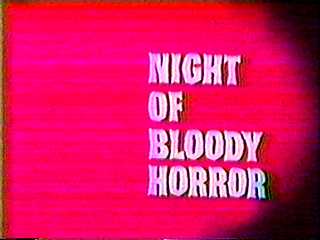
We open with titles over blurred close up of bright spinning objects. It's a marginally psychedelic effect. The soundtrack drops in a few creepy sounds. One of the credits says, "Featuring: The Bored." (Somehow, this doesn't seem like a good omen.)Go to dark room at night. The TV is running on no particular channel. Wesley Stewart (Gerald McRaney) and Susan (Lisa Dameron) are making love under the sheets. After they finish, he lights a cigarette and asks her if she wants one. She shakes her head no, but she takes a drag off it anyway. They snuggle for a bit, and then she rolls over while he gets up and gets dressed.
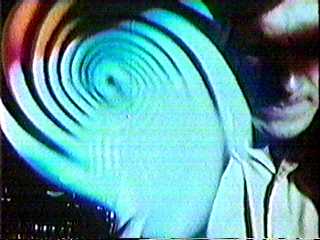
Suddenly, Wes has an acute attack. He pauses as if having a headache
while a neon spiral is superimposed into the shot. (We would refer
to this as a Violent Vision, as hinted by the advertising, but it's not
what you'd call violent. Therefore, we'll be calling this a Swirly
Vision™.) Susan asks if he's ok. He shrugs it off and leaves.
She cries.
 |
 |
| Brought to you by Stayfree Maxi Pads.
[Oh, settle down. Mrs. Apostic came up with that one.] |
Wes has a terrifying vision of The Time Tunnel. |
The next morning, Susan goes to a church. She pauses, but she makes up her mind to enter. She kneels at the front, and sees someone in a robe (with the face covered) go into one side of a confessional booth. Satisfied that someone is ready to hear her confession, she enters the other side and begins. She says her sin is sleeping with a man, and she asks for her penance. The caustic confessor stabs her through the eye with a loooong needle and runs away. (Apparently, this was back when the Church was less understanding about these things.) We see his legs and know he's wearing denim trousers. Back in the booth, Susan's not moving. Blood pools in one eye and runs into the other.
Go to Susan's funeral. Wes, his friend Mark (Bert Roberts), and Wes' mother Agatha (Evelyn Hendricks) are there. Afterwards, Mark drives Wes and Agatha home. As they arrive, they see two boys roughhousing next door. Mark reminisces about being a kid, but Wes is not taking his own trip down memory lane.
As Agatha and Wes enter the house, she tells him that he has no respect for the dead. As an example, she brings up his brother Jonathan. That tears him up. After he leaves, she says there's something wrong with the boy. She goes into the next room and shuts the door behind her. From the other side of the door, we hear her talking to her husband Carl. She tells him she doesn't know what to do. He tells her to calm down.
Cut to Wes, sitting in a chair and wrapped in a blanket. He stares into space while rocking back and forth. Through a flashback, he sees a cemetery. He's visiting a grave while flash cuts show a figure at a table, with a child's voice.
Later, Wes and Mark are at a bar. Wes is pretty messed up, both psychologically and chemically. Mark tries to get him to leave and go home. Wes breaks a bottle, holds it at his friend's throat, and tells him no. The bartender tells Wes he's had enough. Wes pulls out a big wad of cash and pays up.
Just as carnivores will sense freshly spilled blood, several lowlifes sense the freshly flashed money. One of them picks up the bundle of bucks from the bar and checks it out. He puts it into Wes' jacket pocket.
Wes leaves. While he's getting into his car, the greedy guys from
the bar beat him up. (We doubt this is a case of "Barflies don't
let barflies drive drunk.") And they pummel his face. And they
kick him while he's down, too. And they take his money. And
they give his number to a telemarketing group. No, that last one
didn't happen; they've got some restraint. While the hoods hurry
away, a Mustang stops. A woman in a nurse's uniform gets out and
checks over Wes. The bartender comes outside and helps her get the
bludgeoned bar patron into her car.
You Axed For It
Cut to Wes waking in a bed as curtains open during the day. The woman from the night before is walking around in a low-cut nightgown and describing everything as matter as matter of fact to the disoriented dude. She pours him some coffee and introduces herself as Kay Jenson, RN (Charlotte Shite). Then she hops onto the bed next to him. While Wes feels over the glove graffiti on his face, Kay says she took him home, cleaned him up, and put him to bed. After giving him this quick recap, she leaves the room. Wes mumbles, "Things like this just don't happen." (Tell me about it. All those times I got rouged up outside a bar, where was my half-dressed, cleavage-laden sister of mercy?)He gets out of the bed, has a second thought, and crawls back under the covers. He asks for his pants. She's been cleaning them. He tries to work out the rest of the deal. He asks if he tried... "Uh huh," answers Kay. "Did I do any good?" The image freezes.
The still image becomes part of a photomontage of Wes and Kay. They go to a nice restaurant, long walks, and build a romance. (As with most montages, we assume this is happening over a long period; however, only two romantic settings are shown in this sequence.) The last still lingers over the sound of chopping wood. Go to Wes, who is, well, chopping wood. (Note: He's not wearing a shirt in this scene. Not only was there a time when Mr. McRaney had hair, he was also built like a beanpole.) He stops to sharpen the blade. Agatha comes outside to check on his progress. He's been clearing out an area for a garden. He's not finished, but he's calling it a day because he's going to the beach. She wants it done now, but he refuses. Agatha's upset about this.
At the beach, Wes and Kay are frolicking along the water. (To this film's credit, it looks more natural than, for example, the beach frolicking in The Incredibly Strange Creatures, etc. (1963).) After sunset, they're sitting by a cooler. She explains that she doesn't know anything about his family. She's met his mother, but what about his father…or his brother. At mention of brother, he has a Swirly Vision™. He calms down and goes to get some more beer. On his way to the package store, he passes a man chopping wood, and it sets off another Swirly Vision™.
This time, though, the Swirly Vision™ is accompanied by flashbacks. Cut to a table in a dark room. There's a boy at the table. A shotgun spins, leaving a trail of afterimages. Cut to the boy at table again, followed by the view from the business end of a shotgun. It fires. Cut to a splatter of red.
Back at the beach, Kay hears footsteps. She looks up and screams, "Wesly, no!" and gets a hatchet in the chest. She has a flashback of the time she met him. ("Good Samaritans," take note.) Wes stands over her and cries, "My god, what have I done?" He kneels down pulls the hatchet out of her chest, and cradles her. He cries and she dies. Zoom in on a red puddle in the sand.
And cut to red liquid. In a bowl. Stirred by a spoon. An establishing shot shows Dr. Moss (Herbert Nelson) eating soup. (Frankly, it's not as disgusting as the dreaded "cut from a toilet to pot of stew" in A Christmas Story (1983).) A uniformed nurse comes in with a telegram. It says, Wesly held for suspicion of murder, fear that sickness has returned.
He tells the nurse to cancel all his appointments; he's taking off for a week. (For those of us who don't live in Louisiana, which is where this story takes place, we would've figured there'd be too many mental cases for a psychiatrist to drop everything.) She reminds him about how much trouble he got into the last time he did this. In particular, he's expected at a seminar. He tells the nurse what they can do with their seminar. (We'd love to find a fault with this action. It sounds so terribly, terribly irresponsible, but dammit, this guy is likable.)
Meanwhile, Wes is in an interrogation room with two detectives.
(At least we assume they're both detectives. This was about three
years after Miranda v. Arizona, but neither of them seems to be particularly
concerned with Wes' legal rights.) One of the detectives, Spanelli
(Michael Anthony) observes there was the college girl (Susan?) and now
the Jenson girl. Wes says he'd be nuts to do something like that.
The other detective coldly agrees with him.
 |
 |
| "Momma, am I going bald?"
"Hush, child. Only men with hairy chests go bald." |
"Say it, blast you, say it!"
"Alright. I won't make another movie like Jackals ever again." |
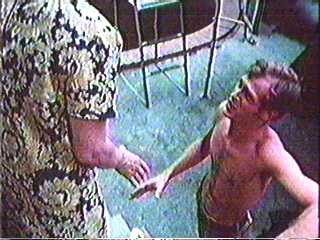
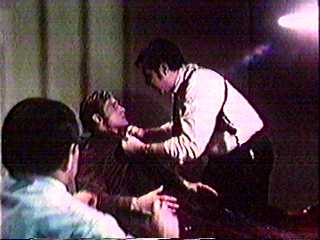
They continue to grill him. The other detective rhetorically asks Spanelli if he remembered the Addison case. "He killed two girls. He was nuts, too. He didn't like girls at all." And so they accuse Wes of being gay. It really trips his trigger. (They accuse him of being crazy and a murderer, and Wes takes it like a man; they suggest he's a homosexual, he's ready to kill. Definitions of political correctness change….) Lt. Cole (Nicholous Krieger) enters. Their suspect is free to go. Before he leaves, Wes asserts that he didn't kill those girls.
Outside, there's a mob of reporters. Someone has set up his bail. His friend Mark is there. He gives him a ride away from the mob. Before dropping him at home, Mark asks Wes if he wants to go out for a beer. Wes declines, because he's beat. (Yeah, last time we saw him at a bar, Wes was beat.) Mark drives off.
An attractive girl (Gaye Yellen) is sitting on the front steps. Wes immediately figures that the girl, Angelle, is a reporter. He gets defensive, but she tells him that if he meets her at a nightclub called The Coachman, he can tell her his side of the story.
Someone is watching them from the bushes. It's Mark. He
sneaks back to his car. Agatha is also watching from the front window.
The Night in Question
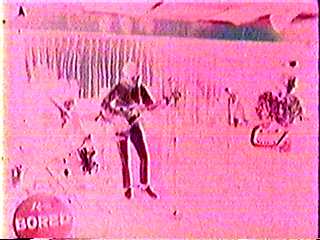
Cut to polarized purple shot (Violet Vision?) of a band playing late 60's acid rock, the kind with the fuzz box. The effect is dropped so we can get a better look. The sign on the bass drum says, "The Bored." (Alternative style garage bands that are searching for a name may take note….) An establishing shot shows us this is a late 60's nightclub. Some of the patrons are dancing. At some of the tables, people are smoking. (Wow, shameless smoking indoors. Those were the days….)Angelle is one of the people smoking at a table. Wes sits down to talk with her, but we can't hear the conversation. (We'd like to salute this sense of realism. In most movies, characters can speak in normal tones and be heard over a background noise that is well over the threshold of pain.) While they talk, we are treated to some more freehanded camera work and psychedelic shots of the band.
A guy bumps into Wes and recognizes him as "the guy who killed those two girls." He badgers Wes about it. Then it comes to blows. Wes subdues the guy and pummels his face for a while. The other bar patrons take a hedonistic, live and let live approach to the whole thing. (We figure they thought this was part of the entertainment.)
Cut to a close-up of Wes' eyes, but it's suddenly quiet. The silence is broken by the sound of slow ticking. Zoom out. Wes is in the interrogation room again. Spanelli is tapping his finger on the table. He stops and picks up the receiver on a phone. "They're ready," he announces. They lead Wes out of the room.
They usher Wes into an office. Lt. Cole and Dr. Moss are there. Cole tells the detectives to leave. After they're gone, Cole asks Wes, "Why didn't you tell me?" Dr. Moss tells Wes that his illness is nothing to be ashamed of. Then he reminds Cole that Wes' thirteen years of treatment after accidentally shooting his brother does not make him a murderer and that the actions of his father didn't help, either. Wes was never charged with a crime. Cole says withholding evidence didn't help. However, the guy at the bar is not pressing charges. (Don't you wish real life was like this?) Cole releases Wes into the custody of Dr. Moss.
Cut to Dr. Moss and Wes in a car, driving at night. Moss tries to get him talking, asks why he didn't call. Wes says he didn't know. Moss gets on his case about this. (He's not into that lame, "Talk when you feel your inner child speaking" nonsense.) Wes admits that he has the headaches and dreams again. Moss asks if there is anything else. Wes says he has blackouts. Moss asks Wes to come with him. Wes doesn't want to go back to the asylum. Moss offers his own home. (Once again: It's awfully irresponsible, but dammit, Moss is likeable. You realize, of course, he's probably doomed.) The doctor gives him time to think about it.
When they arrive at Wes' home, Wes asks Moss where he's staying and offers his own home. (Note to self: Find out if Southern Hospitality still works this way.) Moss worries about intruding on Agatha. Wes grabs the doctor's bags, gets him to the house, and calls for his mom. Agatha is happy to see Moss. They all sit down in the living room and make conversation. She tells Moss she's glad he got her telegram. Wes becomes defensive and asks, what telegram? Moss tells him to calm down. Wes hangs onto his hostility and leaves.
Moss says he's never seen him like this. Agatha says he's getting worse, but Carl has told her to leave the boy alone. After a pause, Moss asks where he's sleeping, and Agatha takes him to his room. She admits that she and Carl have always thought of Moss as a friend of the family. Moss starts to ask something, but lets it pass. After she's gone, he unpacks. He has something on his mind. He opens his briefcase and pulls out Wes' psychiatric record.
Cut to Wes in bed, wide awake. Angelle, wearing a nightgown, comes into view. She hops onto bed with him and teases his face with her hair. She kisses him. He doesn't respond at first, but he finally gives in. They start to make out. As they roll over, it's Agatha in bed with him. She smiles. He strangles her. He wakes up and screams. (Screw that grandiose Nietzche junk in Fight Club (1999) about what bothers the modern American male. Simpler things will get to him.)
Moss looks up. He was shaving in the guestroom. (He shaves
at this hour? Gee, a nice guy and neat. Definitely doomed.)
He opens the door and peeks out. Wes comes out of his room and puts
on a jacket. Moss backs away. Wes has another Swirly Vision™.
After it passes, Moss watches him walk away. After Wes leaves the
hallway, Moss hears another noise. He cleans the lather off his face,
comes out of the room, and calls for Wes. He hears noises behind
another door. It sounds like someone rocking in a chair. He
goes to the door and opens it slightly. A meat cleaver comes down
and lops off his hand. While blood squirts out the wrist and onto
the door, he looks up in time to see the meat cleaver again. He screams.
(Reminder to self: Find out if Southern Hospitality still works this way.)
 |
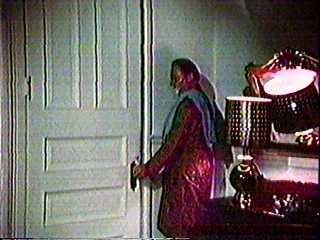 |
| Filmed in Violent, er, Violet Vision | ("For the love of God, please don't let me die in this effeminate robe.") |
"This is The End…."
Ladies and Gentlemen: The rest of the plot description contains spoilers. As many of you know, I will not reveal an ending to a movie that I respect, and up to this point, I have to admit that this movie is better than I'd expected.(Wait for it….)
However (there it is), I have very little respect for the ending. To be fair, most of you have already guessed whodunit and whydunit, but some of you may not. So here's the dilemma. Do I reveal the ending and explain why it's disappointing, or do I respect the movie thus far and say no more? (Those of you who have just read the word "disappointing" have also had your suspicions confirmed.)
Here's my solution.
The ending (and a section of the analysis about the ending) can be found
on another page. If you intend to see this movie sometime and would
like to keep guessing, do not click here.
The Good Stuff
Ladies and Gentlemen: Gerald McRaney
One of the novelties of seeing a movie like this is that you get to see Gerald McRaney when he was young. Today, he's usually cast as a well-adjusted everyman. Ever since he fell into that casting niche back in the early eighties, it's not likely you'd see him playing an explosive, defensive, high-strung man who is the chief suspect in a murder investigation. We've seen him trying to play the bad guy after he developed his even-tempered characters, but his portrayal of a slave trader in Jackals (1986) didn't really broaden his career for villainy.But McRaney does a good job here. His character's conflict between
knowing he's not a murderer and his realization of the facts to the contrary
is compelling. On the other hand, you also see why McRaney usually
plays characters with some emotional restraint. Unlike the pyrotechnic
guests on SCTV's "Farm Report" sketches, he doesn't "blow up real
good."
Good Storytelling
Most B horror movies from this era didn't really try to do anything different with their storytelling. By contrast, Houck put in some creative touches. For example, using a montage to convey the passage of time was nothing new, but making it a photomontage was an artsy move that was usually reserved for movies with higher ambitions. It' a pleasant choice, it's artsy without being pretentious, and it makes use of the full screen.The bridging cut from the blood on the beach to a bowl of red soup is worth a few gruesome chuckles.
The Swirly Vision™ gimmick is pretty dated by today's standards, and compared to other "freak out" scenes in other movies from the time (like The Trip (1967)), it may seem pedestrian. And to top it all off, it looks like a rip-off from Vertigo (1958). However, once this sensation passes, it leaves the realization that this is actually a nice photographic effect.
Just as wise monster movie makers will not show the audience the monster
at the beginning of the story, wise psychological mystery storytellers
will not give all the details at the beginning. Obscuring some of
the clues is a good tactic for manipulating the audience into taking an
interest. This method works well here. The details of Wes'
mental state, the death of his brother, and the hurtful actions of his
father come at us in pieces. The flashbacks about the death of Jonathan
are intentionally obscure and surreal.
The Bad Stuff
That Which We Call "Bloody" Would, by Another Name,...
Ordinarily, a movie should be viewed away from the context of its advertising. However, in this case, we should consider an exception. Its advertising campaign was one of the most creative and misleading works in the history of horror films advertisements, perhaps even film advertisements in general. By analogy, it would be like selling the quirky Joe Versus the Volcano (1990) as a wild, rock & rollick comedy (which they did), or the gangster melodrama remake Gloria (1999) as a standard chick-flick about a troubled adoption (ditto).The title is also misleading. The violence happens over the course
of more than one night, and your standards of "bloody horror" may vary
as well. But as observed in the opening notes, this sort of thing
is not new. Consider some of the titles composed by James H. Nicholson
(as in Beast with a Million Eyes (1955), It Conquered the World
(1956), and Die, Monster, Die! (1965)). Realizing the marketing
potential of this tactic, many other filmmakers followed suit. In
an environment like that, who can fault the makers of Night of Bloody
Horror for coming up with a title that was over exuberant?
The Velvet Blunderground
Despite the acknowledgement above about the director showing some creativity, there's one place where he went a little overboard with a convention of the day. This would be the scene at The Coachman.As noted in the plot description, the opening shot shows a polarized image of the band. Throughout the scene, they try to convey the wildness of the moment by doing wild things with the camera and editing. This includes quick zooming (in and out) on the band, plus sudden flashes of that purple polarization. If you've seen musical presentations from this era, you'd know it was a cliché. If you're too young to remember this era, this and some of the fashions on the dance floor will amuse you. (On the other hand, your kids will probably be laughing at your stuff, too.)
The inclusion of this scene also feels commercially obligatory; that is, it was included for teenagers and young adults because someone, somewhere, felt that a movie marketed to that crowd required it.
I can't recall who said it, but it's true: Music videos do not belong
in horror movies.
The Disappointing Ending
As noted above in the last section of The Plot, this section contains spoilers. If you intend to watch this movie sometime and would like to keep guessing until the end, please do not click here.The Who Cares Stuff
Notes on the Cast and Crew
Joy N. Houck Jr. (director, writer, producer) later joined the MuCulloughs of Louisiana to make Creature from Black Lake (1976). A few years later, he was working with Charles B. Pierce on the authorized sequel to Legend of Boggy Creek (1972), which was called (ready?) The Barbaric Beast of Boggy Creek, Part II (1985).At roughly the same time, Houck made another feature with an equally lurid title, Women and Bloody Terror (1970), and he used several of the same cast members (including McRaney). If you're curious about this feature, a brief description can be found elsewhere.
We've already talked about him above, but here's the career bio. Back in the late '60's through early '70's, Gerald McRaney (Wesley Stuart) played stock bad guys. (He has the distinction of being one of the last gunslingers shot by Marshall Dillon on Gunsmoke.) Today, he's best known from TV shows like Simon & Simon (1981-1988), Major Dad (1989-1993), and Promised Land (1996-1999). His courtship and marriage to Delta Burke was one of the most romantic events covered by the tabloids, and one of the few that lasted, too.
Herbert Nelson (Dr. Moss) mostly appeared in soap operas. He was
in The Guiding Light in the early '50's and Days of Our Lives
in
the early '70's. He also did a small variety of bit parts in other
movies.
Roots, Shoots, and Other Compares
The Parish of Orleans Welcomes You. This movie was shot in New Orleans, and as many Internet literate fans of dubious movies know, one of the greatest events in bad moviedom is the annual New Orleans Worst Film Festival. As of the writing, the next one is scheduled for 10 June 2000. For those planning to attend this event, here are few tips for travelers to this fine city.(Of course, all I know about New Orleans is what I've seen in movies….)
No Mercy (1986) --– Opportunities abound to meet with friends, old and new.
The Monster and the Stripper (1968) – Visit the various cultural centers. Many of them have unique presentations.
Cat People (1982) – Visit one of the many fine zoos.
Zandalee (1991) – Those who are interested in art may wish to try the thriving artist community.
Tightrope (1984) – Ladies will find a variety of fashions available. Gentlemen will be pleased by the broad assortment of unique ties.
Southern Comfort (1981) – For those of you who don't care for the attractions of the city, there are many outdoor activities.
Hard Target (1993) – If you prefer the sporting life, you're bound to find the kind of healthy competition you're looking for.
Angel Heart (1987) and The Unholy (1988) – Those who are religious can find others of the same faith among the variety of churches.
Girl in Trouble (1963) – For those seeking employment, there are many excellent opportunities.
A Streetcar Named Desire (1951) – You'll be able to get around using the excellent public transportation system. (OK, this isn't about trolleys. So sue me. But I think it'd make a case for assuming that the psychiatrists are too busy to drop everything.)
Panic in the Streets (1950) – If visiting from a foreign land (like Texas), please be sure your immunizations are up to date.
The Cat and the Canary (1939) – Occasionally, homicidal maniacs may escape from institutions. Be sure to lock your door and activate applicable deathtraps.
And last but not least,
Abbott and Costello Go to Mars (1953), Easy Rider (1969),
The
Savage Bees (1976), Mardi Gras Massacre (1978), and Candyman:
Farewell to the Flesh (1995) – Most visitors come during Mardi Gras,
leading to a broad mix of guests.
Special Acknowledgment
I'd like to thank Ofer Eliaz for his kind assistance. The trailer for this movie can be found on the tape Mad Ron's Prevues from Hell (1987), and Ofer did a short description about this tape for the B-Movie Mailing List. When I asked him about the trailer (which I had seen years ago), he cheerfully filled in the gaps in my memory by sending me a remarkably concise description. Thanx, Ofer.The Bottom Line
High-strung young man starts leaving a trail of dead bodies. Relatively tame homicide story with some creative touches. Gerald McRaney does a good job as the tormented main character, which is unlike the kind of characters he plays today. Competent direction, editing, and acting, especially when compared to similar examples from the same time. Story unfolds nicely, but the solution to the mystery is remarkably disappointing for experienced movie watchers. Not recommended for gore hounds (who will be even more disappointed), but recommended for those who like the style of late '60's movies, those who wish to laugh at the musical presentations from that era, and, of course, McRaney completists.Published on 27 October 1999
 |
   |
A
Proud Annex of....
|
|