|

Spoilers Page
Contents
The Plot (Spoilers)
"…My Friend, The End…"
Later, Wes arrives at Angelle's apartment. He's mumbling about something he had to take care of. She invites him in and pours him a scotch. She asks if they were rough on him at the station, and says she was surprised they let him go. He gets irritable about that. Then he starts making some moves on her, and she responds. He pauses, backs off, but starts again, looking into her eyes. (Have neither of these people learned from the past?) They start to make out. She doesn't seem to be getting into this as much as Wes. On the other hand, she's not pushing him away, although his hand is massaging her throat. He asks her what kind of games they want to try now. She asks if he'd like some coffee. With a sense of resignation, he rolls off her. She goes to the kitchen and turns on the radio.Recently, Jason MacIsaac did an analysis of the movie Wheels of Terror (1990), which can be found at the Jabootu website. In this article, he introduced the concept of a radio with Relevant Plot Info Sensors™. Angelle, along with many other characters in movies, has one of these radios, too. Hers is suddenly playing a news bulletin about another girl found dead. The police are looking for Wes. He freaks out. She tries to calm him down.
He explains that he couldn’t have killed this girl because he was with Dr. Moss, who is at his house. She tells him to stay at the apartment while she goes to get him. She leaves, but he has a particularly nasty Swirly Vision™. After it passes, he decides he's got to stop her. Outside, the cops grab him.
Elsewhere, someone is dragging the doctor's body on a blanket and dumping him into some water. Angelle arrives at the house and knocks on the door. No one answers.
In the back seat of a moving squad car, Lt. Cole and detective Spanelli are asking Wes where Angelle is. He tells them the truth, but they're not buying it. He tells them that Dr. Moss can say where he was, so he couldn't have done the other murder. In spite of his protests, they're taking him to headquarters.
At the house, Angelle has gone around the back door. It's unlocked. She goes inside and calls for Dr. Moss and Mrs. Stewart. In another room, a hand reaches up and shuts off the power. She stumbles around in the dark. (This is presented as real dark; even we can't see anything.) She finds a candle, lights it, and continues through the house. (Stupid move? She's a reporter.) She stops at the door to Carl's room. That's when she sees the hand on the floor. She freaks, and a gloved hand grabs her, pulls her into the room, and tosses her onto a bed. When she looks up, she sees a long dead corpse. She jumps off the bed and sees another one in a casket. (Yif! Someone has the same taste in companions as in Faulkner's "A Rose for Emily.")
Meanwhile, Wes finally convinces the police to go to his house.
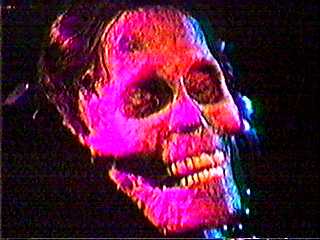
Back at the house, a panning shot shows us some lit candles and a meat cleaver on a dresser. Angelle regains consciousness. (No, they didn't show us how she became unconscious.) She's sitting in a chair with her hands tied together. She looks over and sees the corpse sitting at the table. A voice tells her she should've gone when she had the chance.
Agatha comes out of the shadows. Angelle asks why. Agatha
says because Wesley can't have any friends. Not after killing Jonathan.
(Shot of the corpse in the casket.) Not after making Carl commit
suicide. (Shot of the corpse sitting at the table.) Agatha
switches over to the manly voice and says, let me die. In her regular
voice, she says, no; she's kept them both alive for thirteen years.
(Sure, it's a Psycho rip-off, but since they've already killed off the
psychologist, Agatha has to do the essential explaining.)
 |
 |
| (...Song: "Girl From Ipanema") "Your call is important to us. Please stay on the line, and you will be assisted shortly. Thank you." (Song: "Girl From Ipanema"...) | Aaaannnnd.....cut! |
Agatha picks up the hatchet and swings it down. Angelle is not tied to the chair. She rolls out of the way and stumbles out of the room. (As with most movie villains, Agatha's shortcoming is keeping a character alive for the sake of plot exposition, followed by putting said character into an escapable deathtrap.) Agatha chases her, but is stopped when Cole and Spanelli suddenly arrive and shoot her. She dies explaining to the lieutenant that she did it all to keep Jonathan and Carl alive. (We'd like to know if they find some other bodies in the house of this sweet old lady. Perhaps in the window seat…)
Wes screams "Momma!" (If it didn't seem so forced and obligatory, it might've been an effective end line.) The soundtrack plays a lullaby on a music box. No end credits.
Click here to go to the next section ("The
Good Stuff") on the regular page.
The Bad Stuff (Spoilers)
"Mrs. Bates, can Norman come out and play?"
Let's run through the checklist. Unseen family member? Check. Strong female character killed midway through the story? Check. Middle-aged man investigates the wrong door? Check. Desiccated dummy? Check and double-check. Desiccated dummy discovered by a new female character? Check. Multiple personae lead to ventriloquism with a desiccated dummy? Check. Jealous, homicidal mother? Check.Messy homicide in a shower? No. To this story's credit, they do try some things differently. For one thing, we doubt Norman Bates got lucky as often as Wes. Plus we're given an abundance of red herrings. For example, consider the scene where Wes meets Angelle. Since both Mark and Agatha are spying on them independently, you get a red herring juxtaposed with an honest clue. On the other hand, not all of the red herrings are fair catches. When Kay is killed, the scene is presented in such a way that there is little doubt that Wes did it.
One of the reasons to watch this all the way through is to see if they really did do something besides borrow from Psycho. The non-introduction of Carl makes you realize, within the first few minutes, the identity of the killer, but the distracting clues, plus a few flashes of creativity, make you hope you'll see something different. There's the hope that the staging for Carl is yet another distraction; he might've really been there, but not shown to trick you into thinking that he wasn't. When the simple role reversal variation on the gimmick in Psycho is eventually revealed, the only thing left is disappointment.
Click here to go to the next section ("The
Who Cares Stuff") on the regular page.
Published on 27 October 1999
Return to Night of Bloody Horror (1969)
 |
   |
A
Proud Annex of....
|
|