Another feature of... |
|
Another feature of... |
|
|
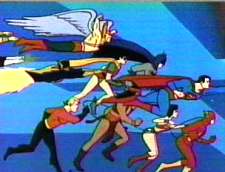
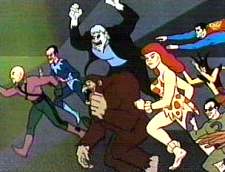
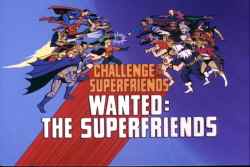
First, I won’t even pretend it’s not lame for a forty year-old man to expend energy mocking a cartoon show meant for wee kiddies. Second, let me stipulate that anyone looking for some quality Superfriends mocking needs look no further than the incredibly funny—if oft profane—character profiles found at http://www.seanbaby.com/super.htm. Sadly, it seem Sean has abandoned the effort halfway through. Still, we’ll always have Gorilla Grodd. Despite my demurrals, however, there’s little doubt the Saturday morning adventures of the mighty Justice League—a.k.a., in horribly lame ‘70s TV parlance, the "Superfriends"—roundly deserves all the pummeling one might afford it. First, the level of animation throughout its lengthy tenure generally sucked. The particular season we’ll touch on today was definitely no exception. Still, in what must have been a nearly decade long run, a comparative apex—emphasis on ‘comparative’—was achieved during the Legion of Doom year. (The four episodes described here can be found on the first Challenge of the Superfriends DVD. A second volume has also been released at this time.) Our Heroes no longer battled anonymous mad scientists and aliens and whatnot, nor were they again saddled with ‘comic’ sidekicks the like of Melvin, Wendy or the infamous Wonder Twins. Instead, DC’s mightiest superhero collective finally got to test its mettle against foes you actually believed might beat them. In fact, that understates the situation. Frankly, I don’t know how the Superfriends ever triumphed over the Legion of Doom, much less doing so with such consistency. First, the Legion had more members. Not that raw numbers really matter all that much in this case. Superman himself could have killed the rest of the Superfriends without even breaking a sweat. More importantly, the Legion of Doom far out-muscled the Justice League. Aside from Superman (and perhaps Wonder Woman, although the series always remained rather sketchy where its characters’ powers were concerned), no one on the Superfriends was super-strong. Well, OK, Apache Chief had proportional strength when we grew to be a hundred feet tall, or whatever, but that’s about it. In the Legion, meanwhile, there were two characters pretty much the physical equal of Supes—the giant albino zombie Solomon Grundy and Bizarro, the chalky backwards version of Superman—with Gorilla Grodd being pretty close. Again, the show wasn’t very clear or consistent with the characters’ powers. In the Marvel Universe, there’s a patent distinction between, say, the super-strength of Spider-Man and that of the Hulk. Here, though, super-strong characters pretty much seemed roughly equal. It wasn’t just in physical power, however, that the Legion fielded a superior bench. Batman was the only Superfriend known for being particularly bright, given his reputation as a detective and all. Well, and Superman, of course, who was better than everyone at everything. The Legion, on the other hand, had a surfeit of characters that could whip up the most insane ‘scientific’ gadgets as the whim took them. Lex Luthor, Brainiac, Gorilla Grodd, Toyman…any one of them could create a Lava Monster Generator at the drop of a hat. Despite this, the Legion was always lusting after the Superfriends’ purportedly all-powerful computer at the Hall of Justice. We can only assume Batman put this together, but it’s sort of odd that the Legion weren’t able to make an equally powerful one for themselves. Aside from Superman, the Superfriends really only sported two formidably super-powered characters. (Again, I’m putting Wonder Woman in the debatable column, as in this show she functioned more as a female analog of Batman.) There’s super-speedster the Flash, who aside from Superman was the only Superfriend who really should have been able to take out anybody on the opposing side. Except for Bizarro, that is, since he presumably shares Superman’s own super-speed and invulnerability. Oddly, the character in the Legion meant to counter the Flash was Captain Cold, a sub-par Mr. Freeze knock-off*. CC was a dude in a parka with a freeze ray pistol. That’s it. The fact that he was occasionally allowed to hit the Flash with his freeze beam, either in the cartoons or the comics, was purely due to laziness on the writers’ parts. I mean, the Flash could run around the entire world in a nanosecond. He could move so fast he could vibrate his very atoms and pass through solid matter. Yet somehow this Captain Cold guy was able to draw down on him and freeze him. Sure. [*Actually, Batman provided, directly or indirectly, a great deal of the Legion’s roster. The Joker was an occasional member, providing the group with another superfluous evil genius. The Riddler, with his superpower of compulsively leaving behind stupid clues that inevitably allowed The Superfriends to foil his compatriots’ plans, also somehow rated a membership. Yet another goofy Gotham scalawag was the Scarecrow, who had, er, the amazing ability to burn up real good. Oh, and he could whip up Fear Bombs—although this talent wasn’t employed very often—and be generally scary. Or as scary as ABC allowed someone on a ‘70s Saturday morning cartoon show to be. Then there were the ersatz Batman villains, Captain Cold (Mr. Freeze) and Cheetah (Catwoman). The latter was a woman in, I assume, a catsuit. Or perhaps she was supposed to be an actual cat-woman, since she had fangs and claws. Of course, if she’s not wearing a uniform but only fur then she’s naked, so…probably not. Anyway, Cheetah in the DC Comics universe is a Wonder Woman villain, but here particularly definitely comes across as a subpar Cat Woman knock-off.] The other powerful Superfriend was Green Lantern. He wields a cosmic power ring that can create any object he thinks up. The Superfriend’s Green Lantern was none too imaginative. If he needed to catch something, for instance, he generally would manifest something along the lines of a giant green baseball glove. That sort of thing. Still, the ring itself was more or less limitlessly powerful. Oh, except for one design flaw: His green energy couldn’t affect, either offensively or defensively, anything yellow. If it were yellow, the giant green hand he whipped up couldn’t pick it up. If a bullet were yellow, his green force field couldn’t block it. The amazing thing, really, is that GL wasn’t shot dead with a yellow bullet weeks after he first showed his face. And that’s not the half of if. GL’s counterpart villain, both in the comics and here in the Legion of Doom, was Sinestro. Sinestro, an ex-Green Lantern himself, was an evil alien with his own power ring. Only his energy was yellow as opposed to green. Needless to say, Sinestro should really have killed off GL in about ten seconds. With a really good writer, you might get a thrilling tale of Green Lantern winning against all odds. Usually, though, you viewed his inevitable triumphs with marked disbelief. The rest of the Superfriends were pretty much second-stringers at best. The versions of Batman and Robin found here were, to say the least, pretty innocuous. This made it difficult to believe that they could fight so far above their weight class. Usually they just used whatever convenient device they had in their utility belts. Plus, as noted before, they were the *cough, cough* brains of the group. After that, we get to the real losers. Being the ‘70s, the Superfriends had undergone an intense program of affirmative action outreach. The members this accounted for included Black Vulcan. (Odd how none of the white heroes felt the need to append their color to their superhero name. "Holy Pigmentation, White Batman!" "Right you are, Caucasian Chum." How Luke Cage managed to refrain from calling himself Black Powerman is beyond me.) Black Vulcan could shoot lightning, or turn into lightning, or pretty much do whatever the script required. Then there was Apache Chief. He was (duh) an American Indian who could, for little apparent reason, grow to tremendous size. He was also especially attuned to nature because, you know, the Indian thing. He also talked real slow because the only Indian the show’s writers knew was Tonto. From the Pacific Rim came Samurai. He had, er, whirlwind powers, or something. Finally, Hispanic Superfriend El Dorado could—uh, I don’t remember. (For those who don’t habla Espanol, El Dorado is Spanish for The Dorado.) Anyway, not all of these characters appeared in every show, and some appeared in certain versions of the series and not others. More established, but yet lame, Superfriends included Hawkman, who could fly. This ability came off as a tad underwhelming. After all, Superman, Green Lantern, Samurai and Black Lightning could also fly. Oh, and Wonder Woman as well, since she had that invisible jet. (Actually, in this year’s worth of shows she flew under her own power, which broke continuity at the time.) And let’s not forget Batman and Robin’s Batcopter. Hell, sometimes the Flash flew, too, indicating the writers really couldn’t keep track of what anybody’s powers were. Then there was the Superfriend’s most notoriously lame member, Aquaman. Aquaman was sort of a Pat Boone version of Marvel’s Submariner. (In the recent, and incredibly superior Cartoon Network Justice League series—also out on DVD—Aquaman has become so Namor-like I’m surprised nobody’s been sued.) You could often see the writers straining to include an underwater element to the adventure so that Aquaman wouldn’t seem quite so useless. His most impressive power was to telepathically command sealife to do his bidding. Like, you know, having a giant octopus grab a supervillain’s submarine in its tentacles. That sort of thing. Luckily, the Legion had it’s own array of weaklings, including the aforementioned Captain Cold and The Riddler. Cheetah was basically there so Wonder Woman would have another girl to fight. Giganta was merely a distaff version of Apache Chief, although even kids must have wondered whether the male Superfriends (or Wonder Woman, for that matter—come on, she’s an Amazon) were staring up her mini-skirt when she grew fifty feet tall. The Legion even had an Aquaman analog, Black Manta. He was a guy with a freaky helmet on his head, which he wore in the water or out of it. (??)
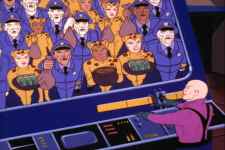
Episode 1: This episode kicked off the Legion of Doom season of The Superfriends. As noted above, these were, believe it or not, marginally less stupid than previous skeins. Since this adventure sets up the thirty-odd episodes to follow, we get a lengthy introduction of the Legion of Doom. "Banded together from remote galaxies," the Narrator informs us, in a bit reused as the opening credits every week, "are thirteen of the most sinister villains of all time." Three of them actually did hail from outer space—we’ll toss in Bizarro, assuming him to be one of the versions that lives on Bizarro World—so the ‘remote galaxies’ thing is only a slight stretch. The miscreants are headquartered in a building that looks like Darth Vader’s helmet and which pops up with little rhyme or reason from the fetid waters of a swamp. Lex Luthor is the group’s leader, presumably because he was Superman’s arch foe. I mean, c’mon, it ain’t gonna be Black Manta. Luthor here is from the period where he was an actual costumed supervillain, as opposed to the Machiavellian evil industrialist we know today. Speaking from a podium, Lex introduces each of his new teammates. Many of these perform petty acts of super-vandalism to demonstrate their fearsomeness. For example, Cheetah rakes her claws over the assembly table. (She also says things like "purr-fect" a lot. Because, you know, the ‘cat’ thing.) Solomon Grundy punches his fist through it. Captain Cold freezes a lighting fixture, which cracks into pieces. You’d think Lex would tell them to stop wrecking the place, but I guess it’s important to their idiom. Still, the Legion’s maintenance bills must be through the roof. This week’s plot involves Lex’s latest gadget. It controls people when they’re sleeping, or some damn thing. Its beam even seeks out whatever victim Lex wishes. Set it to ‘Superman’ and the beam finds him. Now, you or I might have Superman and the rest reveal their secret identities in public, or have Superman kill all his comrades and then fly himself into the sun. But no, instead the Superfriends are made to commit more conventional crimes.
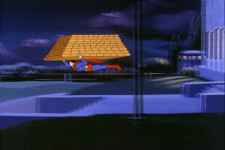
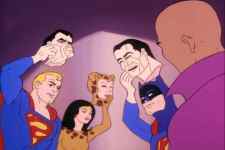
The somnambulistic Superman goes to Fort Knox and steals the one stack of gold they have there. Supes appears to have gained some magnetic powers, too, since he flies off with the pile without dropping a single brick. Some soldiers pretend to try to stop him, but c’mon, he’s Superman. Batman and Robin, meanwhile, rob a U.S. mint. Robin cuts through the two-foot thick steel vault with what appears to be a Bat Light Saber. Robin, by the way, was voiced by Casey "Shaggy" Kasem throughout the show’s various incarnations, and was the version who said "Holy ____!!" a lot. Further felonies are committed by the other Superfriends. The next morning, Our Heroes show up at the Hall of Justice. They all mention having had strange dreams. Then they receive a call on the Hall’s giant Viewscreen, thus learning of the crimes they’ve committed. (I guess none of them watch TV or get the morning paper. You’d think Batman could afford it; he’s a billionaire. And Superman, lest we forget, is a newspaper reporter!) Ordered to surrender to the police, they of course do so. Presenting themselves at Police Headquarters, they are locked up by the Chief and a female officer. "I realize you can easily break out of here," the Chief admits, "so I’m relying on your personal integrity not to." However, their jailers then remove masks, revealing themselves to be Bizarro and Cheetah. In a lame attempt to explain why Bizarro didn’t have his customary weird voice while he was disguised, he refers to a voice-changing gadget. Bizarro also drops all his pronouns when talking, like Charlie Chan. So apparently the Voice Changer inserts these as well. By the way, there’s no practical reason why Bizarro and Cheetah were given the task of impersonating these officers. In fact, this was generally true of the villains’ various work assignments. The Legion—and the Superfriends themselves, actually—often seemed to choose duty teams purely by lot, or perhaps through some sort of rotation system. Which actually makes sense, sort of, as otherwise doofuses like Toyman and The Riddler would never get to do anything. Anyway, the Justice League members end up locked in the cell. Normally this wouldn’t hold them, but here a handy gadget freezes them all in place. This marvelous device works regardless of physiology, incapacitating the regular humans, the Amazon and the aliens (Superman, Hawk Man). "I can’t move a muscle!" the Green Lantern exclaims, as we watch him move his mouth to make this observation. Of course, the cell turns out to be rocket propelled and it’s used to shoot Our Heroes out into space. I mean, what else? To Our Heroes’ horror, they realize it’s taking them right into the Sun. This causes much consternation on their part, as you’d imagine. Oddly, though, none of them seem concerned about the lack of air—probably because they can not only still breath, but talk to boot—or the absolute cold of space. You have to take your hat off to the Legion’s logistical skills, by the way. I’m not sure how Bizarro and Cheetah managed to not only take over the city jail but also install a phony rocket cell there. Of course, you could ask why the Legion, if they wanted the Superfriends trapped, didn’t just command them to come in while they were under the control of Lex’s Dream Machine. They also could have saved the rocket by having Superman or Green Lantern fly everyone into the sun under their own power. I guess those plans were just a little too mundane. With the Superfriends seemingly doomed, the Legion decides to take over the Superfriend headquarters and computer. The building itself is quickly renamed The Hall of Injustice. Wow, that’s clever. They also talk about starting a massive new crime wave, now that the Justice League isn’t here to stop them anymore. Still, why bother stealing stuff when you can just take over the world? Money is just a bartering medium, after all. Why not just have people bring you whatever you want?
By employing the Superfriends’ private satellite, Luthor broadcasts his Mutation Ray worldwide. This causes everyone on earth to turn into analogs of Bizarro or Cheetah. (?) The altered folks then steal stuff and bring it to the Hall of Injustice. (They don’t bother explaining how people in, say, Tibet manage to get the swag over to them.) Again, what’s up with that? Dudes, you now control every single person on Earth. Why do you need money? Meanwhile, Superman uses his Supervision (which he can control without using any muscles, I guess) to spot a comet. Then Wonder Woman telepathically sends her Magic Lasso to seize the comet and use it to knock out the paralyzing mechanism. OK, that’s sort of clever, although I don’t remember Wonder Woman ever having mental control of her lariat. Also, this particular stunt would require the lasso to be really, really long. In any case, I like when Green Lantern explains that if the cell weren’t yellow, he could use his ring on it. This is somewhat undercut by the fact that the animators didn’t in fact bother making it that color. Freed, the Superfriends return to Earth. We get a shot of Superman jogging alongside Batman and Robin. I don’t know, watching Superman trotting along on foot at a normal pace is bizarre. First, he can fly. Second, he can run at super-speed. Maybe he just doesn’t want to show up his buddies. Suddenly, one of the Bizarro-lookalikes attempts to kill Supes by running him down with a street-sweeping truck. You can imagine the result, especially if you can mentally conjure up really poorly drawn images in your head. Superman imprisons the driver in a phone booth by welding the door shut with his heat vision. I thought this sort of pointless, as it leaves about five billion other ersatz Bizarros and Cheetahs running around. Batman and Robin, meanwhile, have retreated to the Batcave to formulate a counter stratagem. Robin notes that the Batcomputer is low on power (?). So he calls for their butler Alfred to bring "another nuclear power pack." (!!) Despite being the World’s Greatest Detectives, Batman and the Boy Wonder are immensely shocked when they see that Alfred, like every other man on the planet, is now himself a Bizarro. Bizarro Alfred captures them with a sort of bolo-bazooka. Then he sets the bound pair in the Batmobile, which he programs to drive off a nearby precipice. Same old story. Dude, they’re tied up. Bash their heads in with a rock, ya mook. Anyway, the auto-piloted (har har) car tools down a road that leads right off the cliff. I’m not a road-building guy, but that seems kind of an odd design. The Caped Crusaders are saved at the last minute when a straining Batman manages to hit the Batmobile Remote Control on his utility belt. This button, one of about two on his belt, causes the Batmobile’s rear rocket thruster to engage. Gee, good thing the car was falling ass downward, somehow. Anyhoo, since the Dynamic Duo are still tied up, and thus can’t control where the car is going, I’d have thought this situation would merely delay their deaths by a second or two. However, once the car rockets up blindly we cut away. When next we see them, they’re fine. Meanwhile, the other Superfriends stop various crimes. Hawkman, who for some reason (cough, cough, bad animation) doesn’t flap his wings as he flies, swoops down on some robbers. And Green Lantern stops a train being driven by a pair of Bizarro and Cheetah engineers. I’m not sure what sort of crime they were committing, but there you go. Back at the Hall of Injustice, the Legion members are gloating. Captain Cold has so much money he freezes some bills, which then fall to pieces. Amazingly, they don’t use a "cold cash" joke. Meanwhile, the Riddler is throwing money around and laughing. "What’s green and black and the richest thing on Earth?" he queries, laughing dementedly. "Me!" Wow, great riddle! Except for the fact that your costume is green and purple instead of green and black. Other than that, though, it’s killer. Mysteriously back in control of the Batmobile, the Dynamic Duo use its "mini-computer" to finish their computations. "According to this printout," Robin notes, "we’ve got to reverse the polarity of the Justice League Satellite in order to reverse the effects of Luthor’s Mutation Ray." Uhm, yes, that sounds very scienmitifical. They beam this information to Superman via a walkie-talkie (where does he keep that?), who proceeds to reverse the satellite’s polarity by flying up and jostling it. (??) Everyone on Earth goes back to normal. By the way, does anyone decide to keep the loot they’re all absconded with?
Back at the Hall, the Legion has somehow failed to notice the whole "Earth’s billions reverting to normal" thing. I think I now understand how they keep failing to conquer the world. Instead, they open their doors to allow another group of Bizarros and Cheetahs in. In a neat twist (cough, cough) on the scene where the Superfriends were fooled by the disguised villains, these pull off masks—where the hell did they get those?—to reveal themselves to be the Justice League. Is that the only way they could get back into their own hall? Don’t they keep a spare key under a fake rock or something? Anyway, Superman’s hair is suddenly colored yellow. That’s some good quality control on the animation there, I must say. Actually, there’s a lot more questions here. Where did they all get Superman/Bizarro costumes for their disguises? And why were they wearing them, when everyone who transformed into a bogus Bizarro or Cheetah remained in their street clothes? And how does pulling off a mask instantly switch you into your ‘real’ costume? And how did Hawkman manage to hide his wings in a shirt? Anyway, a short ‘battle’ breaks out. Sort of. See, because this was a ‘70s kids’ cartoon, the characters are never allowed to hit each other. At best combatants would grapple or wrap their arms around each other. At one point, Bizarro wraps Batman and Robin up in a steel girder. (I’m amazed they could stand with this thing tied around them.) Batman tosses a Batarang, which boomerangs around and saws through the thick metal. Please. Why not just have him use his Bat Magic Wand. Then Batman pushes the exact same button on his belt that was earlier identified as the Batmobile Remote Control. This unleashes a plastic ball that envelopes Bizarro and traps him. Which means that this same gimmick would work on Superman. Yeah, I’m buying that. And, of course, we never see Batman use this device again. Luthor’s not ready to admit defeat yet, though, for he still has his Dream Machine from earlier in the show. Two things. First, for some reason it’s now drawn three times larger than it was before. Second, I thought this thing took control of people when they were sleeping. So what good would it do at this point? Apparently they thought we couldn’t remember that far back, though, for now they imply it can control awakened folks as well. Instead, Superman grabs it—oh, yeah, the super-speed thing; funny how Superman only uses it at the tail end of episodes, like now—and turns it against them. He orders them to surrender to the authorities. (Leaving the question of how they could possibly contain Grundy or Sinestro or…whatever.) They don’t bother to actually escort them off, though. So later Lex calls them on their viewscreen to explain how he programmed the device so that it wouldn’t work on them. What’s scary is that both the Legion and the Justice League supposedly sport some of the greatest intellects in this universe. Yikes. By the way, neither the Dream Machine or the Paralyzing Beam would ever be employed again. In the world of bad Saturday morning cartoons, such devices can only be used once and then you’ve got to come up with something else. Summary: A worthy start to a, er, memorable series. SuperReaders' Respond! In one of your recent Superfriends reviews, you lament the recent decision [i.e., in the Cartoon Network's generally superlative new Justice League cartoons--Kibitzer Ken] to give Wonder Woman the power of flight. While I too have traditionalist leanings, this isn't really as recent an innovation as it seems. In the comics, since as long ago as the late fifties/early sixties, WW has had the power to "ride the air currents", which, translated into actual English, means "She can fly without the damn plane when it's convenient to the plot". Even then, the Invisible Robot Plane (boy, that's fun to type!) was still necessary for flights that involved greater speed and/or distances. Television writers seemed greatly enamored of the plane, though, so they generally chose to ignore the fact that Wonder Woman has been able to fly without it for a long time. On a similar note, there's another comic-to-television hiccup re: Wonder Woman's powers and gimmicks. The Magic Lasso's power was originally to make anyone tied up in it Do Whatever Wonder Woman Commanded (insert your own joke here). Again, television writers stepped in, thinking that using the lasso this way made WW too powerful. So they seized on the fact that she often used it to force information out of criminals and decided that its actual power was the ability to force its captives to tell the truth. Post-seventies comics writers have followed suit, for better or worse. The tail wags the dog. Not that you asked... I'm sorry, have you seen my life around here anywhere? Oh, yeah, and I realize, of course, that the power to "ride the air currents" still wouldn't mean [marginally altered expletive deleted]-all in the vacuum of space. Stupid cartoon!" Jabootu tips his hoary horns to correspondent/proofreader Bill Leary for his notes on this article. As a non-fan of superheroes, the perplexed Mr. Leary also raises the following questions: In regards to Green Lantern's inability to effect yellow objects: "So, if it's so dark that color vision isn't working (say a moon-lit night) did it still not work? And if it's partially yellow, what happens? I mean, Flash's costume was red with yellow accents. If the Flash gets konked on the head and is falling, can he use his big green baseball glove to catch him, or will he fall through it? Can he whack a traffic light while it's red or green, but not when it's yellow?" -by Ken Begg |