Another feature of... |
|
Another feature of... |
|
|
Note 2: As it is obvious by now that I’ll never become a better writer, my periodic attempts at classing up the joint usually involve tricking some more talented soul into doing a tandem review. To this end I have prevailed upon The Warden over at Prisonflicks.com to join in on bashing our current object of study. At the end of this review the lucky reader will find a link to his no-doubt far superior commentary. Hey, ya jerk, you can’t just go there now! You’ve got to trudge through my piece first. BWAHAHAHAHAHA!! Note 3: Things I Learned™ invented by, and borrowed with permission of, Andrew Borntreger of Badmovies.org. ****
Half Past Dead is presumably the last movie headlining the ever aging and thickening Steven Seagal that will be afforded a theatrical release. Seagal’s career as a cinema-worthy star ended with the desultory box office response to his lackluster eco-thriller The Fire Down Below. His next feature, The Patriot, was originally intended for theaters but was instead dumped directly to home video when the Fire Down Below tallies came in. Seagal had several factors working against him at this point. The sort of action flick his work represented was itself dying out, as evidenced by the similar career straits of fellow ‘80s chop socky icon Jean-Claude Van Damme. Moreover, despite a fairly lengthy stint in movies, Seagal had never learned to act in an even remotely convincing fashion. Indeed, there’s something perversely fascinating in watching him here. After fifteen years and as many movies, Seagal is entirely as poor a thespian as when he started. That he was widely considered a jerk and a monumental liar, and in a business in which monsters and idiots thrive, no doubt cut against him as well. Finally, as he approached the age of fifty there was no hiding the fact that he was growing slow and fat. Chuck Norris, eleven years his senior, remained much fitter and certainly more convincing as a dangerous martial artist. To look back at Seagal’s first film, Above The Law, is to experience profound shock at how thin and believable a whup-ass artist he once was. With The Patriot doing poorly even as a video release, it was widely assumed that Seagal’s career was over. Indeed, he failed to appear in a film over the next two or three years. However, none other than producer Joel Silver rode to the rescue in 2001. Amazingly, and this is a rare thing in Hollywood, Silver even appeared to have done some real thinking on exactly what had caused the actor’s popularity to tank. As a result, Seagal’s participation in the project was contingent on several factors. First, the film was shot on a low enough budget that auxiliary revenues alone would see it at least break even. Second, Seagal was purely an actor-for-hire. Unlike the vanity ‘message’ films that ruined his career (On Deadly Ground, etc.), Seagal would have no input on the script. Third, he would be supported by a young black rapper as co-star, at the time a popular gambit used to attract the urban black ticket buyers who at this point constituted much of the action genre’s base audience. Fourth, and this has erased many of the black marks on Joel Silver’s checkered career, Seagal was forced to shave off that damn ponytail. More embarrassing, however, was word that Seagal was contractually obligated to shed weight before filming commenced. If so, his stipulated target must not have been too stringent. The film contains a pretty amusing scene set in a crowded police department locker/shower room. For some reason, the director solely cast massively bulked-out body builders to play the cops in this scene. This only served to highlight, however, the fact that Seagal was the only person on camera during this sequence who wasn’t bare-chested. In fact, he was all too evidently wearing one of the oversized shirts that he in recent years regularly employed in a vain attempt to hide his increasingly expansive waistline. That the entire purpose of the scene was to prove that Seagal was the toughest guy in the room—this involved self-torture with high voltage stun guns (seriously)—only made things that much funnier and sadder. We open with a Generic Hip-Hop tune playing on the soundtrack. Meanwhile, the credits begin. The words turn semi-translucent as they flow across the screen, distorting the picture underneath. This, I suppose, is meant to be ‘cool’ in some fashion. Meanwhile, the action is edited in the now traditional (i.e., staid and boring) ultra-rapid MTV fashion to match the rhythm of the music. I can’t express how disheartening it is to see such lame and desperate directorial gimmicks rolled out during the first thirty seconds of the movie. It’s like meeting a blind date who shows up wearing two inches of make-up and has doused herself with cheap perfume. Our story, such as it is, opens with a group of nattily
dressed gangsters walking in slow motion (sigh) through a darkened
industrial complex. The leader of this crew is Sonny*, a highly original
Vicious and Ruthless Russian Mobster. His right hand man is the
ludicrously young Nick (Ja Rule, who as an actor proves a quite talented
rapper). Sonny is played by Richard Bremmer, who seems to have patterned
his performance on those of veteran heavy Steven "Fair Game"
Berkoff. This might be due to a slight resemblance, with both even
sporting a noticeable boil on their respective foreheads.
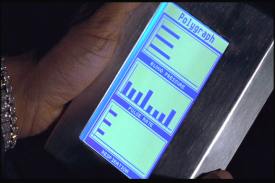
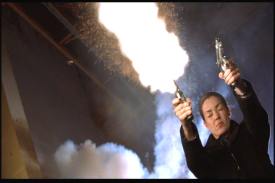
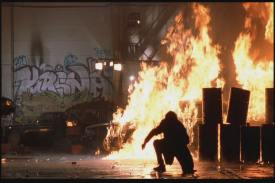
Sonny has come to meet Sascha (Seagal), a close friend of Nick’s who is also a high-end car thief. Nick is pushing for Sascha to be initiated into the gang. Sonny, however, is paranoid as well as vicious and ruthless, and intends to kill Sascha unless he can prove that he’s not working for some law enforcement agency or other. In furtherance of this, Nick has brought along a rather unconvincing pocket-sized lie-detecting gadget. Again, the only word that springs to mind here is generic. The ominous music is generic. The setting is generic, being a big warehouse space, slightly smoky so that the diffused shafts of blue-tinted light filtering in through the windows show up nicely. Although, to be fair, there’s not a backlit industrial fan in sight. The action too is dismally generic. Sonny holds a knife to Sascha's throat and threatens to kill him, a moment accompanied by a swell of the Ominous Music. However, the thief keeps his bland, Seagal-ish cool—i.e., he doesn’t muster a second facial expression—and passes the interrogation. The only really funny moment here is when Sascha acknowledges that he himself is Russian. Perhaps wisely, Seagal doesn’t try for a Russian accent that he probably couldn’t pull off, but its complete and utter absence is still comically apparent. The biggest shock is Seagal himself. He’s quite evidently regained any weight he lost prior to making Exit Wounds, and moreover let his hair grow back out. The long hair was kind of obnoxious when he was thin and fit. Now that he’s old and chunky it’s downright sad, a sign of someone who refuses to age gracefully. Moreover, his frequent close-ups reveal a face that’s not just grown soft and doughy, but which glistens greasily, like a fatty sausage. One suspects that pressing on his skin would cause thick streamers of suet to ooze out. The scene, utterly devoid of tension—yeah, Seagal is going to be caught out five minutes into the movie—progresses lethargically. Not to say that there isn’t the occasional amusing moment. At one point Sonny proclaims himself to run "the biggest crime syndicate from Eastern Europe to the Pacific Rim," whereupon we wonder if he takes the time to personally visit and check out every guy who boosts cars for him. After Sascha passes the test, Sonny accepts him as one of the family and takes his leave. Nick remains behind, so that the two can converse in such a fashion as to clunkily provide us some exposition. Sascha, we learn, has a Tragic Past involving a dead wife. Nick, noting that his friend still wears his wedding ring, gently advises that it’s time to put her loss out of his mind. As mournful music gushes on the soundtrack, Nick muses that, "You felt the loss, cried the tears." Sascha, however, can’t let go of his grief. In its hamfisted way, this is meant to make us care about these characters, and to establish them as the sort of emotionally sensitive, honorable thieves one only sees in the movies. Even if the feeble scripting allowed for this, however, the acting doesn’t. Ja Rule attempts to exhibit streetwise cool by assuming casualness so extreme as to suggest the onset of a narcoleptic episode. Seagal, meanwhile, is Seagal, meaning that if anything he’s even less animated than his young co-star. His attempts to convey a soul-shattering pain are, to be kind, unconvincing. Cut to Sascha and Nick in a Jaguar, presumably one that Sascha has boosted. We cut to the vehicle in mid-flight as it leaps through the air for a ridiculous, Dukes of Hazardian distance. You’d think the street value of a luxury sport car would be higher if its suspension was intact, but I guess not. Sascha drives like a maniac, laughing at Nick’s ‘comical’ fearful moans and exclamations. There’s numerous near collisions and a loud rap number on the soundtrack and zzzzzzzzzz….. Oops, sorry. By the way, did I mention that we never for one solitary second believe that the close-up shots of Nick and Sascha in any way correspond to the exterior shots of the car? Also, there’s a purportedly humorous bit where Nick tries to get Sascha to talk in a jive black accent. This is a character bit so misjudged that it can only be described as appalling. They arrive at a chop shop, a big warehouse space that features open cargo doors and which is atmospherically lit with trashcan fires (!). To my horror, the comedy continues apace as Sascha begins to spin the Jaguar in tight circles. "Stop the car!" a queasy Nick shouts. I’m with you, man. Hell, stop the movie. Instead, we get one of those moments so ineffably stupid that it’s literally surreal. Sascha screeches the vehicle to a halt, whereupon the passenger door flies open and Nick is catapulted a good twenty feet through the air, ultimately smashing into the windshield of a parked car. Of course, he merely dusts himself off and comically threatens to kick Sascha’s ass. I should note here that Seagal is currently dressed in an actual black suit, with matching dark shirt and tie. This makes him look like a typical over-the-hill Mafia hoodlum, but also lends a touch of class that his normal American Indian attire fails to provide him. Sadly, his current attire will be quickly abandoned. More comedy follows. Sascha wants his money for the car, while Nick promises he’ll get it in a day or two. The thief threatens to smash up the car with a sledgehammer unless he’s paid immediately. Nick produces his cash. "You know you’re crazy," he sighs. "Cuckoo crazy," Sascha agrees. (?) Man, that’s some sparkling badinage there. Somebody liked the phrase, though, as it reappears later in the film. Suddenly an SUV pulls into the garage, a vehicle Nick says wasn’t expected. Hmm, those open cargo doors don’t really provide much in the way of security, now that I think of it. A figure leaves the mysterious SUV and strides towards them. This personage is filmed with an unfocused lens so as to leave its identity unclear, thus providing suspense or tension or something else that doesn’t manifest itself. We soon learn that the visitor is Special Agent Ellen Williams (Claudia "Final Voyage" Christian). She swaggers around in a long black unbuttoned coat and wears her hair pulled back tightly, so that we get that she’s a badass. She flashes her badge, if not a warrant, and a crew of heavily armed agents enters the garage. Of course, Nick don’t play that, so he reaches behind his back with both hands and produces a pair of pistols. (He had those both tucked into his pants? That couldn’t have been too comfortable.) "I don’t talk to pigs without my lawyer," he sneers. Especially, you’d think, ones without warrants. Williams tells him to calm down, as she’s after Sonny, not him. "You’ve got five seconds to put the guns down, and increase the peace," she tells him. Increase the peace? Man, even Johnny Cochran would think that was lame. Here Williams pulls back her leather coat. This reveals a brace of semi-automatics in cross-draw holsters, a rig that is Standard FBI issue, I’m sure. Presumably threatening Nick in this fashion corresponds to federal agent training on how to avoid escalating dangerous situations. Quit a pro, our Ellen. The camera cranes back to display a triangular tableau of Nick, Sascha and Williams, an embarrassing nod to Sergio Leone that ain’t helping this movie any. There follows a horrendously uninspired gun battle, complete with zillions of John Woo steals; seriously, it’s time to outlaw guys flying sideways through the air while firing two handguns. Sparking metal is used to suggest ricochets, faceless extras grab their chests and spin around and fall over, people tumble off suspended catwalks, guys seek cover from high-powered firearms by ducking behind empty barrels, pistols and automatic weapons fire thousands of rounds without being reloaded, etc. In the end, haphazardly stacked petrol barrels are shot up, resulting in a fireball of typically nonsensical proportions. Here we get our first painfully obvious incident of a stuntman doubling Seagal (although at least that means the guy was well-padded). DoppelSascha rolls always from the fireball, an act shot from some distance and with his face carefully obscured by shadows. Some of the film’s action bits are so absurd they actually serve to reduce our interest in the movie. One occurs here, as Williams and Nick simultaneously decide to go mano-a-womano. Each steps from cover and begin walking towards the other, both of them blasting away with a pistol in either hand. Now, hitting targets with pistols isn’t quite as easy as most movies would have us believe, and firing a gun in each hand would most likely diminish one’s accuracy even more. Even so, the moment is simply unbelievable. Here we have two people, both supposedly expert in the use of firearms, standing maybe twenty feet apart and firing dozens of shells at the other. This makes it more than a little fanciful that at least one of them wouldn’t find themselves shot to pieces. On top of that, it’s hard not to notice that both Ja Rule and Christian flinch and wince whenever their guns go off, which doesn’t exactly sell the notion that these are two gunslinging hardasses. In fact, if you watch the scene in slow motion, you'll see that Christian has her eyes closed nearly the entire time!
The standoff ends with the only action moment in the film that actually has us cringing from its authentic potential for carnage. As the bullets fly, Sascha begins lumbering towards Nick and finally leaps through the air to knock him to safety. This inevitably calls to mind an old SCTV skit, in which John Candy’s portly Johnny LaRue attempted to protect a baby seal from being clubbed by jumping up and throwing his body over the animal. This, sadly, proved to be a markedly counterproductive strategy for safeguarding the critter’s structural integrity. As we watch Seagal’s bulk tsunami over the reedy Ja Rule, one can only fear a similar outcome. With the camera whipping around in a lame and pointless attempt to foster a sense of cinema verite, we immediately cut to a flatlining Sascha receiving emergency attention from paramedics. He has apparently intercepted a number of bullets while pushing Nick aside. Perhaps he believed that, as with missiles fired at Gleep and Gloop of the Herculoids, said slugs would sink deep into his blubbery layers before losing their kinetic energy and being violently expelled. However, for some reason this intuitively reasonable strategy seems not to have worked. Sascha has a vision of his dearly departed wife. Whether this is meant to represent a flashback or an out of body experience is left for us to determine, at least in the unlikely circumstance that we actually give a rat’s ass. Finally, they shove a hypodermic of adrenaline into his heart and he revives. In a bit headscratchingly inappropriate for even this film, we next see the paramedics ministering to him in fast motion. The only explanation for this I can come up with was that director Don Michael Paul couldn’t resist using each and every special effect available through his editor’s software package. At this point I think we’ve already seen everything but a star wipe. We cut to Alcatraz Island, eight months later. The prison there, closed down decades ago, has been rebuilt. Well, actually, the exteriors look the same, so I guess ‘refurbished’ would be closer to the mark. In any case, the spiffy new facility has been wittily dubbed "New Alcatraz." This is pretty funny, because the other film I reviewed in collaboration with the Warden was a giant snake flick entitled Boa, which was set in an Antarctic prison also called New Alcatraz. You know the saying that great minds think alike? Apparently it works the other way, too, especially with scriptwriters. However, this isn’t the only thing the movies have in common.
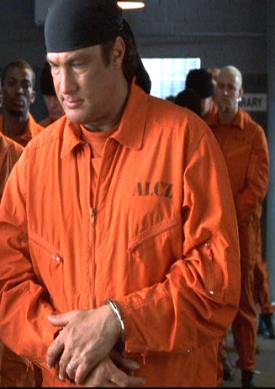
Several lines of arriving convicts, including Sascha, are being processed into the facility. The sight of Seagal’s epic circumference draped in a bright orange jumpsuit proves blighting to the eye, and the doo rag he has wrapped around his pate ain’t helping much either. In any case, Sascha soon leaves his place in line (!), and we see—it’s a small world—none other than Nick in the next row of prisoners over. The reunited comrades embrace as well as they can, given their shackles. Nick is amazed to see Sascha, thinking him killed in the chop shop. "They brought me back," Sascha explains. Presumably this is what the film’s nonsensical title alludes to, although pretty much every single review of the film mused that it was rather a reference to Seagal’s career. Hilariously, Nick reveals that he’s received a nickel. (That’s five years for you squares out there.) This seems a pretty lenient sentence for a guy who was running a high-end auto theft ring, much less one who resisted arrest and attempted to kill at least one FBI agent. In any case, the two affirm that they’re still buddies. Meanwhile, as the scene progresses I wonder more and more why the hell none of the guards have bothered to corral Sascha back to his proper place in line. I wouldn’t have imagined that prisoners in spanking new maximum-security prison would have so much freedom of movement. Sascha sets off the metal detector the prisoners are ushered through. My first thought was that the zipper on his Brobdingnagian jumpsuit was proportionally large and setting the machine off. However, it turns out that he’s got a metal knee to replace the one shattered in the gunfight. The guard doesn’t like his attitude, however. Proving an utterly cliché Sadistic Movie Bull, he zaps Sascha with his baton, which comes complete with a handy electrical arc generator (!). Sascha don’t play that, though, and opens some whupass on the guy. (!!) Cripes, he’s not even in the prison proper yet. Sascha gets pinioned by other guards, and Sadistic Bull prepares to dish out a little discipline. At this point Nick jumps the guy. Man, this is already one of the worst run movie prisons I’ve ever seen, and I’ve seen some doozies. The guard punches Nick in return, and the kid flies up through the air horizontally and spins around a couple of times before crashing to the ground. Seriously, is it even possible somebody thought that would look cool instead of insanely stupid? If they did, they were waaay off. Even so, Nick gamely (and unbelievably) jumps up and begins pummeling the guard. They continue trading blows, as about a dozen other guards just stand around and watch, until Sadistic Bull finally gets him pinned against a wall. Here we meet the Warden—no, not the one from the other website—a strutting bantam Hispanic dude colloquially known as El Fuego, or The Fire. He’s all I’m-so-tougher-than-you and wears a slick black leather sports jacket and is obviously supposed to be muy macho, but in a good way, more or less. He also speaks a lot of Spanish with an aggressive accent, lest we’ve somehow failed to discern his ancestral background. Outside, a press conference is being held on the re-opening of the prison. The speaker is Hubbard, presumably someone in the Federal penal system. He’s played by prolific TV producer Stephen J. Cannell—probably because director Paul cut his teeth helming episodes of various Cannell series—and he’s surprisingly decent. I’m not saying he’s tremendously good, really, but he holds his own with most everyone else in the cast. OK, that’s not as complementary as I thought. Let’s move on. While Don Michael Paul’s contributions as a director are, at their very best, uninspired, his script (which he also provided) is downright awful. The film is positively larded with characters—several more of whom have yet to make themselves known—and he has an unfortunate tendency to try to write philosophical dialog of the Wryly Ironic & Laconic School. People who have seen the dreadful Harley Davidson and the Marlboro Man, which he also wrote, will know what I mean. Still, this trait makes him a perfect match for Seagal, who bollixed up his own career by attempting to inject ‘meaning’ into his own self-produced films. These attempts at philosophy not only prove ponderous and pretentious, however, but are unfortunately no better written than Paul’s tough guy banter. And since pretty much every character in the movie is supposed to be a tough guy, including all the women, this means quite nearly every single line of dialog sounds like Raymond Chandler as filtered through a faulty Japanese translation computer and then back into English. In any case, Hubbard takes some questions from a hostile press—well, Alcatraz Island is outside San Francisco—who question why a prison once closed down for its brutality is now being reopened. (Uh, because forty years have passed, and its been rebuilt and will be run by completely different people?) Hubbard sneers at these questions, sardonically uses the politically correct catchphrase "criminally challenged." Then he calls his assistant Donny to the microphone, who opines that New Alcatraz is "a bad place for bad people. If there’s any discomfort behind these walls, that’s how it should be." Personally, I think that’s a defensible position, within reason, although I find it unlikely that a functionary would cavalierly make so controversial a remark to the press. Back inside, the new fish are being assembled in Cell Block E. Among the prison’s first inmates, they are, we learn, to provide the labor to refurbish the prison. (!!) Oh, yeah, that sounds like a good idea. I’m going to give murderous psychopaths and career criminals access to circular saws and other dangerous implements. As well, allowing them to gain intimate knowledge of the plant’s physical structure is surely another boon. One of the inmates we meet is Twitch, so named because he—are you ready for it?—twitches a lot. He’s played by Kurupt, another rapper, and bears an almost frightening resemblance to ‘70s Blaxploitation mainstay Antonio "Huggy Bear" Fargas. Another prisoner is a gigantic black dude named, inevitably, ‘Little’ Joe. Because he’s not little, get it? It’s impressive that Paul can provide two characters with nicknames that are equally lame for but the exact opposite reason. Seagal enters the room, strutting around in a fashion that unfortunately, although aptly, calls to mind Gene Wilder’s "Uh huh, that’s right, I’m bad" scene in Silver Streak. Fortuitously, the prison’s dress code is surprisingly relaxed. This allows Seagal, as has been his want over his last several pictures, to wear his oversized shirt hanging loose. This doesn’t exactly fool the eye in regards to his excess adipose tissue, but I guess it doesn’t hurt, either. I mean, it’s not like we’d be better off if he were wearing a leotard or Speedo or something. El Fuego makes the scene and gives the Obligatory ‘This Is My House’ speech. Well, actually, because he’s of Spanish descent it’s "mi casa." "You think you’re hard," he tells them. "I’m harder." Wow, that’s some fine writing there, Mr. Paul. In any case, his spiel is less heavy handed then those made by wardens in many other prison films, reflecting that fact that El Fuego isn’t meant to be a brute. He advises them to do their time the easy way rather than the hard, and provides them with Bibles and suggests they read them. (I’m pretty sure that would that would trigger a lawsuit, but anyway.) Also, each inmate has their own individual cell—that’s nice—and even a TV set and video game console if they so desire. Two more of our cornucopia of characters are quickly—well, OK, not quickly—introduced. One is these is Lester, the first man scheduled to be die in the prison’s ludicrously futuristic Execution Chamber. In fact, that’s to happen later this very evening. (They try to make this less unlikely by explaining that he nixed any further appeals, but it’s still pretty unlikely.) He’s afforded a laughable ‘cool’ entrance as he rises up to the cellblock floor via a hidden hydraulic platform, like a performer in a cheesy Las Vegas stage act. Then, as he walks past the other prisoners, the action goes to slo-mo as he and Sascha exchange a glance. Wow! Meanwhile, Supreme Court Justice (!) Jane McPherson arrives at the prison. Seventeen years ago she presided over Lester’s trial, and apparently feels obligated to see the final sentence carried out. Lester was convicted of stealing $200 million dollars in gold. In the process, five Treasury agents were killed. The gold, I’m sure you’ll be shocked to learn, was never found. In any case, if all this doesn’t start putting some pieces together for you, then you haven’t seen many action films since Die Hard came out. As befitting a director who’s mostly worked in television, both Lester and McPherson are played by actors best known for their TV work. Bruce Weitz, at one time well known as the comically loony Serpico-like Belker on Hill Street Blues, assays the former. McPherson, meanwhile, is played by Linda Thorson, who as Tara King lamentably replaced Diana Rigg’s Mrs. Peel on The Avengers. Neither provides a particularly compelling performance here, although it’s difficult to assign them much blame, given the circumstances. The execution complex is moronically large, almost like something out of a James Bond movie. The exaggeratedly sleek chamber itself is known as "Slaughterhouse Five" (oh, brother), since it offers five different ways to kack the condemned. In a novel touch, the prisoner gets to choose. It also comes equipped with holographic walls, so that the guest of honor can enjoy whatever scenery he wishes to meditate on before the main event. Lester has opted to ride Ol’ Sparky, which fittingly rises up from a concealed trapdoor in the floor, just like he did a minute ago. When the chair is so introduced, the camera whips around it in circles and we get a wailing guitar chord. Imagine a film in which nearly every shot is like that and you’ll be pretty close to knowing what this one is like. Sans disappearing chair, the room is extremely Spartan, affecting an austere elegance. Of course, if any state were to design an execution facility with impeccable feng shui, it would be California. The inner chamber abuts a "witness theater," which is part of the larger control center. The latter features a large rotunda sporting an inane amount of computer banks and switches and whatnot. It’s now five hours before the execution, and McPherson is ushered into the viewing area. El Fuego immediately orders her bodyguards, presumably Secret Service, to relinquish their firearms. Liking the cut of the warden’s jib, McPherson tells them to do so, which is patently ridiculous. And thus, now that I think of it, entirely in keeping with the rest of the movie. We cut away to a cargo plane flying over a thick cloudbank. This is accompanied by a loud heavy metal tune, a change of pace from the otherwise incessant loud rap songs. As the music screams on the soundtrack, the cargo door opens and a team of paramilitary skydivers—boy, that’s fresh, too—leaps from the plane. Handily, the group of miscreants picked the night of a torrential rainstorm to put their plan into operation. They glide down from the sky and blow away the exterior guards in various cartoony fashions. After being shot, naturally, all the guards fall forward off the building and plummet to the ground. In this they disregard the laws of physics but act in accordance with Ken’s Rule of High Altitude Mortality. The way clear, the villains touch down on the prison’s roof. One of the team, inevitably, is the Obligatory Butch-Looking Psycho Chick. This is 49er Six—an oblique reference to the San Francisco football franchise, presumably, which they mercifully don’t bother to explicate—as played by Nia Peeples (!!!). She comes shellacked with scads of blue eye shadow and wears a skintight, black leather catsuit that just coincidentally puts one in mind of Trinity from The Matrix, except that this one bares Peeple’s midriff.
The mercenaries open their nylon duffel bags and extract a prodigious amount of guns and gear. Meanwhile, in a bit so retarded it almost made watching the film worthwhile, we see that 49er Six has also packed away a stylish black duster (!!). We shift to a low camera angle after she dons it, whereupon she begins twirling around in the rain in slo-motion, flapping the coat wings in and out as she goes. Anyone seeking evidence that director Paul spent way too much of his life watching Stevie Nicks videos will find this of especial interest. The only other guy to bring a duster along (really, you packed a long coat in your skydiving kit to wear while hijacking a maximum security prison?!) is 49er One. The leader of the operation, he’s also—are you sitting down, because I don’t want to shock the hell out you and have you fall over and crack your head open—Donny, Hubbard’s assistant. You know, that guy we saw for about thirty seconds earlier in the movie. You’d think as an official of the federal penal system he’d have an easier way to get into the prison, but I guess not. Sadly, 49er One is played by Morris Chestnut, an actual actor who is entirely too good to be stuck in low-grade schlock like this. However, after an apparently star-making debut in 1991’s Boyz N in the Hood, Chestnut was quickly regulated to the usual boatload of crap. This includes a string of other action fiascos, including The Last Boy Scout, G. I. Jane and Seagal’s Under Siege II: Dark Territory. Later this year, in continuance of the trend, he’ll be appearing in the no doubt direct to video sequel to Anaconda. Oh, the real reasons Peeples and Chestnut wear dusters? First, because it’s *cough* cool. Second, because everyone on their large team is dressed entirely in black, and they no doubt wanted to be sure we could tell the feature villains from the generic henchmen types. Meanwhile, back at the cell block, we get a classic piece of ‘comic relief.’ This involves Little Joe coming by the cells with the library cart. He hands Nick a book that turns out to be a romance novel, and swears by its virtues. Get it? He’s a great big black convict and he reads girly romance novels. What a quirky character trait! Bravo, Mr. Paul, you’ve done it again! Sascha, for his part, is escorted to the execution chamber. Lester, who at this point in time is understandably interested in what lies on The Other Side, has requested to speak to him, knowing—somehow—of his near-death experience. "The rumor is you went half past dead and came back," he explains. (Wow! He said the title!) "Took a ride on the flat line for 22 minutes and lived to tell." 22 minutes?! Whatever. As the two play ‘Fish’ (really!), their conversation quickly devolves into the two exchanging pseudo-Zen dialog so obviously pseudo that even I recognized it as such. They are filmed in severe close-ups for this, with Weitz affecting a soft, somber tone to match Seagal’s usual whispery mutter. I presume all this is meant to help lend their utterances a profundity they otherwise fail to warrant. (One thing I couldn’t figure out is that Sascha refuses to answer Lester’s questions. He did, in fact, see his wife as he was dying. So why wouldn’t he pass that on?) Lester tells Seagal that his only regret in dying this way is in having no control over his own fate. They go on about this at length, and don’t be surprised if it sets up something later in the movie. However, he takes comfort when Sascha pronounces, "I think God will forgive you." Because, you know, who’d know more about it than another con? I should mention that the film treats Lester like some kind of holy man. His last meal is tea and rice, served in lacquered Japanese bowls and cups to emphasize his Eastern-like serenity. All the other characters evince the deepest respect for him, and those involved in his execution explicitly state their sorrow at having to carry out this duty. El Fuego, for example, does whatever he can for the guy. He allows him to have a long, private talk with Sascha and even provides him a nice suit he’s requested to wear as he’s being electrocuted. (Don’t they place electrodes and wet sponges all over your body? I’d think a suit would just get in the way.) While all this is going on, the mercenaries are covertly taking over the prison. The alarm system is deactivated via the expedient of sending a guy down an elevator shaft on cables. Once in position he pops open a junction box and attaches alligator clamps to some wires. It’s well known that if you’re a top computer hacker, you can override any system in the world with alligator clamps and a handheld device featuring an LED monitor or numerical keypad. Even so, lest we remain unconvinced, 49er One later tells the hacker, "Whoever wired this place was good, but you’re the best." Well, I can’t argue with that. 49er Six herself rappels down from a skylight (!) that overlooks Cell Block E. One guard is handily right below her and she wraps her legs around his neck and presumably breaks it. (Well, if you’ve got to go…) A second guard is shot down at the same time, because—and here’s some good design work—the security booth he’s stationed in is enclosed with regular glass. It becomes increasingly funny how the 49er team is able to rampage through large swaths of the prison, firing their automatic weapons constantly, yet without triggering a general alarm and alerting those in the execution complex. At one point they attack the prison’s overall control center (or some damn thing), which like everything else in the prison is behind regular glass windows and flimsy wooden doors. Yep, that’s some cutting edge security measures there, all righty. Moreover, as bullets fly around, something is hit and all the cell doors in Block E spring open (!!). Why? It’s in the Script, I guess. Numerous gunfights occur. Since the film went for a PG-13 rating, the mayhem is entirely bloodless, with the director leaning entirely too much on huge explosions of sparks to indicate bullets hitting metal railings and such. It’s like the freakin’ 4th of July in this movie. Needless to say, all the prison’s guards, other then the few still with El Fuego, are mowed down like wheat. Only one 49er guy takes a bullet, and that’s only so that 49er Six can demonstrate how dagburned ruthless they all are by *choke* executing her own teammate. That’s Half Past Dead in a nutshell: A conglomeration of stuff we’ve all seen a hundred times before. Oh, another funny bit. As a huge firefight occurs in the Cell Block between the guards and the 49ers, the prisoners all crowd up to their cell doors to watch the action. (This being before they are accidentally freed.) Hey, haven’t they ever heard of ricochets? Hundreds and hundreds of shells get expended here, and there’d be slugs flying around all over the place. Yet the film doesn’t even have the wit to show one of the generic prisoners taking a bullet or anything. By the way, why wouldn’t the 49ers execute the prisoners, just to be safe? IITS. Meanwhile, McPherson meets with Lester. Lester greets her by quoting the Bible, "Whosoever sheds man’s blood, by man shall his blood be shed." Apparently she read this verse at his sentencing, and now he’s throwing it back in her face. That’s pretty rich, coming from a guy who stole a gold shipment and caused five people to be killed, even accidentally. What’s weird, though, is that I think the film is actually pushing the idea that McPherson’s upcoming travails as a hostage—oops, sorry—are karmic payback for her ‘crime’ of presiding over a trial where the defendant received the death penalty. Especially since, you know, we get to know Lester and see what a nice guy he is. Her response, "The jury decided, I presided" (who wrote this script, Nipsey Russell?), is played as merely a rationalization. Even so, Wise Man Lester quickly deduces the real reason she’s come. "You want my forgiveness," he sagely intuits. She tries to act otherwise, but godlike, we peer into her soul and see that it is true. Sure enough, though, Lester proves his moral superiority by forgiving her, and even shakes her hand. What a guy. Hey, director/screenwriter Paul! Screw you, you hypocrite. It takes a lot of nerve to try to lay some anti-death penalty message on us in some schlock action flick whose entire purpose is to entertain audiences with mass carnage. With the execution minutes away, the Sadistic Bull (although he’s been humanized a bit by now) escorts Sascha back to his cell. On the way they come across the 49ers, who get around pretty good considering that we almost always see them moving in slow motion. Sadistic Bull is shot, and Sascha goes down with him, pretending to be dead. It’s amazing how the villains make the most amazing shots when shooting down faceless extras by the score, but can’t hit the broad side of a barn—or something even bigger, like Seagal—when aiming at one of the protagonists. Also, how credible is it that you’d be walking right next to a guy who takes an entire chest full of bullets from a submachine gun that was being fired from a distance, one-handed (!), and yet you yourself would end up entirely unscathed? Man, that’s some good grouping. Lester is seconds away from departing this world when the 49er Team, accompanied by their heavy metal theme, strut into the execution chamber. Luckily, everyone is easily captured because El Fuego took away the guns of McPherson’s bodyguards. You know, you sort of take your villain’s ‘mastermind’ credentials away when his opponents are idiots, he’s aided by a random torrential rainstorm, and his opponents disarm each other before he arrives. It’s better to be lucky than good, I suppose. Meanwhile, Sascha works on the guard. He administers CPR—always helpful for those suffering from multiple gun wounds—and then uses the electrical arc from the guy’s stun baton to jumpstart his heart (!!). This works, and even more amazingly, blood doesn’t start gushing out of his wounds once his ticker starts pumping again. Meanwhile, in a really silly and incredibly obvious bit, the (CGI) helicopter meant to whisk the 49ers to safety smashes into a watchtower because of the blinding (CGI) rain. Again, why do actual humans bother writing these movies? As soon as we see a helicopter in an action film these days, you know it’s going to crash into something and massively explode. See Deep Blue Sea, etc., and so on. Really, why not use a low-grade computer to ever so slightly rescramble these rote elements into marginally different orders so that a new ‘script’ is manufactured? Oops, I did make one mistake, however. Here the ‘copter doesn’t explode in a huge fireball. Instead, it smashes itself halfway through the previously mentioned skylight. (Some of the sets are elaborate, but there aren’t too many of them.) See, that way weapons and equipment and stuff will be available for the heroes to hijack later. This is why they bothered establishing that the 49ers left ropes hanging from the ceiling. Meanwhile, Sascha uses the barely revived guard to get into a secure part of the building. 49er Six and some henchguys are right on his tail, but luckily he just barely gets through what appears to be the only bullet-proof security door in the place. (So, the armory isn’t bullet-proofed, but…) 49er Six wedges a weapon into the closing door, and we get a variation of Seagal’s traditional gun-spinning move, although he doesn’t manage to kill any of the bad guys yet. Comically, though, a reverse shot shows a con nonchalantly standing at his cell bars—this being a part of the prison where the inmates are still safely locked up—despite the automatic gunfire released in his general direction a second ago. Back in the execution chamber, 49er One is conversing with Lester, trying to get the location of the gold out of him. In so doing, they debate the existence of God in a typically superficial fashion. Lester is on the ‘yes’ side, 49er One the ‘no,’ in case you’re wondering. Seriously, I’m beginning to think that director/writing Don Michael Paul was the subject of a malign experiment by a mad scientist from the American Film Institute. My theory is that he was raised in a small room since childhood, without exposure to other humans, his only external stimuli being the constantly screened films of Michael Bay and Shane Black. Then, once he reached maturity, he was released onto controlled film sets to make movies. When Lester proves willing to die rather than take the 49ers to the gold, 49er One shoots the priest attending the execution. Wow, how transgressive. Dangling the dead Padre’s crucifix before Lester’s face, Our Villain explains that he’s a sociopath and thus willing to kill all the various hostages if that’s what it takes to get Lester to talk. By the way, the film of course insults the audience by assuming we won’t know what a ‘sociopath’ is. "Know what that means?" he thus queries. "It means I can kill everyone in this room and not feel bad about it." Du-uuh…OK, boss. Meanwhile, back in the city (where it’s not raining—sometimes) Agent Williams is being informed that the Coast Guard saw the helicopter crash and go down through the roof of Cell Block E. Uhm, so the ‘copter crashed because the pilot couldn’t see a watchtower until he was ten feet away from it, but a Coast Guard boat, presumably from some distance, saw the chopper go down, despite the lack of an explosion, and even was able from sea level to tell exactly where it ended up? That’s amazing! In any case, Williams is worried. Cell Block E is where a deep undercover agent for the FBI is currently located. (Gee, who could that be?) She’s additionally worried by the fact that the phones to the prison are all out. Uh, wasn’t this made in 2002? What about the private cell phones? Or radio? Or…oh, never mind. Oh, and watch the way she pretends to drink from the obviously empty Starbucks container. Seriously, shouldn’t actors know how to hold an object so that it appears there’s something in it? Sorry, that’s an old bugaboo of mine. Once again, I’m wasting a bit more of my life on this film than I planned. At this point there’s almost an hour (!) of it left. Plus, as it segues into a series of amazingly boring action sequences, it seems only appropriate to move to Bullet Time. (Hey, if the movie can rip off The Matrix, and poorly, then so can I.)
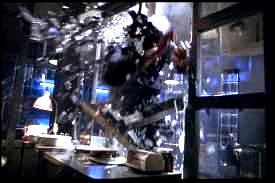
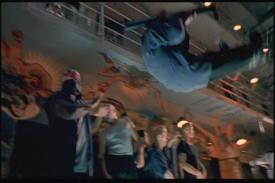
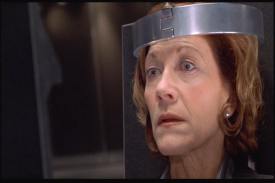
The explication of the above rules proves timely, as three 49ers enter the Infirmary one at a time to contend with Our Hero. Watch Sascha fall to the ground—from the back!! Watch Sascha leap in the air—from the neck down!! Watch Sascha crash through a plate glass window—his face obscured by his arms!! Etc. and so on. Oh, by the way, the plot doesn’t have any more use for the guard Sascha revived earlier, so now he’s dead. Just in case anyone is keeping track. Things I Learned Things I Learned Things I Learned A great moment comes when Sascha grabs one beefy 49er guy’s body and tosses it twenty feet through the air, as well as a closed door, to impact with another villain. This film treats human beings like they weigh about twenty-five pounds. 49er Six returns to Cell Block E to check on what happened to the helicopter. With the exterior doors still intact, the prisoners are playing basketball. This is the sort of movie where you can trust that a large group of inmates in a maximum security prison all mean well and won’t be doing anything even potentially naughty. Things I Learned In bad movies they often cheat by assuming that characters can’t see anything or anyone that’s off camera. In other words, if the audience can’t see it, the people in the movie can’t, even though in real life the object or person would be two feet in front of them. Watch the scene where the guy is firing through the window at a hidden Sascha. He fires and fires, approaching the shattered window as he does so, and then one second later Sascha’s (if not Seagal’s) foot comes into frame at face level and kicks him in the head. How the hell did the guy not see Sascha?! Given where his foot comes from, and the amount of time since he’s fired his gun, it’s literally impossible. This leads to Sascha’s longest hand-to-hand fight in the movie, and everything I said about Seagal’s participation representing about 10% of the scene is very obvious here if you’re looking for it. If you’re not, you might not notice how he’s always filmed from the back while moving or being hit until perhaps halfway through the sequence. The only action Seagal himself actually performs here involves one of his trademark "two guys exchanging a flurry of blows." The reason he can still do those is because they involve only moving his arms while standing in place. Sascha kicks the guy, he flies eight feet through the air, and lands dead. That’s funny, at various other times in the movie people fly or leap twenty or thirty feet through the air to concrete floors with no discernible injury. With the helicopter disabled, they go to Plan B, which involves phoning the FBI and negotiating for McPherson’s safety. 49er One steadfastly refuses to disclose his identity to Agent Williams. However, he contacts them over his personal cell phone (!), which means he has to know they’ll trace who he is almost immediately. I mean, what, the guy can organize this gigantic commando raid but can’t acquire a stolen cell phone? The purported cat and mouse discussions between 49er One and Williams are painful in the extreme. The prototype of these movies, of course, is Die Hard. The difference being that in that film we really believed that Alan Rickman was a criminal mastermind, one whose intricate plans and redundant failsafes required constant undermining by a surprisingly wily and capable hero if they were to be thwarted. The moment in which we learn that Rickman has incorporated the standard FBI procedures against terrorists as an integral part of his scheme is a thing of beauty. However, in this film, as with possibly hundreds of others, we’re just supposed to recognize that 49er One is a Rickman manqué, and afford him the same sort of respect whether he earns it or not. This is like the flood of confined Evil Genius Serial Killers interviewed in dozens of movies following Silence of the Lambs, all of whom undeservingly rode on the genuinely frightening Hannibal Lector’s coattails. Williams takes his call in a mobile command center of some sort—what, there’s not an FBI field office in San Francisco?!—in which the only lighting is ambient stuff from the various computer screens. Hasn’t anyone in these films ever heard of the light bulb? Also, director Paul obviously really
liked playing lighted numbers over Williams face during all this,
supposedly reflections from the computer monitors. However, by the
third instance of this it’s just calling attention to itself, which
is not a good thing.
49er Six, for some reason still hanging around the upper levels of Cell Block E, ends up in a face-off with an armed Sascha. Sascha identifies himself as 1137, his prison number. There’s various foolery here, with 49er Six ultimately knocking Sascha’s gun away and leaping for one of the hanging ropes—again with the hanging ropes—and gliding down to the ground level of the Cell Block. By the way, once you knocked his gun away, wouldn’t it have been easier to just shoot him rather than jumping through the air and grabbing at a rope hanging thirty feet above a concrete floor? Guess not. By the time she reaches the floor, meanwhile, Nick has cinematically slid in slow motion to pick up Sascha’s pistol, and so she finds herself in the same predicament anyway. Seeing what Nick is up too, Little Joe and Twitch leave their cells, where all the good lil’ inmates are staying, until this all blows over, and offer him their assistance. "We got your back, dawg," Twitch drawls. Man, the notion that a white guy wrote that line of dialog for a black guy to say is just embarrassing. Nick provokes a shootout by making kissy faces at 49er Six. As is typical in the firefights in this film, anywhere from two to two dozen people standing right on top of each other just start blazing away while running off sideways—we must see this exact setup at least half a dozen times—all without magically managing to hit a damn thing. And this with 49er Six spraying automatic weapon fire at a guy maybe twenty feet away from her. Her gun, by the way, continues dispensing an impressive amount of ammo, despite her having fired it all the way down the rope and without it having been reloaded. As well, Nick’s pistol seems to have one of those fifty round clips so popular in the movies. Things I Learned 49er Six, ducking into an empty cell (which shouldn’t be empty), fires her gun through the barred cell door maybe a couple of feet in front of her. Let me repeat: She sprays automatic weapon fire at several steel bars two feet in front of her and directly in her line of fire. For some reason, the physics of this universe apparently don’t allow for ricochets. For no apparent reason, the trap door in the floor, the one Lester rode up in earlier, now spontaneously lowers itself. Nick jumps through the entrance into the access tunnel underneath, and 49er Six leaps down after him. (??!!) After dropping for fifteen feet onto the steel in oh-so-cool slo-mo, 49er Six finds Nick out of her line of sight. With several boxes and such in the tunnel, she begins spraying more bullets around. Since the last possible time she could have reloaded her submachine gun, I believe she’s now fired over forty thousands rounds. Things I Learned But, ha ha, Nick is actually hiding among some pipes over her head. (How the hell he got up there goes unexplained.) He drops down and gets the drop on her, wherein she pulls the old "Why don’t we put the guns down and do this like men." Yes, that’s exactly what she says. Hmm, I wonder what they’re getting at? The fight that follows is utterly ridiculous, filled with the gravity-defying sort of wirework that makes sense in fantasy-oriented movies but is ludicrous in a movie like this. At one point, 49er Six just flips herself straight up a wall in a manner that literally caused my jaw to drop, and not because it was cool, and again the opponents soar loftily through the air after taking blows. Even so, it’s probably the least boring fight in the movie—take that for what it’s worth. On the other hand, that means that the coolest hand-to-hand fight scene in a Steven Seagal movie takes place between a willowy rapper and a 5’ 2" former soap opera actress. To be fair, Peeples’ training as a dancer serves her well here, to the extent that she actually pulls off looking like a fighter significantly better than Seagal himself does at any point in the proceedings. By the way, I give credit to Ja Rule, who allowed himself to be in a scene in which he gets his ass handed to him by a girl and in which he doesn’t even land a blow. Given the exaggeratedly macho ethic of the rapper scene, I actually found that sort of impressive. On the other hand, he does take the sort of beating that would kill any other three guys and picks himself up a second later with no ill effect. Spotting Sascha’s sizable shadow silhouetted on a frosted glass door, 49er Six retreats by leaping through a similar doorway at the other end of the hall. In case you were wondering, yes, she also is invulnerable to being cut by jagged glass. Back to the spellbinding cat and mouse conversations between Williams and 49er One. He informs her that he has McPherson strapped into the electrical chair, and that if they try anything, "she’s dead. Dead by the tool of her trade." Yes, that’s an entirely balanced way of stating it. By the way, it’s at this point, after apparently quite a lot of time has passed since their first conversation, that Williams gives the order to trace 49er One’s cell phone. Quite the Sherlock Holmes, our Ellen. In the film’s gut-busting highlight, Seagal’s stunt double climbs up the rope—damn, that thing’s got more screentime than most of the featured actors in this thing—leading to the helicopter protruding through the skylight. At no time in the film are we more aware that Sascha’s face is turned away from the camera than right here. 49er Six returns to the execution chamber and informs her boss about Prisoner 1137. He in turn demands that El Fuego tell him who this person is. (Yes, I’m sure the guy carries the personal information of at least 1,137 different inmates in his head.) "A major pain in your ass," the warden replies with a smirk. Shouldn’t Richard Crenna be telling them that he’s their worst nightmare or something? Or, since this is Seagal, R. Lee Ermy? Up in the ‘copter—that thing must be wedged in there pretty good if even Seagal’s weight doesn’t bring it down—Sascha uses the radio to contact Williams. Hilariously, he now decides it’s the time to bring up how she shot him, apparently seven (!) times. "How does one of the FBI’s finest marksmen shoot one of her undercover agents," he asks. Finest marksmen?! Is this the woman who was wailing away with a pistol in each hand, squinching her eyes closed whenever one of them went off, and failing to hit a target maybe twenty feet away from her with several dozen shots? If so, the Bureau really needs to address this situation. Hubbard, who was knocked out earlier in the movie, pops up to exchange angry tough guy talk with his errant subordinate. Then he disappears from the movie. In the disc’s deleted scenes, we see that originally 49er One shoots him down after Hubbard gives one of those "Once I’m free, I’ll follow you to the ends of the Earth, you SOB" speeches. While I’m the last person to argue that the film’s too short, I’m not sure why they cut this of all things. First, it’s a fairly clever bit, at least by this film’s standard. Why do villains always shrug off such declarations? Second, with this sequence missing there’s even less of a reason for Hubbard to have been in the movie in the first place. While 49er One is distracted, the Secret Service guys get pistols away from two of his men and order the miscreants to surrender. (Why have half a dozen henchmen in the room if they can’t even watch the hostages?) 49er One commends them on their initiative, and then shoots the mercenaries they’re using as shields. This is one of the film’s marginally amusing bits, since we think it’s again meant to show how ruthless 49er One is. However, his men are wearing body armor and are actually unscathed, shooting the Secret Service agents from their position on the floor. It’s not much, but in a film like this you’ve got to take whatever gleanings of entertainment you can. For what it’s worth, 49er One is a decorated military vet (of course he is). He also has claimed that he "suffers from Gulf War Syndrome," which has never been proven to even exist, and which certainly the government doesn’t recognize, for obvious reasons. Ah, the insane veteran, turned into a killer by the government and then spit out once he was no longer useful. Where would the lazy B-movie writer be without him? Conversing with Williams, Sascha shoots down in dubious fashion all her various options for rescuing McPherson. "Sounds like I’m all you got," he concludes. Or was that Bruce Willis talking to the authorities in Die Hard? No, it’s Sascha. Definitely Sascha. Down on the Cell Block floor, Twitch suddenly
is holding a huge rocket launcher. (Where the hell was that thing all
this time?) Naturally, he wants to shoot it at something, because it’s
funny. Right? Anyway, Sascha drops down and gets him oriented on the
door between them and the rest of the prison. When Twitch fires the
rocket, he inevitably flies backwards for about twenty feet and
smashed through a window. Yes, that’s rigorously in accordance with
the Laws of Thermodynamics, all right. He dusts then himself off and
exclaims, "What a rush!" Komedy!
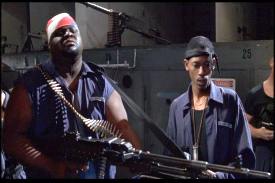
By the way, if case you were wondering, rocket launchers were not in fact designed to be fired indoors. I know that might surprise you if you see a lot of movies like this one. With this one door taken care of, Sascha is able to lead the inmates into the prison armory. (This is not apparently the area mentioned earlier, whatever that was.) The guys all gleefully grab various implements of destruction, but hey, if you can’t trust prisoners in a maximum security institution, who can you trust. Little Joe, being a huge guy, naturally falls in love with one of the row of belt-fed heavy machine guns the prison keeps on hand (?). Twitch, meanwhile, grabs one of the facility’s supply of Mac 10s (!!!). Sascha, though, being a pro, only takes a pistol. That might have been a nice moment, in another movie at least.
Commentary Track Commentaries
Director Don Michael Paul had the [extraordinary self-confidence] to provide a commentary for this piece of [sub-par filmmaking]. I was going to subject myself to it, but gave up when a minute in he declared that this was the revolutionary first film where the editing was designed to match a hip-hop tempo. He forgot to mention it, but it was also the first movie shot with synchronized sound and in color. HELLO!! Ever hear of New Jack City? It came out in friggin’ 1991. And I’ll bet the producers of the TV series New York Undercover will be glad to hear of your amazing innovation. Oh, except that it went off the air in 1998.
OK, I might have overreacted a bit in the above paragraph. You must understand, however, that I had just spent nearly every waking moment of an entire weekend stuck in the same room with this movie, subjecting myself to its banal component parts again and again. Now, however, I’ve returned from a restful day at work, and with my gorge receded to quite nearly normal levels, and I’m ready to give Mr. Paul’s commentary another try. Heck, I even went back and cleaned up the above remarks a make them a bit more palatable for our family audience. Halfway into the first sentence of Mr. Paul’s commentary, I was feeling a little sheepish. He is, I’m sure, a nice enough guy in his personal life, and perhaps it’s a bit mean to…it was at this juncture that he ended the sentence by saying, "get ready to be rocked!" It is true that while watching the film I often felt ‘rocked,’ but presumably I mean this in a different context than that Mr. Paul was intending. Still, fair is fair, sir. I’ve taken what you’ve had to throw at me, and now I’ve accumulated a sizable pile of bricks I would like hurl in response. Mr. Paul first authored a script for this project a number of years ago, which was at that time entitled The Rock. Events caught up with him via an obscure competing project, and the screenplay was shelved. This is entirely possible, and I’m willing to grant the timeline he provides for this. I have two reactions, however. First, I was no big fan of Michael Bay’s The Rock, but it’s a masterpiece compared to this film. (And no, you can’t just blame the budget and Seagal.) Second, if Mr. Paul’s script sat around for seven or eight years before being put into production, well, I don’t know, couldn’t he have polished it up a bit in the meantime? Of course, the scarier possibility is that he did. There follows the comments mentioned above, as he speaks of Half Past Dead being, "it’s the first…what I tried to do here was take the hip hop movement, which is so big in our country today, with really fuse it with an action movie…because I felt you really hadn’t seen action cut to hip hop. That’s really the style of this movie." Genius! Build a better mousetrap and the world will beat a path to your door, eh, my friend? Mr. Paul blathers on for a bit, although some genuinely incisive comments are made with Steven Seagal’s entrance in the movie. "He gives you what he gives you in lots of his movies," he asserts, and I certainly can’t gainsay him there. Moreover, who can argue when he says of his star, "He really fills up the screen." I’ll say!! (Mr. Paul later follows up on this train of thought by noting, "Steven Seagal is a huge action icon.") The fact that quite nearly every set in the movie was massively under lit was, he explains, to help foster a "dark, atmospheric" quality. Thanks, there’s no way the layman could have figured that strategy out. And a highly original one it was, too. He then describes what the directorial choices he made for the film, like the constant employment of jump cuts, was meant to achieve by using terms like "percussive" and "staccato." Those aren’t the exact words I’d use, but hey, to-ma-to, to-mah-to. I would suggest that staring at a guy operating a jackhammer for an hour and forty minutes would seem percussive and staccato, too. One gets the feeling Mr. Paul didn’t prep a lot before recording his commentary, although to his credit he does keep talking. Anyone who regularly listens to them knows the bane of such things is the commenter who goes silent for ten or twenty minutes at a stretch. However, if I seem to be jumping around, it’s because I don’t want to belabor his more innocuous statements. I did shake my head in consternation when he declared, "It’s rare that you see big action cut to hip hop or rap." And I positively felt like weeping when he asserted, "We really wanted to give it a style all its own." On the other hand, I did get a laugh from his contention that the film functions as a "hip hop opera." I sort of tuned in and out on Mr. Paul’s commentary until we got the Cell Block set, which was actually, he maintains, an authentic former Stasi prison (the film being shot in Germany to save money). That’s appalling, and I mean that in the most literal sense. The Stasi performed for the Communist East German government the same function as the Gestapo did in Nazi Germany. In fact, Mr. Paul goes on to say that the prison had in fact held Jews during the WWII era. That’s disgusting. Filming there is nearly the same as making a film on the ground of a decommissioned concentration camp. I continued to listen to the commentary for a total of forty minutes, and frankly wasn’t getting much out of it. Since the odds of hearing anything of genuine interest seemed increasingly remote, I gave the last hour of it a pass.
The Critics Rave!! "I’ve finally figured out the problem with all Steven Seagal movies that keep them from being very good: Steven Seagal is in them." David Cornelius, The Amazing Colossal Website. "I really liked Half Past Dead the first time I saw it - when it was called The Rock." Bill Muller, The Arizona Republic. "Half Past Dead is like an alarm that goes off while nobody is in the room. It does its job and stops, and nobody cares." Roger Ebert, The Chicago Sun-Times. "Opponents tend to run into [Seagal’s] palms or fists, and then fly back as if broken on their own accord." Cynthia Fuchs, PopMatters. "All but obscured by strategically darkened rooms,
oblique angles and long shots, Seagal ends up being less of an action hero
than simply missing in action." Manohla Dargis, The Los Angeles
Times. "[Seagal] is back and bigger than ever…When I say bigger, I mean that when [he] appeared in an orange jumpsuit, I wanted to stand up in the theater and shout, "Hey, Kool Aid!" Mark Rehner, Seattle Times. -by Ken Begg Note: Thanks to Proofreader Extraordinaire
Bill Leary for his valuable notes. And
now for the |