Another feature of... |
|
Another feature of... |
|
______________________________________
I’m sure (or rather I’m hoping) one of my colleagues will provide a more complete historical primer on the Golan/Globus years of Cannon Films. Assuming you’ve already read such a piece, feel free to move on to the film reviews posted below. Basically, Menahem Golan and his cousin Yoram Globus emigrated from Israel to the U.S. in 1979. Both were passionately interested in making movies. Therefore, they bought a majority position in Cannon Films, a small production company. They were able to procure the company at a rock bottom price. Under their leadership, Cannon became as emblematic of the B-movies of the ‘80s as AIP had been of ‘50s B-movies. AIP is mostly remembered for their sci-fi pictures; Cannon for their action movies. These films tended to be low-budget affairs starring popularity-impaired actors like Charles Bronson, Chuck Norris and Lou Gossett, Jr. (who sadly became a has-been roughly ten minutes after An Officer and a Gentleman left the theaters). Aside from previously documented Jabootu fare as Death Wish 3 and Firewalker, these ranged from the five (!) ‘American Ninja’ films to such titles as Missing in Action, Bloodsport, Cobra, Delta Force, Assassination, Cyborg and the two Allan Quatermain pictures that so patently aped Raiders of the Lost Ark. Yet their endeavors didn’t stop with action flicks. Golan and Globus also produced bad sequels (Superman IV: The Quest for Peace), bad erotica (Bolero), bad dubbed Italian imports (the Lou Ferrigno Hercules movies, Outlaw of Gor), bad sci-fi (Lifeforce, Alien from L.A.), bad period pictures (The Wicked Lady) and even bad Rocky knock-offs (Over the Top, which featured Sylvester Stallone ripping-off his own best movie). Perhaps the oddest thing about their slate of films was that they almost totally ignored the venerable horror movie. I would guess that with the lucrative low-budget action field almost cornered, they felt little inclination to compete with the veritable flood of awful slasher films unique to that period. More relevant for our purposes today, though, were their excursions into films based on dance fads. These included Beat Street, Rappin’, Salsa and Breakin’. In this fashion they also unleashed the immortal Breakin’ 2: Electric Boogaloo, thus creating what is undoubtedly the most parodied sub-title in motion picture history. (Of the two films we look at today, Lambada has the advantage of drawing director Joel Silberg. Silberg had directed Breakin’ and Rappin’, and thus at least knew his way around a musical sequence.) Given this, the modern reader may well ask, "Where, then, is Macarena: The Motion Picture?" It was stopped cold, my friends, by the double whammy of Lambada and The Forbidden Dance. Moreover, as the ‘90s approached, industry economics were shifting ever further in favor of the major studios. Home video sales still allowed for smaller firms to make movies. However, getting them shown in theaters, as Cannon’s films were throughout the ‘80s, became increasingly difficult. Instead, such pictures increasingly were made for the direct-to-video market. This, in turn, required lower budgets to insure turning a profit, and even then the margins were shrinking Cannon, like many of the minor production companies, was floundering. Again, it seemed as if the company were the very manifestation of ‘80s-style independent filmmaking. As the decade drew to a close, Cannon largely went with it. It was a familiar tale. Golan and Globus’ wares were successful, but largely derided by the mainstream Hollywood community. As immigrants during the Reagan years, their action films were often robustly and unapologetically patriotic. This paralleled the heavily pro-American nature of World War II era films, made by studios that were the fiefdoms of Jews who had fled Europe to make their fortunes here. The politics of Hollywood had changed radically in the intervening decades, however. So while Cannon’s admittedly crude action films were wildly popular in large swathes of the country, the establishment critics and mainline "artistic" community wrinkled their noses in patrician distaste. Cannon was making money, but wanted to become more than the biggest fish in the cinema world’s small pond. Instead, they wanted to become a major studio themselves. They hungered as well for the acceptance of the larger Hollywood community. In pursuit of the former, Cannon began spending more money on their films. However, their attempts at comparatively expensive pictures were dismal. The results were movies that, if anything, were merely more extravagantly bad than Cannon’s often-laughable low-budget fare. Such titles included Lifeforce, Superman IV: The Quest for Peace, Masters of the Universe, and Over the Top. The latter three were all released in 1987. Failing at the box office, they helped bring about the company’s dissolution two years later. In retrospect, the public’s rejection of these pictures seems all too predictable. Take Over the Top, an arm wrestling epic (!). Golan and Globus massively overpaid Sylvester Stallone to star in the film. Stallone was still a big name at the time, but his movies never really made money unless they featured him playing Rocky or Rambo. Over the Top was more or less No Holds Barred, the Hulk Hogan movie made two years later by the Cannon-esque New Line. Only instead of wrestling it revolved around the even more dubious ‘sport’ of arm wrestling, and instead of a cheaply procured TV wrestler it featured a star commanding a $12,000,000 fee. Admittedly, that figure (which was a humungous amount at the time) bought Stallone’s services for another film as well. However, since the other picture was the similarly disastrous Cobra, Cannon was still much ill served. More successful were the company’s effort in aggressively producing a lot of art house fare. Roger Ebert once observed "No other production organization in the world today has taken more chances with serious, marginal films than Cannon." These included such efforts as an extremely strange, existential sci-fi film entitled King Lear, directed by Jean-Luc Godard (!!) and starring Woody Allen, Julie Delpy, Norman Mailer, Peter Sellers, Burgess Meredith and Molly Ringwald. (!!) Other, comparatively prosaic highbrow titles included John Cassavetes' Love Streams and Franco Zeffirelli's take on Verdi's opera Otelo, with Placido Domingo in the lead role. Unfortunately, these films generally were differentiated from Cannon’s more high profile failures only by the fact that they lost smaller amounts of money. Nor did these films do much to raise the company’s artistic profile in the filmmaking community. Cannon was still regarded as The House that Chuck Norris Built. By 1989, the jig was up. Cannon was in bankruptcy and the SEC was investigating problems with its financial records. Under the strain, Golan and Globus broke up their partnership with notable acrimony. The two would not speak to one another for many years. About this time the short-lived Lambada craze was, as they say, sweeping America. The Lambada, for you youngsters out there, was a South America dance that basically consisted of two partners grinding their crotches together in mimed intercourse. Dirty Dancing was a huge hit in 1987, and the Lambada provided both men with a chance to make some coin—or so they thought—via even dirtier dancing. Globus had remained at the downsized Cannon. Golan, meanwhile, had started a new company, 21st Century Productions. Both began work on Lambada projects. When word got out that the other was doing a similar project, the rivalry quickly intensified. Globus had won the first round by being the first to register the title Lambada. Golan, meanwhile, procured the rights to the actual "Lambada" song by Kaoma that had started the whole thing. Release date were announced and then abandoned as each strove to beat the other to the screen. In the end, in one of the weirdest Hollywood footnotes, both films hit theaters on the same day. Both sucked, and both lost money. It was becoming clearer that the day for this sort of cheapie fare was ebbing quickly. With twice the number of screens (1000 to 500), and somewhat less scathing reviews, Lambada ended up the marginally more popular film. Globus' victory over his former partner, however, proved to be somewhat Pyrrhic. The opening weekend totals for Lambada were $2,000,000 compared to the $720,000 earned by The Forbidden Dance. The final figures weren't much better. The Forbidden Dance ultimately gleaned a feeble $1.8 million, while Lambada raked in a not tremendously better $4.3 million. Since Lambada is the slightly less stupid of the two, let’s save Forbidden Dance for dessert.
Lambada
Telling the two Lambada movies apart is simple. While both contain ludicrous attempts at a ‘social’ message, only one is a rip-off of the 1998 social drama Stand and Deliver. Lambada, lest you confuse those two, is the one with more dirty dancing and a hunkier lead. Stand and Deliver was based on a real-life story (for whatever that statement is worth.) Edward James Olmos plays a teacher with an uncompromising belief that his class of poor Hispanic high school students can learn advanced math. His message of hard work and exacting discipline is at first resisted by the jaded students, then embraced. Eventually his pupils do so well on college-level math exams that they’re accused of cheating, although retesting would later vindicate their achievement. Unlike most films of its ilk, this one was genuinely inspirational. Which leaves Lambada. We open on a backyard party for rich high school kids. Their sports cars, Miami Vice-inspired threads and hedonistic antics are meant to inspire hissing and cat calls from the audience. And maybe it did. For my part, the hissing and cat calling were directed at the awful pop tune that accompanies all this. We meet our teen lead, Sandy. [Correspondent Bill Leary points out that Sandy is also the name of the heroine in Grease. Surely a coincidence, I'm sure.] She looks quite well off. So either she’ll learn some sort of Valuable Lesson as things progress or reap instead some (purportedly) audience-pleasing comeuppance. Soon one of her lunkish male compatriots introduces her to his date for the evening. But…wait for it…he gets the girl’s name wrong. See, he’s a shallow jerk. Get it? Out on the driveway are two student valets. We know they’re better and more authentic or whatever than the rich kids because:
We next meet Dean, Sandy’s boyfriend and the film’s obvious Chief Evil Yuppie. We know he’s so because:
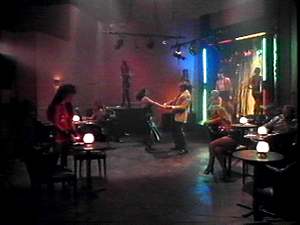
Cut to the next morning at staid and affluent Stonewood High School. Here we meet teacher Kevin Laird. He’s sort of like the result of Dean Cain and Lorenzo Lamas having fallen into the Brundlefly Machine together. Collins, another teacher, jokingly deprecates Laird’s unfashionable car. This cues the viewer that despite teaching in a private (?) school, Our Hero is a Working Stiff and therefore Accessible to us in the audience. To disguise this from the Stonewall snobs, he wears a pair of Clark Kent-like eyeglasses. Cut to the office of Principle Singleton, who’s currently firing the head of Stonewood’s Math Department. Singleton is portrayed by Keene Curtis, who built a career on playing prissy and officious authority figures. Then it’s on to Laird’s class. He’s drawing math symbols on the blackboard. His pampered students, needless to say, mostly sport bored, jejune expressions. Except for the Class Nerd. This fellow’s status is quite apparent, due to his bad haircut, clunky glasses and tie. "Complementary angles," Laird explains. "They’re like partners in a dance. If you know one, the other follows." (Huh?) Wow, I can feel the subject matter coming alive! Laird asks a question. Nerd Kid, of course, is the only one to raise his hand. We learn that his name is, and I crap you not, "Egghead." Presumably those in the audience who didn’t get he was the film’s Designated Nerd are now nodding their heads as this hits home. The answer to Laird’s query is "A right angle." I’d think private school kids would have learned about right angles before reaching their early twenties, but I guess not. Laird removes his jacket. (Wouldn’t school rules frown upon this, assuming Stonewall is the private academy it appears to be? Then again, Laird is obviously going to prove a bit of a rebel.) As he returns his attention to the board, Sandy and her friend Leslie gaze with lust upon his tight ass. A helpful close-up of this is provided for the benefit of those viewers who wish to enjoy the sight as well. Laird asks another question. This time Sandy raises her hand. "There she goes again," a fellow student notes. (Amusingly, another is using one of the phonebook-sized ‘portable’ phones they had back then.) Instead of answering Laird, she asks him if he’d like to pose for a "calendar." Laird, for his part, proves to be all business. "Posing for calendars," he intones, "has no relevance to what we’re doing in class today." Which apparently is learning sixth grade math. We cut to Laird’s modest home. (Or, at least, what the movies consider a modest home.) He has, we learn, a wife and an Adorable Son named Rudy. This all provides a platform to showcase what a terrific family man Our Hero is. Then we cut to the imaginatively named Drive In, a hamburger joint all the Rich Kids hang out at. (??) Dean is fetching Sandy some ice cream while she yaks with Leslie on the car phone. The mood turns frosty, however, when she spots him talking to another girl. Dean, we learn, has a history of fooling around with other women. Despite the fact that he’s standing right out in the open with his girlfriend waiting for him, Dean takes the girl’s phone number and tucks into his pocket. OK, do we get that he’s a heel yet? (And a none-too-bright one at that.) The scene ends with Dean getting the ice cream cone ground into his crotch before Sandy stalks off. To his further consternation, Sandy accepts an invitation from another girl, Muriel, to join her and two dudes from the ‘Hood. The Hispanic ‘Hood, in this case. They’re heading over to No Man’s land, a hot ‘street’ dance club. We cut to a leathers-wearing biker as he rides his Harley out of his garage. Then we move on to the club. Since this is where the ethnic kids hang out, it’s all Authentic and stuff. For instance, the girls are all dressed in an extremely slutty fashion. If that’s not authentic, I don’t know what is. The packed crowd engages in various exhibitions of dirty dancing to the accompaniment of generic Lambada music. As the camera moves from one gyrating ass to another, we get an idea of what a million dollar William Grefe movie would have looked like. In attendance are the two dudes we saw acting as valets earlier. The black one is Ricochet, the Hispanic one is Trevino. Another guy the camera keeps cutting to is Ramone. The latter is played by the noted thespian Shabba-Doo. (You remember him; he was Scooby Doo’s funky cousin.) Given his performance, I’m assuming he received a contractual bonus every time he bugged his eyes out on camera. D. W. Griffith would have told this guy to tone it down. Then Biker Dude arrives. This is the first time we see his face and *gasp* he turns out to be Laird. Moreover, he’s not wearing his Clark Kent glasses, which signals us that this is the ‘real’ him. He’s greeted as Blade, and apparently has a big rep there.
Ramone tosses hostile glances in Blade Laird’s direction. He’s clearly the pretender to Blade’s status as the coolest dude at the club. Blade Laird strips to his muscle shirt and takes to the dance floor, where he begins grinding his pelvis into that of a (pretty hot) partner. This behavior would be a little less questionable if Laird weren’t already established as being married. As to whether Laird’s a good dancer, well, given the parameters of the Lambada, I’m not sure what that would constitute. He does grind his crotch into another’s convincingly. Meanwhile, Sandy, Muriel and the Barrio Boys arrive. Sandy is much impressed, in a slumming Rich Kid way, with the street-ness of the club. "What is that?" she gasps. "The Lambada!" Muriel replies in an awed voice, as if they were gazing upon some secret ceremonial rite thought lost to the ages. "Can you believe they outlawed it in Brazil?" she squeals, passing on everyone’s favorite Lambada factoid. Ramone sees Sandy and gets the hots for the White Trophy Girl. Then Sandy sees Laird engaging in what would constitute sex in a Cinemax movie. It’s clear she’s developing a little sleeping-with-the-help thing. Again, though, this calls Laird’s attendance here into question. Even aside from the fidelity issue, should he be hanging out with a bunch of kids young enough to be his students? Particularly in a Lambada club? In any case, Sandy needs time to assimilate this shocking info and gets the others to leave. Lest you think the film is sophisticated in the moral ambivalence with which it portrays its lead, well, not so. For right after Sandy leaves, an announcement is made and a bunch of kids peel off into a side room. Laird, you see, is here to teach these kids math. (!) The classroom is a smoky pool hall with a blackboard stationed in it. Watching the half-dressed ‘teens’ cheerfully leave the dance floor to get their after-hours math lessons is pretty damn funny. On the way in, Laird asks Ramone if he’ll be joining them tonight. "Do you think you can dance your way into my mind, too, man?" he scornfully replies. This line is presumably meant to justify Laird’s dance floor antics, as it provides him with the street cred that pulls the kids into his classes. Ramone, meanwhile, will obviously be the hard ass whose eventual acceptance of Laird will be the teacher’s greatest accomplishment. Like Erik Estrada was Pat Boone’s in The Cross and the Switchblade. Remember? You don’t? Really? Well, take my word for it. Laird begins to teach, and we cut to him in his classroom at Stonewood. Despite being back in his civilian identity, Sandy is practically drooling at him, having seen his secret self. We segue to her fantasizing about doing the Lambada with a shirtless Laird. Normally such a dream would constitute a sublimated sexual fantasy. However, given the whole ‘Lambada’ thing, it’s really not all that sublimated. I will say, however, that Sandy’s dreams could use a better choreographer. Oh, and that hot chicks never go wrong with fishnets. After class, Collins tells Laird that’s he wanted in Singleton’s office. "He’s been expecting you," his secretary snidely notes after he arrives. Uh, didn’t he just finish teaching class? Also, if Singleton’s so anal retentive, maybe he should have a better system to contact his staff then sending word out on the Teachers’ Grapevine. Rather than being in trouble, though, Laird learns he’s the new head of the Math Department. I’d have thought him a little young to become a department head at a fancy private school, but apparently not. Actually, his predecessor was no seasoned vet either. Doesn’t this school employ any teachers over the age of thirty-five? But hey, there you go. Of course, Singleton ends by issuing an Ominous Warning not to let him down. That night, Blade Laird prepares to leave for another hard night of teaching and pelvic gyrating. First, though, he stops in Rudy’s room for a Poignant Scene. See, Rudy is wanting for some paternal attention, which is lacking since Laird goes out teaching every night. Laird explains he has a special job, although he doesn’t explain whether he means the math instruction or the crotch grinding. Rudy also accuses Laird of "dressing like a Greaser." This leads into a Significant Discussion on the Evils of Racism. (Actually, given Blade Laird’s black leathers, the kid was probably referring to characters from the movie Grease.) Rudy learns that Laird was adopted by Anglo parents, but is actually of Mexican descent. I should note that the actor playing Laird does not really look all that Hispanic. I mean, he’s not Nordic or anything, but still.
Sandy is over at Leslie’s, preparing for a night at No Man’s Land. In order to get Laird’s attention, she’s wearing a black miniskirt and matching bustier bra adorned with shiny metal studs. Her preparations complete, it’s over to the club for more Hot, Butt-Groping Lambada Action. Ramone is there, attempting to get his girlfriend Pink Toes (!) to drop out of Laird’s classes. The latter shows up and Ramone accuses him of being a ‘coconut.’ Which is, I guess, the Hispanic version of a calling someone an Oreo. Following this, Ramone goes off to pout. Pink Toes, tired of his attempts to control her, asks Laird to dance with her. This seems like a bad idea on several levels – especially since Ramone just accused him of using the classes to get himself chicks – but Laird agrees. While this is happening, Sandy enters the place. Secure in her Wonder Bra-iage, she struts over the dance floor and grabs Laird’s shoulder. She throws herself at him while he tries to extricate himself from the situation. (Yeah, you’d think.) The miffed Pink Toes heads back to Ramone, whose table is adorned with Diet Pepsi cans. This brings to mind the rather prominent Pepsi machine we saw in the Teacher’s Lounge earlier. Which raises a suspenseful question: Did Coca-Cola manage to grab a product placement deal with The Forbidden Dance? Sandy continues to attempt crotch rubbing with Laird, who persists in resisting her, uh, overtures. Eventually her Secret Weapons are employed, meaning she removes her jacket and thrusts her boobies at him. Perhaps due to this admittedly impressive display—helped by the fact that the actress playing Sandy seems not to have resorted to surgical augmentation—he begins to dance with her, although in a (comparatively) chaste fashion. When her attempts at seduction fail and Laird tries to send her home, she hooks up with Ramone. (Laird sure seems to be at the center of a lot of sexual intrigue.) Ramone continues getting into Laird’s face, and when Laird pushes him, he draws—what else?—a switchblade. It’s not like there’s much doubt that Laird will win this tussle. Still, you’d think they could at least make Ramone look a little less inept as a knife fighter. Especially considering what a bad dude he’s supposed to be. When even I can tell you don’t know what you’re doing, that’s a bad sign. The fight ends when Laird’s torn shirt reveals an old gang tattoo. Ramone comes to the shocked realization that Laird comes from the streets too. This raises the question of when the Lairds supposedly adopted "Carlos Gutierrez". You’d think if he was old enough in his old identity to be a gang member, he’d have resisted changing his name upon being adopted. However, this remains unaddresssed. Laird covers for Ramone when Big, the club manager, appears. Then Our Hero orders Sandy to hop on his hog – no, you perverts, I mean his motorcycle – so he can take her home. Again, you’d think sending her in a cab would be a better idea, but what do I know? We witness a weird montage – weird in that there’s no way these two will end up together – as he tools through the streets with Sandy running her hands across his chest and through his hair, all while staring dreamingly. Nor is the accompanying romantic ballad helping any. She manages at one point to snag his bandana. I thought maybe they were going to do an Othello riff, but she returns it when he drops her off. Laird departs. Next Dean appears, trying to patch things up with her. In response, she throws his car into gear (somehow) and nearly crashes it. ‘Nearly,’ because there’s no way this film had the budget to let them to smash up a Ferrari. I realize Dean is a jerk and all, but Sandy isn’t coming off much better. In fact, I think she’s a bigger creep than he is. Back at the club, the kids await Laird’s return. Ramone, meanwhile, is showing off his pool moves. His game is interrupted when Laird appears and calls class to order. Here we learn that he is, in fact, instructing the kids in all the regular subjects, which at least explains why he’s here every night. In six weeks, we learn, the kids will be taking the GED. Ramone remains at the pool table, yelling at them to be quiet as he has a tough shot lined up. This leads to perhaps the film’s dopiest and hence funniest scene. Laird comes over to demonstrate that the Rectangular Coordinate System the class is studying has practical applications. (If boring the hell out of the audience is a practical application, then mission accomplished.) He does so by showing that it can help you figure out the vectors that will get the ball into the pocket. This, of course, holds true in some fashion in all sports, and explains why Albert Einstein held the National League batting title from 1932-37. Anyway, this sequence lasts a good five minutes and just keeps get goofier as it goes along. It’s so much the heart of the film, in fact, that you can see why the TV commercials warned, "No one will be seated during the thrilling ‘protractor’ scene." Laird goes home – and it’s a pretty nice one, as his and Linda’s bedroom sports a working fireplace – for a romantic scene. She alludes to the possibility of having sex. "Did I ever show you my Rectangular Coordinate System?" he archly responds. "I love it when you talk dirty to me," she giggles. Egads. Let’s move on, please. The next scene has Clark Kent Laird speaking to Sandy. This being the part of the movie where all the plot threads have been introduced and we’re treading water until we get to the climax. Anyway, he tells her he wants to talk to her after school. Sandy, still thinking they’re a prospective item, slyly agrees. Next we see Laird teaching a computer lab, one featuring what appears to be the world’s most primitive CAD (Computer-Assisted Drafting) software. He then steps out—Why? IITS—and leaves Egghead in charge. Needless to say, this proves a recipe for disaster, or hilarity, or something. Egghead gives Dean and his crew some lip when they *gasp* insult computers. He almost gets beat up, but then mesmerizes them with a computer music program that must have been laughably bad even in 1990. It even features an awkwardly achieved ‘dancing guy’ who’s about two steps beyond the graphics of Pong. Soon we are exposed to one of the most horrendous epidemics of White People’s Choreographed Funk Dancing that I’ve ever seen.
Setting this scene up as a Comic Tour De Force—aside from the dancing, I mean—is the fact that Prickly Principle Singleton is currently meeting with Superintendent Leland. (Superintendent? Is this a private school or not?) First we get dialog establishing that in the entire school only Laird’s students are showing improvement in their grades. Good school, especially since the majority of his pupils seem to utterly ignore him in class. Then, in a Wacky Set-Up Moment, Leland requests to see Laird in action. So he and Singleton head to his classroom. By the way, why is the head of the Math Department teaching a computer class anyway? Leslie sees Singleton approaching and calls out a warning. Everyone runs for their seats, except for Egghead. He’s ‘comically’ too caught up in The Funk to realize what’s happening. Therefore he’s still dancing – I think he’s supposed to be noticeably more awkward at this than the other students were, but it’s a call – and his bad computer music is still playing when the men enter the room. With Laird still absent – he’s in the library returning books he ‘borrows’ to teach his night classes, although why he returns them during class time remains a mystery – Leland looks around. Noting the lame computer graphics on the screen, he counterintuitively opines, "This is interesting." A student tells him that Laird designed the program. By golly, is there anything that guy can’t do? (Not to mention that, according to what we’ve seen so far, he must be doing all this on about four or five hours of sleep per night.) There follows a bit meant again to demonstrate Laird’s Awesome Teaching Abilities. Now, I still think he relies a bit too much on the protractor. Yet it’s only fair to note that here they use a virtual protractor on the students’ computers. Take that, Tron! (Although said computers do seem to respond in odd fashions to random keystrokes.) Even so, one might argue, if you’re a high school student in your school’s best class, and need a protractor to ascertain that a telephone pole stands at a 90º angle to the street, well, that’s pretty sad. With everything seemingly going Laird’s way, the Plot-o-Matic 3000™ now demands that something go awry. And so we cut to Sandy entering his office for the chat he requested. She vamps for him, whereupon he walks out. However, she’s waiting for him in his car when he leaves for the day. (Note to teacher: They have these things called door locks.) She comes on to him again. Then they see Singleton approach. She ducks into the well of the passenger seat, and Laird covers her with his attaché case. (!!) This hides her so completely that when Singleton sticks his head in the driver’s side window for a word, he doesn’t notice anything. This despite the fact that Sandy starts running her hand up Laird’s leg. This is all meant to be funny. Just to let you know. At this point I think Laird would be justified in driving her to a field, strangling her to death and burying the body. No means no, you know, Sandy? Instead he just boots her out of his car. Cut to the club. Blade Laird is there, chewing ice (!) out of, surprise, a Pepsi cup. Big tells him he’s procured the bus Laird requested. Then we cut to Sandy driving around. Dean calls her and again tries to mend fences. She again blows him off. So he calls Leslie. Again, I can’t really say Sandy doesn’t deserve what she gets. Sandy appears at the club, sees Blade Laird, and heads over. At this point I return to advocating the murder option. When Laird again declines to dance with her, Ramone moves in. Sandy, of course, takes him up on his offer. This, also of course, irritates Pink Toes. Meanwhile, Laird calls the class to session. This time they board the aforementioned bus, which looks like a late ‘80s update of the one the Partridge Family drove around in. On the dance floor, Ramone whispers something presumably naughty in Sandy’s ear. She assumes a shocked and aghast expression and walks off. (Little late in the game for that, you’d think, but there you go.) Meanwhile, the kids in the bus are singing together in a manner meant to show how happy they are and such like that. At this point they’ll be singing "Old MacDonald" in another block or two. We then cut to Dean and Leslie, sitting in his car at the Drive In. He’s moping about Sandy; she’s trying to move in on him. During this she mentions the club. Dean reacts angrily, making her leave the car and drives off. Meanwhile, the bus (which given it’s paintjob isn’t exactly a stealth vehicle) arrives outside the closed Stonewall. The Galaxy High kids – that’s what they call themselves – disembark. Laird has arranged with the janitor to sneak them in. To the returning strains of the film’s theme song, "We’re Gonna Set The Night on Fire," he herds them to the computer room. There they will take a practice GED test. This explains the song. Nothing sets the night ablaze like hot Macintosh typing action. Ricochet nervously explains that they don’t know how to use a computer. "Computers are your friend," Laird replies. "They work for you." Oh. OK, then. Laird has Book – an Asian girl with clunky black glasses who wears a red ball cap – hand out discs, which presumably contain the test. Of course, if Laird had printed out the tests, he could have had the kids do them at No Man’s Land. Then he wouldn’t be risking his job by sneaking them into Stonewall. Oops. Hope I didn’t blow a plot point there. Next Laird hands out T-shirts with an airbrushed Galaxy High logo on them. "Rad!" and "Wow!" are among the comments dubbed onto the soundtrack. Given how lame the T-shirts are, the kids’ profuse reactions seem a bit forced. Back to the club. Dean drives his Ferrari up and parks it. (Despite the huge number of kids always in attendance, there are never more than half a dozen cars parked in the club’s cavernous parking garage.) Seeing some Barrio dudes, he arrogantly gives them five bucks to watch his car. Then he calls one "Paco." This is meant to portray Dean’s less than deft touch with those members of discreet insular minorities. And also that he’s an idiot. Which I think we already knew. Dean enters the club proper. Big leaves his table, which is adorned with Diet Pepsi cans, and goes over to investigate what this outsider wants. Meanwhile, we see Ramone on the sidelines. He’s writing in a notebook and has a protractor propped up on his table. (Again with the protractors!) Big tells Dean that Sandy has already split. Ramone, for his part, sees an opportunity to get back at Laird. After Big leaves, he tells Dean that Laird took Sandy to Stonewall for a little nooky. An irate Dean returns to his car. He then mugs in horror upon finding the words "Don’t Touch This Car" spray-painted on his Ferrari. This is ‘funny.’ Because he’s a rich jerk, and thus deserves having his car vandalized. Ha ha ha ha. My sides. Anyway, he gets on his car phone and calls his buddies to meet him at the school. Meanwhile, Pink Toe rats Ramone out to Big. This is Ramone’s Revelation Scene. Big tosses him around a bit. "You start messing around with other people’s dreams," he’s told, "and that really sucks." Big explains why Laird works so hard to get him to join his class. "You got potential," Big tells him. "College potential!" Ramone reacts with shock. "He never said that!" he replies. (If that’s all it would have taken to get Ramone in his camp, it doesn’t make Laird look all that smart either.) Anyway, this is all it takes to put Ramone on the straight and narrow. Sandy, who’s still in the dark about why Laird assumes the secret identity of Blade, is seen walking through the school halls. (Uh, how did she get in? The janitor had to open the door for Laird’s group earlier.) The shocked janitor sees her and, being Hispanic, crosses himself and says a prayer. Because, you know, that’s what shocked Hispanic people do. Unless they have a switchblade. Back in the class, Laird is bucking up the more nervous students. "It’s only a waste if you don’t try," he tells one kid. Wisely, he keeps "The early bird gets the worm" in reserve, just in case of an emergency. Oh, and everyone’s wearing their shirts, and looking incredibly dorky. Maybe this is why Blade Laird hasn’t donned one himself. Sandy appears outside the classroom, and is amazed to see what Laird is up to. This is her own Revelation Moment, and from now on she’ll be a completely selfless character. It’s just that easy, folks. Seeing her, Laird tries to minimize the damage by inviting her to join them. She meekly enters and watches, drinking from the big ol’ Cup of Inspiration that Laird serves up. Amazingly, actress Melora Hardin is good enough that she almost makes all this work. They’re lucky that their best actor ended up in this part. On the other hand, it’s more than a little patronizing. Sandy basks in her newly acquired sense of Social Awareness as she watches the Poor ‘Lil Minority Kids learn and stuff. I mean, not just the Asian girl, but the black and Hispanic kids too! Why, they’re just like us if we only give them a chance! Thanks, Lambada, for bringing all of us together. Let’s sing! "I’d like to buy the world a Pepsi…" As Sandy’s eyes fill with tears, Laird resumes teaching the kids. Which makes no sense, really. If they’re here to simulate the GED test, and have only one shot at using the computers, he should have them working under the same time constraints they’ll face later. Still, I guess just having the kids silently typing on computers wouldn’t be very dramatic. Meanwhile, trouble rears its ugly head. Yes, I just noticed there’s nearly half an hour of this crap left. Cripes, people, just keep these things ninety minutes or less, would you? That extra fifteen minutes is just excruciating. Also, in the movie itself, Dean and his crew of jocks are arriving in the school parking lot. They intercept the Galaxy High bunch as they leave. (By the way, I don’t see the bus. Where is it?) Dean, thinking Laird’s been getting into Sandy’s pants – and not unreasonably, I might add – tosses a punch at him. Only his arm is grabbed by *gasp* Ramone. Ramone then bugs out his eyes (check) and pulls his switchblade (check). If only the janitor were here to cross himself and whisper "Madre de Dios!" the scene would be complete. Laird talks Ramone into dropping the knife, and a good old movie brawl breaks out. You know, the kind where nobody gets seriously hurt, despite the folks getting repeatedly punched full in the face and such. Not to mention the baseball bats the Mean White Jocks brought. Needless to say, the Yuppies are quickly trounced. Then, however, the cops show up. Laird ends up being fired. And, actually, with pretty good cause. However, since Principle Singleton is an officious jerk we’re not supposed to notice that. On reflection, though, Laird’s lucky he isn’t in jail and/or being sued by a number of the students’ parents. As he cleans out his locker, other teachers drop by to say hello. Since we’ve seen these characters for about ten seconds much earlier in the movie, this isn’t exactly heartrending stuff. The school’s sole black teacher, meaning its most authentic one, muses, "You let yourself care too much." Wow. That really sums it up, I guess. Meanwhile, Laird’s apparent friend Collins turns out to be a jerk. Well, he’s a preppie white guy who looks down on people that drive old cars, so there you go. He’s currently teaching Laird’s old class. Sandy speaks up, wanting to start a petition to have Laird reinstated. (Since she’s knee-deep in the mess, she might not actually be the best spokesperson for this, you’d think.) Collins tells her to forget the idea. To be fair to him, though, maybe he’s just chocking on the obnoxious moral superiority Sandy’s newfound Liberal Guilt is providing her with. "We’re all just a little spoiled," she exclaims. Although what she really means is, except for me, because now I’m all enlightened and stuff. By the way, let’s look at the deck stacking here. Laird is a teacher with a good record, and has the ear of the Superintendent. Even if Singleton would have kept him from using Stonewall’s facilities for his extracurricular teaching project, why didn’t he apply to hold the classes in another school? Aren’t there grants available to fund such educational programs? Couldn’t Laird have brought in a sympathetic reporter to do a story on what he was doing, and raise public support? How about seeking a corporate sponsor. (You’d think PepsiCo would chip right in.) Maybe such efforts wouldn’t have panned out. Even so, movies that attempt to sell a social message while eliding over such possibilities drive me up the wall. It’s an obnoxious game: You gin up a situation much worse – or at least less nuanced — than it would be in real life, and then use it to supposedly indict Society at Large. Even Stand and Deliver fell victim to this sort of thing. While the suspicions that Olmos’ kids cheated on their exams are chalked up to racism, part of the problem is that many of the kids made the same mistakes on the tests. (Presumably because of a fault in Olmos’ teaching technique, although this isn’t addressed.) This makes the idea that they copied off each other a realistic concern. In the end, the System allows them to retake the test, and they are vindicated. That’s an entirely reasonable solution, and playing the race card for the audience’s moral satisfaction was intellectually inappropriate. Anyway. Sandy decides that the only solution is to Take to the Streets. She enlists Big and the kids, and they storm into Singleton’s office. Of course, this occurs when Superintendent Leland is there, so we can contrast the Officious Jerk Guy with the Caring Education Official. For instance, when Singleton earlier explained that he’s fired Singleton, Leland is dismayed. "Laird?!," the latter gasps. "Your best teacher?" Well, let’s see. He’s been hanging out at a teenage Lambada club every night, which means you’d have to at least suspect he’s been sleeping with minors, used school resources without permission, and was involved in a brawl in which Stonewall students were assaulted. ‘Good’ teacher or not, these do seem like reasonable grounds for dismissal. Also, in keeping with the Let’s Ignore Messy Reality vibe, the notion that the students’ parents would most probably be suing the school as a consequence of Laird’s activities is utterly ignored. In a typically ridiculous set-up, Leland agrees to a "Super Quiz" Math-Off between Laird’s Galaxy High bunch and some Stonewall students. If the former win, Laird will get his job back. Singleton, needless to say, fumes over this. The Super Quiz Math-Off draws a huge and enthusiastic student and public audience, of course. Don’t they all? They do on the cable SQMO channel, anyway. Sitting up front are Laird and the Mrs. Rudy is nowhere in sight, however. In fact, I don’t think we’ve seen him in about an hour. Well, he was just there to provide opportunities to show what a super guy Laird is, anyway. Notice also the idea that Leland has nearly magical powers to ordain anything he wants. No constraining rules or regulations in this universe. For that matter, wouldn’t there be a union representative fighting for Laird’s job, no matter how bad a screw-up he is? Look at the horrible teachers they battle to keep working in real life.
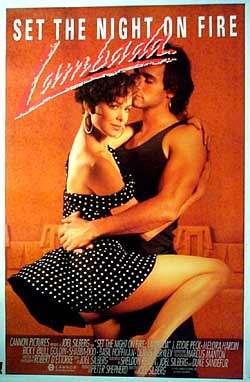
Then there’s the whole quiz idea. Here’s some problems I have with that. First, one reason this film probably lost money, you’d think, if that most prospective audience members might not have wanted to see a Lambada movie that ends with a Math-Off. In fact, there’s very little Lambada stuff in the entire second half of the film. Which, when you think about it, is kind of weird for a film entitled Lambada. Look at the poster art at the beginning of this review. Not a protractor in sight. Second, Leland decides it would only be fair to have the GH kids square off against those they were fighting with. In other words, they’re going against Dean and the rest of the school jocks. Throughout the movie, these guys have been played as morons. It took three of them and a computer to determine that a telephone pole stands at a 90º angle to the street. The test, meanwhile, covers advanced calculus and trig and the like. This means the Galaxy High kids should mop the floor with them. I mean, according to the answers they give (although always in street vernacular, so we know they’re still ‘real’) these kids are now flat-out math prodigies. Instead, for the sake of ‘suspense,’ the contest will remain close throughout and eventually come down to one last question. This is so stupid on the face of it that we only actually see one of the jocks answer a question. And this is after he cheated by distracting his opponent, so I think we’re meant to be musing on that rather than on him answering correctly. Otherwise the jocks always answer off-camera, and only the changing scoreboard keeps us apprised of how the contest is going. Presumably they hoped that we wouldn’t notice the unlikely change in the jocks’ intellects if we don’t actually see them being smart all of the sudden. Yet suddenly the jocks are ahead 5 to 3. In an attempt to explain this, Laird at one point jumps up to complain. "How do you expect these kids to know Beverly Hill geography?" he seethes. See, the answer demanded that you know the local streets around the school. The idea that Leland would allow this question is just beyond stupid, but it’s necessary to justify a come from behind win by the GH bunch. Oh, and one of the jocks provokes his opponent into pushing him, so the jocks pick up a default point. Man, this is crude scripting. Another funny pedantic touch is that Singleton, the Uncaring Education Figure, never knows if the kids’ answers are right or not. (So why is he the judge? For that matter, he’s a partisan in the contest, so he shouldn’t be officiating anyway.) This despite the fact that the cards he’s reading the questions off would, presumably, have the correct responses. In fact, at one point he even reads the question wrong, and has to be corrected by Pink Toes on his math terms. All this is in contrast to Superintendent Leland. As the Caring Education Figure, he always follows the kids’ convoluted answers and knows off the top of his head when they’re right. I don’t know how many School Superintendents in the country could do the same, but I’d bet it’s not many. Oh, and we keep cutting outside to where some homies are setting up their DJ equipment in the parking lot. To allow for a post-triumph (oops, sorry) dance thing, you know. In the end *gasp* the last two participants, going for the win, are Dean and Ramone. Since Dean again has been a total meathead throughout the entire film, the only ‘question’ is whether Ramone will overcome his sense of low self-esteem to give the correct answer. This just happens to turn on the Rectangular Coordinate System. Laird manages to remind Ramone about the system by pulling an eight ball out of his attaché case and flashing it at him. Don’t ask why Laird has this object in his bag. It was (sorta) established, but in a really, really dumb way. For that matter, why would he have brought his attaché case to a Math-Off? In any case, Laird’s use of this comes dangerously close to constituting cheating, although he’s the hero so I guess it’s OK. In the end, Peace & Justice triumph. (Duh.) Singleton tries to disallow Ramone’s answer, but Leland overrides him. Then the jocks cheer their opponents and Laird, a note of grace that pretty much comes out of nowhere. Laird gives a speech revealing his racial background, the death of his parents (they died when he was fourteen – again, I can’t imagine him changing his name after reaching that age), etc. For what it’s worth, the speech isn’t that bad, at least when compared to, say, Steven Seagal’s closing lecture in On Deadly Ground. After all, it’s hard to find fault with someone expounding on the benefits of an education. The fact that the audience remains mesmerized during this is a bit much, but to be expected. The moment where Ramone and Dean shake hands and then hug (!), though, really pushes the envelope. The DJ Guy runs in, yelling "Let’s Party!" Both groups of kids run outside in the pouring rain for a very sub-Fame dance number, as we hear the "Set the Night on Fire/Lambada" song for like the tenth time. (Luckily—or not so, depending on one’s perspective—all the electrical equipment fails to electrocute anyone.) Then the end credits start, as we see where Education has taken the GH kids. Ramone is something like a stockbroker. Book is a lab technician. Pink Toes is a fashion designer. (!) Ricochet has become a teacher. That sort of thing. Normally, at this point I say, "Yay, I’m done." Here I’ve a whole other movie to review. Stupid twin Lambada movies.
The Forbidden Dance
It’s hard to believe the stolid Lambada did better in theaters than this flick. Yes, it’s the better film, at least in the conventional sense. (For what that’s worth.) Still, if you were the sort of person who would run out to a theater to see a Lambada movie, and were inexplicably offered two different such films on the exact same day, wouldn’t you choose the one that’s just plain flat-out nuts? You’d think so. For the Jabootuist particularly, Forbidden Dance has it hands down over Lambada. Which, as the above review might indicate, is saying something. First, Forbidden Dance is far more inane. Miles and miles so. Second, it sports a bit of a cast. Perennial B-movie heavy Sid Haig is on hand, and in a rare good guy role. Also lending the movie his talents is Richard Lynch, perhaps the premiere crap movie villain of the ‘80s. Now, that’s a cast already. Yet others are worth a mention. Co-star Miranda Garrison isn’t really a "name." Still, she appeared as an actress/dancer not only in The Forbidden Dance, but in Xanadu, Dirty Dancing and Salsa. In the latter, in fact, she received fourth billing as ‘Luna.’ Here she plays the role of Mickey, another of her more prominent parts. Her real career, however, was as a choreographer on over thirty movies. The film’s male lead, Jeff James, was primarily a hardcore porn actor. His résumé included such titles as Young Buns 2, Grandma Does Dallas and Anal Storm. Oddly, Forbidden Dance appears to be his only mainstream picture. (Although that becomes more believable after you’ve seen his performance here.) I can think of various scenarios to explain how he got the lead in his only non-porn film. I just don’t want to. Our female lead, meanwhile, is Laura Herring, aka Laura Elena Harring. Ms. Herring, for what it’s worth, is indeed a very beautiful woman. She’s gone on to have a fairly successful acting career, as well. Recently she had a famous lesbian scene with Naomi Watts in David Lynch’s Mulholland Dr. That alone should have her image bouncing around the Internet for decades to come. She also has a role in the upcoming Willard remake. Finally, one must never discount the presence of auteur Greydon Clark. Mr. Clark has appeared on these pages in many guises: Actor. Producer. Writer. Most prominent, though, are his contributions as a director. Mr. Clark’s various artistic attributes can be enjoyed in such Jabootu subjects as Dracula vs. Frankenstein, Final Justice and, especially, The Uninvited. While his name enjoys less cachet in bad movie circles than fellow hyphenates such as T. V. Mikels or Al Adamson, I firmly believe his day is coming. Few directors of the last thirty years can stack their work against his. Our film opens on a black card:
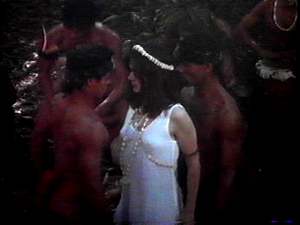
We cut to a helicopter (and undoubtedly stock) foot of said jungle. A huge plume of smoke indicates a section being burned out. Native-style drums and flutes are heard to further establish the milieu. We cut to a, er, native dance. Wow, this was made in 1990 and not 1950, right? Because even Kipling would be… Anyway, a credit promises that the film will be"Featuring KAMAO’S HIT SONG LAMBADA!" Also, we’re alerted that it’s "Starring KID CREOLE AND THE COCONUTS". Well, that’s good enough for me. The focus of the, er, ceremony seems to be Nisa (Laura Herring), the extremely hot Village Princess. One dancer is covered with moss, because, you know, Nature and stuff. It’s symbolic. Joa (Sid Haig), the village Medicine Man, sternly watches over all this. The dancers leap in the air and do gymnastic maneuvers and…seriously, though. This was made in 1990? Really? Huh. And hey, less than two minutes in and Joa’s already employing the Whooshing Powder. Truly, they are wise in the ways of their ancestors. In a moment fraught with anthropological import, Nisa starts dancing sexily between two studly villagers. It’s apparent that the Lambada is an ancient fertility rite, performed by South American tribes for centuries. The figures writhe, almost as it…wait! They…their dance seems to be summoning some malevolent eldritch force…I see a dark, behorned figure materializing in the…oh. It’s you, Jabootu. I should have known.
After much simulated sex, er, Lambada dancing, we move on. Everyone looks on Nisa with apparent sorrow. She eats a ceremonial pear. Then a tribesman, carrying a spear (!), comes running into the clearing. The tribal King speaks, but is interrupted when Evil Unnatural Vehicles appear and smash up their Eden-like homes. The dust clears and a White Man – and since he’s played by Richard Lynch, I really mean a white man -- steps forward. He introduces himself as Benjamin Maxwell, and *gasp* he represents the Petramco Corporation. Maxwell offers up a piece of paper that supposedly gives the company ownership of the land thereabouts. Of course, Nisa’s tribe is One With Nature and so on and so doesn’t grok the White Man’s idea of, like, you know, owning stuff. To signify this, the King spits on the paper. Unfortunately, spitting on all the shotguns Maxwell’s men have brought along might prove more problematic. To get this point across, one of the men fires his boom-stick into the air. The villagers are startled by this White Man’s Magic. Save for Nisa, who screams "Stop!" Maxwell is surprised to learn that she speaks English. "Father sent me to the missionaries to learn about the White Man," she explains. Yes. Yes, I guess that really does clear things up. Maxwell tells her to inform the villagers to get on the trucks so they can be relocated. Oh, did I mention that all this is EEE-vil? Because I wouldn’t want you to miss that part. Instead, the tribe members all trot off on foot. A confused Maxwell asks where they are going. "Deep in the forest, to the river," Nisa replies. He laughs derisively. "Well, sooner or later the flames will find them," he snorts. So…Petramco’s planning to burn down pretty much the entire rain forest? That’d be quite a task. Perhaps they intend to build the world’s largest oil platform, but one that will explode the moment they start…no. No, that would be stupid. Having chased off the Noble Native People, Maxwell takes his leave. First, though, he swings away with the Message Hammer, just in case somebody in the audience doesn’t "get" which side he’s on. "It’s a shame to clear this jungle," he opines regretfully. "It’s so pretty. But Business is Business." Why, that Maxwell fellow in naught but a cad! As well as an imperialist running dog and a tool of Capitalistic Oppression! Boo, sir! I say boo to you! Then, in a moment worthy of such great political iconographers as Leni Riefenstahl and Sergei Eisenstein, Maxwell’s men drive through the now deserted village. As they do, they run over a freshly planted sapling, bending it down and stripping it of bark. Director Clark’s canny employment of slow motion to capture this indelible, powerfully symbolic image serves to make the resultant tableau all the more compelling. A tearful Nisa runs forward to embrace the sapling’s shattered remains, themselves a crushingly tragic representation of all her people has lost in the White Man’s insane pursuit of the Demon Oil. In the end, only Joa, Nisa and her father the King remain. She pleads with him, begging permission to embark on the one mission that may yet save their Native Lands. Only she among their people has the requisite knowledge of the White Man’s ways and language to win others to their cause. Though the King would save his only child from this course if he could, in the end, he must relent. He instructs Joa to act as her protector in the Foreign Climes of the White Man. A quick plane trip later—let’s just pass over such as issues as buying tickets or passports or anything of that nature—and the pair arrive in Los Angeles. They grab a cab over to Petramco’s corporate headquarters. By the way, how many gigantic corporations staff their front desks with security guards instead of secretaries? Just wondering. Wandering inside, they attract the attention of a guard who notices their bewildered glances, strange clothes and unusual amount of melanin. Nisa, an Innocent Earth Child from a pure and no doubt classless society—albeit the kind of classless society with princesses and Kings--asks to see the company’s CEO. The guard identifies this worthy to be one Mr. Gaines. We’ll see him for a few moments later on, but he really doesn’t have much to do with our film. Nisa is surprised and angered to be told she can’t just walk in whenever she feels like it and see the company’s chief executive. She hotly demands to be allowed access to him. In a way, she’s like a hotter and less obnoxious Michael Moore. Of course, any other Michael Moore would almost by defination have to be hotter and less obnoxious. So never mind. The guard evinces cynical amusement at Nisa’s simple ways, thus revealing his own spiritual corruption in the face of her pure spirit. Ascertaining that they do not, in fact, have an appointment, the guard explains he’ll have to escort them from the building. (The bastard!) However, as he begins to scoop up the totems Joa has spread on the floor, he’s overcome with paralysis. That’s right, the film is actually assigning Joa magical powers. Why, he can incapacitate a man through magical paraphernalia alone! A White Man couldn’t do that. He’d have to use a taser or some pepper spray or something. Another guard, seeing the commotion, draws his weapon and approaches. As well, two cops are shown entering the lobby. As the three watch Joa blow some sort of powder on the guard to revive him, they somehow don’t notice Nisa making her way up to the executive area. However, Nisa is blocked when she meets Maxwell coming down the stairway. He turns her over to the cops. Joa reacts by waving a feather, one that causes sparks to erupt wherever he points it. This allows Nisa to escape, although Joa is taken into custody. What’s he being charged with, anyway? Illegal possession of a Sparking Feather? Man, if he gets caught holding an ounce of Whooshing Powder we’re talking a mandatory three to five year. Nisa sleeps in a municipal park that night. (She’s apparently the only vagrant in Los Angeles, since no other squatters are in sight.) As dawn rises, a Hispanic woman comes along and sees her. Since this is Los Angeles and the woman isn’t Jennifer Lopez or Salma Hayek, that means she must be a maid. And so she is. This is a stroke of luck for Nisa, of course. After all, she could have been found by a White Person, who as part of the System would have immediately begun oppressing her and stuff. In contrast, members of your discrete insular minorities, especially those forced to make their living as servants for the White Man, quite obviously are inherently more compassionate. If we learn anything from this film, let it be that. The woman stops and introduces herself as Carmen. Learning the that police have Nisa’s papers—again, I don’t want to be pedantic, but these would have to include a passport, right?—Carmen advices that only one thing can save her now. "Dinero," she explains, rubbing her thumb along the tips of her fingers. Thus we know that Carmen follows the way of most foreigners in American movies, who speak English 98% of the time but also toss in a recognizable foreign word here and there. Luckily, Carmen thinks she can get Nisa a job. What a stroke of luck for Our Heroine that this woman just happened to come along! Being an Honest Soul, Nisa exclaims that she’d be glad to work. Then a cut reveals that her new job is—three guesses—being a maid. Now, I "get" that the film is trying to show us something here. See, in her land Nisa is royalty. (Although not, heaven forefend, the sort of bossy royalty that tells other people what to do.) Here, though, just because she’s not Anglo, she’s reduced to working as a domestic. Oh, the humanity. Still, I’m sure the people who made this film know what they’re talking about. After all, they live in L.A. When they go to other people’s homes, you know, people who aren’t in show business, they undoubtedly have seen how those people exploit illegal aliens by given them menial jobs. I mean, nobody in Hollywood would do such a thing. Let’s just be quite clear and upfront about that. They have too much social consciousness and are very progressive and caring. Still, L.A. unfortunately has lots of rich people who aren’t in show business. Those being the sorts of folks the movie so bravely exposes. Mrs. Anderson, the mistress of the estate, shows Nisa about while explaining her duties with unthinking condensation. To be totally fair, this stuff really isn’t entirely bad. In the end it does manage to make its point, albeit in a more than slightly ham-fisted manner. Still, you get the idea that they cribbed a lot of this from El Norte, an acclaimed 1983 independent film about illegal aliens making their way in Los Angeles. That film is the template for a lot of this one, in the same way Stand and Deliver was for Lambaba. Sadly, El Norte, a vastly superior film to either of these, is not currently available on home video or DVD. What’s up with that? Mrs. Anderson opens the door of her son Jason’s room. He is, we gather, a bit of a ne’er-do-well. We seem him sprawled across his bed, clad only in his underwear. Mom notes with exasperation that it’s three in the afternoon and orders him to get up. She then sardonically informs Nisa that he’s probably been out "dancing all night." Hmm. Dancing, eh? I wonder where this could be going. We cut to a holding cell. The inhabitants are Joa, three Hispanics dudes, two black guys and a token white bum. This provides further evidence that minorities have it bad in America, thus blowing the minds of any white squares who might be watching the film. One fellow tries to steal the meditating Joa’s apple from his lunch tray. However, Joa is One with his food and grabs the guy’s wrist. Then, in a display of common humanity not often seen on these shores, Joa smiles knowingly and gives the guy all his food. This is a powerful moment, reminding us about how non-white people often share stuff. Back in the Manor, Nisa is preparing to bunk down for the night. No White Man’s artificial lighting for her, however. She instead uses candles. OK, maybe that’s artificial lighting too. But not necessarily the white man’s. She shrugs off her uniform, revealing her semi-transparent little white native dress. This pretty much is just a slip, and it provides us with a good gander at her perky nipples. As Latin-style music plays, she breaks out the stuff she brought from home. She anoints herself with some sort of oil or lotion. This, I’m assuming, has an intoxicating effect. Either that or it’s just her Oneness with Nature and stuff. She runs beads over her body while arching her back and performing other purportedly erotic activities. This seems a good spot to pause and raise a question: Would either of the Lambada films have done better were they, well, harder. I mean, the whole status of the Lambada as more or less simulated intercourse—did you know the dance was so dirty it was outlawed in Brazil?—is such that maybe folks who’d want to see a Lambada movie would expect some actual sexual content and/or nudity. You know, a film about dirty dancing that was actually dirty. Instead, both pictures follow the path forged by the earlier Cannon dance films. Therefore, the erotic content is downplayed to the extent that each movie earned a PG-13. Now, I’m not arguing outright that either flick would have made more money had they gone for an R rating. Yet watching a film strain to be as "erotic" as possible without really showing anything that’s much erotic is a bit comical. Not that you need to be explicit to be erotic. Still, if that’s that route you’re taking, you probably want a more imaginative director than Greydon Clark. Cut to meet Dad in the kitchen. He talks to Mom so that they can exchange the sort of casually bigoted comments you’d expect. "I hope she takes a bath once in a while," he exclaims upon hearing of the new maid. Then Jason runs briefly through, explaining that he’s going out dancing. I was amused by the fact that Jason, despite supposedly being maybe in his early twenties, already sports a patently receding hairline. You can comb it forward all you want, dude, but you aren’t fooling anyone. Back to Nisa’s room, where Our Heroine is still writhing around and running her hands over her body and such like that. That girl really needs to get herself a boyfriend. During all this Jason walks by—he apparently lives in the sort of mansion where one must walk past the servant’s quarters to reach the garage—and of course Nisa has left her door ajar. He stops to take a peek, as you’d imagine he would. By this time Nisa has become so enflamed that she’s grabbed the room’s curtains and begun to rub them across her body as she sways to the music on the soundtrack. Then she collapses on the bed. Hearing a noise, she looks up to see Jason spying on her. She gives him a little smile (!), while he withdraws, flustered at being caught. Presumably this is all meant to indicate how uptight white people are about sex, as opposed to members of discrete insular minorities, who being closer to Nature are earthier and less repressed and stuff. Jason just then gets a phone call from his girlfriend Ashley. They’re supposed to get together that night to, what else, go dancing. She’s breaking the date, though. Jason, being a bit of a wanker, pouts at having his plans go awry. Still, he heads over to the Creation Club, an apparent rich kid hangout. The camera makes sure to focus on a poster announcing an appearance by, hey, Kid Creole and the Coconuts. You can never milk an act like that too much. (Get it? "Milk"? "Coconuts"? Damn, I’m funny.) Since this film was made by people whose mindsets are trapped in the ‘80s, the club is festooned with neon signage. To our *cough, cough* amazement, Jason has brought Nisa in Ashley’s stead. "You look great," he exclaims. "Mom would die if she saw how you look in her dress." Actually, she’d probably die when she saw that someone shrunk the dress down about five sizes so that it would perfectly fit our petite heroine. Jason and Nisa hook up with a pair of his friends, Dave* and Trish. The latter asks where Ashley is, and Jason explains she blew him off. "Aren’t you’re going to dance with Ashley at the Kid Creole audition?" a shocked Trish replies. Jason remains noncommittal. It’s pretty clear—and when something is made clear in a Greydon Clark movies, it’s made clear—that Trish isn’t thrilled to see Jason out with someone other than her friend. [*Proof that you can survive this sort of thing, actor Kenny Johnson, who played Dave, can currently be seen in the role of Curtis "Lemonhead" Lemansky on the critically acclaimed cop show The Shield.] Let’s pause and examine another point. How old are these characters supposed to be? Clearly they’re not teenagers. Yet they all seem to hunger to get on this Kid Creole dance show, sort of a hipper Soul Train sort of thing. Given this, and their jobless, party hearty lifestyles, presumably these characters are meant to be in their early twenties. Perhaps it’s just meant to portray the ravages of their iniquitous way of live, but the actors playing Jason, Dave and Trish all seem to be well into their thirties. I’ve noted already Jason’s apparent receding hairline. In any case, it’s hard to get past. Dave, being a fellow hound, is less judgmental about Jason’s new arm candy. The latter introduces Nisa as being a prospective lawyer, because, you know, the maid thing is so gauche. "This is my song," Jason notes, as a truly generic piece of pop plays on the soundtrack. He and Nisa hit the dance floor. They don’t want us to forget that Racism is one of the issues the film raises. So Trish asks Dave, "When did Jason start dating wetbacks?" Probably when he saw one that looked like a supermodel, you’d think. (By the way, the actors playing Trish and Dave are both horrendously bad.) I find it unlikely that in a city as multicultural as Los Angeles, hip party dudes only date other whites. Perhaps I’m mistaken. I thought Lambada has some bad white people’s dancing, but I had no idea. You should see the people they have on the dance floor in this thing. Have you ever seen the San Diego Chicken come out between innings and funk dance? This isn’t that good. Given the film’s budget, they probably just pulled in people who wanted to be in a movie without asking to be paid, but wow! The DJs put on a new song, one that drives all the dancers from the floor. So why would they play it? So that Nisa can react by saying "I like this," as opposed to the music the white kids liked. See, as an ethnic character she’s more in touch with what good music is. For instance, to me this song sounds fully as lame as the one they just played. So that proves it. Jason, being an unfunky white dude—and no argument there—replies that it’s Lambada music. (Albeit a particularly sedate piece of Lambada music.) "It’s all the rage in Europe," he dismisses. Nisa wants to dance, but he notes that it’s "more East LA than Beverly Hills." Which does, in fact, match the geography of Lambada, since East LA was where the No Man’s Land club was. It’s actually kind of fun to muse on both the films taking place in the same city at the same time. Or maybe it’s just more fun than actually watching them. By the way, although Jason needs to identify what Lambada music is here, later it will be Nisa who gives him a rundown on its history in Brazil. Just for the record. Jason finally accedes to dance because, after all, Nisa is really hot. Still, he’s obviously nervous to be the only guy on the dance floor. (If the club were to introduce a completely new style of music, wouldn’t they have shills out on the dance floor so that it wouldn’t be empty?) Moreover, Nisa has to take over to show him how to dance in a slightly less awkward style. By which I mean she instructs him on how to bend his joints and waist and even sway back and forth. Jason is flummoxed by these bold new concepts, but strangely excited. And so they dance. We get a pretty good look at this. They are, after all, the only ones on the dance floor. It turns out Nisa, or rather Laura Herring, isn’t a very good dancer, either. Still, compared to the clods we saw earlier she’s Cid Charisse. And when the dance quickly progresses to the hip friction stuff, Jason becomes suddenly more appreciative of East LA dance. Then, when the other guys see that dancing can involve crotch-grinding, they all grab their dates and run back onto the dance floor. Why, yes, this is better than the Robot! Meanwhile, Nisa is dropping elliptical hints about her background. "This world seems so far away from the world of my problems," she notes, looking around. Oh, yeah, that "saving the rain forest thing." Right. Well, plenty of time for that later, I suppose. Actually, I’m impressed at how well Nisa is adapting to life in the U.S. After all, she grew up in a thatched hut with a native tribe right out of a 1950s National Geographic photo spread. Nisa is just about to bare her soul to Jason when Ashley shows up. After all, there’s well over an hour of movie left. So they can’t very well have Jason and Nisa get together already. Ashley seems to have thrown herself together quickly, presumably after getting a call from Trish. (Although the timing of the scene makes this more or less impossible.) "So," she smirks at Nisa, "when did they start letting your kind into the club?" Again, how many dance clubs in Los Angeles exclude Hispanics? Is this really a problem out there? I mean, that’s a pretty major portion of the city’s population. By the way, we’re all supposed to be responding, "Oh, yeah, you stuck-up bitch, well, Nisa’s a princess." Well, yeah, but a princess of a teeny tribe of Brazilian Indians who live in thatch huts. I’m not sure that’s the sort of ‘royalty’ that would blow the socks off the local social elite. The woman playing Ashley, by the way, isn’t skewing the acting curve too much. In fact, she sort of comes off like a less subtle and talented Shelly Long, if you can imagine what that’s like. Anyway, she reacts less than stoically when Jason begins to leave with Nisa. This results in Nisa’s borrowed dress getting ripped, an obvious plot device since the dress actually belongs to Jason’s mother. In fact, Jason’s parents are already waiting up for him. Mom in particular means to have a talk about how he’s wasting his life by going out dancing all night. Which again raises the issue of how old Jason is supposed to be. If he’s in his teens, then his being out until two in the morning (for so the time is identified) is a legitimate topic of parental concern. This might even be true if he’s of college age and just mooching off of them. Again, though, let’s say he’s in his mid-20s. Which, given the physical appearance of both him and his contemporaries, is a bit generous. Still, we’ll go that far. Then the issue isn’t that he’s out until *gasp* two in the morning, it’s that they haven’t booted him out of the house yet and made him go support himself. By the way, they were at the club for one dance, and now it’s two o’clock? When did they leave in the first place? Meanwhile, Jason is still outside yakking with Nisa. "Why do they call it the forbidden dance?" he asks. This sets up the obligatory mention of its legal status in Brazil. "Fifty years ago," she explains, "the government of Brazil forbid it because it was too sexy." By the way, did she learn this in her deep-forest native tribe, or from the English-speaking missionaries she hung out with? This just seems a strange bit of trivia for someone from her background to have come across. Or are that my Patriarchal, Imperialist mindset talking? They step inside. Mom’s black mood—Dad is rather more laissez faire—isn’t helped when:
These circumstances get Dad’s ire up too. Nisa is sent off while Jason is given his talking to. I was imagining something along the lines of, "For Heaven’s sake, Jason, you’re thirty-five years old. Move out and get a job already." Instead, we get more of his parents’ offhand racism. For instance, Mom complains that Nisa’s perspiration soaking into the fabric will have ruined the dress. I suppose these attitudes are not unknown in the rich enclaves of Los Angeles—or Hollywood, for that matter—but they still seem oddly harsh. This might be because the rest of the film is so damn goofy that these sudden shifts in tone really throw you. Nisa can hear all this from her bedroom. Again, this house, which is huge in the exterior shots, must have the weirdest layout. Why would the servant’s quarters be anywhere near the front parlor? I’d also like to note that they’re putting the worse possible face on Jason’s parents. Their objections to his dating the help are portrayed purely as racist. Yet there’s a reason the upper classes frowned on this sort of thing, and it’s not just because the servant class was considered socially unsuitable. (Although that was obviously a large part of it.) The fact is, if you’re going to talk about your inherently uneven balances of power, a guy ‘dating’ a servant is perhaps the classic scenario. Also, Jason being threatened with being kicked out of their house might draw more of our sympathy if he didn’t appear to be an over-aged lay-about. If he wants to go out every night and dance, he should probably start supporting himself first and earn the privilege. Here’s an idea: Jason might be their son, but that doesn’t mean he has an automatic moral claim to the fruits of their labors. This is portrayed as being mean, but it’s just common sense. Why should they keep supporting him if he’s just going to sleep all day and party all night? So let’s be clear: I have no problem with the presentation of Jason’s parents as grossly unpleasant and forthrightly racist people. There are plenty of folks like that in the world. However, that doesn’t make them wrong about Jason, either. There’s no reason for us to root for Jason that I can see. Instead, the film’s strategy seems to be to put him opposite more overtly unattractive characters, thus making him seem better than he objectively is. Which is, frankly, just sloppy scripting. Nisa’s attraction to Jason seems forced, as well. In a movie made twenty or thirty years earlier, maybe a poor native girl hooking herself a rich Anglo would have been considered a Cinderella story. However, by the time this was made, Nisa’s "People of the Land" status made her the more attractive catch. This means that, rather than justifying Jason’s attraction to her, the film has to establish the opposite. In other words, Jason needs to go through the sort of Moral Awakening that Sandy did in Lambada. In fact, Jason is really a merging of the Sandy and Dean characters from that movie. (The fact that both films employ a lazy shorthand of "good minorities vs. mean Anglos" is indicative of screenwriting by the numbers.) The instrument of Jason’s reformation into a Serious Person, ludicrously, seems like it will be through his purported Love of Dance. During the aforementioned argument he blurts, "I dance. I like it, and I’m good at it!" Well, first of all, he’s not that good at it. Second, we haven’t yet gotten any real indication that he’s serious about dancing. Is he planning to make a living from it somehow? If so, you’d think he’d be a sizeable disadvantage to all those with similar dreams who are half his age and been training since childhood. When Jason goes to retrieve the dress, he finds that Nisa has left. We cut to her strolling the streets of some bad part of the city, primarily marked by neon signs proclaiming various wares of a sexual nature. Apparently this stretch abuts the Beverly Hills mansion Our Heroine just left on foot. We watch as she meanders past a veritable Parade of the Damned, teaching us…well, something. Life is Mean, I guess. Or, Behold the Plight of the Urban Poor in Amerikkka. Something like that, anyway. Eventually, Nisa comes across the Xtasy Club. This sports a sign offering to hire dancers. Inside we witness the sort of erotic dancing you can show in a PG-13 film. This includes a woman doing a tribute act to Madonna, highlighting her black bustier period. Luckily, the act involves imitating Madonna’s mediocre dancing skills rather than her hideous acting abilities.
We meet the club’s cashier, or something, a black dude of the "Lord have mercy!" persuasion. Here the camera shows us the entire "club," It’s just a smallish set with a couple of stages in it. Since there are more "dancers" than customers, I’m not sure how they stay in business. Still, way to go, Bud Light Product Placement department! Nisa is greeted by Mickey, a buxom woman of A Certain Age. She’s the manager, and proves quite happy to hire on a tasty Latin number. Of course Our Heroine, being pure in spirit, has no idea what her duties here will entail. Moreover, we quickly learn that Mickey is not to be trusted. For instance, she offers Nisa the vast sum of ten dollars a night for her services. It’s ironic. In her land, she was a Princess. Here…oh, wait, we already went over all that. Mickey takes Nisa upstairs. There they walk past rooms where, er, private sessions are taking place. You know, given the available evidence I’d have thought lap dancing places make a pretty good amount of dough. So wouldn’t running an onsite brothel would be inordinately risky? Also, for a place on skid row, more or less, the club sure boasts a fine selection of attractive and healthy looking young woman. Nisa gets groped by a sleazy customer. Mickey warns him off. Nisa’s "fresh" status makes her a higher ticket item than this guy can afford. He continues anyway, whereupon Mickey reaches into her cleavage and pulls out an absurdly large switchblade knife. By this time, Nisa is probably rethinking her employment plans. There’s a weird and ominous lesbian vibe coming from Mickey as she orders Nisa to put on a slinky red dress she’s provided. Any undressing, though, occurs off-camera. Again, why did they include all this sleazy material in a film they knew they wanted a PG-13 rating for? Also, why is Nisa suddenly so compliant? Is she really afraid that Mickey’s going to kill her if she just walks out? My point being, this element would make more sense if Nisa didn’t catch on to the nature of the club until she was more firmly ensconced there. Cut to Petramco headquarters. Oh, yeah! The whole "rain forest" thing! For some reason, they keep dressing Maxwell in Western attire. Here it’s a ten gallon hat and a bolo tie. I guess it’s because he’s an oilman—thanks for another lame stereotype—but humorously enough actor Lynch doesn’t even try to affect a Southern accent. (Actually, if you heard his "Cajun" accent in Alligator II: The Mutation, you’d know why.) Nor is "Maxwell" a particularly Texan name. This proves a pretty short scene. Basically, Maxwell’s Eee-vil Boss warns him that there better be no problems with the Brazilian Situation. And that’s it. This actually takes place out in front of the building, next to a limo. I think they cut this in here just so we don’t forget what the movie’s supposed to be about. Which probably isn’t a bad idea, although actually sticking to the plot might have been an even better one. Cut to three of Jason’s nitwit friends, including Dave, out slumming in the city, looking to get laid. (I found the idea that their girlfriends go dancing with them but won’t put out a little unlikely, especially given their ages.) Of course, this means they quickly find themselves in front of Xtasy. Here we see that Nisa has already become the club’s star. By which I mean, there’s a poster outside featuring her in a red dress and referring to her as the Queen of the Jungle. Which I guess is demeaning, as opposed to referring to her a Jungle Princess. "Hey, that’s Jason’s beaner!" one fellow charmingly notes. You know, I’m beginning to think some of Jason’s associates and family members are racists. This stuff just keeps throwing me. I sorry, but a hard hitting exposé of American racial problems, this film ain’t. Talk about dressing a hog in a wedding gown. Dudes, you’re trying to add sociological weight to a film about a Brazilian jungle princess who comes to America to save the rain forest by winning a TV Lambada contest. At least the makers of Lambada were smart enough to sprinkle some lighthearted scenes into their piffle of a movie. In contrast, this picture is so relentlessly grim that, coupled with its outrageously ludicrous plot, it comes off as literally insane. It’s like somebody made a film after reading Oscar Bait for Dummies. We cut inside. Oddly, all the dancers we saw earlier are in the exact same spots doing the exact same dances. Nisa is on the floor, dancing with three different businessmen-from-Akron types at one time. I guess this is an indication of how business has picked up since her arrival. Oh, and the black dude’s wearing a suit, too, so I guess the money is rolling in. Again, it’s hard for me to believe Nisa’s putting up with all this. Still, her degradation is important for the film’s Social Message, or one of them, anyway. The three stooges come in. Black Dude demands a ten dollar cover charge. Wow, no wonder everyone looks so flush. The club must make a hundred or two each night in that manner alone. They watch Nisa dance with the guys, moving from one to the other whenever they get too grabby. David and his compatriots move onto the dance floor and muscle the businessmen off. (Somehow I doubt Mickey would allow that sort of thing, it’s bad for business.) Nisa, naturally, is disconcerted to see friends of Jason’s here. Nor does it help when they start manhandling her. David’s not about to take no for an answer, moreoever, despite Nisa’s cries. Even his buddies are freaked out a bit. In the end, Nisa takes care of the situation by showing him a dance move from the Nutcracker Suite, if you know what I mean. Mickey steps in. She sends Nisa off to collect herself, and offers Dave and his remaining pal—the other split in disgust—a selection of the sort of hookers you only see in the movies. (Or in places a lot more high end than this, anyway.) She does promise him, though, that next time Nisa will be "ready." Cut to the police station. Two uniform cops are leaving with Joa. They’re to take him to the airport to be deported back to Brazil. In case we’re wondering, they establish that they have his "passport and papers." Although that still leaves us wondering how a guy from the deep jungle, with no official paper existence, would have gotten a passport in the first place. Joa’s mystical powers come to the rescue. A weird sound like an animal’s roar draws off one of the officers. The other handcuffs Joa to a rail and joins his partner. When they return, of course, their prisoner is gone. By the way, I don’t think L.A. beat cops ever carried military issue Colt .45 semi-automatics. Ashley finds a dejected looking Jason hanging out at the Creation Club. She’s come to make up with him, but more so to finalize plans for their audition for the Kid Creole show. "I mean, think about it!" she exclaims. "A spot on national television! Isn’t that intense!" Ah, yes, well does my generation remember the massively popular Kid Creole variety specials. Or, uh, dance program or whatever it was. I like to think they or it marked each and every one of us. Still, the idea that the show is this gigantic platform is essential to the movie’s lunatic plot, so we might as well go with it. Ashley really goes out of her way to humble herself here. In reply, Jason sneers and generally responds to her with surly contempt. Again, why are we supposed to be rooting for this character? I understand that, you know, he’s a changed person now and can’t be with Ashley anymore. On the other hand, if we’re supposed to hope he and Nisa get back together, shouldn’t he be less of a prick? Eventually he does deign to talk to her. Ashley refers to his "fling with a street girl." When he gets angry at this characterization, she scornfully tells him about how Nisa is working in a brothel. Frankly, these two losers deserve each other. He stalks off to investigate, leaving an enraged Ashley frothing at the mouth. The next day (I’m assuming, it’s bright daylight out), Jason arrives at the club. He’s told the place is closed until that night, but his gold Visa card gets him in. Nisa is called down and is, naturally, shocked to find Jason. She’s angry at him—for what, I’m not entirely sure—but he begs her to dance with him. He promises to help her. "Why now?" she asks. "You didn’t help before." This doesn’t hold up very well. After all, she split in the couple of minutes that he was arguing with his parents. So I’m not sure when she expected him to help earlier. Also, at this point I guess we’re to believe that she’s accepted her fate as a prostitute. If I’m getting this right, and who knows if I am, she did so because she felt deserted by him. Which is even dumber, as she knew him for about two or three total hours before fleeing the house. "I didn’t know you," he whispers. "I didn’t know myself." Well, he didn’t know her, that’s for sure. He’d just met her. He wants to take her out of there. She demurs. "Immigration will send me home, and I cannot go back until I am finished here," she explains. I’m not sure how being held prisoner in a brothel is helping to stop Petramco from despoiling the rain forest, but then I’m not Pure in Spirit. Jason tells her he can protect her (from the INS?), and has money. "You don’t have to sell yourself," he tells her. She flies into a rage, asking what he knows about what you can be forced to do. About time somebody told this punk-ass rich white boy off. Well, besides his parents and ex-girlfriend, that is. They don’t count, after all, because they’re Morally Compromised. Then Nisa tells Jason that he’ll be her "first upstairs." So Mickey’s let her avoid actually sleeping with the customers so far? Whatever. This movie just can’t make up its mind whether it’s a hard-hitting social drama or a cartoonish fairy tale. I’d say the idea that Nisa has remained untainted in a brothel pretty solidly falls into the latter category. Jason begins to pull her out of there. Nisa tells Mickey she’s leaving. Mickey, of course, isn’t about to let that happen. She calls Eddie (that’s the black dude’s name) and he starts whomping on Jason. Mickey, meanwhile, unlimbers her switchblade to threaten Nisa. Could we at least see Mickey paying off some cops or something, because the idea that she’s getting away with all this is moronic. Especially when assaulting rich kids from Beverly Hills. The cavalry arrives in the form of Joa. Don’t ask how he got here, he’s got mystical powers. (And isn’t that convenient for the scriptwriters?) Eddie makes to intervene. Joa tosses him the Paralyzing Pouch, and when Eddie catches it he goes down. Joa then blows the counteracting powder on his hands. Now that Eddie knows Joa has the Mojo, though, he declines to further intercede. Mickey’s switchblade provides a similar lack of utility. Joa mesmerizes her, plucks the knife from her hand, and snaps off the blade by pushing his thumb against it. Either that was a very cheap knife of he’s a very strong dude. Joa fixes up Jason with hoodoo stuff and they heft him over to a table to rest. Now it’s time for Nisa to fill Jason in. Meanwhile, Ashley has arrived looking for Jason. She ducks back outside the door and hears everything. Nisa warns that Petramco "must stop killing the trees, or the Sun will eat the air." Jason is amazed. "You’re talking about the hole in the ozone layer!" he exclaims. Wow, their Oneness With Nature allows them to intuitively understand things it took Western Science thousands of years to learn. Amazing, eh? Well, that’ll teach us for wasting our time appending Latin names to everything. Ashley runs in to reclaim her man, but Jason blows her off. She vows revenge, and I think we can pretty much anticipate that she’ll be going to Petramco with all this. In real life that last sentence wouldn’t even mean anything. In the movies, though, it undoubtedly means that she’ll get through to Maxwell, who will, as all corporations do, decide to murder the person standing in their way. (Although the exact manner in which Nisa is standing in their way is still sort of vague.) Filled with the sudden fervor of a fourteen year-old who’s just read an Earth First! brochure, Jason runs home to lecture his parents on the environment and stuff. When Dad sensibly notes that Petramco apparently has obtained rights to the land, Jason sneers, "Just because a scrap of paper says they own it, does it give them the right to round people up like cattle?" Well…yeah, probably. Assuming the "scrap of paper" was issued by the Brazilian government or whoever legally owned the land. Jason demands that his father use his resources to take Petramco to court. (Uh, here or in Brazil? ‘Cause, you know, that’s where this is happening.) The following exchange results: Dad: "Are you suggesting
that I set up a court hearing, because a servant of mine wants to shut down
one of the world’s largest multinational corporations?" OK, read that over again. Is it even possible the screenwriter meant this movie to be taken seriously? I suspect that the script was written tongue firmly in cheek, only that the supremely unimaginative Greydon Clark didn’t get the joke and filmed it utterly straight. If you have a better theory, I’d like to hear it. After further indications of how wise Nisa and Joa are, Mom yells that she wants these barbarians out of her house. Dad warns Jason that if he goes with them, they’ll cut him off. "Who’s the barbarian, Mom?" Jason replies as they leave. Wow. Really makes you think, huh? With the Rich and Powerful having cast them out, there’s only one recourse: Turn to the Power of the People. And so they end up at Carmen’s house—which proves pretty friggin’ nice for that of an unmarried maid—where they are welcomed with open arms. Wow, rich people are mean and poor people are kind. Isn’t it true?
Man, my eyes are glazing over. Let’s get moving:
-Review by Ken Begg ________________________ Wait!
There's a lot more Cannon fodder
|
||||||||||||||||||
|
|