Another feature of... |
|
Another feature of... |
|
|
for
The Flying Serpent Plot: George Zucco and the Aztec god Q reprise The Devil Bat. Of the cheapie productions Bela Lugosi made for PRC Studios, The Devil Bat remains the most popular. Bela played a seemingly benign and much beloved town doctor. In his spare time, however, he sicced the title beastie on those he thought had wronged him. The mechanism for this involved a shaving lotion whose scent drew the embiggened bat once Bela released it. The movie proved so popular that it eventually warranted a rare PRC sequel, Devil Bat’s Daughter. Oddly, this chapter tried to exonerate Lugosi’s character, despite the fact that his murderous activities were portrayed in elaborate detail in the initial picture. Besides the official follow-up, the Devil Bat’s basic plot was also refurbished for this effort. Which brings us to actor George Zucco. While an unfamiliar name to the non-buff, Zucco was a genuine star of horror genre pictures back in the 1930s and ‘40s. Admittedly, a star rather far down on the totem pole. Basically, you went from Boris Karloff to Bela Lugosi to Lon Chaney, Jr.* to Lionel Atwill to George Zucco. John Carradine might also be fitted in somewhere below Chaney, although he wasn’t yet as associated with the genre as he would come to be. [*Actually, for most of this period Chaney Jr. would rank above Lugosi, at least in a commercial sense. Chaney remained busy in Universal’s comparatively opulent horror films whilst Lugosi languished at Monogram and PRC. In fact, in its efforts to market Chaney as a "One Man Monster Factory," Universal cast him in roles for which he was woefully unsuited, such as the titular Son of Dracula. Chaney also played Kharis the Mummy, The Frankenstein Monster and, of course, Larry Talbot the Wolf Man. During this same period, Bela remained a big cheese only at the mini-studios.] In other words, let’s say you were producing a shoestring horror pic. You want a ‘name’ to draw in the fans, but Atwill is either making another movie or demands a bit too much money. At this point, you’d hire Zucco. Or if the budget allowed – which wasn’t that unusual even for poverty row movies, considering what they were generally paid -- you might hire a Zucco or Carradine to act as a second banana to the (comparatively) high priced Lugosi. A character actor with a naturally menacing air, the British Zucco would appear in up to a dozen films in any one year. He generally would alternate character parts for the major studios with starring roles for the minor ones. By the late ‘30s his villainous turns became more prominent. Highlights would include appearances as Prof. Moriarty opposite Basil Rathbone in The Adventures of Sherlock Holmes (1939) and as a sinister lawyer in the early Bob Hope smash The Cat and the Canary (1940). 1940 also saw his first major role in a straight-out horror film, playing the High Priest in charge of Kharis the Mummy in The Mummy’s Hand. (Fittingly, after playing the character twice, he briefly appeared in the third Kharis film, The Mummy’s Ghost, to turn the tana leaf concession over to successor John Carradine.) By this point, although still appearing in a wide variety of pictures, it was the horror and thriller genres with which he became most associated. In the first half of the ‘40s alone he appeared in The Monster and the Girl, The Mummy’s Tomb, The Mad Monster, The Mad Ghoul, The Black Raven, Dead Men Walk, Voodoo Man, The Mummy’s Ghost, House of Frankenstein and Fog Island. The second half of the decade began with The Flying Serpent. An opening scroll -- a literal one -- informs us of the existence of Aztec ruins near the town of San Juan, New Mexico (!!). These include the remains of a great temple, abandoned by the Aztecs when they migrated south to establish their somewhat better known empire. Eventually, of course, they found themselves faced with Cortez and his conquistadors, who, we’re told, "had inaugurated a campaign of loot [sic] and murder." Therefore the "wiley" [sic] Emperor Montezuma had his "fabulous treasure" brought back north and hidden in the old temple. He then "implored his native gods to guard it. Among these gods was the feathered serpent QUETZALCOATL." This last bit is superimposed over a puppet, er, serpent. I think. The print used for the DVD of this film is presently too dark to let us really see what the beastie is. It has a little horn on its head and it hisses, but that’s about all we’re getting here. Next we see Zucco ‘driving’ a car in front of a rather obvious rear screen projection. He arrives in front of a matte painting, and a surprisingly good one, representing the massive temple. He then makes his way to a secret door, one that leads inside to a hidden chamber. This is where the aforementioned treasure is secreted. Also there is a cage holding Quetzalcoatl. I’m not sure why the Aztecs caged him if he was meant to guard the treasure, but there you go. Again, the image is quite dark. Still, we can see that Q is a rather goofy looking winged marionette, perhaps three feet in length. Not very big for a god, but perhaps he’s secure enough in his omnipotence that he doesn’t feel the need to show off. Zucco goes over and begins ranting to the beastie, which is a pretty convenient way to shoe in some exposition. (The film lasts just under an hour, so this abruptness is a necessity. See also The Mad Monster, where Zucco’s character similarly lectures a bunch of hallucinated [!!] adversaries.) During the course of things, Zucco’s character helpfully drops his own name and even his academic title. This occurs when he gloats that Quetzalcoatl now guards the treasure "for Professor Andrew Forbes." He continues apace. "It was I who found it five years ago. It’s mine, by right of discovery." To protect his ownership of the fortune, Forbes has kept it a secret all this time. What good it does him whilst remaining hidden in a temple, however, eludes me. Further established is that Quetzalcoatl is protective of its plumage, and would kill to retrieve one of its feathers. [The manner in which Forbes came into possession of this information remains a tad murky.] The beast’s feathers, then, will substitute for The Devil Bat’s chiroptera-attracting shaving lotion. Luckily, despite the creature’s homicidal jealously regarding these feathers, it’s always leaving one on the edge of the cage where Forbes can snatch it up. We cut to an article in some National Geographic-esque magazine on "Birds of the Southwest" by a Dr. John Lambert. The man perusing this piece is none other than the author. Soon he’s visited by Mary, a young woman played by an actress more attractive than expressive. Mary notes that the front door was open and so she walked right in. "Why not," Lambert replies. "You’re Andrew Forbes’ daughter!" (Naturalistic dialog is not one of the film’s hallmarks.) After a few more bon mots – "One can’t chase birds and women at the same time, you know," bachelor ornithologist Lambert quips – we learn the reason for her visit. Forbes, she reveals, is furious that the article mentioned the legends of Aztec treasure being hidden at the old ruins. He fears that amateur treasure hunters will appear and interfere with his work. Further exposition reveals that Forbes has never been the same following the death of his wife several years past. (Indeed, this is one of the things that distinguishes the film from The Devil Bat. That film’s villain hid his machinations behind an aggressively avuncular facade. Forbes, on the other hand, is an out and out dickhead.) "Mother’s death was strange and horrible," Mary reveals. I’m assuming Quetzalcoatl killed her then, although whether Forbes set it on her or if her death was an accident remains an open question. Forbes himself arrives to rake Lambert over the coals. "Father, you talk as though Dr. Lambert committed murder!" Mary chastises. "When I want your advice I’ll ask for it!" Forbes sneeringly responds. (??) As Mary apologizes to their host, Forbes stops to drop the Fatal Feather beside a chair before stalking out. Mary sees it and hands it to Lambert, who is astounded by the find. He notes that the plume came from "not a bird, but a creature!" Mary is puzzled by his excitement. "There are only three known specimens in the worlds," he explains, two in museums and one in a private collection. Meanwhile, he mauls the supposedly priceless artifact in his hands, a bit I found a tad dubious. Mary again asks about why he uses the word creature.
Now, that might sound like hooey. Still, it’s significant that both the theory and the facts behind it are, as Lambert confirms, "scientific." (Although I’m not sure why Quetzalcoatl would bother killing three men to reclaim his feathers and then leave them behind!) Lambert continues spinning further theoretical webs. Such a creature, he muses, would likely be a survivor from prehistoric times. Seen by an Aztec priest, it might have been the inspiration for Quetzalcoatl. (The screenwriter really liked this ‘god or prehistoric creature’ angle and it pops up throughout the film.) This all has Mary in a tizzy, since it would explain what it was that killed her mother. Lambert, meanwhile, is determined to find this creature, should it exist. He is, after all, a scientist. Mary goes home and reports the above to Forbes. He’s unnerved to learn that it was she who found the feather. However, she confirms that Lambert ended up with it. Learning that Lambert is out looking for the feather’s owner, Forbes departs. We replay the footage of him arriving at the temple – no use paying for a second matte shot – where he opens a skylight to free Quetzalcoatl from its cage. Oddly, I think stop animation is used during this quick sequence. As Q flies about we finally get a decent look at it. The ‘flying Q’ is a stuffed, rigid model equipped with an interior motor to flap its wings. The prop department took the script literally, and here we see what is basically a thick snake with wings and a horned head. (I think the marionette used in the cage has a somewhat different appearance, but I haven’t gotten a good enough look at it to confirm this.) This flies across the country suspended on a long wire, in the same fashion as such serial heroes as Captain Marvel and the Rocket men. The creature finds Lambert, who having spotted something in the sky has stopped his car and stepped outside. Now clearly seeing the thing, he reaches inside his pocket for the feature, so as to make a comparison. You might think he’d recall his own story about the feathers being found in the hands of dead men, but I guess his scientific curiosity has gotten the better of him. Moreover, when the screeching beast makes its attack, the panicked scientist strangely dives into a bush rather than seeking the protection of his nearby automobile. This proves a less than optimal solution to his problem and he bites the dust. Its murderous mission accomplished, Q returns to its sanctuary. Lambert’s mysterious death draws nationwide press coverage. (Slow news year, I guess.) This makes Forbes look rather foolish. Surely such attention would draw many more thrill seekers and scientists to the area than Lambert’s small blurb in a magazine article about birds of the southwest. Also, his demise would even more likely draw in the amateur treasure hunters Forbes fears, given that it adds a splash of mystery and romance to the whole affair. In any case, Lambert’s article was already published, so I don’t know what good it would do to kill him at this point. Luckily for Forbes, thrill seekers, scientists and treasure hunters fail to take the bait. There isn’t even much press presence, despite the play the story’s getting nationwide. In fact, the only result is that a big city radio station has hired mystery writer Richard Thorpe. He’s to travel to San Juan, investigate the crime and issue daily broadcasts on his progress in solving it. This provides the film with its single most horrific element, which is Jonesy, the ‘comic’ radio technician who comes to San Juan with him. Jonesy is played by bad comic relief veteran Eddie Acuff. His biggest claim to fame was playing the mailman Dagwood always knocked over in the Blondie series. Listening to Thorpe’s musings on supernatural creatures on the radio, Mary shivers. "First thing you know," Forbes says to her, "you’ll be believing in werewolves and devil worshippers." If I’m not mistaken, this might be an in-joke, referring to movies Zucco had previously made for PRC. The Mad Monster had a werewolf in it, while Dead Men Walk featured a murdered devil worshipper who returns as a vampire. (Besides starring Zucco, all three films were directed by Sam Newfield.) Poverty Row genre movies tended to include more such japery than the films made by the major studios. The most obvious example would be Lugosi’s The Ape Man, made for PRC rival Monogram. The picture features a goofy dude who’s always seen on the periphery of the action, taking things in. Questioned at last following the movie’s climax, the fellow reveals that he wrote the picture. "Screwy idea, ain’t it?" Things progress as you’d expect. Forbes plants a feather by Thorpe, trying to get rid of him. Another man, however, falls prey to the plume’s owner. Mary at one point is revealed to be Forbes’ stepdaughter rather than his own flesh and blood, telegraphing that he’ll be willing to knock her off too. Meanwhile, Jonesy engages in the sort of ‘zany’ behavior that makes us hope he’ll bite the dust too. Of course, he doesn’t.
Summary: Surprisingly padded for a 58-minute film featuring four gruesome deaths, but nonetheless essential viewing for fans of ‘40s schlock. ___________________
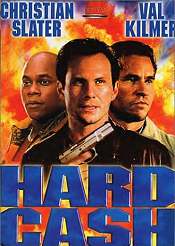
Hard Cash (2002) Plot: Typical manqué
Tarantino antics. I’m an old hand at this whole B-Movie/exploitation picture thing. I understand the vast majority of the anonymous direct-to-video flicks that flood the shelves of our video stores are going to be rip-offs of some established, actual, real life film. This is especially true of genre stuff. Hell, if you removed every Terminator/Alien/Aliens/Scream ‘homage’ from said stores their inventory would drop precipitously. Even so, at least I was able to mention four distinct movies there. Throw in Robocop and Jurassic Park and Anaconda and The Matrix and you’re well on your way to a dozen titles that launched five thousand rip-offs. Unfortunately, and bewilderingly, in the thriller/action category things have actually been much more stifling. Here they seem to pick one film every five or ten years and then spend a decade creating an endless parade of patently derivative clones. In the ‘70s the DNA for these was extracted from Dirty Harry and its close relative Death Wish. Many of these retreads were numbingly rote. And when new wrinkles were occasionally introduced, they would often end up establishing their own subgenres. Vietnam Vet vigilantes, either singular or in teams, being an obvious example. Eventually such Rogue Cop and Vigilante picture were supplanted by rank -- in more ways than one -- imitations of Basic Instinct (1992) and its cousin Fatal Attraction (1987). The result was a seemingly endless flood of ‘erotic’ ‘thrillers.’ This newly emergent genre provided work for any actress willing to bare her breasts (and whatever else she was willing to disclose – remember how far prototype Sharon Stone had to go), engage in numerous sex acts of highly dubious authenticity, and enact various and sundry acts of treachery before reaping their just desserts. B-Movie Queens emerged: Your Shannons, Tweed and Whirry, and Maria Ford. Young up’n’comers joined in, ala Drew Barrymore and Alyssa Milano. Former TV stars, of various vintages, also took their shots: The Tanya Robertses, the Shannon (another one!) Dohertys. Eventually, with the ample help of cable movie channel Cinemax, the market for this sort of stuff became glutted. It took some years, but it did happen. This forced exploitation film producers to search for something else to, uh, emulate. And they found that the youngsters coming out of film school, the sort hungry to make a movie, pretty much all came with Quentin Tarantino knock-off scripts in hand. This suited the production houses just fine. First, any video box featuring a guy pointing a forced perspective gun barrel out at the customer rented well. Second, such films proved fairly cheap to churn out. The kids, sure that their masterwork would be their ticket to Hollywood directorial stardom, were willing to work cheap. Even better, so were the necessary, if generally tarnished, ‘star’ names required for commercial success. Such thespians watched with envious eyes as the formerly moribund John Travolta found his career jumpstarted following Pulp Fiction. With this in mind, actors ranging from Richard Grieco to Kevin Costner were glad to attach themselves to what were assumed to be similar projects. Of course, at this point in their careers many of these were glad to be attached to anything. As you may have gleaned, I am fairly bewildered by this particular variety of crap. Slasher movies stripped out everything that made Halloween a good film in order to produce hundreds of imitations for a voracious and sadly undiscerning audience. In a like manner, these kids whipped out their scripts without really comprehending what makes Tarantino, in his own way, a genius. (Whether he’ll prove a genius with a distressingly limited bag of tricks, like David Lynch, remains to be seen. I do note, however, that Travolta in Pulp Fiction and Robert DeNiro in Jackie Brown are both playing what is basically the same character.) As with Halloween, Tarantino’s work seemed to revolve around easily replicated elements: Casts of faded, formally ‘cool’ stars; hipster dude haircuts and suits; discursive conversations full of pop culture references, constant profanity and casual racial invective; overwrought stylistic elements, including the heavy use of slo-mo; sudden bursts of horrify violence, portrayed with baroque visual flair, and lots of ‘70s pop music on the soundtrack. The notion that such a formula sums up Tarantino’s work, however, misses the forest for the trees. In this, we can discern a familiar devolution of the filmmaking art. Films were first made by authentic geniuses and artisans, creating not just a new art form but also the world’s first truly international language. (Albeit a visual one.) Once the power of this new medium became clear, a new generation of filmmakers made their way to Hollywood in the ‘30s and ‘40s. There they found the financial backing and technical expertise necessary to expand upon what their predecessors had created. These men – for they were overwhelming male, due largely, one assumes, to the prejudices of the time – lived lives present day Americans can barely comprehend. They knew real poverty and physical hardship. They lived in a world comparatively free of technology. They had lived through various Great Depressions, some American, some European. They had fought in horrific wars, including World War I. Many were European expatriates, having fled totalitarian regimes that sprouted up in their home countries. Many were significantly more educated then people today, and certainly better read and more cosmopolitan. They were worldly men back in a day when the term meant something. So they came to Hollywood and made their films. The intelligentsia sneered at their efforts, which of necessity were aimed at the masses. Until the ‘50s, that is, when a handful of young turks in France began to hail various Hollywood directors as ‘auteurs,’ or authors, of the films they made. These directors, the John Fords, Henry Hawks, Hitchcocks and others, were posited to be the creators of identifiable artistic visions. Visions that were, moreover, as personal and idiosyncratic as the works of any highbrow novelist. This new school of film criticism realized that the cinema could no longer be laughed off as a seedy little novelty. It was instead recognized to be a massively powerful medium, one inexorably becoming the dominant art form of the 20th Century. And so on until we hit the ‘70s. With the idea of ‘education’ getting foggier and less rigorous, and with the imprimatur of hip French intellectuals, college film programs burgeoned. The students in these programs were the first generation to have fully and unequivocally embraced Film as being Important, as worthy of the sort of intense analysis that literature had earlier merited. These youngsters, to fall back on a cliché, ate, drank and slept movies. They brought a fervid, unapologetic intellectualization to using the intuitively created tools provided by their forbears. These; Lucas, Spielberg, Coppola, etc., were the post-modern filmmakers. They referenced not their life experiences but rather the films of those who referenced life experiences. (Scorsese is one of the few whose work integrated his personal life experience along with his ‘film’ experience. This is why he remains a great director while most others of his generation haven’t.) Now, with the coming of the MTV generation, we get the post-post-modern filmmakers. They are also commenting on the films they grew up on. Only the films they watched were the works of the post-modernists. In other words, they are commenting on films that were themselves comments on earlier films. These guys didn’t grow up on Hitchcock; they grew up on Brian DePalma. And so we go from John Ford to Steven Spielberg to Michael Bay. Tarantino, however, is a throwback. A throwback to the post-modern school of filmmakers, admittedly, but even so. He was obsessed not with the work of the Lucasas and Spielbergs and such, but instead with the Jack Hills and Larry Cohens of the world. (Listen to the commentary track on the Switchblade Sisters DVD. You can actually hear how weirded out director Jack Hill is to have his low-budget exploitation work so rabidly praised by fellow commentator Tarantino, at that moment perhaps the world’s most famous director.) Tarantino sucked up films characterized by their raw vitality: Kung Fu movies, Italian horror flicks, Spaghetti Westerns and, especially, Blaxploitation pictures. Then, like the ‘70s generation, he regurgitated these influences into works marked by a new and overtly self-conscious awareness and sophistication. The thing that those who seek to imitate Tarantino don’t get is that he’s not primarily a director. (More so he’s not an actor, at which he comes across like an even more mannish Sandra Bernhard.) He’s a screenwriter. And while he has his characteristic stylistic tics, as enumerated above, he brings a lot more to the table than that. And so his apers copy the profanity but miss the poetry of his dialog. They include the abrupt violence but miss the intense characterizations that motivate it. They include the snarky pop culture references but forgo the fierce and playful intelligence behind Tarantino’s use of them. In any case, could somebody please make a new movie to rip-off, so that we can move on? Thank you. Our present subject opens with a severe close-up of a jeweler’s loop. This peruses a subsequent severe close-up of a hundred dollar bill. The familiar voice – but for how much longer? – of Christian Slater is heard praising the quality of this ersatz currency. The phrase IN GOD WE TRUST is scanned over. (Tarantino Irony. Or something.) The owner of the bogus bills is veteran heavy William Forsythe. He has long John Travolta/Pulp Fiction hair and speaks in torrents of ill-motivated profanity and racial slurs. He’s meant to be a Tarantino-esque ‘Bad’ Bad Dude, as opposed to his ‘Good’ Bad Dudes. Forsythe gamely works with what he’s been given here. In the end, though, he’s torpedoed along with everyone else by the inferior script. Slater stops to attend to Paige, his massively pregnant girlfriend. (Tarantino Quirkiness.) Her presence triggers much of Forsythe’s tiresome ‘street’ dialog. Otherwise it’s mostly directed at Nikita, Slater’s Russian henchman. Paige starts experiencing labor pains, and Forsythe orders a henchman to escort her to a washroom. In the film’s first
unsuccessful attempt at doing something ‘cool,’ we learn her bogus
swollen stomach in fact hides a brace holding a scrunched-up Verne Troyer.
(!!) Two objections. First, it seems unlikely that this hundred pound
woman could carry around the sixty or seventy pound Troyer like that.
Second, when the henchman helped her to the bathroom, he should have
noticed her disproportionate weight. (Double so when she returns and leans
on him after dispensing of her load, now using an inflated air sack to
simulate her false pregnancy.)
Well, so much for sleeping well tonight. Say, how about a remake of Sextette with Troyer in the Mae West role? It would be as gruesome. Anyway, the idea is that Slater is the criminal as professional, an Elmore Leonard-esque (by way of Tarantino) Good Bad Guy. This isn’t a deal to buy counterfeit money, it’s a heist to rip off Forsythe. Troyer hides in the compartment under the sink – good thing no one needs any toilet paper – until later that night. Rousing ("Time to make the doughnuts," he quips – Tarantino Pop Culture Reference), he pops out and begins shooting the bad Bad Guys with quick-acting tranquilizer darts. (!) In a particularly moronic bit, Troyer ambushes a guy by hiding in the bowl of the bathroom commode. (!!) First, even Troyer’s too big to hide in a toilet. Here forced perspective is used to disguise the dimensions of what is presumably an outsized prop. Also, his clothes are later obviously dry, despite the fact that they should be drenched. Whatever. Troyer lets the others in. Nikita (Tarantino Psycho Nutjob) opens a violin case and removes a fire axe. From a violin case, get it? (Tarantino Irony and Pop Culture Reference.) He means to repay Forsythe for his slurs, but Slater stops him. You’d think Slater would have noticed Nikita carrying in the violin case, but I guess not. They start to scuffle but are interrupted by the appearance of numerous cops. Apparently they’ve triggered Forsythe’s alarm system. (By now Slater’s criminal mastermind credentials are getting a bit threadbare.) He sends the others out the back and stays behind to take the rap. "You’re going down for this one," one cop helpfully notes. Gee, thanks. Actually, isn’t it more likely that mobster Forsythe would have him whacked in prison? Guess not. We cut immediately to ONE YEAR LATER. Slater is already out of prison – another triumph for our criminal justice system -- and is taking a bus ride back home. This sequence will run about four minutes and be accompanied by a bad Jewel-esque pop ballad. We watch Slater examine various childish drawings. One, in a rather artless touch, has MEGAN written in large letters upon it. Young daughter established, we continue on. Jose, an indigent Hispanic man, boards the bus. He’s gregarious and pauses to chat with each passenger as he strides to the rear. Slater is friendly to him, of course, again establishing his Good Guy credentials. The other whites on board, however, treat the man with disdain. Because, you know, that’s how white people generally act when confronted with a minority. This would rankle me less if the film hadn’t been directed by a émigré from the former Soviet Union. Which wasn’t a country known for treating its minority populations particularly well. Thanks for that trenchant commentary on America’s racial problems, Mr. Antonijevic. Not all the blame is his, however, as the screenplay was provided by presumed native Willie Dreyfuss. (Talk about J’accuse!) Slater disembarks at a rural trailer park, perhaps a commentary on American Poverty. Or something. Sitting in my own house trailer, gazing upon the thousands and thousands of dollars worth of DVDs, videocassettes, Godzilla toys and other useless crap heaped about in cascading piles, I can only admire such penetrating insights. In any case, Slater sneaks up on Paige, who naturally didn’t know he was getting out. Really, wouldn’t she know this? Following this joyous reunion, we meet Megan, Slater’s roughly eight year-old daughter. Such a figure can only be included in a film like this to be endangered, which doesn’t make me any happier. Anyway, they bother to ‘comically’ establish that she’s a bit of a card shark. I can only assume this will be utilized later in the movie. Slater mentions getting a job driving a paramedic ambulance. No training required for that job, I guess. Nor any problem with being an ex-con. Cut to the vehicle, speeding to some incident. Next we cut to a parked car. In this Val Kilmer (!!!) is tormenting another fellow with his insights on the opera music – Tarantino Quirkiness – issuing loudly from the car stereo. (Great, characterization points stolen from Bats.) Kilmer looks monumentally bored here. I imagine he was also bewildered and frightened at finding himself filling a second banana role in a DTV Christian Slater movie. And not a big Christian Slater movie, like Kuffs. In any case, he provides an incredibly lazy and ornately bad performance here, presumably his way of registering his disdain for the project. The ambulance pulls up at an off-track betting parlor. Slater and his coworker step inside, and soon find themselves in the midst of an armed robbery. The robbery is supposed to be all cool and stuff. Emphasis on the ‘supposed to.’ A woman is shot and Slater trundles her off on his stretcher. Then we learn this was all a purportedly brilliant heist planned out by Slater. By now, a mere twenty minutes into things, I was starting to become really bored. So here’s the highlights:
Summary: Suu-uuucks. ___________________
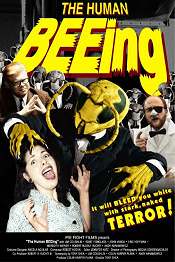
Human Beeing (2000) Plot: A forty-five minute parody of ‘50s sci-fi movies. Thirty seconds into the film and I knew I’d like it. Of course, the people who made it would be in a lot of trouble if I didn’t. If a guy like me isn’t their target demographic, I’m don’t know who would be. We open on William Cistern, the mock producer of this mock film. Sitting in a darkened theater, he lights a cigarette and looks out at us as the lights come on. He delivers a William Castle-esque spiel, warning us how terrifying the movie is. Patrons with various medical conditions, ranging from several types of palsy to stitches, are warned to watch his film at their own peril. Such tidings, of course, are meant to draw the kiddies in rather than scare them off, which is ably suggested here. The ‘film proper’ begins with a Mad Scientist, the Doctor, dictating exposition into a reel-to-reel tape recorder. He elucidates his dreams of Man being freed by his experiments to live lives of leisure and contemplation. However, an ominous misshapen shadow appears over his head. He turns and screams, but it’s too late. This cues a short but very amusing opening credits sequence. Then it’s on to the bulk of our subject. I hate to nitpick…wait, that’s what I do here. Rather, I hate to nitpick movies I like. Still, it must be said that the piece’s recreation of a ‘50s look isn’t perfect. The Human Beeing was obviously shot on video. Admittedly, they no doubt couldn’t have afforded to use film, so that’s perhaps inevitable. Still, it means that the grain of the image isn’t quite right. And some scenes, like those set in the typing pool, are too brightly lit. Getting people to resemble actors from the ‘50s requires more than slicked back hair and poodle skirts. Also, some of the dialog and more of the acting are too broad. The models for pieces like this tended to be pretty deadpan. Satirists, usually to the detriment of their work, often ignore this quality. Sci-fi films from this period were themselves often in danger of shading over into self-parody. The broader you get when satirizing such pictures, the less effective it can be. The line between sly (funny) and silly (not so funny) can be quite thin. The more filmmakers trust the capacity of buffs to get extremely nuanced material, the better. Take our leading man here. The part would have been better served by casting a more woodenly handsome and earnest type. Think John Agar or Peter Graves. This is why Lyle Waggoner, who could easily have been a leading man in such movies, proved such an essential satirical tool on The Carol Burnett Show. Harvey Korman and Tim Conway were extremely funny on the show, but Waggoner just perfectly fit some parts in way those two never could. On the other hand, the people who made The Human Beeing might well be the same ones who acted in it. In this case, they might well be disinclined or perhaps unable to afford bringing in outside actors. Don’t get me wrong, though. The above comments are meant to be mild gripes and offered purely in a constructive sense. On the whole, this is extremely enjoyable stuff. Moreover, many elements are right on the nose. Take the following scene: The Doctor, rather the worse for wear from the aforementioned encounter with his creation, drops by his sponsor’s office. Allen is the greedy corporate type backing the Doctor’s clandestine experiments. Humorously, Allen runs a typing service, and thus isn’t someone you’d necessarily expect to fund work on human/bee hybrids. Appearances aside, the B-Movie logic is dead-on. I can already imagine Allen salivating as he fantasizes about replacing his all-girl typing pool with super-efficient mutants. Allen refers to the prototype creation as a "Humbee," prompting an angry response. "I just call it ‘The Bee’," the Doctor hisses. "There’s nothing human about it at this point. Except that I’ve put it in a suit and tie." The Doctor’s inevitable Speech about his Mad Work is also note perfect. (Although the references to DNA are anachronistic; albeit probably intentionally so.) Allen, the film’s designated amoral and cowardly Fat Cat, worries things might get out of control. "Progress is never safe," the Doctor sneers. Little touches, the sort that make these things work, abound. For instance, most everyone in the film smokes. I liked the fact that you can occasionally spot microphones drooping into shot, but that they don’t lower them enough as to demand you see them. Another pleasing touch is the lines and ‘print’ damage added to the film to make it appear old. Not all the laughs come from such subtleties, however. I laughed out loud at the co-workers who prove incapable of penetrating the Bee’s rather minimal disguise. On another front, the musical score is perfect. The blaring trumpets that emphasize all the key lines of dialog are hilarious. Whoever wrote it really knows his stuff. The only flaw is that some of the musical riffs don’t really fit the time period in which the film was supposedly made. I don’t know for sure that The Human Beeing was inspired by "Mant!", the bug man film-in-a-film supposedly produced by John Goodman’s William Castle-inspired character in Joe Dante’s Matinee. You’d certainly have to suspect so. I don’t want to belabor an unfair comparison, though. Dante’s homage perhaps no more loving, but his superior resources and, let’s admit, understandably greater directorial talent made his version much more dead on. He was even able to secure actors from the period, like William Schallert. Schallert, for example, appears as the ambulance driver seen early in definitive big bug movie Them! (Fans of this sort of thing should also seek out Popcorn. A slasher pic set at a science fiction movie festival, it features several humorous monster movie parodies. Another slick piece is the titular parody in the Joe Dante-produced sketch comedy Amazon Women on the Moon.) This isn’t going to be a long review, as I don’t want to blow too many of the gags. The Human Beeing is available on cassette for $8 and DVD for $10 and can be ordered at http://www.piefightfilms.com. (In case you’re wondering, I did pay for my copy, so this isn’t a brown nose job.) I should caution that Pie Fight’s DVDs don’t play on all machines, my Panasonic included. However, once alerted to the situation the company quickly sent me a replacement VHS tape. In a way, this proved more appropriate. The softer image gleaned from a video more closely approximated bygone nights spent staying up to watch crappy old sci-fi films on my local UHF television stations. I hope Pie Fight will continue doing work in this vein – if not necessarily a direct sequel to this film – and look forward to their next effort. It shouldn’t be too hard, as there’re plenty of clichés they didn’t get to. Heck, the film’s heroine didn’t have an androgynous name, and there’s not one scene of her serving anyone coffee. Summary: Rewarding stuff for sci-fi enthusiasts. ___________________
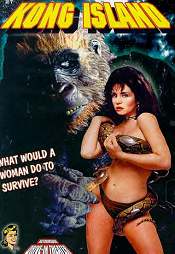
Warning: Poster Art may not
accurately represent movie. Plot: A mad scientist puts a couple of actors into bad gorilla suits and then implants mind control devices into their brains. (You’d think the first part would have been easier after the second part, but…) First, despite the movie’s title – more so it’s even cheesier alternate tag, King of Kong Island -- there’s no giant apes in this film. (If there were, I’d be reviewing it next month. But that’s neither here or there.) Even so, there’re plenty of guys in bad ape suits. Well, technically, there’re two guys in bad ape suits, since that’s the most we ever see at one time. We open on a jeep driving around a rocky desert landscape. I stifle my instinctive cries of PTCGS (Post-Traumatic Commando Girls Syndrome) and keep watching. The jeep is helpfully provided with a handmade "East African Mineral Company" sign. Cheesy, but an effective way to quickly communicate the film’s setting. The men in the jeep are armed, but it does them little good. They are ambushed and forced from their vehicle. One of their assailants, Muller, brutally shoots them down. At this, fellow robber and apparent mercenary Burt issues shocked protests. Muller isn’t done yet, though. He opens fire on his compatriots and takes the payroll the jeep had been ferrying. Burt is left on the ground, badly wounded. Frankly, if Muller can’t kill a guy with a submachine gun at point blank range, he doesn’t strike me as much of a villain. Cut credits with ‘60s ahh-ing theme music, like with Star Trek. Then we see Muller, now revealed to be Mad Scientist Dr. Muller, performing some Mad Experiment. This, naturally, is taking place in a cave, where many Mad Medicos of the era did their Dastardly Deeds. There are panels filled with lines of flashing lights and toggle switches, indicating the high level of Mad Science occurring here. The soundtrack sports a loud heartbeat rhythm and goofy electronic sound effects, ones seemingly right out of Astro Zombies. Dr. Muller reaches for a scalpel and bends over his subject, which proves to be a *cough, cough* gorilla. After swathing a shaved area behind the ape’s rubber ear with an alcohol-drenched cotton ball, he makes an incision. The cut open, he implants a device that seems to consist of an AA battery (!) and a short length of curly-cue yellow wiring. Following this the slit is carefully sutured up. This thus proves to be the goofiest cinematic ape-related operation to be seen until King Kong Lives. In any case, the stitches secure, the ape suit is again ready to possibly startle extremely small children next Halloween’s night. Satisfied with his Evil Work, Dr. Muller releases an Evil Cackle. Cut to a hotel bar, or something, closing up for the night. Bearded owner Theodore steps back to the dressing room of entertainer Ursula. Ursula strolls around in a green bra and panty set, providing the de rigueur Euro-cheesecake. With her is none other than Burt, and Theodore greets him fulsomely. Burt ‘casually’ asks about Muller, but Theodore replies that he hasn’t heard from him lately. Extreme close-ups of his and Ursula’s faces – this was an Italian film, after all -- indicate that this statement is less than candid. Theodore asks after his interest in Muller. Burt wryly shows them a small wad of wax on his collarbone, er, I mean, his bullet wound, and takes his leave. Theodore jealously confronts Ursula, who once was Burt’s squeeze. She maintains that she no longer has any feelings for him. On the way out, Burt hears another voice. It’s Diana, a redhead of the Elisabeth Hurley persuasion. She’s wearing a bullet bra under a tight sweater and gold leather skirt and knee boots. Last time Burt saw her she was a little girl, but now she’s all woman, yada yada. If anyone cares to lay some money down on it, I’m betting she’ll be Burt’s love interest. Meanwhile, Ursula will stew on the sidelines in a jealous rage. Then she’ll betray Burt before getting killed. The only real question is whether her demise will be one of ‘tragic repentance’ or the ‘just desserts’ variety. Diana is Theodore’s daughter and the sister of Burt’s old pal Robert. The latter makes his presence known by jokingly sticking a rifle barrel in Burt’s back. Ha, ha, what a card. Unfortunately, Robert has forsaken the cast’s general desert khaki costuming for a more typical Euroware wardrobe. Here this means a shirt sporting a pattern that’s more appropriate for a ten’s year-old pair of pajamas. The siblings are headed to safari out on an area "forbidden to white men," where legend heralds the existence of a purported Sacred Monkey. They invite Burt along, but he declines. He’s still looking for Muller. Robert lets slip that Muller’s henchman, Turk, still comes by the bar. We cut back to the bar on what is apparently ‘60s Frug Night. Various patrons, both black and white, do the Mashed Potato and so on to hip electric guitar ‘n’ synthesizer instrumentals issuing from the juke box. A Mysterious Guy sitting with Theodore is keeping tabs on Burt, a fact Ursula warns him of. Diana enters the room, clad in, uh, sort of a short, black leather slip cut way up high on the sides. This is decorated with white fabric straps that match the sides of her white panties, evident via the aforementioned slits. If I’m not mistaken, this outfit is part of the Modesty Blaise Collection. Burt and Diana head out onto the dance floor and end up embarrassing both themselves and the viewer. The camera then moves about the room focusing on various female dancers’ shaking racks and cans, for all the world looking like a William Grefe homage. At one point you can see the steadicam operator’s shadow thrown up on the wall as he mistakenly walks in front of the lighting guy. Suddenly, although not soon enough, Burt’s dance stylings are interrupted when he spots Turk in the room. And yes, this does cue the film’s 147th sever zoom shot. I was sort of puzzled by Turk’s presence. It’s been intimated that Theodore is working with Muller. So you’d think Turk would have been warned that Burt was nosing around. Of course, then Burt couldn’t have chased after him when Turk bolts outside. Well, my bad. Turk was at the club as part of a nefarious plot. When Burt runs outside, he’s surrounded by henchguys who escort him over to a waiting Turk. Turk orders one to give Burt a nogginectomy with the big machete the dude’s carrying. Burt breaks free though and dishes out some less than inspired Whoop Ass to five brawny toughs. He more than holds his own, although one fellow nearly carves him up from behind. Our Hero is saved by the Mysterious Guy who was sitting with Theodore earlier. Burt thanks him and walks off, without even getting the guy’s name! You’d think Burt could at least have offered to buy him a beer or something. Cut to the couple of jeeps transporting Robert and Diana’s safari party. By which I mean the siblings and six native bearers, or whatever we now call the guys who do all the actual work. The two bwanas exclaim at various pieces of intercut stock footage, including the inevitable elephants. (You are fairly warned, Freeman.) The choice of this footage could perhaps have been more judicious. For example, at one point the rough, rutted path they’re driving along suddenly changes into a full-fledged road. This, moreover, cuts through terrain that doesn’t remotely match their previously established surroundings. This is then followed by shots taken from a vehicle transversing a plain sporting no road or path whatsoever. Having eaten up the requisite amount of running time, the jeeps arrive at their apparent destination. Amazingly, as soon as they stop a binocular-wielding Turk is spying upon them. Either there’s only one possible campsite in Africa or it’s a much smaller continent than I was led to believe. (Turk’s POV shot is daringly represented by the ‘sideways hourglass outline’ rather than the more traditional ‘two joined circles.’) Leaving the jeeps behind, the party enters what is presumably the aforementioned area Forbidden to White Men. And yes, the native workers are carrying the bwanas’ crap, so I guess they’re still bearers. Canned monkey and other jungle sounds add to the exotic ambiance, as does having the lead bearer unnecessarily swinging his machete through the conspicuously clear path before them. Suddenly Diana is startled by some leopard cub stock footage. Watch out! It’s an entirely different movie!! After some more minutes of them walking through the jungle, they finally make camp on a set. The bwanas eat their chow, Eventually noticing a ruckus involving the bearers. Hmm, could it be they’re uneasy about entering a Forbidden Area of the jungle? Robert goes over and asks the crew chief, Malumba (!), what’s going on. It turns out the bearers are uneasy about entering a Forbidden area of the jungle. "They say there’s a powerful evil spirit and it follows the Sacred Monkey," he reports. Robert offers them more pay – oh, those white guys, they just don’t get it – and orders them to get some sleep. I’m not Nostradamus or anything, but I’d be surprised if the bearers were still there in the morning. Later Diana is in her tent, preparing for bed. Outside, two guys in bad ape suits are seen in the surrounding bushes. They look on lustfully – after all, they are gorillas – as her cast shadow is seen shedding clothes. Waiting until she’s in a somewhat translucent nightie, one guy in a bad ape suit bursts into her tent (uh, Mr. Director, we can clearly see that it’s daylight outside). He makes a honking noise that suggests not an ape but rather a goose stand-up comic doing an ape impersonation. She inevitably faints and is carried off, although her oft remarked upon bracelet falls to the ground. Good thing the characters kept mentioning this bracelet or we wouldn’t even know she had one. In any case, this should prove handy once Scooby and the gang show up. Meanwhile, another guy in a bad ape suit assaults Robert and a bearer as the other natives scatter in fright. Robert momentarily regains consciousness and sees Turk. Turk tells him to go back home and inform Theodore of what’s occurred here. By the way, and I don’t want to be pedantic (or would didactic be the correct term?), but why an army of mind controlled apes? I know it’s a real Mad Scientisty thing to have, but wouldn’t a human army be more efficient? Sure, gorillas are strong. Really, though, if they’re so great why aren’t they running the show? I mean, Turk was carrying a rifle. Couldn’t he and another guy just kidnapped Diana on their own and left Robert with the same message? Just wondering. We see the bare feet (first William Grefe, now a Doris Wishman homage?) as someone stops to pick up Diana’s bracelet. Then we see Robert back home, telling Burt his tale. He makes a lot of surprisingly detailed observations for somebody who ran out into a dark campsite and was seconds later knocked senseless by a guy in a bad ape suit. For example: Robert:
"They behaved as if they had a plan, as if it had all been
prearranged. I don’t know, as if they were some kind of robots!" Despite Robert and Theodore’s exhortations, Burt refuses to lead a team to search for Diana. This despite the fact that he’s apparently the only guy in Africa who might be able to save her. That’s what we’re told, anyway. Frankly, Burt is kind of a prick to be our protagonist, but you get what you get. He only changes his mind when Robert throws in a last piece of information: That he ‘saw’ Turk in the jungle. (He must mean when he awoke and found Turk standing directly over him and pointing a rifle at his face.) This startling news triggers a Severe Zoom Shot tight onto Burt’s face. "I’m convinced he’s behind it…the kidnapping," Roberts continues. Well, duh. Hearing this, Burt agrees to take the job. He does, however, demand a wad of bills to do so. Burt Dawson, you’re a hero for the ages! After a time wasting bit with Ursula warning Burt to watch his back, we cut to a motorized canoe heading down a river. This is the (rather small) rescue party, and their sojourn is a repeat of the jeep trip seen earlier. By which I mean it lasts several minutes, serves no real purpose, and largely consists of Burt and Robert pointing at and commenting on several bits of stock animal footage. Sometimes I wonder whether this film was even made in Africa! When they disembark they waste even more time by hiking around for a while. Their destination, we’ll eventually learn, is the campsite from which Diana was kidnapped. So…if you could reach the area more easily by boat, why did Robert and Diana drive there? Or vice versa? My suspicion, and forgive my cynicism, is that the different means of travel were used to justify separate sets of stock footage – one of land animals (elephants, lions), the other river animals (crocodiles, hippopotami). During their trek we see Mysterious Guy, the one who earlier saved Burt’s life, covertly following them. Exactly how he followed them down a river with miles long sightlines without being detected is left to our imaginations. For that matter, I’m not sure how he manages not to be found out, considering that he’s trailing them from about three hundred yards back. At one point Malumba the Chief Bearer – one of two brought along this time – yells out, "The Sacred Monkey!" We are then shown a chimp in a tree. When Burt questions him, he replies "I don’t mean the chimpanzee." Then there’s an abrupt cut. This is where the film’s obligatory wild Jungle Queen character was introduced in the European version. However, since there was some nudity here, it was edited from the American prints. More on this later. At that camp, Robert notes "it’s just the way I left it." Indeed, the body of a slain bearer is still lying in the exact same spot. (!!) Oddly, it’s neither begun to decompose in the jungle heat or been disturbed in any way by scavengers. This despite the fact that it’s presumably been at least a couple days since Robert went home, collected Burt, and returned to camp. Even if it’s only the next day, you’d think a corpse would fare less well than this. As they look around, they are shown being observed by the Jungle Queen. Since we didn’t get her introduction in this version, we just have to accept her presence. Burt notices that Robert is acting strangely pensive. Meanwhile, Jungle Queen is looking upon Our Lead with some favor. Plus Mysterious Guy is still lurking around. Then Robert heads off into the brush, where he meets with *gasp* Turk. We learn that the price for getting Diana was for Robert and Theodore to lure Burt into the area. (This was pretty much telegraphed, and so isn’t much of a revelation.) Robert is enraged at having to betray his friend, but there’s nothing he can do. Turk, acting for Dr. Muller, reveals that they’ll be hanging on to Diana for a while longer. Cut to a topless Burt sleeping in his tent. Jungle Queen, enrapt by his manly brawn – like most European leads of the period, actor Brad Harris was a veteran of several Sword and Sandal pictures – strolls in for a closer look. You’d think after the gorilla incident they’d set a watch or something. Or, for that matter, have brought more than four guys, which is half the number routed during the first ape assault. Also, Burt seems like a weirdly sound sleeper for a professional mercenary. Anyway, she runs her hand over his chest, then flees when he shifts in his sleep. Well, that was essential sequence. The next day they set off for more stuff. They walk around. Mysterious Guy trails close behind. Jungle Girl is seen (by us) flitting around the area hand in hand with her pet chimp. Burt and Robert pretend to see and react to a stock footage lion. Jungle Girl also sees some stock footage of the lion and laughs in delight. The guys walk around more. Stock footage elephants. Stock footage panther. Mysterious Guy. Jungle Girl. Stock footage leopard. Stock footage lion. Stock footage panther. Are these felines meeting up or something? No. Jungle Queen. Suddenly the soundtrack goes silent. Jungle Queen and the chimp react and run off. Back to the guys. "When the jungle is silent, the Spirit of Death is near," Malumba helpfully explains. Meanwhile, Mysterious Guy’s bearer takes off in a panic. Then two guys in really bad ape suits assault Mysterious Guy. He fires his gun, which is heard by the guys. Burt runs over to investigate, killing one of the guys in a really bad ape suit while the other heads off. Mysterious Guy, somewhat scraped up, introduces himself as Forrester. He is, to my complete lack of surprise, the film’s Obligatory Interpol Agent. He’s been assigned to track down Muller. "We’re convinced that Albert Muller is experimenting on conditioned brain reflexes on simple kinds of animals. The results could be disastrous," he explains. He knows of Burt’s role in the payroll robbery, but offers him a pardon and a reward if he helps out. Moreover, his job is to stop Muller, not necessarily arrest him. So he agrees not to intercede in Burt’s plans for revenge. "I think we’re going to get along, Forrester," Burt observes. Returning to the party, Burt and Forrester find the bearers dead and Robert mortally wounded. Robert reveals that the apes got them, and spills the beans about Muller and Diana. He’s interrupted in the traditional fashion, by a bullet fired by Turk. Suddenly some savage native tribesmen make their presence known. Turk manages to escape, put Burt and Forrester are taken prisoner. This quickly leads to a really weird and hilariously discursive sequence that blatantly rips off The Naked Prey. (By the way, what kind of world is it where Kong Island is out on DVD and The Naked Prey isn’t?) Their wrists are bound and they’re set free. "They’re savages," Burt explains. "They expect us to run for our lives!" And guess what? The savages are right. The two stumble down a hill as the natives throw toy spears at them, which tend to land flat rather than point first. A native or two meets them at the bottom and Forrester is slain. Which means he had no real function in the movie, so why was he there? Burt, however, makes the trees. After perhaps five more seconds of jogging, we cut to Burt by a scenic waterfall. Apparently the rules are that once you get out of the sightline of the natives, they let you go. Which makes them the laziest group of murderous savages I’ve ever seen. Using his knife to cut his bounds, he removes his shirt and takes a refreshing swim. Jungle Girl, meanwhile, is again spying upon his mighty, Hercules-esque thews. Actually, bronzed and bare-chested, clad in tight khakis slacks and black boots, Harris looks like he would have made a credible Doc Savage. While this has been going on, Turk reports to Muller on Burt’s capture and presumed death. Muller is annoyed, since he had the obligatory Mad Scientist designs on his old partner. This scene doesn’t really lead anywhere, and again seems designed to stretch the film out a little longer. Back to Burt. He splashes around for way too long a time. Returning to his shirt, he finds fruit piled upon it. Stock footage of a monkey. Of another monkey. Brad spots Jungle Girl. He runs towards her, she takes off. He heads back to his shirt. She returns. This time he sits still. She smiles at him. He smiles back. He lights up a cigarette. She smiles at him. He smiles back. Ad nauseam. In my mind, I can picture hundreds of drive-in movie patrons leaving their cars at this juncture to get popcorn. He gets up. He grabs his shirt, which is dry when he picks it up but sodden when he dons it. Suddenly a guy in a bad ape suits grabs him. He manages to stick a knife into the beast and it runs off. Again, the whole robot ape thing just doesn’t seem to be holding much water. In fact, as is often the case with these sorts of experiments, their applications seem more theoretical than practical. Hmm. Maybe that’s why they call them ‘mad’ scientists. Burt makes camp, lighting a fire and piling up fronds to make a comfy bed. As he reclines, Jungle Girl shows up. (She appears in a short bit that, on the DVD, has the music track playing backwards!) Unable to get her to speak – to give the movie points, she doesn’t have a mysterious knowledge of English – he names her Eva. He plays along with her until he sees Diana’s bracelet tucked into her skirt. Eventually he gets her to show him where Diana is. This makes little sense, since Eva picked up the bracelet at the campsite. So I’m not really sure why she’d know where Muller’s cave is. It also doesn’t make sense that in the scene we see of her ‘leading’ him, he’s walking ahead of her. Whatever. In between all this, we see Ursula in the bath. This is the American version, so we don’t see anything. I imagine in the Euro version maybe we’d get a brief topless shot. Anyway, the point of this scene is that she’s desperately unhappy with Theodore. Unfortunately, he’s desperately happy with her. She pulls a gun on him, he gets it away from her, he slaps her around, etc. And so things go. We cut to Muller’s cave. The Guys in ape suits, despite being ‘robots,’ engage in the traditional scaring of Some Caged Women. Two of the prisoners are black native women, the last a white chick in Jungle Girl dress. This, uh, raises more questions than it answers. Does Eva come from a tribe of such women? There’s no other indication of it. Besides, Eva looks more Polynesian than white. Whatever. It’s a fleeting thing, but it caught my eye. Also, this is the best look we get at the ape suits, and they’re even lamer than I’d previously suspected. Ape Suit Guy grabs Diana from her cell and hauls her over to Muller. I guess its time for the traditional Mad Scientist Expository Rant. It’s all standard stuff. Evil guffaws. Insane technobabble. Plans to make Burt his first human slave. Demands that Diana become his bride. Fill in the blanks, people. Only the Insane Technobabble is really worth going into. He takes her over to a huge, backlit cross-section model of the human brain. "This brain is the nerve center that controls all the apes," he brags. (When are these guys going to learn?) "I’ve inserted radios in their skulls, to receive impulses from that transmitter over there. Their will ceases. It puts them at my command." He points to a particular spot on the Brain Model. "This brain cell is responsible." I think we all see where this will end up. Then he tries to get some sugar off Diana, who naturally resists. Per tradition, this leaves him less than pleased. "I can take control of all humanity with this invention," he yells. Uh, yeah. Suuuure you could, Doc. The Brain starts flashing, which I guess is the intruder alert. What a handy gizmo! I mean, is their anything it can’t do? Turk is sent to check things out. Outside, we see Burt and Eva approaching. Being a Mad Scientist, Muller has had an apparently huge array of speakers place hither and yon, just so that he can taunt people in a situation such as this. Here he delivers the standard "You’ll be my Slave!" spiel, intermingled with bouts of Evil Chuckling. Turk gets the drop on him, but Burt escapes when Muller distracts his henchman by talking to him over the loud speakers. Good help is so hard to find. Proving this axiom, Turk proceeds to take the occasional potshot at Burt. This despite Muller annoyed broadcast reminders that he wants Our Hero alive. This constant importuning must be getting on Turk’s nerves, you’d think. After all, it lets Burt know that Turk isn’t allowed to employ lethal force against him. In any case, they (Eventually) begin engaging is what I think is supposed to be a gritty, life and death struggle. In the end, needless to say, Turk reaps his just, if exceedingly bland, desserts. Meanwhile, Eva is in for a rude shock upon learning that the robot guys in bad ape suits no longer obey her Tarzan-esque commands. She’s scooped up and delivered to Muller, so expresses his pleasure at finally capturing the Sacred Monkey. Speaking over the PA, Muller orders Burt to surrender, lest he do something nefarious to the girls. Instead, it’s Theodore and Ursula who show up, guns in hand. Theodore is a mite pissed, what with Robert getting whacked and Diana being all kidnapped and everything. This scene goes on for a while (a better title for this film might be "Blah Blah Blah"), but Ursula proves to be on Muller’s side and shoots Theodore dead. Well, it’s not like he had much of a life expectancy after we learned that he helped sponsor Muller’s work. Of course, neither does Ursula, especially following her act of treachery. So she, like Theodore, is afforded her own little rant. Then Muller shoots her down in turn. Just goes to show, you can never trust a Mad Scientist. By the way, there’s a bit here where Muller grabs his forehead in pain. This occurs again right at the end of the movie. Is he afflicted by a brain tumor? Was he attempted to remote control the guys in bad ape suits, rather giving them verbal orders? We never find out. Like the white woman in the cell, it’s feels like a subplot the bulk of which was left on the cutting room floor. Burt shows up and shoots the gun out of Muller's hands. Muller sics his apes on him. Diana yells out to shoot the Brain. He does so. Sparks fly out of various pieces of equipment, for little apparent reason. The apes, meanwhile, are freed of Muller’s control and Eva orders them to finish him off. Gee, how ironic. Killed by the very beasts he meant to rule the world with. (We don’t actually witness Muller’s death. Perhaps they were leaving things open in case a sequel was called for.) Eva heads back into the jungle, presumably mourning the loss of the hunky object of her affections. Still, she does get to keep the bracelet and still has her chimp. Burt, meanwhile, heads back to civilization with Diana. Luckily, there’s no one left alive to tell her that Burt that refused to come rescue her in the first place. Woman can really be touchy about stuff like that. As mentioned, there was a slightly more explicit European version of the movie. And I mean ‘slightly;’ the Euro cut is a scant 55 seconds longer. Most of this extra footage, as noted before, involves the scene where Malumba first sees the Sacred Monkey. In ‘our’ version, they cut away without revealing her to the audience. In the ‘racy’ Continental version, Malumba gives a little speech that unfolds over footage of Eve romping around in the buff. (And all I can say is, damn, somebody get that woman a sports bra.) I think she does so in slow motion, but given the tempo of the rest of the film, it’s hard to tell. Malumba’s soliloquy is worth quoting at length. Malumba:
"The Sacred Monkey! We’re near forbidden territory. Taboo, bwana,
taboo!!" By the way, I checked the scene where Ursula takes a bath, and it’s the same. So the entire extra footage is as noted above. (Eat your heart out, Video Watchdog.) I know what’s on the Euro edit because good ol’ Fred Olin Ray himself, in the guise of his DVD company, Retromedia, included it on the Kong Island DVD. (There’s three words no sane person ever expected to be standing next to each other.) Aside from being more ‘complete,’ this cut is also presented in a slightly letterboxed format. So why did I review the American version? First, it’s notably more vibrant, albeit far from pristine. Moreover, the Euro version, while still in English, has foreign language subtitles burned into it. (I don’t recognize the alphabet. Greek? Turkish?) So of two imperfect presentations, the edited version remains the default viewing option. Still, you’ve got to give Retromedia credit. They must have figured, "Hell, let’s toss both versions on there and let the viewer pick which one to watch." That even this much care would go into a disc for a film like Kong Island remains both charming and somewhat farcical. Things I Learned™:
Summary: For bad ape suit
and Jungle Queen completists only.
-by Ken Begg |