Another feature of... |
|
Another feature of... |
|
|
for
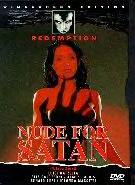
Nude for Satan
Plot: Uhh…. If you’re going to make an exploitation film, there seems little purpose in giving it an overly subtle or elliptical title. Even so, Nude for Satan must surely take the cake for sheer, hamfisted literalness. Once you’ve come across an artifact with a moniker like that, the only question is whether the actual movie can possibly live up to it. In this case, the answer is both, "Oh, yeah," and "Hell, no." In any case, before I begin the review proper, I should tip my hat to Mr. Sandy Petersen. First, he has donated by far the largest amount yet plunked down in the Jabootu tip jar. (Too much, really). Moreover, upon learning of my woeful ignorance of a particular passion of his, Italian horror films, he mailed me a couple of DVDs. One was Mario Bava’s brilliant Black Sunday, provided as an example of the lofty heights such movies have scaled. Nude for Satan, in contrast, was meant to illustrate the genre's depths. If it has little chance of replacing the delirious Bloody Pit of Horror in my heart, it definitely made its presence known. I must admit, however, that I started watching the disc with a certain amount of trepidation. As I’ve noted in the past, I’m shockingly squeamish for someone who’s spent so much of his life watching horror movies. As well, my brain does not process surrealism gladly. Non-linear storytelling typically drives me up the wall, especially since such works often set my BS Detector a’wailing. (And yes, Donnie Darko, I’m looking at you, you arty-farty piece o’ crap.) These are the primary reasons I’ve largely steered clear of a lot of Euro and Asian horror flicks, which are often both unremittingly grisly and annoyingly ponderous. Well, Nude for Satan is certainly pretentious, that’s for sure. In fact, it reminded me of no other film so much as Last Year at Marienbad, and not half because both films are criminally, brain-throbbingly dull. (Indeed, Marienbad is my declared Most Boring Film Ever Made, edging out even the ghastly Jonathan Livingston Seagull.) Even so, there’s a real tension here. The conflict generated by film’s utter shamelessness in tossing as much nudity and sheer goofiness at the screen as possible, weighed against its laughably unwarranted artistic airs, definitely affords the resultant mess an identity all its own. Indeed, its overpowering tediousness ultimately assumes a bizarrely triumphant cast, heroically vanquishing the picture’s incessantly displayed boobies, butts and pubic triangles, not to mention the bondage, sadism and occasional papier-mâché arachnid*. [*That’s in retrospect, of course. While actually watching the film, the horrified viewer could only fixate on how a picture running a mere 81 minutes can be so bleeding endless. Rasputin gave up the ghost easier than this thing.] We open with some farily typical ‘70s Euro synthesizer music accompanying footage (which—I hope you’re all sitting down and have some nitroglycerin tablets handy—is in slow motion) of a woman running through some woods. She’s wearing a nightgown, but the garment gapes open, lest the audience grow bored and hostile after going five full seconds without getting some Full Monty. We cut to a Volkswagen Beetle cruising down a dark, isolated road. The car approaches the camera and stops right before it (which I think is meant to be taken for a freeze frame), the headlights and front hood filling the shot. We remain focused on this dynamic and provocative visual for about two straight minutes (!), while it is used as a backdrop for the credits. These completed, the car continues on its way. Unwisely, roaring engine sounds are foleyed in, ones that seem a bit virile to be emanating from a Bug. Inside the car is William Benson, a sort of Jack Palance-in-muttonchops looking dude. We cut to what is supposedly his car arriving outside a building. This is somewhat unconvincingly suggested via the use of twinned spotlights panned in a laughably slow and shaky manner across the exterior of a building. They then dub in a car door slamming shut, following which the actor walks before the 'headlights' about three or four seconds before he possibly could in real life. Rapping urgently upon a door, he rather counterintuitively yells out to any occupants in English. I assume from this and his name that the character is supposed to be an American, but who knows? In any case, all rest of the movie’s dialogue is Italian. (The disc gives you the option of listening to the original soundtrack, along with optional English subtitles.) Eventually a man answer his call. Benson identifies himself as being a doctor, one attempting to answer an emergency call from a "Wildford Cottage." The house owner reacts negatively when hearing of his destination, calling it "the farm of those madmen." (Given that this takes place in Europe, perhaps he means that the owners of said farm grow wheat from *gasp* genetically engineered seed.) He cautions Benson to abandon his goal, which, given the sort of movie this is, he obviously doesn’t. Then the actor playing Benson walks back off-camera and they pan the spotlights offscreen, fostering the all but seamless illusion that he’s driven off in his car. Following this, we reach a key moment in the film’s artistic development: Its first largely unmotivated and jerkily executed Extreme Zoom Shot (or EZS). The subject of this is the man Benson was talking to. We see him grin evilly, indicated some dire thing or other. We cut back to Benson, sitting in an obviously motionless car that is meant to be roaring down the road. These close-ups are intercut with actual footage of the car actually moving. As he (supposedly) flies along in the Bug, presumably having attained its uppermost velocity of sixty to sixty-two kilometers an hour, he suddenly sees before him a woman in white—presumably the one seen in the woods earlier—and swerves to miss her, losing control of the car in the process. Unfortunately, the visualization of this event proves beyond the technical expertise of the filmmakers, and is conveyed via some brief but sped-up footage of the car slowly pulling over to the shoulder, followed by the actor whipping his head around to suggest a sudden stop. As ersatz thunder and lightning are used to help further the film’s creepy Scooby Doo-esque ambiance, the shaken William climbs from his vehicle. Yet when he plays his flashlight across the road, the woman has proved to have mysteriously vanished. (Wow!!) As he turns around, shaking his head in bewilderment, they dub in a really fake-sounding car crash. Apparently feigning William’s similar incident pushed their resources to their limit, for here the second accident is indicated solely via the soundtrack and then, laughably, by having an off-camera stagehand shove a tire so that it rolls into shot and on past Our Hero. He turns back and now sees another car, also in pristine condition, parked on the shoulder of the road. I have to admit, I gave a pretty good laugh when I saw that both tires facing in his direction were still quite evidently right where they should be. The continuity kookiness continued, however. Protruding from an open door is the body of young woman. In the establishing shot from Benson's original position, she’s clearly wearing a white blouse. Yet when he runs over to examine her, the blouse has magically turned black, and moreover its now her opposite arm that's hanging down to the ground. To be fair, though, it does seem to be the same car in both shots. Being a trained medical professional, William immediately grabs the unconscious woman and starts waving her upper torso around. Apparently failing to hear any loose shards of her spine rattling around, he carries her back to his Bug and mashes her into its voluminous passenger area. Then, proving beyond all doubt that he is Italian, he begins to slap her face in an effort to rouse her. The woman proves that she also is Italian by coming awake but failing to protest this technique. Instead, she asks what happened. "Nothing," he replies. "Nothing happened." Hmm. Yes, except for the part about dragging her insensible form from a wrecked car, that does pretty much cover it. Further hilarity ensues when he goes on to note,
"I believe there’s an accident. I don’t really know." True,
as the only things he definitely can swear to were the sounds of an
automobile crashing, a loose tire rolling past him immediately after, and
finding her hanging unconscious from a stilled car. Extraordinary, Holmes,
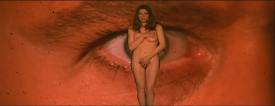
what do you make of it? As he approaches the house (I guess), he’s startled by a man in a dark cloak and slouch hat. This is the same guy he talked to earlier, and I assume his attire is meant to explain why Benson doesn’t recognize him. This despite the fact that the fellow’s face isn’t really obscured and that Benson stands right next to him on both occasions. Benson asks for help, explaining about the injured woman, but the Man replies "My orders are not to move from here." He instead suggests seeking help at the previously mentioned house, although I guess it's actually a castle. This suggestion triggers an Ominous Music Cue, although I couldn’t help thinking that the castle was where Benson was heading before the Man popped up to distract him. Benson moves forward for a moment and stares at the castle in trepidation. When he turns back around, he finds that the Man has mysteriously disappeared. (Wow!! Bet you didn’t see that coming.) He continues on to the castle, several of the windows of which are glowing brightly. Reaching a door, he knocks and cries for attention (in Italian, this time), only to see the lights wink off. Confused, he turns to leave—what a go-getter—only to have the door creakily open behind him, apparently of its own accord. (Wow!!) While the exterior of the castle was quite well maintained, with electric lights visible in several windows, the interior of the building proves to be that of an abandoned ruin. Once inside, he immediately heads up a dilapidated stairway, one strewn with trash and cobwebs. A mysterious wind kicks up and blows dust and other crap around. (Wow!!) Upstairs he finds a dusty chamber filled with old furniture and such. As he enters, he’s the subject of an EZS, followed by the film’s first SP-BS (Subsequent Pull-Back Shot). Exploring, he hears a creaking sound. Pulling open a door, he sees the body of a middle-aged servant dressed in 18th century—or something—fancy dress and sporting an official Steve Martin Knife-Through-Throat gag™. Despite being covered with cobwebs, the body appears otherwise fresh and intact. In fact, following its own EZS, it pops open its eyes to leer at Benson and deliver an evil cackle. (Wow!!) "What do you wish for, sir?" it chortles malignly. It was about here that I gave up on taking the film at all seriously. The fact that the Servant’s two ‘missing’ teeth were quite obviously intact and merely covered with black stage wax wasn’t helping much either. Looking at best mildly perturbed, Benson closes the doors and turns to continue looking around. (!!) Soon he hears what sounds like a woman crying out in torment. He approaches another door, behind which he sees a man suckling at a naked woman’s breasts. Turning from this sight with rather more evident horror than he evinced upon seeing a talking corpse, he pauses for only a moment before continuing his explorations. Amazingly, Benson might be the most inane horror movie character I’ve ever seen. Bored with the reanimated dead and nooky, he instead pauses before the obligatory Ancient Tome, found lying open on a display stand. "The light is twofold," he reads, "the way is only one. The essence of life is not in time. He who has made a pact with Him, belongs with Him. It is written: You will see through the darkness." Ah, well, now everything is clear. Interrupted by another Mysterious Breeze (Wow!!), Benson moves on. Next is an effects shot so weird it’s hard to describe. In an apparently empty painting frame appears an image of a woman in outmoded attire that is obviously matted in, especially as its perspective keep shifting around and changing in size. I have no idea what this is meant to mean. Benson hears a voice behind him and turns to see none other than the woman in the painting. (She is introduced via, why yes, an Extreme Zoom Shot. This one, however, stands out as perhaps the jerkiest the film delivers, with the camera wiggling desperately back and forth as it attempts to get her properly centered in the shot before the zoom action is complete). Moreover, the room they’re in is suddenly all squeaky clean and brightly lit. Here’s the kicker, though: The woman, despite her period dress and hairstyle, is the spitting image of the accident victim he left in his car. But then, given the sort of movie this is, she’d pretty have to be, wouldn’t you say? The Woman looks at him in shock. She appears to recognize him, although she calls him Peter. "You came at last," she purrs, grasping his hands. "I have waited forever for you." Then she feverishly kisses him. He sort of goes along with this—OK, that’s kind of realistic—but meanwhile he hear him think, "I don’t understand. What’s going on here?" I know what you mean, buddy. Women, huh? Why even try to understand them? Continuing to prove something of a nimrod, Benson still believes the woman to be the same one from the road. He demands an explanation, but if the film’s not interested in letting us know what the hell’s going on, why should he be any different? Her ‘poetic’ reply to his queries marks the film’s first fully Marienbad-esque moment. "To remember…" she dreamily responds. "What is a memory, but a fraction of time in the parenthesis of the past? And the past is not in time anymore. And time is silence. There is no space here for memories."* [*Actually, that’s the subtitled translation. The English dubbed version goes, "Darling, what is a memory? It’s just a fraction of time, a moment recovered from the vastness of the past. And the past is no longer of this time. And time is silence. Here there is no place for memories." These variances continues throughout, although most are more tonal than anything else. Still, I believe the subtitles are generally closer to the actual original dialog.] The two leave the room. Then, in a bone-chilling--not to mention completely unconnected--insert shot, the Servant emerges from darkness into a patch of light, whereupon he bends towards the camera and leers as it performs another EZS. (Wow!!) This has nothing to do with anything, and they might has well have cut to a young Goldie Hawn doing the Frug, with the camera stopping upon a wacky slogan painted onto her body. We cut to the next morning. The woman from the car… OK, I’m tired of this, so I’m going to cheat and look at the end credits. Only, of course, there aren’t any. Fine. On to the Internet. Hmm, according to the IMDB, the modern incarnation or whatever of the woman is Susan, while the period version is Evelyn. Just as Our Hero is Benson, while his presumed doppelganger is Peter. Everyone up to speed now? Anyway, a dazed looking Susan is approaching the castle, presumably looking for Benson. Meanwhile, the camera tilts and zooms up towards the battlements to reveal the Man (the one Benson twice talked to), now stylishly dressed in the very latest from the Barnabas Collins collection. This includes the black suit, black ribbon tie, black half-cape with scarlet interior lining, white shirt with ruffled front and sleeve ends, all capped off with the obligatory walking stick, complete with the ornamental brass animal head handle. A music cue makes sure we know that his presence is all ominous and suchlike. A moment later we see Susan knock on the front door. Hearing a voice, she whips around and, of course, finds the Man standing behind her (Wow!!), prompting yet another EZS. They converse for a bit, and for some completely retarded reason they are filmed from a extremely close and low angle, with the camera tilted up in such a way as to create a distorted perspective of the two. It’s the sort of camera work most generally used in Dai Kaiju movies to make the guys in the rubber monster suits look big. Meanwhile, the Man is clearly looking down Susan’s blouse, although given the kind of film this is I wasn’t sure whether it was the character or the actor doing this.Susan explains about the car accident and her missing rescuer, and the Man invites her inside. The interior of the castle is now pristine and richly ornate, as opposed to the ruins Benson had entered. Given the whopping continuity errors we’ve been treated to, there’s no way I’m even going to bother trying to figure out what the changing condition of the castle ‘means.’ Anyway, he ushers her into a room, she looks about for a second, and then when she turns around the Man has mysteriously disappeared. (Wow!!) Here I considered just sticking a galvanized steel pail over my head and beating on it with a hammer for an hour. However, I would have felt bad about taking the coward’s way out, so I continued watching the movie instead. Susan is now in the room where Benson met Evelyn. Looking at the same blank picture frame, she sees another weird insert ‘painting’ appear, this one portraying a sneering version of Benson in period dress, with darker hair and maybe a somewhat older face. This time when she turns around, the Man is again standing behind her. (OK, where’s that bucket?) "But this is…" she begins, confused. For some reason, she now begins backing away from the Man, who begins stalking slowly towards her. This is filmed with him walking towards the camera while the lens simultaneously zooms in on him. The end result is a severely tight shot of his eyes, although before then end up there the image goes from sharp to blurry and back again, quite apparently because the camera operator didn’t know what the heck he was doing. As the camera wiggles back and forth while trying to keep the Man's peepers in the center of the shot, he pops wide his eyes. We cut to a close-up of Susan, then there’s a pull-away shot until the length of her body is in view, at which point she gasps and all her clothes disappear. I swear to Jabootu, this really happens. Perhaps it’s merely symbolic of his ‘undressing her with his eyes,’ or maybe he magically made her clothes actually disappear (usually that would seem like a tremendously cool power, but frankly this film has sucked all the life out of me, and I really can’t raise much interest). As the movie continues, such fine distinctions will become increasingly meaningless.
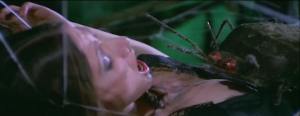
Susan holds her hands over the goods, although probably only to save them for a better look later. Here we cut to a really, really severe close-up of one of the Man’s eyes, whereupon they optically layer a miniature shot of the nekked Susan over it. (!!!) Then we cut to the Man’s face, which the camera quickly zooms in tighter on, cut to Nekkid Susan, back to Man’s face, from which the camera now quickly pulls back, then back to Susan, who now has her clothes on again. So I guess her nudity was more figurative, and…oh, who am I kidding? And like I care. The momentary awkwardness by the board, he suavely offers her a chance to "refresh yourself, perhaps take a bath?" I hope she accepts, and quickly, if only to end the interminable ten seconds that have already gone by sans nudity. Susan agrees to become his guest, and he goes off to make the arrangements. "What a strange man," she thinks after he leaves. Yes, maybe you can muse on this topic as you lay naked in the guy’s bathtub. The Servant appears, silently bearing a wine glass filled with, what else, a blood-red beverage. How spooky. She gulps the contents downs, and we cut to an extreme close-up of her naked bum, as she stands bent over in the tub. I personally prefer a prone position while bathing, but she instead stands and bends over to splash water up on herself while using her hands to (sort of) make herself clean. Man, those Europeans just can’t get that washing thing down. In any case, while her technique may not be particularly ergonomic for hygienic purposes, it does ably allow us in the audience to examine with great clarity what Thomas English Muffins would call her "nooks and crannies." After we’ve gotten a good eyeful, and with Susan facing away from the camera, a person appears in the foreground of the shot holding out a spread towel. The figure moves forward, revealing herself to be a servant girl, and she wraps the towel around the yet unsuspecting Susan. Susan turns, and the Girl begins immediately fondling and nuzzling her. Susan accepts this state of affairs with great equanimity, so perhaps it’s the European version of having a mint left on your pillow. The two women begin making out, and… …we cut to Evelyn leading Benson through the castle gardens. She’s simply gushing with joy at being reunited with her lover, while he is starting to find the entire situation wearisome. His protests are cut short, however, when she grabs him and drags him to the ground. Whereupon… …we cut back to Susan, wearing only the towel (actually, I eventually figured out that she’d changed to a very flimsy white wrap) and a satisfied smile, herself entering the gardens for a look around. Then it’s back to Benson, who is locking lips with Evelyn while thinking, "Oh, poor girl. She’s lost her mind." So thinking, he eventually pulls away from her, and we learn that he still thinks she’s Susan, gone a little potty after the car accident. He urges that they leave and go someplace to get her help, noting that their stay here at the castle is like being shipwrecked. "Shipwrecked?" she replies. "Oh, yes, shipwrecked. Of love [sic], stranded here from endless shores. In this dimension, where time doesn’t exist anymore. Where I have been waiting for you always, and always I find you again. To obey the command." That’s what the subtitles read, anyway. In the dubbed English track he describes them not as being shipwrecked, but instead as "drowning people." "Drowning?" this Evelyn replies. "Ah, yes, drowning in love, Peter. Survivors on the shores of infinity. In this dimension, where time no longer exists. Where forever I’m waiting for you, and always I find you again. To obey the commandments." This idea, of commandments (I assume in this case the dubbed version is the correct one), presumably refers to the book Benson read from earlier. When he asks who commands her, she replies, "He does." Pondering her words, he reaches for a cigarette. When he flicks his lighter, however, she rears back in horror, screams "No!", and runs away. In fact, this description fails to do justice to her reaction, which would seem broad and exaggerated in a silent-era melodrama. For those who never have seen a movie before, this means that ‘fire’ will play some important role later on in the picture. As noted before, Susan is currently in the gardens as well. (Meaning, I guess, that at this point both she and Benson are in the past, or some other dimension, or some damn thing). She hears Evelyn’s shouts, and begins to head over to investigate. However, a voice with a sort of Bela Lugosi accent calls out, "Evelyn." She finds herself confronted with Peter, who apart from his dress is indeed Benson’s double. Playing like the worst French farce in history (no, not World War II), they mime their opposite’s reactions. Peter expresses a profound joy at finding again his lost love. Susan believes him to Benson, and inquires as to where he had gotten off to. However, as you might expect, she also finds his pawing attentions to her kind of creepy. (Again, again, being European, perhaps not as creepy as an American woman would.) She walks away, but stops when the Man calls her name. When she turns around, he is there, but Peter has disappeared. (Wow!!) "Everything has been prepared," the Man notes, and offers to show her to her room. The camera angle, meanwhile, cants back and forth, I guess to indicate Susan’s disoriented reaction to these events. Either that, or the cameraman was mildly narcoleptic, which given much of the rest of the film isn’t an entirely implausible theory. After he escorts her inside, they engage in yet further pseudo-existential (or something) dialog. "So many things seem to exist," he replies at one point, "but don’t. And so many things do exist, and seem not to exist at all." Perhaps he’s referring to the rumor that someone actually wrote a script for this film. In any case, he continues blabbing on and on, and I began inventing alternate but equally appropriate titles for the movie: ‘Incoherent for Satan’, ‘Incessant Nattering for the Devil’, ‘Shallow Pop Philosophizing for Lucifer’, that sort of thing. Bringing her to the door of her room, he bids her good night. "How can it be ‘good night," she muses. Because, you see, it was just broad daylight in the garden. However, as she crosses to her window, she indeed finds that it’s now night outside. Spooky, huh? (By the way, if fire is the bane of Evil in this flick, then what’s with all the lit candles? Or are they just illusions?) Apparently deciding when in Rome, she pulls off her dress and dons a mini-nightgown she finds on the bed. Then some ‘70s Euro "LaLaLaLaLaLa" vocals are heard, followed by the use of a gauzy lens and other attempts to create a dream-like atmosphere. These prove more effective than you might suspect, as I think I just nodded off for a second. Anyway, this leads into a lengthy lesbian interlude with the Servant Girl, albeit of the ‘roll around and sort of paw at each other while assuming ecstatic expressions but not really doing much of anything’ variety. This is intercut with purportedly artistic shots of blurry candles, the Man, extreme close-ups of his eye, and best of all, a marble bust of a woman’s head, which for some damn reason is shown spinning around. Susan awakens from this dream (or whatever) when the wind smashes her window open. She closes it, and as she crawls back into bed she’s startled by a black cat. Picking the errant beastie up, she places it outside her room. (Comically, its ‘meows’ are clearly delivered by an actor rather than a cat.) Then, in her thoughts, she begins to ponder Life and Death. "Alive?" she muses. "Or maybe, I’m dead." That’s funny, I was just thinking the same thing. Especially since, cripes, this movie is only about half over. That said, I was in full accord when she mulled, "What a clown’s act. What a disgusting joke." Hearing the ‘cat’ say meow out in the hall, she naturally decides to tour the castle in her clingy mini-nightie. Here they again cut in an unconnected (?) insert shot of the Servant, once more emerging from darkness and leering into the camera. (Wow!!) This time he chortles at us evilly, too, so it’s even eerier than last time. Back to Susan. The camera again cants from Dutch angle to Dutch angle, as she calls softly for Benson (?!). She follows some Mysterious Closing Doors, and then there’s some Ominous Lightning and Thunder (oh, brother) and then suddenly she’s seeing the Servant bloodily flogging the naked Servant Girl with a length of rope. This goes on for some time. (‘Bondage for Beelzebub’?) Then we’re suddenly in a chamber where the Man stands before a throne adorned with skulls on the armrests, and the Servant Girl is whole again, and they pass her a goblet, and she drinks from it, and there’s dry ice smoke, and she lies naked on a table or alter, and she writhes as the Man stands over her, and she talks of the Kingdom of Death, and the Man demands she enter it, and they both cry "Ashtharoth!" and a pot full of Whooshing Powder whooshes, and he stabs her with a stage knife, and stage blood oozes out, and she dies (I guess) and Susan runs off in borer. Wait, did I just write ‘borer’? I mean, ‘horror.’ That’s weird. Susan runs into a dark room, and they very poorly suggest that she’s plummeting through darkness, and then she ends up landing in an extremely unconvincing giant spider web, and a football-sized, utterly inert spider-piñata* is lowered towards her, and they pretend this artifact begins scuttling up her body, towards her now-bared breast (?!), and she screams in error, er, terror and suchlike. [*When Sandy Petersen mailed me the DVD, he promised it featured the worst giant spider he’d ever seen. I considered the possibility that it would be the same prop used in Bloody Pit of Horror. However, this one proves even lamer. As manifestly goofy as Pit’s spider was, at least its’ legs moved around. The one featured here looks largely like a football that’s been slathered with clay and then had pipe cleaner legs and googly-eyes stuck on.] Meanwhile, Benson (remember him?) is somewhere having sex with Evelyn. The mechanics of this act are as stylized as Susan’s earlier Sapphic activities, and are lit with green and red filtered lights and accompanied by some bad jazz music. I must confess that during these two 'erotic' sequences, the fast forward button on my remote was oft employed to good effect. In the midst of his carnal cavorting, Benson hears a terrified Susan screaming for him to come help her. He’s somewhat confused—what a moron—as he still thinks the woman he’s just been boffing is Susan. Evelyn reacts to his consternation with an Evil Laugh. As Susan’s shrieks of horror continue, Benson sits there and asks, "But who are you?" This kicks off a conversation of comical length, given Susan’s continued vocalizations. "I am her and yet I am not," Evelyn helpfully explains. "Not her, but the other one." Ah, yes, now I get it. Eventually, Benson does get out of bed, and being in a ‘70s movie, proves to be wearing pajama pants. Grabbing his pistol, he goes to Susan's aid as Evelyn continues expressing her malign mirth. Meanwhile, Susan continues to be assaulted by her arachnid assailant. (Man, that is one slow-ass spider.) Mysteriously, when we next see Benson, he’s wandering around with his shirt and pants on, meaning that he must have dropped by his room and gotten dressed in the midst of Susan’s wailing. (!!)
Downstairs, the dawdling spider is finally approaching Susan’s face. Here we’re treated to a good, long close-up of the creature, which frankly is not a good idea. Just then Benson finally rushes in, and of course he instantly decides to shoot at the spider sitting atop Susan in this darkened room. Proving an incredible shot, he takes out the spider—feathers, I swear, fly out of it when the squib goes off—without hitting her at the same time. Big Whooshing Powder Whooshes start Whooshing, and he pulls her free from the quite obviously non-sticky web and carries her from the chamber. There are additional pyrotechnics, and at one point you can actually see a tube that that been holding some explosives come flying up into sight at the bottom of the screen. Upstairs, they are confronted by the Man, who appears from the darkness via a convenient, albeit presumably eldritch, spotlight. "Time is gone," he laughs. "You are your own prisoners." Boy, I can’t wait ‘til the part where this all starts making sense. Then he disappears (i.e., the spotlight is turned off) and a mirror behind Benson and Susan shatters for no real reason. (Wow!!) Oh, wait, it’s so they can now see the Man appearing in some dry ice smoke in a space behind the mirror. For some reason, he seems to blame the broken mirror on them and orders them back to their rooms. They follow his instructions (!), although Susan begs Benson to stay with her. He tells her to get some rest, and takes up watch. Of course, they begin talking. "I live in an alienated world where reason is lost," Susan babbles. "I had thought the same thing," Benson concurs, and I have to say, I know what they mean. Although it would be more precise in my case to say I’m alienated from a movie where reason is lost. They blather on for a while, with only the sight of one of Susan’s boobies hanging from her rent nightie to keep the audience interested. Frankly, it’s small comfort. Susan dozes off and Benson immediately decides to go exploring again. Yes, that’s just so incredibly believable. He darts around various rooms, wildly waving his pistol at everything. He ends up outside, in the daylight, as for some reason a jazz drum number explodes on the soundtrack. Seeing a Mysterious Figure walking in the garden, he begins after it. He runs around confused, there’s a lot of canted camera angles, blah blah. We watch him trot around like this, I kid you not, for a solid two minutes of screentime. Finally he pauses and examines a nearby castle spire, and the camera starts quivering to mark this location’s importance. Cut to Benson, cut back to quivering castle shot, cut to Benson, quick zoom in on him, blur the focus of the shot, back to the spire…somebody, kill me. In the end, Benson runs away, knowing that nothing good ever comes from a quivering camera shot. Finally, nearly four straight minutes since he started pursuing the Mysterious Figure, he manages to catch up to it. Grabbing its shoulder and spinning it around, he finds himself staring into the visage of his doppelganger Peter. Benson is shocked and disbelieving, Peter laughs evilly, etc. Meanwhile, the camera shifts angles a lot to ‘disguise’ the fact that we never see both their faces at the same time. Eventually, Peter reaches out to push at Benson’s face, whereupon Our Hero goes tumbling down a hillside. This is where you can provoke hilarity from your friends by drolly noting, "This must be that actor’s greatest roll." (On the other hand, if you have friends, you really shouldn’t be making them watch this movie.) Benson returns to the house. In a darkened room he is confronted by Peter, who either has his own satanic spotlight or has borrowed the Man’s. They talk in more riddles and abstractions, although I missed some of this as I was daydreaming about kicking in the head of the guy who wrote and directed this movie. Long story short, Peter pretty much represents what Hyde did to Jekyll, i.e., the evil in Benson’s soul. Although typing that took me only a couple of seconds, Peter continues to ramble on in this regard for several minutes. At one point he uses a medallion to illustrate how they are different sides of the same being. He then hands the trinket to Benson, and it’s afforded the sort of meaningful close-up that assures we’ll be seeing it again later in the proceedings. Eventually, and I do mean eventually, Susan appears, boob still hanging out—where’s her regular clothes, for Pete’s sake?—demanding to know why Benson left her alone. (Uh, because he’s a total ass?) However, the film’s unique blend of monotony and pretentiousness quickly reasserts itself when he learns that Susan can’t see his other self, currently sitting nearby. Then Susan sees Evelyn for the first time, although Benson doesn’t. He deduces that they can only see one version of each other at a time, at which point Evelyn enters Susan’s body, I guess, so that now Benson is seeing Evelyn, and Evelyn walks over to Peter and they start making out, much to Benson’s distress. Then they’re all in a room with little stands with skulls on them. Then there’s a puff of whooshing powder and the Man appears in an ornate chair. Benson watches with horror as Peter and Evelyn continue to, sort of, frolic in each other’s arms. Then a coffin opens, and a cloud of dry ice smoke wafts out of it, followed by a nekkid woman, then another coffin opens with the same result. If casket manufacturers ever decide to advertise on the Spice Channel, they might want to examine this movie before filming their commercials. The women prance around in slow motion, and even mime making out a bit, so that with Evelyn now fully on display we are treated to six boobies and everything else that goes with them. Then in puffs of smoke two buff dudes appear (who are, I was relieved to note, wearing loincloths), with their faces and chests painted red on one side and light blue on the other, ala Frank Gorshin on that old Star Trek episode. They start dancing together, and again all this is still shot in slow motion. Benson, apparently not a fan of modern dance, looks upon the tableau with further horror yet. He eventually pulls his gun and fires, but this proves of little effect. He suddenly decides the answer to their situation might be found in that old book he was reading earlier. He splits to seek it out, and is unimpeded from leaving by the Man, who remains behind to enjoy the floorshow. Sure enough, the very page the book is open to mentions that "Fire will destroy all evil!" First of all, destroying evil with fire seems pretty conventional, so you’d think he’d have tried that right off anyway. However, I was more amused by the fact that the Man keeps the instructions to his own destruction and presumed damnation sitting out on a display stand, with the key passage already turned to. If I were a minion of Satan, I’d at least make the heroes flip around the pages. Returning to the room, Benson lights a lamp and smashes it to the floor, setting the room rather mildly ablaze. Kind of. The dancers all turn around in slow-motion circles and wail, Peter laughs malignly, the Man sits in his chair and yells, "You have won! May you be cursed forever! Damned Ashtharoth!!" Whatever that means. Then some whooshing powder goes off behind a prop skull, the camera blurs, and… Benson finds himself back in his car, having returned to the moment he heard Susan’s vehicle crash. He dazedly walks over, only to find her dead in the wreck. (I guess because she was possessed by Evelyn when he started the teeny little fire that defeated the Devil’s envoy. Good work, Einstein.) Wow, it was all a dream, I guess. OR WAS IT?! For he finds Susan’s clutching a medallion just like the one Peter had given him, which Benson now pulls from his pocket so that we 'get' it. The End. As I’ve noted, the film itself runs about 81 minutes. This might be confusing to those who note the 95-minute running time listed on the DVD. However, that more generous figure includes an unconnected teaser opening of a female vampire/angel of death fondling and bloodily suckling at the neck of a swooning, silicon-endowed naked lady. While a fitting introduction to the film that follows, this is, in fact, a minute long production card for Redemption USA, the company that released the DVD. Thus it’s only at the 1:08 mark that the actual movie begins. Then, after it concludes, we are treated to two long theatrical trailers. Actually, it’s the same trailer, in both the original Italian as well as the English dubbed version. Rather than being partitioned off as special features, these play automatically following the movie, adding a whopping eight-plus minutes to the picture’s actual length. Summary: It’s something, I’ll say that. ____________________________
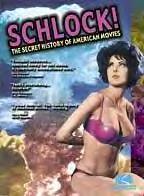
Schlock!:
Plot: A documentary tracing the history of the exploitation film. First things first. A subject this broad really requires a more in-depth examination. For instance, perhaps a series of programs, each one exploring at greater length some of the topics covered here. That being said, Schlock! remains an extraordinarily well-constructed primer for the novice B-movie buff who seeks a compact outline of the form’s history. Made by folks who obviously have invested much affection and no little amount of thought into these movies, it’s the best such project I’ve yet come across. I knew I was in good hands when I saw the parade of filmmakers the movie chose to interview. Roger Corman—displaying the exaggeratedly avuncular mien he’s assumed over the last several years—is well known enough to constitute a no-brainer, but the genre movie aficionado can only marvel at an all-star line-up that includes Forrest J. Ackerman, Doris Wishman, Harry Novak, Dick Miller, Maila "Vampira" Nurmi, Samuel Z. Arkoff and David F. Friedman. Moreover, the documentary team’s timing proved fortuitous, as some of the subjects listed above have already passed away since their appearances here. Lasting just under an hour and a half, the picture begins with a look at a campy low-budget stage musical based on the infamous Social Menace flick Reefer Madness. (This looks, unsurprisingly, quite similar to the more famous adaptation of Little Shop of Horrors.) Although it gets the show off to a comparatively slow start, it aptly illustrates the documentary’s view that the lowly, oft-scorned exploitation movie has exerted a surprisingly strong influence on the larger culture. This isn’t exactly a controversial assertion, in a day in which there’s a nearly limitless array of college courses built entirely around pop culture artifacts, but one that is ably supported here. Schlock! begins its exegesis by inevitably asking, "What is an exploitation movie?" Various answers to this query are then provided by the aforementioned interviewees. The first we see is Roger Corman, perhaps in an effort to still audience anxiety as to when the Great Man will show up. Corman’s response is hard to argue with, however, as it’s basically, "There’s no good answer to that question." By which he means, of course, that there are several equally valid answers that one might proffer. And does said exploitation refer to subject matter, or to exploitation your film’s audience? 60’s softcore porn producer David H. Friedman suggests that such films require an element of bad taste. There’s something to this, and it also serves to explain why such fare continued to get harsher and more explicit throughout the years. The films had to keep pushing the envelope, as viewers become inured to what earlier would have been considered shocking content. In the end, though, it’s difficult to argue with the cinema’s first female skin flick maker, Doris Wishman. "You say to me that I made exploitation films," she shrugs, "and I say to you, every film is an exploitation film, because as soon as you advertise something, you’re exploiting it." After a bit of this, the historical narrative begins. The first subject broached, and offered up as the engine that first drove the exploitation film, is the general transformation of American culture brought about by World War II. Millions of soldiers returned home, and their tastes in entertainment had grown rather more worldly as a result of the horrors they’d been exposed to. It wasn’t just cynicism that was rife, however. The same men also because America’s first mass-educated generation, the result of the G.I. Bill that helped veterans pay their way through college. Again, this isn’t entirely provocative material, but the clean manner of its presentation keeps such musings fresh. The following decade, of course, saw a period of reproductive activity (the Baby Boom) and material gain unmatched in human history. Here we launch into an examination of that era, although that sacrifices a purely chronological format. Maila Nurmi is the first subject to speak at length. As television’s first horror host, Ms. Nurmi is a vastly under appreciated cultural icon. Her show, locally broadcast in Los Angeles, was the first to bring low-budget horror fare to the young Boomers. Moreover, her mocking asides regarding the films she showed were an extremely early example of the sort of ironic humor that constitutes so much of the American psyche today. Her show also represents an early mixing of horror with comedy, also of a sort extremely prevalent today. More to the point, Ms. Nurmi and those horror hosts who followed in her footsteps—or, in the case of Cassandra Petersen, her bra cups—represent the first manifestation of the entire discipline of organized Bad Movie mocking. Before the myriad crap movie Internet sites, before Mystery Science Theater 3000, before the pioneering books of the Medved Brothers, there were Vampira, Zacherlie, Svengoolie and too many others to list. It’s more than a little appropriate, therefore, that in the guise of Vampira, Ms. Nurmi assayed a pivotal role in the Citizen Kane of Bad Movies, Ed Wood’s seminal Plan 9 from Outer Space. Television most prominently fostered the development of the exploitation film, however, by forcing filmmakers to offer something the tube couldn’t provide stay-at-home audiences. For the major studios, this generally meant vast spectacle. The low-budget independents, however, by necessity relied more upon content that, while tame today, was far bolder than that provided by the Establishment makers of entertainment product. The independent filmmakers were further helped by the court-mandated dismembering of the major studios from their previously self-owned movie theaters. This resulted in the end of what is now known as the Studio System, and meant that movie houses were now autonomous, free to show whatever fare they felt would make them the most money. The emblematic exploitation studio of the period was AIP, or American-International Pictures, founded by the legendary James Nicholson and Samuel Z. Arkoff. Their real insight was in realizing that for the first time, teenagers had the money and mobility (i.e, they had their own cars) to constitute a viable commercial audience. By catering to the first Media Generation, AIP is arguably as important a cultural institution as Sun Records. This demographic, moreover, sought entertainment with a vastly different vibe than that their parents’ enjoyed. "The ideal world for a teenager is a parentless existence," Arkoff muses. "No parents to shout at them, no parents to lecture to them." Seizing on this insight, AIP’s films featured teen protagonists (admittedly, often of dubious provenance) who were smothered and ridiculed by adults who were at best clueless and at worst tyrannical. I Was a Teenage Werewolf, for instance, features an authority figure who literally turns a trouble youth seeking his help into a monster, all for his own selfish ends. Even better, the technical quality of these pictures didn’t matter much, so long as the material alienated the sensibilities of the older generations in a manner similar to Rock ‘n’ Roll music. Thus sheer crassness became an important element of the films’ appeal, bringing old-fashioned ‘ballyhoo’ back into vogue. Colorfully lurid poster art featuring pretty girls, blazing guns, speeding hot rods and outrageous monsters was a major tool for attracting the audience the studio sought. Famously, AIP would actually begin by coming up with exploitable movie titles. Arkoff and Nicholson would compare notes, and the using the ones they both liked, they would commission poster art to match. Said artwork would then be shopped to theater owners. If enough of them showed interested in showing such a movie, only then would the two actually have a script written up and a film made. By pre-booking their movies in this manner, the projects would often be in profit before production had even begun. As Sun Records became the most historically influential music studio of the period by producing the records of the young Elvis Presley, though, AIP achieved similar cultural importance through its association with a hungry young producer/director of shoestring genre fare named Roger Corman. The Corman/AIP pictures are without doubt the films I know and love best amongst the various sub-genres examined here. On the other hand, this is the material that been most heavily trod in the past. Therefore, while still as intriguingly covered as everything else here, this is the section that held the fewest surprises for me. As well, I must admit, Corman’s overly avuncular mannerisms, ala those of fellow junk culture Elder Statesmen Stan Lee, tend to provoke me to a certain amount of eye rolling. Corman’s output is the stuff of B-movie legend, and needn’t be covered here in much depth. To be fair, though, everything said about him is warranted. He made films on incredibly, indeed insanely, small budgets. Indeed, it was his drive for economy that caused him to become a director, since it was one less person he had to hire in his role as producer. As well, obviously, it meant that he was in a position to rush the films through production, come hell or high water. Weirdly, though, Corman actually proved a pretty good director. Even before the Edgar Allen Poe films that he made with Vincent Price, the ones that solidified his artistic reputation as a director, Corman helmed films that are almost miraculously good, given the constraints they were made under. I’m not going to match such flicks as It Conquered the World or Bucket of Blood with, say, On the Waterfront. Even so, the casual viewer is likely to be amazed at how much better such movies are than they have any seeming right to be. By the early ‘70s, however, Corman had retired from directing. Unsurprisingly, this is because he decided he could make more money purely by producing. He started his own production company, New World Pictures. Amazingly, this period of his career remains arguably even more noteworthy than his days with AIP. Corman turned out to have perhaps the most uncanny eye for young talent of anyone who’s ever toiled in the movie business. Taking advantage of the fact that such hungry youngsters were more interested in making films than money, he was able to produce films that tended to be much, much better than their mind-bogglingly minute budgets and shooting schedules would seem to allow. Having covered the ground most folks are likely to be familiar with, the film now moves on to less explored territory. This includes a look back at the very pioneers of exploitation cinema, the ‘roadshow’ men like Kroger Babb. Such fellows traveled from town to town, literally carrying their film with them, renting theaters and hawking prurient yet purportedly educational movies—films like Reefer Madness—to inevitably packed houses. Another fairly obscure area covered here is the evolution of the softcore porn film. At first there were films that basically just presented topless girls for audiences to ogle. These films, which were entirely sans any actual sexual content, became knows as the Nudie Cuties. Following these were the Roughies, unpleasant films that mixed generally non-explicit sexual content with violence. The film ponders whether the restrictions on showing explicit sexuality itself ironically encouraged the introduction of the more unsavory material. Although they don’t follow through on the idea, it is notable that once actually hardcore porn became legal, violence increasingly was removed from the mix. I probably really shouldn’t go into everything the film covers, so as to leave some surprises for those who I hope will seek the DVD out. However, it’s a mark of how good it is that I retained the itch to keep responding to it, as to establish a sort of ersatz conversation over the issues it raises. The overall tone of the picture is quite admirable. The narration is both intelligent and admirably concise, and it compliments the audience by assuming that we will understand words like, "alchemical.’ Even better, it does so without falling into the sort of intentionally arcane and smug academic tone that so often characterizes works like this. I became a little nervous when ‘50s government propaganda films like Duck & Cover were discussed, but luckily the filmmakers don’t go off on tangents like this very often. Schlock! inevitably brings up the two competing schools of B-movie fans, those who basically find entertainment value in their shortcomings (guilty) and those who believe that the films, for all their evident flaws, retain some actual measure of both sociological and artistic import. Unsurprisingly, the scholarly documentarians themselves lean towards the latter camp. Refreshingly, though, they don’t bash us chortlers. I have to give them credit, too, because the film they chose to examine through this lens is the ultra-schlocky The Brain That Wouldn’t Die. They admit the movie is, to some, "a sublime example of the so-bad-it’s-good esthetic." However, they also weigh its possible deeper meaning(s). "Yet in its own weird way," they posit, "The Brain That Wouldn’t Die can be interpreted as a bizarre feminist allegory." That kind of thing can get pretty thick, but they wisely argue their brief in a way that doesn’t suck the fun out of watching the film, and without attempting to overstate their case. "Could The Brain That Wouldn’t Die’s makers have meant for such abstract ideas to be drawn from their work? Almost surely not," they admit. "Does that negate the possibility that they’re present anyway? Not necessary." The theory is then advanced that the movies were made so quickly, with so little time to rough out edges, that they basically emanated from the filmmakers’ ids. In the end, most fans probably follow that philosophy, believing these films to be both crappy and yet somehow culturally important at the same time. Even if that’s not true, however, the more people who are drawn to such fare, whatever their motives, the more likely the films will be preserved and made widely available for future generations to debate and snicker over. In the end, about the only slight complaint I could muster involves the film’s early showcasing of pithy quotes from its interview subjects, which statements are then reused later in the proceedings. In a film otherwise so lean, I found such repetition just a little annoying. That’s pretty small beer, however. The DVD includes a commentary track by the film’s makers. Having mostly said what they wanted to in the film itself, this largely involves their experience in putting the documentary together. There’s quite a lot of extras, besides. For example, extended interview clips with Harry Novak, Doris Wishman and David Friedman are provided. (Admittedly, in a perfect world all the rough footage of all the interviews would be included.) Another highlight is an entire industrial short entitled Atom and Eve, a cheesy—and, the filmmakers’ contend, frightening—effort to sell consumers on the benefits of nuclear power. This proves so amazingly kitschy that you half expect Troy McClure to make an appearance. Also of interest are a twenty-minute radio interview with the film’s writer/director Ray Greene, as well as the movie’s entire musical soundtrack, available as an audio track. I was amused, by the way, when the radio host got the entire significance of the Social Menace films—he refers to them as "hygiene" pictures—exactly backwards. He remarks that they were sold to the audience as sex films, but then turned out to be cautionary tales about the dire consequences of fast living. In fact, the opposite is the case. The films were rather sold as cautionary tales, so as to provide their audiences in a more conservative time with a fig leaf of justification for watching the decadent doings that made up the bulk of these pictures’ running times. (Unsurprisingly, Greene quickly corrects his misnomer.) Unfortunately, you can’t pause or more through the interview, but rather must listen to it from end to end. Summary: Somebody at the Sci-Fi Channel should commission a series from these guys, stat! ____________________________
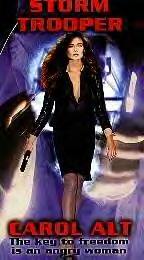
Storm Trooper (1998)
Plot: Eeee-vil Gov’ment SpOOks ineptly attempt to kill an escaped experimental subject. Every hobby has its inherent downsides, the sort of things generally referred to as occupational hazards. For hardcore us B-movie addicts—by which I mean, those who buy random, wholesale lots of cheesy sounding videos on eBay, or load up a weekend’s worth of viewing fodder from the sci-fi and action shelves of their local rental store each Friday—one of those hazards is that you’ll all too often pop a cassette or DVD into your player, only to be confronted by the words "Directed by Jim Wynorski.*" [*Actually, while the result is generally the same, there are permutations to this. For instance, looking at the reviews found at various of my colleagues’ sites, it seems that many of them are more prone to be afflicted by the oeuvre of Albert Pyun. Perhaps I just spend a greater amount of time perusing generic ‘action’ films, but more likely it’s because I’m not as enamored as they of movies about cyborgs. The all-too plentiful works of Fred Olen Ray deserve a mention here as well.] It’s says something about the human condition that I continued to watch the movie even after these dire words appeared on the screen. Well, actually, maybe it just says something about my particular condition, but I’d prefer not to dwell upon that. In any case, Storm Trooper proved pretty representative of Mr. Wynorski’s output. Utterly nonsensical and shot presumably over the course of several days and with an apparent budget reaching well into the tens of thousands of dollars, the film is most noteworthy for how exceedingly tedious it is, given the vast amounts of violence, gunplay and explosions it crams into its barely 80-minute length. As is his habit, Mr. Wynorski apparently spent the bulk of his meager resources assembling the sort of ‘name’ cast that mysteriously must increase video unit sales. The star of this feature is model-turned-actress…hmm. On second thought, that’s a bit much, based on her performance here, anyway. Let’s instead say, ‘model-turned-object-filmed-by-Jim-Wynorski,’ Carol Alt. To be fair, Ms. Alt no doubt gives her all here, and the script, for good or ill, provides her plenty of opportunities to do so. However, I don’t believe she’ll be mentioned in the same breath as Jessica Lange, or even Rebecca Romijn-Stamos, anytime soon. On the other hand, I await with a pathetically fierce anticipation her upcoming project, Snakehead Terror. The remainder of the cast is typically made up of serviceable, eminently familiar B-movie vets, as well as wince-inducing turns by folks who previously had starred in real, actual movies. The former set includes the venerable Ross Hagen, Rick "Deathstalker" Hill, Jay "Hollywood Chainsaw Hookers" Richardson, Melissa "Raptor" Brasselle and Melissa "Raptor" Brasselle’s breast implants. (Don’t get too excited, the latter remain under wraps throughout the proceedings.) Since there’s now a union rule that every DTV movie must have a rapper in it, Kool Moe Dee makes a rather pointless appearance. The saddest face to appear here, however, it that of Zach Galligan. Less than fifteen years earlier, Mr. Galligan had starred in Joe Dante’s Gremlins, one of the films that defined the ‘80s. By 1991 he was appearing in woeful crap like Zandalee, and in 1994 his fate was sealed when he played in the likes of Cyborg 3: The Recycler. How the likeable young man who starred in Gremlins ended up toplining the second sequel to a Jean-Claude Van Damme/Albert Pyun movie is too depressing to contemplate. In any case, here his part can’t even be called a second banana role. It’s more of a third, forth or fifth banana. That’s not the end of it, either. Also appearing here is Corey Feldman, which perhaps explains why he consented to appear in the embarrassing WB reality show, The Surreal Life*. Mr. Feldman appears as one of a number of mostly faceless mercenaries, and his former fame only garners him a couple of personal close-ups and an eye-patch presumably meant to help us distinguish him from his fellows. I suppose the most damning statement I can make about his film is that it makes you feel sorry for Corey Feldman. [*Perhaps the most revealing moment of The Surreal Life involved the show sending the has-been cast—except for still-working rocker Vince Neil, Feldman and MC Hammer were easily the program’s biggest names—to buy themselves groceries. Entering the store, the majority of them looked around the place in obvious ignorance and wonder, and I realized with a shock that even Corey Feldman still has people who buy his groceries for him!] The film hits the ground running, or at least limping. A group of *ahem* elite solders—I guess, although they don’t even have matching clothes—arrive and deploy themselves at a building identified as the Tannis Corporation. (Per usual, this edifice is obviously, in real life, a water filtration facility.) Leading the team is General (!) Beckett. "Two got away," he snarls. "Find them." Meanwhile, two of his men fall prey to a naked man and woman, who kill them and steal their clothes and weapons. The nudity is implied rather than explicit, by the way. Given the sort of film this is, makes you wonder why they’d bother. The two are dispatched via the "cup chin from behind and twist head one inch to the side" technique that’s so popular in movies today. In fact, this method will be employed at least half a dozen times throughout the proceedings. Who knew it was so easy to snap a person’s neck? Meanwhile, Beckett demands a report from his (clearly civilian) subordinate, Kreigal (Galligan). Kriegal reports that their targets remain at large, lamely noting "They offered maximum resistance." Whatever the heck that means. I mean, seriously, who writes dialog like that? Anyway, other soldiers (I guess they’re soldiers, but if their civilian dress is meant to be a disguise, what’s with the fully uniformed Army general?) find the fugitives and begin to fire at them in a less than professional appearing manner. The woman falls, and convinces Stark, the man, to flee before he himself is captured or killed. Hilariously, the soldiers all stop at the woman’s body, apparently under the belief that if a guy has got a thirty or forty step lead on you, there’s no real point in attempting to pursue him. Making it aboveground, Stark happens fortuitously happens across an unlocked and unsupervised shed marked "Danger High Explosives." Inside he finds a rack of military rifles, as well as a cabinet upon which sits several pistols, some grenades and two bundles of dynamite. Stuffing some of this stuff into his jacket—did I mention the clothes he took off the dead man fit him perfectly?—he takes his leave. In a moment that defies explanation, he walks over to a guy on a motorcycle five whole feet away from the shed and steals the guy’s bike. Somehow the guy doesn’t at all notice the dude leaving the weapons’ shed, and moreover seems mysteriously unaware of the armed raid taking place. Several men fire at Stark, but he rides to safety. We cut to a motorcycle trooper turning down a remote country road. Then we cut to a farm house, from which exits Grace (Alt). She calls for her dog, Rocky, and is playing with him when the trooper arrives. This proves to be her husband, Randall. The next portion of the film, which takes up way too much of its running time, concerns that revelation that Randall is an abusive husband. Grace wishes to leave him, but fears he will kill her should she try. Including this sort of genuinely distasteful material, culminating in a sex scene where a camera pan eventually reveals the terrified Grace’s tearful reaction to her husband’s attentions, struck me as a bit presumptuous, considering how willfully junky the rest of the picture is. Meanwhile, Beckett calls his Sinister Superior, General Gardner, to report on the escapee. Gardner, for some reason, has in his weirdly gigantic office a full-sized pool table. Gardner berates Beckett, as the camera reveals a quite evident Gov’ment Spook sitting amidst the vast shadows beyond the pool table. Should the Mysterious Project be revealed to the public, "It’ll make those Watergate conspirators look like a bunch of choir boys compared to us," Gardner helpfully explains. I also liked Beckett noting that the fugitive can’t escape, as he’s "a hundred miles from anywhere." Yeah, wow, traveling a hundred miles on a motorcycle would take, uhm, weeks. We cut back to Grace’s house for more of that feel good storyline. Meanwhile, a rainstorm kicks up. Hmm. Well, Randall’s a trooper, and it’s raining, so I guess that covers the film’s title. It’s as good an explanation as any other I could think of, anyway. Out on the highway, we cut to a car occupied by Driver (Kool Moe Dee) and Shotgun. That’s what they’re credited as, presumably because one is driving the car and the other has a shotgun*. Yep, somebody put a lot of thought into this film. [*Actually, as Jabootu Minister of Proofreading Carl Fink has pointed out, the second fellow is probably named not for his weapon, but because he's riding 'shotgun' to the Driver.] Following some ‘comical’ banter, and after allowing us to bask in the pure star glow of Kool Moe for a bit, the two happen upon Stark on his motorcycle. There follows a none-too expert chase/shootout scene. The only pleasure I derived from this was by comparing the angle of the barrel of Shotgun’s weapon and the placement of the squibs going off around Stark’s cycle. I don’t know what kind of loads Shotgun is using, but apparently his shot is falling straight to earth after traveling about fifteen or twenty feet. In any case, the pursuers blow a tire and Stark escapes. Meanwhile, Kriegal contacts McCleary (Hagen), who sets off in a big rig to find Stark. Eventually the two meet up on the road, leading to another lame action sequence. McCleary tries to run Stark’s cycle down, although oddly he first tugs on the truck’s air horn first. Yes, you should always alert your victim before attacking him. Now, it’s pretty clear that Stark could just ride off the road, as there’s a number of spots where McCleary’s truck couldn’t follow. But hey, it’s not that sort of movie. Ultimately, Stark turns around and chucks one of aforementioned dynamite bundles at his tormentor before inevitably skidding himself and the bike under his opponent’s vehicle. Given the way the semi goes up, by the way, it was apparently hauling a load of napalm. Also, as this is a Wynorski movie, I’m assuming the explosion and bike stunt were stock footage from another picture. Shaken, and with his bike demolished, Stark staggers off the road. Immediately, Driver and Shotgun show up and continue the chase on foot as the rain begins to pour. By now the ‘non-stop action’ concept is starting to wear, because while the action might be non-stop, it just ain’t that great. Jumping from one clunky action scene to the next to the next doesn’t a good movie make. Meanwhile, Grace is finally telling Randall she wants a separation. She then actively goads him into hitting her. I guess that sort of self-destructive behavior might be a realistic portrayal of some abusive relationships, but again, what the hell is this sort of material doing in a perfunctory piece o’ crap like this? This is followed by some backstory about how Grace’s son was killed in a car accident while Randall was driving. By now I was finding all the time they were spending on this stuff kind of weird. However, I guess it’s meant to motivate Grace’s subsequent action. When Randall turns away from her, she picks up his service revolver and shoots him in the back, killing him. Panicking, Grace drags the body into the bathroom and hides it in the tub. This little bit actually works. First of all, she seems at this moment believably nuts, and furthermore she has a realistic amount of trouble getting Randall’s corpse into the tub. Having achieved this, she returns to the living room and begins scrubbing the sizable bloodstains in the carpet. She’s distracted when she hears Rocky attacking Stark, who’s stumbled into the yard. She begins to call the cops, but, you know, the Randall thing. The badly wounded Stark makes it inside before collapsing. This pretty much sets up the rest of the picture, which becomes one of those siege deals with Stark and Grace teaming up to defend themselves against a series of attacks. First Driver and Shotgun appear and begin shooting the place up. Meanwhile, Beckett brings in Denton, the leader of a *cough, cough* elite mercenary squad. Feldman and Brasselle are members of this, and needless to say, they are sanctioned to kill whomever they need to in accomplishing their mission. Given that Gov’ment Assassinations apparently murder tens of thousands of innocent civilians every year, it’s amazing they are able to keep it all a secret. In any case, the film ultimately racks up a prodigious, if increasingly unexciting, body count.
One oddity is that, despite being more like Robocop (or, as argued above, R.O.T.O.R.), the film signals its ‘shock’ revelation with all sorts of Terminator and Terminator II references. The man the naked Stark kills and steals clothes from was wearing a leather jacket and biker boots. Stark tells the wounded woman cyborg, "I’ll be back for you." Stark steals a motorcycle, which is employed in some action sequences, including one where a semi chases the cycle while attempting to run it down. Randall at one point says, "A storm is coming." After a huge explosion involving a trailer truck, Stark is seen rising amidst a bank of fire. Etc. I can’t say any of this is particularly witty, but at least they try. If you are going to watch a Wynorski movie, I strongly suggest one of the ones on DVD that he provides a commentary track for. (Storm Trooper, sadly, doesn’t fall into this group.) Since Wynorski doesn’t try to pretend his films are any better than they are, these usually prove to be pretty funny, and reveal quite about the world of low-budget filmmaking. Such discs include those for Final Voyage, Cheerleader Massacre, Deathstalker II, Extreme Limits, Raptor and quite a few others. Summary: I judge this movie to be lame and sentence it never to be watched again. -by Ken Begg |