Another feature of... |
|
Another feature of... |
|
|
for
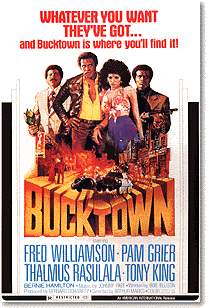
(1975) Plot: Fred "The Hammer" Williamson kicks some white ass. (Well, OK, that’s the plot of every Fred "The Hammer" Williamson movie.) Our setting is the Southern town of Buchanan, nicknamed Bucktown due to its largely black population. Getting a radio call, two redneck cops are soon chasing down a black thief. Catching the miscreant at the train station, they beat the man severely. Duke Johnson (Williamson), stepping off a train, sees this. He walks on, but has attracted the officers’ notice. Duke has come to Buchanan for the funeral of his brother Ben. At the service he meets Aretha (Pam Grier!), Ben’s girl. She’s hostile to him, knowing that he’ll leave town the first chance he gets. Which is true. In fact, Duke is angered to learn that he’ll have to wait two months before he can sell off the property he’s inherited from his brother. This includes a bar, which he decides to run until the waiting period is up. Soon the cops come around for payoffs, though. Duke beats two of them up and tosses them out on the street. Then he confronts Patterson, the Chief of Police (Art Lund). Patterson advises him to go along to get along. He also reveals that Ben was murdered, and hints that he had it done because Ben was causing trouble. Seething, Duke takes off. Aretha comes by to visit Duke at Ben’s old house, which he also got in the will. (If Aretha is going to be constantly pissed off, maybe she should save some of her ire for her ex-boyfriend. He could have left her something.) The two quickly fall into bed, allowing for Grier’s then de rigueur topless scene. After that, the cops appear out on the lawn and shoot the place up with shotguns. This is a warning, but naturally it only gets Duke’s back up. He is, after all, a Blaxploitation hero. He dismisses Aretha’s suggestion to leave town, explaining that he doesn’t run from anyone. He will need help. Calling up north, he reaches his old buddy Roy (Thalmus Rasulala). "It’s a jive town with a bunch of crackers," Duke explains. Roy quickly arrives with three other dudes to lend support, as witnessed by one of the cops. He’s naturally bewildered to see four large, nattily dressed (for the ‘70s) bru-thas getting off the train. How large? Let me put it this way: The smallest is played by Carl Weathers. The Blaxploitation film was not the most sentimental of genres, and Duke’s newly assembled crew is soon dishing out vengeance is an uncomfortably cruel manner. Watching the hulking Weathers, for instance, beating a runty coward to death with a baseball bat is pretty unpleasant. The other cops – a sum total of four officers – are taken out in short order. Patterson, meanwhile, is locked in the town jail while they try to get the location of his swag out of him. In most Blaxploitation pictures, this would mark the end of the movie. Here, though, we’ve still half the film left. Bucktown proves to have a lot more meat to it, putting it alongside such other complex genre entries as Detroit 9000. The town’s mayor, a black man who under Patterson’s regime was a figurehead, thanks Roy and his crew by making them the police department. Unfortunately, they quickly prove as corrupt as Patterson’s men were. (Many Blaxploitation films were loosely adapted remakes of old Westerns. This one is pretty similar to the Yul Brynner oater Invitation to a Gunfighter.) Ironically, the new officers look down on the town’s black citizens as much their redneck predecessors did. Not because of their race, but because they consider them hicks. Aretha is the first to figure out that the new state of affairs will pretty much resemble the old one. "Let me tell you something about people," she tells a scoffing Duke. "Whether they’re white, black, green, yellow or purple, when they smell a few dollars, they all act alike." And if anything, the new men are even more sadistic than Patterson’s crew. One of Duke’s friends is a garrulous old lush. Tiring of stories about his glory days as a school football star, Roy’s underlings set upon him with knives. This is more than a simple assault, however. It’s also a plan to drive a wedge between Roy and Duke, whose relationship the men resent. This is another way in which the new regime proves even worse than Patterson’s. The latter’s flunkies, as crooked and violent as they were, clearly recognized him as their boss. To an extent, Patterson made sure things didn’t get too out of hand. Roy, however, doesn’t have similar control over his men. (Worse, he thinks he does.) Patterson did keep a sort of brutally maintained civic peace, if only because Buchanan was their home. Roy and his men, conversely, obviously intend to squeeze the town dry and then take off. Avoiding the genre’s usual ‘black is good/white is bad’ mentality, Bucktown is a much more provocative film than most of its siblings. Which is why it remains relevant while many other Blaxploitation entries have simply become camp. Seldom, for example, does such a film foster sympathy for a character like Patterson. A scene where Roy’s men threaten him with a straight razor, however, is more than a little discomforting. Here evil isn’t solely a white man’s characteristic. In addition to its comparative moral and racial sophistication, Bucktown was made by pros. First, of course, there’s ex-pro football player Fred Williamson. The Hammer was perhaps the most handsome and talented lead actor to emerge from the heyday of the Blaxploitation film. He’s in full Clint Eastwood mode here, right down to his trademark panatelas. While Bucktown doesn’t provide him quite the showcase that Black Caesar did, this is still Williamson’s picture. Pam Grier presumably needs no introduction to anyone likely to be reading this. Her part here is somewhat generic, and certainly she’s not awarded the attention she got in her own starring roles. Still, there was seldom a film Grier appeared in that didn’t benefit from her presence, and this is no exception. Aside from Grier and Williamson, there are several faces quite familiar to fans of ‘70s genre films. Thalmus Rasulala appeared in zillions of Blaxploitation films, including Blacula, and was also a very busy television actor. He makes Roy, a mirror image of Patterson, all too believable. Carl Weathers, of course, went on to play Apollo Creed in the Rocky movies and famously starred as the titular hero Action Jackson. Patterson is assayed by busy actor Art Lund. Lund remains best known as McKinney, the venally racist cop who is Williamson’s nemesis in the classic Black Caesar. Patterson is less aggressively evil than McKinney, though. He’s portrayed more as a hypocrite -- he’s a fervent Christian who believes God made whites superior to blacks -- and someone who accepts the way things are as natural order of things. He doesn’t particularly enjoy using violence, unlike his more sadistic deputies, but nonchalantly employs it as a tool to maintain the status quo. Think along the lines of the Gene Hackman character in Unforgiven. Veteran helmer Arthur Marks provides the film with clean, crisp direction. Bucktown is generally considered one of the classics of the Blaxploitation genre, and Marks directed two others as well. Friday Foster was one of the films that made Grier a star in her own right. The other was the superlative Detroit 9000, a cynical heist picture that’s a favorite of Blaxploitation connoisseur Quentin Tarantino. Whether by design or not – I’m assuming it was the former -- all three films portray racial issues with a much more nuance than was normally the case. I really wracked my brain to come up with a complaint about this movie. The best I could do is that Patterson’s police force of four officers seemed a little light for what appears to be a pretty good-sized town. That’s a small thing to carp about, though. Also, the end of the movie gets a little goofy in the action department, and the climatic ‘fight to end all fights’ is a bit much. Otherwise, this is a gem. Summary: Classic fare for action junkies, and more besides. ____________________
The Glove Plot: The life and times of a down-on-his-luck bail bondsman. The video box art for this film is completely deceptive. It suggests a Futuristic Psycho Killer film, ala Future Kill, featuring a Darth Vader-ish guy (or maybe a robot) employing some sort of spiked, presumably bionic killer glove. Therefore the problem with The Glove isn’t just that I really have no idea why it was made – not that that’s helping – but that they made this highly tedious and pointless flick and then tried to pass it off as something it ain’t. We open on a note of real promise, with a really bad ‘funky’ ‘70s theme song. The sound on my video isn’t too good, but here’s a taste:
We cut to Rosey Grier (!) dressing in bulky riot gear. As if he wasn’t bulky enough to start with. (Hey, did you know Rosey Grier is Pam Grier’s cousin? Really.) This outfit includes the titular object. Unlike the item portrayed in the poster art, however, this proves merely a leather gauntlet with steel plating attached. I’m sure being hit by this thing would mess you up pretty bad, but it’s really no more fearsome than a set of brass knuckles. Anyway, Rosey stalks Aldo "Bog" Ray (!), a prison guard who ends up in a parked car having a make-out session. (OK, it’s now officially fair to call this a horror movie, as anyone who knows what Ray looked like in 1978 can attest to.) Rosey assaults him, perhaps out of his own disgust at this nauseating spectacle, smashing up the car in the process. Ray is left badly, perhaps fatally, beaten. Again, I have to ask: Would Rosey Grier really need a steel-studded glove to beat up Aldo Ray? Also, how scary can Rosey be when he stalks his victims in a beat-up old station wagon? Next we meet Our Hero, ex-cop and bounty hunter Sam Kellough. (John Saxon!!) Given what we’ve seen so far, you might expect the film would be about Rosey and Sam’s pursuit of him. You’d be wrong. Admittedly, the picture occasionally meanders in that direction. Mostly, though, it’s just vignettes of Sam and the people he interacts with, usually portrayed by a bewildering array of guest ‘stars.’ There’s nearly omnipresent voiceover narration by Sam, to boot. In sum, the film reminded me quite a bit of episodes of Kolchak: The Night Stalker. Fans will remember that the supernatural plotlines often took a backseat to Kolchak’s oft-comic interactions with wacky interview subjects, hostile cops and, of course, his gasket-blowing boss Tony Vincenzo. Except that the scenes in the Kolchak series were interesting and genuinely funny. These aren’t. Also, Kolchak was a fascinating lead character. Kellough isn’t. Still, I wouldn’t be astounded to learn that this was originally written as a TV series pilot. Lest you think I exaggerate about the meandering nature of the proceedings, here’s a nearly scene-by-scene run-down. (Be aware that every scene featuring Sam begins, ends, and is often interrupted by his voiceover narration):
Trivia fans will be interested to learn that this film was directed by B-movie icon Ross Hagen. Well, OK, maybe not. Summary: Bor-or-or-or-ing. ____________________
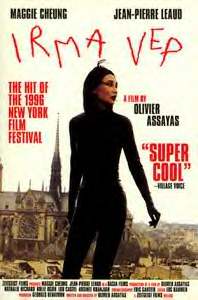
(1996) Plot: French filmmakers shoot a remake of Jack Feuillade’s Les Vampires. (For clarity’s sake, you might want to read this first.) Filmmakers, who like most artists are essentially narcissistic, love making movies about filmmakers. In several ways Irma Vep calls to mind Roman Coppola’s recent CQ. Personally, though, I found it a more interesting and coherent work. By the end of CQ I had become rather impatient with it. While Irma Vep didn’t knock my socks off, on the other hand, it easily sustained my attention throughout. It’s definitely a French film, however, and displays all the qualities of such: It’s extremely talky, there’s very little action, nothing much in the way of a plot and ends without anything resembling a climax. Irma Vep’s main concern is the state of the French film today. (Or in 1996, anyway) We open at the offices of a film company. In America the firm would be a small independent, but in France it’s probably a fairly big example of such. The image presented is one of chaos, with constant movement and back-to-back-to-back phone calls. A company executive is discussing money matters over the phone. The receptionist, meanwhile, is fielding questions about their latest movie. "It’s an art film," she says, as a prop guy wanders around the office looking for someone to accept a heavy revolver to be used as a prop in the movie. At this point, the film’s concerns have already been summed up. French cinema is now a business, as indicated by the executive’s discussion of the project solely in terms of large monetary figures. Also, the gun represents the dreaded idea of ‘action’ in a film. It’s so…American. (Ugh.) The revolver is meant to be an ironic counterpoint to the assertion that the project is an "art film." France takes its films very seriously (big surprise). The cultural elite over there is extremely agitated by the mass success – in France, worst of all -- of such recent ‘American-esque’ movies as Le Femme Nikita and Le Pacte des Loups. Many of the film-obsessed in France, however, really enjoy the vitality action brings to films. This, naturally, conflicts with the cultural imperative to reject all things American. Therefore, they cover by fervently embracing the rawer action films coming out of Hong Kong. Thus the star of the company’s new project turns out to be Hong Kong action film Maggie Cheung, who plays ‘herself’ in the film. She arrives in the office soon after the above bits. Cheung’s role as a fish out of water provides the film with much of its humor and heart. For instance, she doesn’t speak French. Thus conversations with her are in English, the universal second language. (I was initially surprised to hear Maggie speaking English with a British accent. Which proves I’m a moron, since she’s from Hong Kong.) Maggie’s literal outsider status brings perspective to the debate over French cinema. As everyone around her rabidly debates the semantics of Film, it’s apparent that she’s just here to do a job. She likes movies, but it’s her profession, not her passion. Cheung is taken to meet the film’s director, Rene Vidal. He was once a prominent director in France, but since has lost his way. (Again, it’s implied, due to the increasing Americanization of French cinema.) The project is a remake of Feuillade’s 1915 serial Les Vampires. The idea of remaking such a film is itself considered overtly commercial – a character later angrily complains, "It’s already been made, what’s the point?" – and Rene has accepted the job with major misgivings. In fact, he only agreed with the stipulation that Maggie was hired to play the central role of Irma Vep. He himself, he reveals, is enraptured with Hong Kong action cinema, especially Cheung’s The Heroic Trio. Choosing a remake of Les Vampires as the project the (real) movie revolves around is a canny choice. First, the work is a seminal one in French, and arguably world, cinema, thus providing all sorts of additional subtext. And, of course, subtext is what French Film is all about. Also, it adds a note of reality that wouldn’t be provided by some generic fictional project. And again, as an artistically pointless remake, it ably sums up the film’s overall concerns. It’s interesting that the central problem of the remake, how you would condense a seven-hour serial into a single film, is never addressed. The core of the idea is considered so bad, it seems, that such practical issues are beside the point. Many of the above concerns are explicitly raised by the various characters, who obviously spend a lot of time thinking about film. In other words, Irma Vep is almost entirely advanced via dialog. As is often the case with French movies, we don’t really have a plot, but merely observe our various characters as they go about their business. Much emphasis is on the grunt work of making the film. Early on, company costumer and gofer Zoë takes Maggie to a fetish shop. There they search for the skintight latex outfit for the actress to wear while playing Irma. Rene wants something that resembles the Catwoman outfit from Batman Returns, another example of American contamination. Zoë is one of the film’s major characters. She’s the company rebel, aghast at the nature of the project they’re working on, and a fervid believer that Film must be "political" to have any justification. As such she’s constantly butting heads with Laure, the film’s line producer. The two clearly hate each other. Since we get to know Zoë better, Laure comes off as a rather unsympathetic character. Even so, her complaints about Zoë might not be entirely unfounded. Zoë becomes Maggie’s main friend on the set. In fact, the bisexual Zoë develops a deep crush on the actress. This we learn during a dinner party Zoë ends up taking Maggie to. (This after the actress is found abandoned following the break of filming.) Zoë, a little tipsy, admits her feelings to a friend. Said friend, a rather more forthright type, approaches Maggie on her behalf. Zoë is mortified by this, but also clearly hopeful something comes of it. Maggie’s feelings on the matter, however, remain somewhat elliptical. We see a little of the actual filming of the remake, although that’s not the focus of the piece. Oddly, Rene’s version of Les Vampires isn’t really updated at all. It’s shot again, for instance, as a black and white silent. We see this during a screening of the day’s rushes, following which Rene goes ballistic. He’s come to realize that he doesn’t want to make this useless film, and he soon suffers a convenient mental breakdown that has him removed. These scenes, and all the others, go on a lot longer than they would in an American film. While they do advance things to an extent, that’s not really their function. Instead, we’re meant to get to know the characters better. Therefore we just jump around from incident to incident. Zoe takes Maggie to the dinner party. Zoe fixes a hole in the costume worn by Maggie’s stunt double. Maggie is interviewed by an amazingly obnoxious film buff, who mostly ignores her and stridently blathers on about Jackie Chan and John Woo. Again, these scenes last far longer than would be justified by their apparently importance in advancing the plot, such as it is. One such sequence doesn’t touch on much else going on, but is of central importance anyway. Late one night, following a conversation with Rene wherein he ponders making the film more realistic, Maggie climbs into her catsuit and skulks around the halls of her hotel. On impulse she surreptitiously follows a maid into another woman’s room – the latter providing the mandatory full frontal nude shot required in all French Films – and ends up stealing an expensive piece of jewelry. Climbing to the roof, Maggie quickly disposes of the artifact, but has tasted what makes Irma tick. Two points here. First, this scene reveals that Maggie is serious about her profession. She does, after all, commit a felony here, even if it’s in the interest of her craft. Second, the nude woman, full bodied and with pendulous breasts, bears a noticeable resemblance to the actress who played Irma in Feuillade’s serial. I’m not sure if this is intentional or not, although you assume such things in a French film have been thoroughly thought out. There’s some other stuff I could talk about, but I probably shouldn’t blow everything that happens here. Still, I was amused by the end of the film. At the end of the movie, the business executive is looking around for Maggie, having procured her return ticket to Hong Kong. He learns that she has already left on a flight to New York, where she’s meeting with Ridley Scott. There’s an amusing sense of appalled envy here. They thought they were dismissing Maggie back to the boonies she came from, only to find that she’s moving on to Hollywood. It’s like watching a guy who’s callously dumped his girlfriend learn days later that she’s now dating a rich, handsome stockbroker. If I had one complaint about the DVD, it’s that English language subtitles are provided for the French language scenes, but not for the English ones. This is a problem, as a number of the characters, especially Rene, have heavy accents. Summary: Interesting, even fascinating for a select audience, likely to bore the hell out of everyone else. ____________________
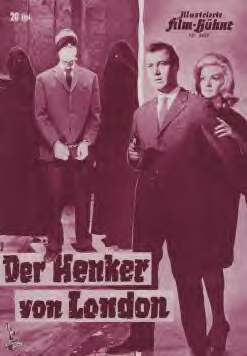
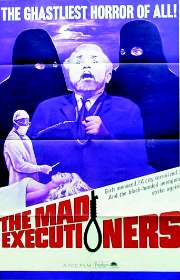
The Mad Executioners (1963) Plot: A hooded star chamber in England is executing criminals who have escaped legal justice. This is another of the Edgar Wallace adaptations so popular in West Germany during the ‘60s. Like the others I’ve seen, this is rather spuriously set in Britain, per the English Wallace’s novels. (See also The Mysterious Magician. An earlier, actually British Wallace-inspired flick, meanwhile, was Chamber of Horrors.) Also per tradition, the action is played more or less straight, with the exaggerated gothic elements there for those who want to take it as camp rather than as melodrama. However, this might be the most baroque picture of a very rococo bunch. We get to the goofiness right off. We open on a decrepit stone wall arrayed with cobwebs and a shelf bearing a *gasp* skull. This visual, inevitably, is accompanied by blaring organ music. Said music will be nearly omnipresent throughout, much to my delight. The camera pans away. A bound man, wearing a modern suit to indicate these events are contemporary, is being tried by a tribunal of hooded judges. (Shades of Brainiac and Bloody Pit of Horror. Apparently you can’t go wrong when you begin a movie this way.) This set-up alone is, as you might have noticed, a bit over-the-top. Still, this is an West German Edgar Wallace movie. So the tribunal meets in a moldering dungeon, sits behind a line of coffins (!), and has another occasional skull sitting here and there as a knickknack. Despite his protests, the defendant is sentenced to be hanged. No surprise there, I guess, as acquittals are fairly rare in the Secret Tribunal circle. Stuffing the gagged man in a coffin, they carry him outside, through a – what else -- foggy graveyard. The coffin is loaded into a horse-driven funeral hearse and they take off. Luckily, in Britain hooded men riding around in a horse-driven funeral hearse in the middle of the night is a fairly common sight. Or so I suppose, as the men aren’t stopped. The party is next seen in a boat, motoring down the Thames. As they approach London Bridge, we see a noose hanging from it. The man’s head is inserted, the boat pulls away, and the execution is accomplished. Cue credits and blaring theme music. Police Inspector John Hillier appears on the scene the next morning. This, we learn, was the third such execution. In each case, a file of evidence was left dangling around the victim’s neck, proving them guilty of some horrid crime. Hillier returns to Scotland Yard, where brainstorms with his fellows in the office of Commissioner Smith. (Trivia note: Smith is played by Wolfgang Preiss, who assayed supervillain Dr. Mabuse in a number of ‘60s series.) Smith, of course, is hot on getting this case closed. Seconds after admitting that the murderers left no clues, Hillier notes, "There’s one thing I know for sure. That the executions were performed with the same rope in every case." (!!) That sounds like a ‘clue’ to me, but then, I’m not a professional police Inspector. I was also somewhat baffled by this, since the rope is, of course, now in police custody, and presumably would have been after each body was found. It turns out the rope was used to hang criminals in the good old days, and is currently an exhibit in the Yard’s famous Black Museum. Before each killing, the rope has been stolen. (!!!) Smith and his underlings, learning of this, duly trudge off to the exhibit hall. There Hillier points out where the rope is normally displayed. All his is exceedingly comical, of course. Here’s some obvious reasons why:
After everyone but Trooper and Hillier has left, we notice that one of the wax figures in the hall is clearly a guy in disguise. Given that Hillier walks right past him without noticing, he’s not exactly making up for the rope business. Hillier finally does discern his presence, while he’s returning the rope to its display area for the third time, but only because the fellow keeps moving his head around. Rather than being a villain, the guy proves to be Pennypicker, a reporter, would-be sleuth and self-proclaimed master of disguise. Hillier just takes him at his word and lets him go. It’s that kind of movie. Pennypicker will be the film’s comic relief character, but also, I couldn’t help noticing, does most of the actual detective work as well. That night Hillier and Trooper visit their old friend, Sir Francis Barry. Sir Francis is a retired judge, noted for being of the hanging variety. Hillier has long used him as a sounding board, and thus brought the ‘indictment" of the latest victim as provided by the executioners. (I’m not even going to go into how many rules Hillier keeps breaking with stuff like this.) Sir Francis pronounces the work more than sound, and notes that he himself would have given sentenced the man to death based on the evidence it provides. Also attending is Ann, Sir Francis’ buxom blond of a daughter. Buxom blondes being de rigueur in these things. Her character is a little hazy in construction. Here it seems like she’s at best a casual acquaintance of Hillier and Trooper, allowing for exposition on Hillier’s background. However, a couple of scenes from now, she and Hillier will act like they’ve been romantically involved for some time now. Whatever. In any case, Sir Francis also has an inordinately loyal butler, Jerome. Oh, and occasionally we cut to a vaguely seen figure lurking outside in the garden. The reason for all these characters, of course – Chief Inspector Smith, Trooper, Pennypicker, Sir Francis, Ann, Jerome -- is that at least one of them will prove to be an executioner. Even at this point, however, it’s pretty clear that Sir Francis will not be amongst the guilty. Currently, for example, he’s giving a lengthy speech on how namby-pamby the justice system has become. In other words, he’s such an obvious suspect as to almost certainly be a red herring. Even Hillier is meant to arouse our suspicions. It seems his beloved sister was brutally murdered a number of months earlier. Sir Francis brings the matter up in a hilariously nonchalant way, as if horribly slain relatives were common after-dinner conservation fodder. Ann is shocked to learn of the situation – see above note – and Hillier confirms that it’s so. "You might as well say it," Sir Francis prods. "It was a sexual crime." He apparently knows that the secret to an amusing anecdote is in the details. Anyway, she was killed by a serial murderer who so far has eluded arrest. "You tell her, Doctor," Sir Francis helpfully continues, turning to Trooper. "You examined the body of Inspector Hillier’s sister." Anything to avoid those awkward pauses in the conversation, I guess. Attempting to be more circumspect, Trooper explains that the body was found under a bush. Sir Francis, a natural raconteur, has more to add. "Yes, amongst the flowers," he notes. "Her head cut off." (!!) Yep, no host ever made his guests feel more at ease than Sir Francis Barry. I mean really, can you picture seeing this in a theater? I can only imagine the gales of laughter that would result from watching all this with an audience. Try to visualize the scene: The host, yakking on at gruesome length to his daughter about the horrible crime committed against the sister and friend, respectively, of his two guests. As for Hillier and Trooper’s restrained reaction to all this, well, they certainly have solid command of that British ‘stiff upper lip’ thing. Eventually we get to the point of all this, which again is to set up Hillier himself as a suspect. Sir Francis asks Hillier if he would derive a measure of satisfaction were the executioners to hang the man who murdered his sister. Hillier admits he would. Sir Francis also casually mentions that crime rates have plummeted since the executions began. This is interesting, since it prefigures the scenarios of such popular ‘70s vigilante movies as Death Wish made a decade or more later. Cutaways and blaring organ chords remind us of the guy lurking out in the garden. Sir Francis reenters the room after a brief absence, bearing a gift box. Suddenly, a voice from outside yells, "Watch out! Don’t open that box! Throw it outside!" Hillier quickly obeys, tossing it out the patio door. There follows (what else?) a huge explosion. As the dust clears, they see Pennypicker, dressed as a Bobby and covered with debris. Good thing he’s the comic relief, or he might have been killed. Pennypicker, we learn, had heard of a threat against Sir Francis. So he went undercover dressed like a Bobby (!) to get more details. (Why one would get info from the criminal set by dressing like a cop isn’t explained.) Word was that a crime boss, released from prison earlier that day, was planning to kill Sir Francis. Rather than just reporting this to the cops, he decided to lurk out in the bushes until something suspicious happened. He again offers his detecting services to Hillier, who again turns him down. Despite the fact, which seems somewhat relevant, that Pennypicker just saved all their lives. Sir Francis at least has the courtesy to thank him. "That was very considerate of you," he opines. Gee, Judge, don’t gush all over the guy. Soon the hangman’s rope is stolen again (!!), right under the noses of some card-playing cops guarding it. Hope you weren’t counting on that pension, boys. The hooded fugitives, meanwhile, escape in their horse-driven hearse. (!!) I don’t really want to go into too much more of this, since people might want to see it on their own. There are more hangings, Pennypicker shows up in more comical disguises, Hillier remains baffled, etc. In any case, don’t let the above details dissuade you from checking this out. Up to know everything’s more or less been set-up stuff, and there’s about two-thirds of the movie left. I will say that the picture eventually takes a sudden lurch into even wackier territory, as if a hooded cabal of murderous vigilantes wasn’t enough. If you do decide to see the movie -- and you can buy a
copy from Sinister Cinema, which is where I got mine -- you should stay
clear of the film’s IMDB entry. There details of the final plot-twist
are unfortunately revealed there.
These films have not, to my knowledge, ever been released in an authorized version. You can buy copies of many of them, though, through sources like Sinister Cinema. (Movies must be in the public domain to be legally sold in this manner. The erudite Scott Munro kindly provides directions to an article addressing the issue of bootlegged videos: http://www.fetc.org/fetcon/1199/copyright.html.) Unfortunately, these aren’t always the best presentations. The film here, for example, is extremely rough in the beginning, although it smoothes out into a better condition as things progress. Expect some rough splices, though. Still, better to have the films available in some form, even if it’s less than perfect. Unfortunately, as German film historian/author David Kalat explained on his commentary track for the 1,000 Eyes of Dr. Mabuse DVD – a must buy, by the way -- master prints for many West German films of the ‘60s no longer exist. The Dr. Mabuse film following 1,000 Eyes was the example he gave, but it’s sadly possible that many of these Wallace adaptations are in the same boat. Therefore, copies taken off of damaged and dubbed English prints like these might be the best possible way to see them, even if somebody wanted to put them out on disc. And even those old prints are probably dying out. Summary: I just love this stuff. -by Ken Begg |