Another feature of... |
|
Another feature of... |
|
|
for
Bored of the Rings: Ben Stiller and Owen Wilson, when did comedy become difficult for you two? I was half paying attention to the pre-show, waiting for Sally Kirkland to totter by in a monstrosity, when I was treated to your staged bit of humor. Ben, I know Mr. Furious is pretty much your stock-in-trade, but it might be time to look into a Zoloft prescription. And Owen, are all those years of my standing up for you for nothing? When people dismissed you as a Gonzo-nosed stoner I tried to explain your comic genius, how it wasn’t your fault you couldn’t pick scripts to save your life. And my thanks? Your act of parodying shallow, self-obsessed pretty boys never got around to the parody. And both of you should know that making fun of plugging your movie on stage doesn’t make it any less lame. It was an ominous start to the show, and though it actually clocked in under four hours, it was still a chore to sit through. I know writing this will bar me from any future appearances on this site [Editor Ken: Uh…OK.], but it was due to the Lord of the Rings sweep. I have nothing against Peter Jackson; I enjoyed Heavenly Creatures immensely. I appreciate the skill it took to bring the trilogy to the screen. And even though I don’t think they are the very reason celluloid was invented and capable of curing blindness in several cases, I don’t begrudge them best picture or best director. However some of the special effects would embarrass the makers of Spider-Man, that award belonged to the virtually flawless work in Pirates of the Caribbean. And best song? I love Annie Lenox but pairing her with two sonorous Stingified pieces from Cold Mountain didn’t help. And compared to Catherine O’Hara and Eugene Levy’s sweet performance and the swinging "Bellevue Rendezvous," it lags a distant third. These are minor quibbles however, compared to Billy Crystal. His opening medley has been a short and sweet, entertaining-in-spite-of-itself way to open the show. Well, they seemed to have forgotten ‘short’ this year. As for ‘sweet,’ barely ten seconds into things we were treated to Bill in the buff. My only request if he chooses to go topless next year is to please put on a bra. Well, after hopping through an interminable assortment of clips, it ended with the specter of Jack Nicholson, a sight more terrifying than any Balrog. (Though I do wish to thank Michael Moore for finally displaying a sense of humor about himself. You’re back on my guilty pleasures list, Mike [Editor Ken: Ok, now you’re off the site.]). As if that wasn’t enough, Crystal then trotted out the threadbare song parodies of the Best Picture nominees. As I began to search for any sharp object to jam in my wrist he finished by serenading Clint Eastwood. I will admit, though, Paint Your Wagon jokes are always funny. That finished, Sean Connery took the stage. I have sympathy for the man, it can’t be easy to be of an age where your voice sounds like someone doing a poor impression of you. Following his mush-mouthed introductions, Best Supporting Actor was up. Now, while I’m glad Tim Robbins behaved himself (and looked dead sexy doing it), if I had known then how boring the ceremony was going to be, I would have hoped he’d be the bearer of the Fictitious Torch of Ill-Formed Political Sentiment. Oh, and Susan? You might want to pull that dress up a titch, I’m saying that as a friend. Next came a spate of technical awards and Rings began to pick up the 4,678 awards it would collect that night. It seemed like a good idea to pile all the best song performances together but with three drowsy songs of vague Celtic extraction right after another the show seemed to have moved backwards. And for those who wondered why Sting was playing a breadbox, it’s called a Hurdy Gurdy, a fact far more interesting than either of his tunes. Still, I’m appreciative of anything that kept Crystal from making timely japes about the Rodney King trial. The next acting award was for Best Supporting Actress. I’m slowly becoming unstuck from my Zellwegger loathing, but her acceptance speech didn’t help. Yes, it’s a big moment, but you don’t have to thank everyone who ever crossed Los Angeles’ city limits. And put down the damn handkerchief, it’s nice for the audience to believe you weren’t expecting to win with every fiber of your being. After that, a rough sea of Crystilian jokes, until a bald Jim Carrey took the stage. At first it seemed the failure of his repeated Oscar grabs had gotten to him as he jabbered like a howler monkey. If you listened closely you could discern that he was actually doing an Inspector Clouseau impression (sort of). Blake Edwards was this year’s lifetime achievement recipient, and after a very funny entrance through a wall he gave his speech. His jokes were hit or miss, but they were easily more entertaining than his last six movies. It proved a much better tribute than the late Katherine Hepburn received. Julia Roberts made it all about her, again, as she introduced the clip reel. Gregory Peck led the annual roll call of death. And the audience treated it like American Bandstand ("Wow, Michael Jeter earned a six on our clapometer!"). And then Will Ferrell and Jack Black appeared, bringing humor with them like a healing rain. Comedy accomplished. Best Actress was announced. Charlize Theron really needs to lay off the self-tanning lotion. Combined with her garish white foundation, it had the effect of looking like she hadn’t washed all her Monster makeup off. Her speech was the tearful wow-I-can’t-believe-this-even-though-I-was-the-odds-on-favorite-to-win deal. But she did thank her agents for all the help they gave, and as that includes getting her involved in The Astronaut’s Wife and Sweet November, she’s far more forgiving than I would be. Then came a quick kick to the groin of all that is good and decent, as Sean Penn took home Best Actor. Sean freakin’ Penn, who thought bulging his neck muscles and screaming constituted a good performance, beat out Billy Murray’s lovely, thoughtful, work in Lost in Translation. And to add insult to injury, we were denied a classic Sean Penn speech. No obscenity, no Black Helicopter conspiracy theory, just a jape about WMD so weak he probably borrowed it from Crystal, a few mumbled thanks and he shuffled off stage. Even so, it was very fun to entertain yourself by pointing at various objects and crying out, "IS THAT MY DAUGHTER IN THERE? ARRRRRGH". Then Peter Jackson was anointed the One True King of Hollywood. Congratulations, Pete, maybe next time you can run a comb through your hair before showing up. It was an off year for fashion, too. The Grecian trend was split two ways, with Angelina Jolie in a stunning white number and Uma Thurman seeming to have picked up her dress at an Etruscan yard sale. Sandra Bullock worked the Bridesmaid from 1975 look, and Jude Law is starting to look like a bit too much like Kevin Spacey than what is healthy. But JLo was nowhere to be seen, and for that we should all be grateful. And next year I’ll be able to enjoy a cold beer with the show, and if Whoopi returns, a fifth of Turkey too. ***** Note : I’m not interested enough in the teen genres to discuss either the plethora of gross-out comedies or teenie romances. There are a lot of them, though.The Desert Island Film (although I’ve never figured out how the heck I’d watch a movie on a desert island…) Hellboy -- There’s a surprisingly strong slate of films this spring, but I’m picking this one, and pretty much purely on the strength of director Guillermo Del Toro. I’ve never even read a Hellboy comic and know roughly nothing about the character, although I think I’ve got a rough idea of what he’s about just from seeing Ron Perlman in the make-up. Why do fans love Del Toro? According to Entertainment Weekly, he walked away from a done deal at Paramount when they demanded a supposedly more box office attractive star like (three guesses) Vin Diesel or The Rock. Del Toro balked, got backing from Revolution, and cast the guy he wanted. Muy bueno, my friend.Best of the Rest… The Alamo -- Delayed from the 2003 Christmas rush, and hopefully for the right reasons, i.e., to give director John Lee "The Rookie" Hancock more time to beat the movie into shape. I love historical films, especially if they don’t either prettify the past or descend into a politically correct smugfest, and it’s got a strong cast, including Billy Bob Thornton and Dennis Quaid. I’ve got my fingers crossed.Kill Bill Vol. 2 -- I’ll see this, obviously, but I’ll admit that as much as I enjoyed the first half of this work, it left so little after-impression that if I somehow missed this I could go on and live a contented life. I’m hoping for a little more breathing space between the ultra-violence myself, but that may not be the majority opinion. The Ladykillers – Normally, a remake of a Alec Guiness/Peter Sellers classic comedy would have me locking myself in my trailer until it left theaters a week later. However, with the Coen Brothers behind the movie, and Tom Hanks as a star…these guys aren’t infallible, but I’m willing to give it a spin. The sweet British old lady is now a sassy old black woman, and why not? Who slaps people around better than a sassy old black woman? It Could Be, It Might Be…. Broken Lizard’s Club Dread – Slasher movie parody made by the fellows behind the enjoyable dumb looking Super Troopers. No one’s ever made a decent satire on the slasher genre, which is begging for it. And Bill Paxton is in it, so that’s a plus. A sleeper?Eternal Sunshine of the Spotless Mind – More musings on consciousness and identity, from a story by the guy who wrote Adaptation and Being John Malkovich. Kate Winslet is a woman whose memory is erased, husband Jim Carrey decides to go through the same process. It is a comedy, and let’s hope a less pretentious one than the title indicates. Hildalgo – Period flick about a horse race across a 3,000 mile stretch of Arabian desert. The previews, chock full of exaggerated CGI sandstorm footage, ala The Mummy, didn’t exactly raise my expectations on this, but it’ll be interesting to see if Viggo Mortensen will have a career past the Lord of the Rings trilogy. Laws of Attraction -- Pierce Bronson and Julianne Moore are divorce attorneys on opposite sides who might just possibly fall in love. The odds against this being another Adam’s Rib are huge, but I like the stars. Still, Parker Posey’s name is quickly becoming a red flag where I’m concerned. Man on Fire – Shoot ‘em up starring Denzel Washington as a gun-slingin’ mercenary protecting eight year-old Dakota Fanning in Mexico. Directed by Tony Scott. This year’s Bad Company? Probably, but hope springs eternal. Ned Kelly – Bascially an Australian Western, with Heath "I’m in every period film" Ledger as the real-life outlaw. Naomi Watts and Orlando Bloom co-star. The Punisher – The vigilante comic book character returns to the screen, hopefully done right this time. Still, the words "face off against a villainous John Travolta" fill me with dread. Scooby-Doo 2: Monsters Unleashed -- I didn’t see the first one, but this sequel supposedly uses all the cool monsters from the first, and only decent, season of the cartoon show, including the ‘ghost’ in the glowing diving suit. Hmm…. Welcome to Mooseport – Ray Romano I like, and Gene Hackman, well, there you go. The plot, with Ramano running to be mayor of a small town, an office also sought by ex-U.S. President (!) Hackman, could allow for some really sly comedy or end up like whatever the hell movie that was with James Garner and Jack Lemmon. A Strange Attraction (But check the reviews first…) Starsky & Hutch -- By all rights, this should completely and utterly suck. And what the hell is Owen Wilson doing in another TV series adaptation after I Spy? Still, now that I’ve seen the commercial with Ben Stiller in that sweater, and driving that car…what can I say? I’m a child of the ‘70s. (And man, I never even watched Starsky & Hutch…)Whatever… Agent Cody Banks 2: Destination London – Uh, you’re kidding, right?13 Going on 30 – It’s Big with a girl (Jennifer Garner getting to show her comic chops). I’d actually see this before some of the other movies listed below, but the odds are still pretty unlikely. Dawn of the Dead – Seriously, what’s the point? I'll wait for the British comic horror piece Shawn of the Dead ( see trailer here), supposedly being released here this fall.Godsend – Rebecca Romijn-Stamos and Greg Kinnear clone their deceased daughter, and inevitably the kid turns eeee-vil. The increasingly uninteresting Robert DeNiro is in this somewhere. Unless the reviews are through the roof, I’ll never get around to seeing this one, but I long to read Liz Kingsley’s review of it. Home on the Range – Another Disney animated movie, starring three cows in a barnyard. Dame Judi Dench provides one voice, which is awesome. The other two leads, however, are voiced by Jennifer "Marginally better than Fran Drescher" Tilly and Rosanne (!). Ouch. Secret Window -- They keep making the Stephen King movies. This one might not be that bad; certainly a cast including Johnny Depp and John Turturro is encouraging, and I’d like to see Timothy "Archie Goodwin" Hutton and Charles S. Dutton catch a break, movie-wise. Depp is a writer—no one writes about writers as much as King—hounded by a nut. Was casting Hutton is this kind of a gag? He played the author in a similar situation in the King adaptation The Dark Half. Taking Lives -- Angelina Jolie is an FBI profiler after a serial killer (Keither Sutherland) blah blah blah. Like most of the films in this section, I’m not knocking the movie itself so much as admitting that the sort of film it is just isn’t my bag. It’s not a bag thing that director D.J. Caruso reportedly worked to make the script "darker" after taking the assignment, but these cops after the serial killer flicks just ain’t my cup of tea. Twisted – Ashley Judd is a cop after a serial killer…hey, wait a minute! Oh, wait, this is completely different than Taking Lives, because in that Angelina Jolie is an FBI profiler hunting a murderer, whereas in this Ashley Judd is a police detective hunting a murderer. In any case, if there was ever a time in which I could distinguish Jolie and Judd's careers, it's passed on. Twisted apparently apes Sea of Love, in that Judd's sex partners are being systematically kacked. Could Our Heroine herself be the killer? Bum bum bum. Direct by Philip Kaufman? What the hell? Co-stars Samual L. Jackson, or Lawrence Fishburne, since I think they’re now the same person in the same way Jolie and Judd are now the same person. I will say that Judd looks hot with her hair clipped short. The Whole Ten Yards -- In a spring with a Cody Banks follow-up, this might be the year’s least necessary sequel. Somehow they managed to reassemble the original’s all-star cast of Bruce Willis, Matthew Perry and Amanda Peet. No, Thanks Envy -- Wacky comedy with Jack Black and Ben Stiller. I saw the preview a while ago and was markedly unimpressed. Everyone’s rooting for Black at this point, but Stiller’s film career is a real mixed bag.Danger, Will Robinson… Against the Ropes – A white chick gets involved in black sports, ala Wildcats. This time the women becomes a boxing manager. Starring the no-doubt increasingly desperate Meg Ryan. Well, it’s got to be better than Marci X. Doesn’t it?Dirty Dancing: Havana Nights -- Pretty much just another period dancing/romance flick, with the ‘Dirty Dancing’ thing slapped on to add commercial appeal. Er, after nearly twenty years? It takes place in Cuba before the revolution, and Swayze apparently has a cameo as the guy he played in the real Dirty Dancing, although his age change thus makes no sense. Let’s just say that I probably won’t have the time of my life. Jersey Girl -- Presumably the last Bennifer movie, the advance word on this is poisonous. It’s written and directed by Kevin Smith, whose numerous films I’ve never seen, but which strikes me as movies I’d hope to like while failing to do so. Put me in that large group of folks somewhat mystified by Affleck’s promimence, and certainly J Lo’s participation isn’t going to draw me to theaters. Despite the fact that Lopez reportedly dies off early in the movie, it’s hard to see this one not instantly disappearing from theaters, especially following Gigli. Saved – A girl who goes to a Baptist school is ostracized when she gets pregnant by, and I quote, "her newly gay boyfriend." Co-stars Mandy Moore (?). Finally, a film that boldly exposes how intolerant evangelical Christians are, and how ready they are to view people who disagree with them and hold different values in a cartoonish, two-dimensional fashion. Oh, wait… What the Hell? Good Bye, Lenin! -- And I quote: "When a German socialist mom wakes up from a coma after the Berlin Wall has fallen, her kid goes to elaborate, comedic lengths to make her believe Lenin’s way is still thriving. A Golden Globe nominee for Best Foreign Language Film." Substitute ‘Hitler’ for Lenin and ‘Berlin’ for the Berlin Wall and you’ll know exactly what I think about this movie. Then I went to the IMDB and saw this in a user comment: "[The director’s] point is that communist oppression has been over-run by tacky commercialism." That’s a ‘point’?
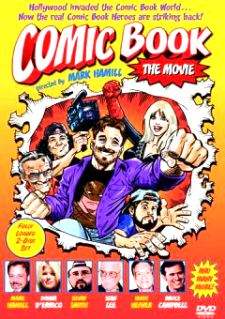
Comic Book: The Movie It was only a matter of time until other filmmakers began aping the pseudo-documentary format that satirist Christopher Guest has lately made into a career. All you need is a group event to build your movie around (the staging of a play in a small town, a dog show, a television reunion of folk music acts) and actors capable of improvisation, who can adlib conversations as the quaint characters they’ve been assigned, rather than merely reading scripted lines. Of course, not all actors are up to the challenge, which is why Guest has ended up with what amounts to a repertory company. On the other hand, even many of Guest’s fans have begun to admit that the format is subject to diminishing returns. Despite this, actor Mark Hamill has picked up the gauntlet and fashioned a similar film, his first as a director. Wisely, and unlike Guest’s most recent works, Hamill’s film is set in a world he himself has intimate knowledge of. (Indeed, during the DVD commentary track we learn that in real life Hamill’s dogs are named Simon and Kirby!) Comic Book: The Movie largely takes place against the background of a huge, real-life comic book convention in San Diego. Hamill, both recognizable and yet quite ordinary looking for a celebrity, plays high school teacher Don Swan. With his curly hair, beard and oversized round glasses, not to mention his oft-crazed expressions, Swan looks amusingly like Trotsky. I’m not sure if this was intentional or not, especially since there’s no mention of Trotsky in any of the auxiliary materials, but I found it pretty funny nonetheless. Swan is an old-time comic book fan, in both senses. His age is apparent in that he publishes a physical fanzine, Once Upon a Dime, rather than offering up his views via a website. He also co-owns a comic book store, although this setting doesn’t impact the film much. In sum, this is a guy who’s been involved with the comics scene for decades and never lost his fervor for them. Swan has been brought in as a technical advisor on a soon to be produced Major Motion Picture. This is built around an updated version of a golden age character originally called Commander Courage. Courage is/was a patriotic hero, one based most obviously on Captain America—he even has a pseudo-Bucky in sidekick Liberty Lad—although his powers and origin have been cribbed from the old Captain Marvel. However, the film will actually be based on a revamped and re-dubbed modern update of the character, Codename: Courage. Courage is now a violent Punisher knock-off who assassinates Islamic terrorists in place of the Nazis the original Commander fought. Moreover, Liberty Lad has been replaced with a busty Liberty Lass, who wears the obligatory skintight costume and who may be even blood thirstier than Courage himself. (I assume this is mostly based on Howard Chaykin’s cheerfully ultra-violent and sexed-up redo of ‘40s radio and pulp character The Shadow, although that’s only a guess.) This has all brought Courage renewed popularity, much to the chagrin of Swan, who has idolized the original Commander since childhood. In any case, production company Timely Films is planning a blockbuster extravaganza based on the property. Hoping to keep the fanboy crowd happy, or at least quiet, the studio has hired Swan to help sell the film to the attendees of the con. Swan, however, has his own agenda, which is to steer the film towards a more traditional take on the character. Even so, he attempts to see the good in the update. "I resolved to keep an open mind," he avers, "and try to stop hating it so much." Swan escorts studio hack Taylor Donohue to the Con, where the film will be officially announced. Donohue, along with his boss, Anita Levine, both view the attendees with marked disdain. Welcome to Hollywood. Dealing with the hardcore fanbase, of course, is a delicate business. There aren’t nearly enough such people to make a large budget movie a success, so paying overmuch attention to their concerns isn’t practical. At one point we see a Once Upon A Dime article headlined, "30,000 Fans Can’t Be Wrong." Actually, they can be. 30,000 tickets at ten bucks a shot equals $300,000. A major studio film needs to attract tens of millions of viewers, including a large non-nerd contingent. Even saying that, though, the hardcore fans can’t be ignored, either. Nerds are, as a class, technologically savvy, passionate about their pop culture and have a lot of time on their hands. If a film starts emitting a bad smell—like, say, the upcoming Cat Woman movie—the Internet can definitely be used to generate bad buzz. This is hard to defuse and can help tank a film, as with last year’s League of Extraordinary Gentlemen. In the end, your best bet is to assume there’s something worthwhile in the material or character(s) you’re buying, and to craft a good movie that stays relatively faithful to its inspiration. That’s when you end up with a Spider-Man or Superman the Movie instead of a Doc Savage, Godzilla or The Shadow. Taylor, a typical studio toady, is both bewildered and infuriated to realize that Swan has interests he puts above the movie’s commercial success. Through the fan network, for example, Swan has dug up Leo, a sheet metal worker who turns out to be a previously unknown grandson of Commander Courage’s late creator. Swan is ecstatic with his discovery, and brings Leo to the con. When the studio execs get wind of it, on the other hand, they’re horrified. Now that Leo knows about his grandfather, he could sue the studio for a piece of the action. Even if he doesn’t win, the delay in getting the film off the ground could torpedo the project, ending Taylor and Anita’s career at the same time. Swan has also, out of his own pocket, paid for a professionally made (if goofy) replica of the original Commander Courage outfit. Moreover, he’s actually hired an actor to wear the suit at the con. Taylor freaks out when he sees this, as the old Commander Courage has nothing to do with the character they’re building the movie around. If anything, it raises issues the studio is trying to avoid. Which, of course, is exactly what Swan is counting on. On the other hand, if the execs are slimes, they aren’t complete dopes either. Swan’s gambit is effectively neutralized when Taylor brings in a hot young thing—Baywatch’s Donna D’Errico—to fill out a vampy Liberty Lass costume. Needless to say, this draws a lot more attention from the younger fans than the square-jawed ham Swan has hired. The narrative is slanted, naturally, to take Swan’s side. There are plenty of good reasons for this, and clueless and venal studio executives certainly present an irresistible target. However, the picture might have been better off were it a big more even-handed in its venom, or at least a tad more objective. In other words, if an outsider like Guest had made it. As it is, the film is an affectionate valentine to the sort of fan that Hamill has interacted with over the last thirty years, and is, in fact, himself. Harrison Ford remains an actor who appeared in the Star Wars franchise, but Hamill’s personal geek credentials are pretty convincingly established here. Certainly one imagines that voicing characters like the Joker and Solomon Grundy in recent cartoon series has been more than just a job to him. Even so, Swan clearly represents an older sort of fan, one who ironically may be much less in touch with the younger generation fans than the vapid film execs are. Swan’s area of expertise is characters from the ‘40s. He loves the old Commander Courage, but it’s the homicidal update with the stacked blond sidekick that’s struck a cord with the kids. Swan does everything he can to pressure the filmmakers to make the movie he’d prefer to see. Yet when the Codename: Courage project is officially announced at the con, thousands of young attendees joyfully leap to their feet in a standing ovation. It’s perhaps too much to expect Hamill to do a William Shatner/SNL job on his fans. Shatner remains a bemused outsider looking in at the various nerds and dweebs who make up much of his fanbase. His detachment is largely due to the fact that he had a successful career outside of Star Trek, unlike the bulk of his junior co-stars, who have largely been forced to prowl the cons for lo these many decades. Hamill, meanwhile, is quite contentedly One of Us. Indeed, his continued happiness in the face of his diminished stardom is inspiring. Show business turns so many people into freaks that his normality is pleasing in itself. If the film could stand to be a bit more detached, it does happily get nearly all of the small details correct, which is the essence of good satire. The moment when Swan spots a Sub-Mariner comic and starts riffing to a blank-faced Leo about how Namor was "the original anti-hero," sounds like way too many of the excited pronouncements I’ve made myself over the years. He even speaks in the same rushed fashion, the mark of someone who’s thought about an issue a lot over the years but very seldom gets to communicate it to another person, and who fears getting cut off before making all his points. There’s also a great moment where Taylor is in the middle of reading Swan the riot act, when the latter suddenly takes off because he’s spotted Ray Harryhausen. The psychology here is perfect. Hollywood is legendary for the abuse it heaps on those trying to work their way up the studio ladder. Taylor accepts the crap Anita piles on him with as much grace as he can muster, savoring every humiliation and dreaming of the day when he can maltreat others in turn. Thus his utter astonishment when Swan, someone lower on the food chain than his is, just blows him off in order to genuflect before Harryhausen. Swan’s comments on stop animation to the Great Man, meanwhile, are all dead on accurate. The film is literally stuffed with cameos, including many geek superstars who appear as themselves, such as Stan Lee, Matt Groening, Kevin Smith, Bruce Campbell and even Hugh Hefner, who early in his career wanted to be a cartoonist. (I was at first amazed at this line-up, until I stopped for a second and remembered that the guy making the film had been, you know, Luke Freakin’ Skywalker.) Most of these appearances are justified as interviews being conducted by Swan for his fanzine. There are many knowing moments in these segments. Smith, elaborating on his fictional writing of an abandoned Commander Courage script, inserts an anecdote that references a famous story about producer Jon Peters. In real life, Smith once wrote a script for a proposed Superman movie, one that like several dozen others never got off the ground. The story goes that Peters' demanded that the screenplay feature a battle with a giant spider. This has been floating around for years, and several commentators have noted the giant mechanical spider that pops up in Peters' gawdawful Wild Wild West redo. Campbell’s appearance is great, of course, but in continuity it represents one of the film’s rare slips. The actor, we’re told, is up for the titular role in the Codename: Courage movie. As Swan interviews him, he subtly nudges the actor, in large part by appealing to his ego, towards favoring the old-school Commander. (The classic Commander Courage mask could leave much of Campbell’s face unobscured. The revamped Courage, meanwhile, wears a hood that completely covers his head. This is presumably a nod to Sylvester Stallone’s similar complaints about playing the helmeted Judge Dredd.) As always, Campbell evinces little ego in parodying himself, and his charm and intelligence are also much on display. Even so, the sad truth is that Campbell will likely never star in such a big-budget, mainstream film. In actuality, somebody like Vin Diesel would be talking to Swan. Still, the scene itself is great. Moreover, as a filmmaker Hamill knows what the fanboy crowd wants, which is everything. Although I haven’t seen the second disc in the DVD set yet, it apparently contains the complete and quite lengthy interviews ‘Swan’ conducts with his star subjects. You’ve got to admire that sort of insane attention to detail. Another great moment involves Matt Groening. "I try to keep it classy, I try not to be associated with shoddy products…" he blathers, whereupon, inevitably, a guy bearing a bunch of Simpsons-themed Kellogg’s cereal boxes arrives behind him. It’s an obvious gag, but the fact that they hit it and immediately move on keeps it funny. Some might find Swan’s ability to contact and interact with all these (comparative) pop culture giants unlikely. I, however, didn’t. Fandom used to be a much smaller place, and people like Swan were talking to folks like Lee and Harryhausen back when few others were interested. An especially nice cameo is an appearance by Maggie Thompson. She, along with her late husband Don, wrote some of the earliest books on comics, including the seminal All In Color For a Dime. Later they published the Comic Buyers Guide Weekly, a tabloid that provided the pre-Internet comics community with an invaluable forum. Anyone might have put Stan Lee in the this film, but only a real, hardcore nut like Hamill would have put Thompson on screen for five minutes. My other favorite character is a friend of Swan’s. The guy, himself a fan, drags his long-suffering wife and sweet young son to the Con. The wife puts up with it at first, with the air of someone who’s been in this situation way too many times, before finally grousing about how he bait and switched the vacation he promised her. The guy is played by the actor who voices SpongeBob Squarepants, and apparently this is really his wife and kid. One imagines she didn’t have to strain herself too much to play out this scene, and hopefully she found acting it out sort of therapeutic. The kid, meanwhile, who’s perhaps all of four years old, is a stitch. When handed a toy emblazoned with the word "Shazam," he pedantically explains that the figure inside isn’t Shazam, but Captain Marvel. (This is true. ‘Shazam’ is the word young Billy Batson utters to transform into Captain Marvel.) He then stops his mom from removing the toy from its box, informing her in a grave tone that it’s a "collectable." This is funny and scary at the same time, especially since it seems the kid actually knows this stuff and isn’t parroting lines. I especially enjoyed the glances at the various evolutions Commander Courage went through over the years, which do a pretty good job of detailing the comics scene as a whole. In the ‘50s, the superhero comic went into a tale spin. In an attempt to remain relevant, the Commander went from fighting Nazis to battling Communists. This again reflects what occurred with Captain America, who briefly did the same during this era. These activities have been reworked in the continuity of the ‘real’ Captain America as being the work of an imposter, who typically is presently portrayed as having been a racist bad guy, part of a larger cultural attempt to whitewash the Communist threat as being merely a red scare. When that failed to increase sales, Courage was awkwardly worked into the era’s more popular romance and horror genres. Eventually, however, the character fell pray to a Seduction of the Innocent-esque tome that, in a parody of Fredric Wertham’s theories about Batman and Robin, pronounced the Commander and Liberty Lad to be gay fantasy figures. In the ‘70s, the Commander returned as a member of the Utopia Squad, which included superbabe Allura and the Afro-Avenger. (The latter, presumably, is a parody of Cap’s hip black sidekick The Falcon during that same period.) He and Liberty Lad were also the subject of a Saturday morning cartoon series so cheaply produced that modern ‘toon wunderkind Paul Dini pronounces it to have "made the [‘70s] Justice League look like Fantasia." Presumably voice talent actors have a knack for this sort of improv work, because the film is chock full of them. Hamill, of course, voices the Joker on Batman: The Animated Series and Solomon Grundy on Cartoon Networks’ recent Justice League cartoons. Leo is played by Billy West, who assayed roughly half the characters on the late and much lamented Futurama. (Let me get this straight: They’re bringing back Family Guy, but not Futurama?) As noted above, Swan’s best friend is played by the guy who voices SpongeBob Squarepants. There are plenty of other such actors here as well. Finally, let me direct those interested to one of the better commentary tracks I’ve heard recently. Hamill and about half a dozen of his co-stars yak excitedly about the movie. It’s one of those happy affairs that comes across like a group of buddies chatting over pizza and beer. As a group commentary, the only other one that comes to mind as its equal is the hilarious track on the CHUD DVD. An especially funny moment occurs when Donna D’Errico makes her first appearance in the film. The guys all fall over themselves to praise not only her evident beauty, but also her sweet personality and sense of humor. One of the guys even interjects that she’s "the ultimate mom" and briefly talks about what a neat kid her young son is. The great thing is that they don’t sound like they’re leering at her, they sound more like ordinary guys with a dazed crush on the prettiest girl in high school. I doubt this picture will go down as any sort of classic. It has its share of flaws, and could have perhaps been five or ten minutes shorter. Still, there’s some great stuff here, and anyone who’s attended a comic book / sci-fi con of some sort or other will find themselves both laughing and perhaps wincing with some regularity. Hopefully Hamill will continue on in this vein, perhaps centering a film around the making of a cheesy horror or sci-fi movie. Summary: If you’re the kind of person who would watch this sort of thing, you won’t be disappointed.
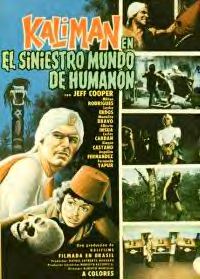
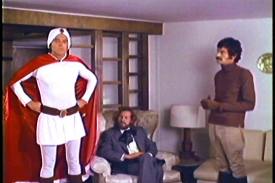
Kaliman in the Sinister World of Humanon (1972) Plot: A visiting adventurer in Mexico engages in various, uh, adventures. Ah, DVD…the format that keeps on giving. While it would have been nice to get the first ‘Kaliman’ film out first, any time a weirdo flick like this comes out, it’s cause for sublime joy. Well, OK, maybe ‘sublime joy’ is a bit much. Something, though. Fervid Excitement? Bemused curiosity? Mild interest? Anyway. Kaliman apparently was a hugely popular radio and weekly comic book character in Mexico. In 1972 he came to the screen in a lavishly budgeted (for Mexico, anyway) flick entitled Kaliman, El Hombre Increible. It apparently did well enough to justify a sequel, which is now on available on disc. My knowledge of the character is at best sketchy. I think Harry Belafonte asks him to count his fruit in "The Banana Boat Song," but that was all I could come up with off the top of my head. However, here’s what I gleaned from watching this movie. First, he apparently hails from some Eastern country. In any case, he dresses like Punjab from the old Little Orphan Annie comic strips. His full costume includes blinding white slacks, tunic and turban. A black leather belt cinches the tunic at his waist, and he also sports black boots and a full-length white cape (!) with a red satin interior. On the whole, Kaliman appears to be a knock-off of Clark ‘Doc’ Savage. Like Savage, Kaliman apparently represents the very acme of human physical and mental development. Both men are portrayed as having an encyclopedic knowledge of even the most esoteric subject, as well as being expert in various and sundry martial arts. Unlike Savage, however, Kaliman also displays some psychic abilities, although their variety and extent remained more than a little vague. Therefore he has a bit of The Shadow mixed in as well. Indeed, like The Shadow, Kaliman learns his telepathic skills from Tibetan lamas. Moreover, all three heroes share a personal code doesn’t allow them to take a life. As played by Canadian (?) actor Jeff Cooper, Kaliman is indeed a big, buffed-out dude. Mucho evidence of this is provided when he ends up shedding his tunic for much of the latter part of the film. Apparently he gained these various skills while studying with (who else?) Tibetan lamas. He travels with what I guess to be his ward, a young lad named Solin. The film opens with an airliner landing in Rio de Janeiro. The music accompanying this image is weirdly perky and lighthearted, the sort of thing you’d expect to hear in a Mr. Hulot movie. After the plane lands, Kaliman and Solin disembark. Apparently this is the same world inhabited by El Santo, or so you might suppose from the fact that no ones ever takes much notice of Kaliman’s outré attire. After taking a shuttle bus (!)—ah, the classically Mexican mixture of the prosaic and the absurd—Kaliman and Solin are picked up by a car containing young bearded scientist Professor Pheraul, his secretary Shamara, a redhead wearing a veil over the lower half of her face, and Cabaledo, who is apparently the winner of the South American Burt Reynolds Look Alike Contest. During all this that jaunty music continues to play, which was really weirding me out. Shamara thinks about how handsome Kaliman is, and he thanks her for the compliment. "Do you read minds?" she asks, albeit with only mild surprise. "No, he’s just telepathic," Solin replies. I think that’s supposed to be funny or something. Our Hero, we learn, is in town to attend a "congress of psychology." He mentions that he looks forward to meeting the eminent Dr. Avadamn*, hoping that he’ll "explain his theory on psycho-cellular." Hey, who doesn’t? [By the way, whoever did the subtitles couldn’t make up their mind over how to spell this name. It keeps alternating between ‘Avadamn’ and ‘Avadam.’ Since the second is shorter, I’ll use that one.] His remarks prove unfortunate, however. Later, Professor explains that Shamara "was" Avadam’s "ex-wife." "What do you mean, ‘was’?" a shocked Kaliman asks. "Are you trying to tell me he’s dead?" Aside from being an amusing attitude that you wouldn’t have seen in American pictures since the ‘50s—that if a woman is no longer married to a man, it must mean that he has died—this is an example of faulty subtitles. These do indeed use the phrase "ex-wife," when clearly the proper translation to lead into the above rejoinder should have been something like "She was his wife." Avadam has not only died, but he was murdered, in fact decapitated. "But they never found his head," Professor admits. "Shamara has not recovered from such a terrible shock," he explains. I should mention the Kaliman spends this entire scene in the Official Superhero Pose, but which I mean he stands with feet spread, arms crooked and fists planted on his waist. At this point Cabaledo jumps in, noting, "We think he was a victim of an old witch. Professor Avadam tended to attract those kinds of people." Given that this is a Mexican film, we’re unsurprised to learn that he means ‘witch’ in the literal sense. Cut to a public beach, where the first thing the camera focuses on is two hot women in bathing suits. At this point Kaliman comes striding into view, with Solin in tow. The two women giggle as they check out the studly adventurer. Either that or they’re wondering why a man in a turban, long sleeve tunic, boots and cape was on the beach. Actually, he’s just passing through. Soon he and Solin are cruising around in a classic Mustang convertible. Here the music finally switches from intimate and whimsical over to a jazzy, Jonny Quest sort of action theme. These two pieces of music will be alternated throughout much of the picture, with the content of the particular scenes they play over seemingly not a factor. For instance, watching Kaliman and Solin drive around for several minutes admiring the skyscrapers of Rio would not, in itself, seem to require ‘action’ music per se. I especially like the bit where they briefly pause the music as the two stop to survey a giant statue of Jesus ("His inheritance," an inspired Kaliman muses, "which he [sic] gave humanity, was to be humble and to love") then abruptly restart it as we cut back to them on the road. This goes on for a while, including a sequence where the two ride a cable car up to a mountaintop. Again, none of their fellow tourists seem to even notice Kaliman’s rather flamboyant attire, which maybe we’d buy (maybe) if it weren’t for the cape. Anyway. We eventually see that by are being followed, apparently by Cabaledo. It’s no problemo, though, for Kaliman is casually aware of the fact. In a nice bit, he uses the opportunity to instruct Solin on how one should always remain aware of their surroundings. They return to their hotel suite, where Our Hero instantly senses the presence of Shamara. She is now wearing a cleavage-bearing mini-dress to compliment her veil. She’s brought him some document for Prof. Pheraul, and he takes the opportunity to quiz her on her husband’s death. Yep, you’ve sure got a way with the ladies, Kaliman. As does her employer, Shamara believes witches were behind his demise, an act meant to disrupt the congress of psychology. (Those fiends!) That’s not all, she reveals, for several other scientists associated with the congress have disappeared. Around about here he reaches to remove her veil—Kaliman, El Hombre Jerko—but she stops him. "My religion forbids it," she explains. Ah, that religion. The one that requires women to wear veils but otherwise dress like tramps.
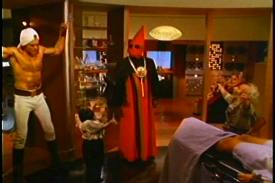
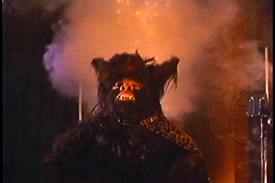
We cut to the mansion-like home of Prof. Pheraul, who apparently does pretty well for a scientist. Shamara comes outside to sun by the pool, but in strict accordance with her beliefs, wears a veil that matches her slinky black bikini. Never one to miss a good show, I guess, Kaliman and Solin come striding into the yard. Spotting a volume entitled Controlled Genetics, Kaliman turns to a photo of the now deceased author, a Dr. Luvian. I have to say, it’s a very cheaply printed tome. The author photo, for example, is clearly a faded photocopy just jammed in the front of the book. Avadam, we learn, was one of Luvian’s students. Stepping inside to consult with Pheraul, Kaliman learns that the planned Congress is starting to fall apart. They also hamfistedly introduce the fact that Pheraul has a grown daughter, supposedly away at school. Then Kaliman tricks Shamara into revealing that she’s not, despite her veil, a Muslim. (He quotes the Koran, and she fails to recognize the remark’s provenance.) Later that night, a skulking Cabaledo sends a South American Indian, and a pretty cliché one at that, to the balcony of Kaliman’s upper story apartment. Oddly, the guy appears right outside the window Kaliman’s working next to, but remains unnoticed. (!) In fact, the window itself makes no sense, if the guy is supposedly standing on the apartment’s balcony. It’s almost like the room Kaliman’s in doesn’t match the exterior establishing shots. But anyway. The Indian is equipped a Goofy Pendent, complete with flashing Christmas lights. When activated, this puts Our Hero in a hypnotic trance. (You’d think a guy with telepathic powers would be immune to this sort of thing, but I guess not.) Once in operation, the doohickey introduces one of the film’s more amusing/annoying running elements. From here on out, any active super-scientific gadgetry—and there’s a lot of it coming—is indicated by the outrageous use of those unmistakable electronic sound effects from Forbidden Planet. The mission accomplished, Cabaledo orders the Indian, also obviously under mental control, to commit suicide by jumping off the balcony. Why? I guess they just thought it was cool, as it doesn’t exactly lend an element of stealth to the mission. Once the Indian hits the ground, his head explodes (!) in a burst of sparks and stuff. Meanwhile, following the command he’s been given, Kaliman exits his apartment. However, Cabaledo then cuts through the crowd surrounding the Indian’s body and steps on the Hypo-Pendant, presumably to destroy it as evidence. (Again, then, why have the guy jump to his death?) Yet once the device is wrecked, Kaliman regains his senses and returns to his room. I have no friggin’ clue what the hell was going on here. Oh, wait, now I get it. While Kaliman was downstairs, they kidnapped Solin. That seems a roundabout way to work things, but there you go. A note explains that instructions will be coming. Of course, they could have left them on the note, but instead they use the phone. Five seconds later. So again, why the note? Anyway, they’ve secreted him (in the last two minutes, apparently) in "the old cemetery in the south of the city." Yes, I’m sure a modest burg like Rio only has one of those. If Kaliman wants to see him again, he’s to come to get him…alone. C’mon, why even bother with that last part? It’s standard kidnapping boilerplate. However, time is of the essence, too, as Solin only has a limited amount of air. Kaliman arrives at the graveyard. He telepathically calls out to Solin, who awakens to find himself trapped in a coffin with an old body. Apparently the two can communicate, but since Solin doesn’t know his own location, he can’t pass it on to Kaliman. (That’s what I gather, anyway.) "Remember," Kaliman Obi Wans to his pupil, "that the body gives out a magnetic force. Some magnetic forces that the mind can capture." Uh, OK. By using these forces to concentrate, Solin can draw Kaliman to him. Or something. Kaliman enters an old crypt. Lurking nearby is Cabaledo and his Burly Henchguy, so I guess this is the place. BH aims a rifle at Kaliman, but Cabaledo knocks it away. Meanwhile, Our Hero finds the correct tomb and pops it open, freeing his sweaty, and no doubt funky, ward. Cabaledo pops up right behind them with his rifle, which seems a weird choice of weapons for such close quarters. "I’m sorry, Kaliman," he notes, employing for the first time a line that will become a popular refrain throughout the rest of the picture. Of course, Cabaledo has also gotten too close to his quarry, and Kaliman is able to get his gun away from him. In a pretty unlikely bit, he then breaks it in half over his knee, barrel and all. Then comes the sort of fight scene where Kaliman delivers a series of immensely powerful blows to his two opponents, who keep popping up for more punishment. In the end, the bad guys run off. However, they only run outside to their car, where they grab a spare rifle from the trunk of their car. (There’s something you don’t see everyday.) They then return to the cemetery and cut off Our Heroes’ escape. Luckily, Cabaledo proves an incredibly poor shot, and misses them repeatedly. In the end, Kaliman and Solin seek refuge in an empty burial plot. (!) For some reason, Solin believes this provides them a good opportunity to escape. Kaliman, however, intends to draw his foes in. "I want to get to the bottom of this," he replies. Given his current location, I thought that was a pretty funny line, especially since they seem to have missed the irony. We cut away to Cabaledo as he and Burly Henchguy approach the plot. Peeking over the edge, he sees Kaliman from the back and shoots him. However, it turns out that he’s fired into a hastily (I’ll say!) manufactured scarecrow that Kaliman has constructed from a flower arrangement and his cloak and turban. Kaliman jumps from hiding and brawl #2 commences. Meanwhile, BH draws a knife and prepares to skewer young Solin (!). The lad is saved, however, when a Mysterious Figure in a masked skeleton costume (!) pops up and conks the miscreant on the noggin. Solin’s benefactor then runs off. Obviously, the person’s identity is supposed to be a secret. Still, it’s pretty easy to tell that it’s a woman in the suit, even if we aren’t supposed to notice. Kaliman heads over to Prof. Pheraul’s house, where he finds the car the Mystery Person drove away in. Having brought BH with, he hauls him into the house, where he meets Pheraul and Shamara. Meanwhile, Cabaledo arrives outside. (Why don’t these heroes ever secure the guys they beat up?) He parks and checks in his trunk, which turns out to contain two of his Indian/Zombies. They rise up, making lion noises (!), but he shuts the hood on them and approaches the house. Inside, Kaliman begins using hypnosis to get info out of BH. "But Solin says he is a mute," Shamara says. (How would he know?) However, telepathy apparently will solve that problem. "No one is going to harm you," he assures his captive. Sadly, he proves wrong. Cabaledo uses some sort of ray pistol (cue Forbidden Planet Sound Effects) to kill the guy from outside. Kaliman runs outside to find his foe waiting for him, gun in hand. Kaliman tries to hypnotize him from where he stands—just how powerful is his telepathy, anyway?—but Cabaledo just laughs. "I’m a zombie-tronic," he reveals. Seriously, that’s what he says. "You’re wasting your time," he laughs. Yeah, him and me both. Anyway, he warns Kaliman not to force him to use his ray gun. "It sends waves into the brain that effect [sic!] the mind or cause instant death," he explains. Hopefully which result occurs isn’t entirely random. In any case, Kaliman risks the beam (cue Forbidden Planet Sound Effects), presumably protected to some extent by his rather flexible mental powers, and charges his opponent. Meanwhile, a curious butler is examining the car Cabaledo left in the driveway. Hearing Mysterious Noises issuing from the trunk, he pops it open, with predictable results. I will say, though, that it takes the two Indian zombie-tronics quite a long time to dispose of the chunky old guy, lion roars or not. At the same time, Kaliman has gotten to Cabaledo, and for the third time in roughly a half hour, lays the smackdown on him. The latter proceeds to call for his zombie-tronic backup, so I guess it was lucky for him they got out of the trunk. The fight continues. However, given their performance against a gray-haired house servant, the results are about what you’d expect, especially given that they’re fighting alongside Pheraul’s swimming pool. Then Cabaledo comes back for a forth licking, and you’ve got to say, he’s persistent. In the fight, Cabaledo’s shirt gets torn away, revealing a black torso. "His body is not white!" Solin exclaims, lest we somehow miss the significance of this. They never really explain why Cabaledo’s head doesn’t match his body, but at least it proves that somebody had seen The Four Skulls of Jonathon Drake. Just when all looks safe, Kaliman is clobbered by Pheraul, who grabs a big metal pipe that was rather conveniently leaning against the wall of his house. "I’m sorry, Kaliman," he tells our shocked hero as he passes out. Perhaps he was shocked because you shouldn’t be able (you’d think) to sneak up on a telepathic dude. We cut to our various characters, including a now-shirtless Kaliman, and some Indians filing through a jungle. They walk past a big snake—it’s actually a real one—so that everyone but our hero can cower and/or walk wide of it. Next they walk past an idol of some sort with a hidden camera in its eye. Rather, it would be hidden, if it wasn’t marked with a blinking light and emitted Forbidden Planet Sound Effects. Meanwhile, various caged zombie-tronic guys are tormented with a whip by Sergeant Perfecto. Perfecto is quite short, has a white scruffy beard and sports gold epaulets and fringe on his jacket. As you might have gathered from his activities, he is, of course, a villainous henchman. (Despite his designated rank, however, the structure of command here remains a bit vague.) In any case, is played by an actor who is presumably known as "the Mexican Sam Jaffe." Here we meet the Lead Villain, Humanon. Well, sort of. He’s robed in scarlet and black, with a pointy red hood and wraparound mask, his eyes covered by stylish black eyepiece inserts. Around his collar, meanwhile, hangs an oversized pendent on a wand, covered with currently inactivated mini light bulbs. The outfit is completed with a black cloak (we later see a huge diagram of an atom on the back of this) and gloves, and he is presently carrying a baby leopard in his arm. In sum, imagine a Grand Wizard of the Ku Klux Klan after a makeover by the Queer Eye squad. In fact, one can just imagine them assuring him, "Don’t worry, this outfit will be totally comfortable to wear in a Brazilian jungle!" Humanon is also your standard megalomaniac. He demands total control in his jungle kingdom, and prefers his henchman bowing on their knees before him and calling him "Excellency" and "Your Majesty." In a weird way, he seems a prophetic merging of the Marlon Brando characters from Apocalypse Now and The Island of Dr. Moreau. In fact, as if contractually obligated, they immediately get these lines of dialog out of the way:
The Sergeant pays the price for his effrontery by turning around and raising his ass in the air, so that Humanon’s can plant his boot in it. Given how generally serious (if goofy) the film’s been up to now, this bit seems a little bizarre. Back to the March Through the Jungle. I felt sorry for the woman playing Shamara, who has to file through all the thigh-high foliage while wearing a mini-skirt (ouch), high heel boots and breathing through a veil. However, it’s Pheraul that falls to the ground exhausted, despite being fairly fit and seeming forty at the most. He and Shamara engage in an amusingly long conversation, as we see how comically attenuated the marching order has become, and low long it is before Cabaledo yells back (yes, that’s proactive leadership) to see what’s keeping everybody. Pheraul whines about how he had to betray Kaliman, because Humanon is holding his daughter hostage. Shamara implies that she’s also being forced to aid Humanon; presumably he has her supposedly dead husband. About here Solin walks by, staring at Pheraul in disgust. Kaliman, however, manfully helps Pheraul back to his feet and helps carry him. "Kaliman, I am sorry," he says, a bold departure from the more oft employed, ‘I’m sorry, Kaliman.’ Hmm, still fifty minutes of movie to go, and we’re (again) getting bogged down. It’s Bullet Time.
The presentation on the DVD isn’t great, but probably about as good as you could reasonably expect for a Mexican film of this vintage. However, the disc is pretty much the definition of ‘bare boned.’ There’s chapter stops and that’s it, there’s not even a trailer. The English subtitles seem a little skimpy at times, and, as indicated above, are rife with spelling errors. Worse, there’s no background material on the character. (I did rent the movie, so maybe there was a booklet or something with the original packaging, although I doubt it.) Certainly it couldn’t have hurt to include some brief notes on the character and his history. Summary: Grade-A schlock, fit for the entire family.
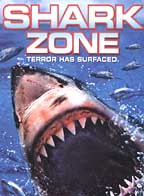
Shark Zone
Albert Einstein opined that insanity was doing the same thing over and over again and expecting different results. I don’t know why I was thinking about that. Anyway, on to reviewing this new, low budget killer shark movie. I was excited when I rented it, because it was a killer shark movie, but sadly it wasn’t that great. Hopefully Dark Waters or Red Waters will prove to be better when I rent them over the next couple of months. Man, I can’t wait to see those. In truth, when you’ve watched as many of these things as I have, you don’t really hope for a very good movie. In truth, a couple of nice flourishes and a neat scene or two will do you. So I was, actually, favorably impressed with the film’s opening credits. First, the music accompanying these was a nice Spanish-inflected orchestral piece, one that wouldn’t be out of place in Bizet’s Carmen. This provided a very pleasant change of pace from the generic techno/hip hop/rock stuff most thrillers foist on us these days. Second, while the accompanying image was the usual ‘helicopter gliding over water’ POV shot, here the image was flipped so that the viewer seemed to be skimming along under a ceiling of water, rather than over it. It’s a little thing, but it turned a completely rote visual into something at least vaguely fresh. I wouldn’t call it ingenious, much less artistic, but it was sort of clever. Sadly, though, this pretty much exhausts the film’s better than average elements. The reason for the orchestral music soon becomes apparent. A prologue establishes that a Spanish galleon approaching the New World went down in a storm hundreds of years ago. This is presented in a pretty funny mix of unmatched stock footage of oceanic storms, both real and faked; a bad model galleon bobbing around in a tank and a vast army of three entire extras (!) to represent the crew of the doomed ship. In an especially memorable moment, a brief stock footage insert of a sinking modern yacht (!!) is used to portray the galleon sinking beneath the water. I also like how the narrator not only explains that the ship was laden with booty, but in fact was carrying "the Crown Jewels of the Spanish Monarchy." (!) And they were sending those to the New World in the late 16th century for why now? In other words, the film is going to rip off the plot of the genre’s most famous and oft-copied film. No, not Jaws. Killer Fish. What? Killer Fish. You know…1979…Lee Majors…Margaux Hemingway…treasure hunters battling deadly piranha in an effort to salvage a sunken treasure. But, yeah, I guess Jaws might be the genre’s second most famous film, now that you mention it. Anyhoo, we cut ahead to modern times, or close to it. The film is supposedly set in San Francisco, or so an insert shot of the Golden Gate Bridge would have us believe. If I know my modern DTV movies, however, I expect to see a lot of Slavic-looking and sounding actors soon. A scuba tour group is traveling by helicopter to a location that proves by sheer coincidence to be near a (bum bum bum) sunken ship. I assumed because of all the metal bulkheads and its wildly different architecture and stuff that this was meant to be a more modern wreck, but the film later confirms that it’s indeed supposed to be the galleon. Wow, that’s…something. The guide is Andrew Wagner, a crusty, no-nonsense ex-Navy Seal. (There’s some original scripting). Among of his four customers are the exaggeratedly obnoxious Tyler—this guy practically has a big "SHARK CHOW" tattoo printed across his forehead—and his busty wife Melissa. Her inadequately disguised accent and stilted command of the King’s English pretty much confirmed my suspicions of where the film was shot. Which, if you’re interested, the IMDB indicates was Bulgaria. Working at Wagner’s side is his son Jimmy. Before they dive they mawkishly express their love for one another, suggesting that the old man won’t be around much longer either. Eventually everyone takes turns jumping into the water—watch how poorly the footage of the cast in any way matches the stock footage of people leaping from the ‘copter—and naturally the four sightseers immediately begin to ignore Wagner’s orders. (He also proves oddly passive for an ex-Seal, I thought.) The oddest bit is that Melissa, who in the helicopter had short blond hair, now sports long brunette tresses. Must be the salt water. Everyone enters the "kelp forest" Wagner advised against. Cue a pack of quite mammoth great white sharks. That’s right, a pack of them. However, they only built one prop shark head for the insert shots, assuming it wasn’t left over from a previous movie, so the party falls one at a time. The sharks also growl like lions or tigers (!) as they attack. In the end, only Jimmy survives, albeit none too convincingly. Moreover, the scene features of the fakest looking mock shark fins I’ve ever seen. The shark attacks are a real throwback. No CGI here, which I actually found sort of pleasing. Instead, we get lots of stock footage shots of actual sharks. These don’t always match correctly, but it’s cool stuff. There’s also the aforementioned prop head, a big old thing with an intricately detailed interior. That aspect allows for numerous victim POV shots into the sharks’ gullets as the beasts close in for the kill. I personally would have liked to have seen the exterior prop head a lot more, instead of the short glimpses we get as it holds its kicking victims in its maw. They probably limited its use because it looked fake, but hey, it’s a big (I’m guessing) fiberglass shark head. Fake-looking or not, its cool. As you’d expect, they try to disguise this mélange of techniques by having the camera whip around, editing the footage in quick shock cuts and filling the waters with stage blood. Again, I’d have preferred just more straight looks at the dummy shark(s) chomping down on the divers, although the comically gruesome crunching sound effects and lion growls certainly do add a whimsical note to things. Cut to ten years later. Lest the earlier shot of the Golden Gate bridge or the trolley car now featured onscreen have somehow failed to set the scene, a card establishes the setting as San Francisco. Jimmy, played by the same actor sans the ball cap he was wearing earlier, is seen looking wistfully across the bay. He’s got his own family now; a wife, Carrie, and a small son named Danny. Let’s just say that the actors playing these two aren’t going to keep Meryl Streep or Haley Joe Osment up at night. As the family sits down to dinner, they toss out like ladlefuls of chum a hilarious number of elements that will prove familiar to any veteran Jaws aficionado. Carrie mentions that Jimmy’s boss is "Mayor Cortell" (!), and, inevitably, that the Mayor is "very excited about the Beach Fiesta next weekend." I don’t want to surprise the hell out of you, but Jimmy’s job involves making sure the beaches are safe for such activities. Striking another highly original note, we learn that he’s perhaps more diligent about his job than the Mayor might prefer. Danny says something about sharks, and Carrie evinces annoyance; not well, perhaps, but it is evinced. "We live on the beach, Jimmy," she sighs heavily. "You’ve managed to scare him to death about the ocean. He’s afraid to go swimming." Hmm, where have I heard dialog like that before? On the other hand, I don’t remember anyone saying of such a kid, "He won’t even eat fish." (!) Also, I love movies that raise a number of plot points in just a few lines of dialog, only to do so in a completely haphazard fashion. For instance, just a minute ago Danny revealed that it was Carrie who filled him in on his dad’s fear of sharks. If that’s true, I’m not sure such a revelation would serve to diminish her son’s fear of the water. Second, you’d think Carrie might be a little more understanding, given that her husband was, in fact, the sole survivor of an entire diving party, including his own father, that was brutally slain by ravenous great whites. Lastly, uh, yeah, why the hell would Jimmy live on the beach, and have a job policing the waters outside San Francisco—the very locale where the attack took place—after all that? (Psssst. IITS.) Cut to Jimmy and Carrie on a pleasure boat. Dialog is definitely one of the film’s major weak spots, and this scene is no different. After mechanically noting that the scenery isn’t "as beautiful as you are, darling" (blech), Jimmy moves in for the romantic clinch. However, the moment is interrupted by a sudden squall. Again, the intercutting between the ill-matching stretches of stock footage and the stuff the actors shot, quite obviously on a set, is pretty obvious. This aspect intensifies as storm footage is cut in. Jimmy sends Carrie below as he prepares to head back in. However, the interior is already flooded (?), although Carrie doesn’t bother to mention this as she continues to head below. Topside, meanwhile, Jimmy does various boat-related things. Suddenly, a stock footage shark is seen, which turns into the prop shark head, which rams into the boat and easily pierces its half-inch balsa wood hull. (This allows us to see the sunny exterior behind the beast’s body, which again don’t remotely match the stormy seas the sequence otherwise features.) Jimmy somehow fails to hear Carrie’s screams as the massive head wiggles around, and by the time he ducks his head inside it’s somehow managed to get at her. This is helpfully signified by chopped meat being sprayed against a wall, which I personally found a bit tasteless. I’m not sure how this all sounds in print, but let’s just say that as an actual viewer of the film, I wasn’t exactly flabbergasted to learn that all of the above was a nasty nightmare Jimmy now wakes from. As is often the case, though, I was impressed by the fact that someone’s dreams would feature such bad special effects. The next morning, Jimmy drives to meet with Mayor Vaughn. Er, Mayor Cortell. By editing in stock footage scenes of San Francisco, they almost quite nearly fool us into believing that the film was shot there. Except for when they cut to outdoor shots actually filmed in Bulgaria, where the light levels are completely different. Cortell, who has a surprisingly ratty office for the Mayor of San Fran, introduces Jimmy to prominent businessman (uh oh) Mr. Volkoff, who has assumed the entire underwriting of the Beach Fiesta. Volkoff, as his name suggests, just happens to have a thick Eastern European accent. Unfortunately, his accent is so thick that half the time I couldn’t understand what the hell he was saying. Too bad the DVD doesn’t provide subtitles, which I’ve found a valuable feature in situations like this. Volkoff, if I’m following this correctly, is interested in the wreck seen during the first attack, which I guess, despite how hilariously goofy that would be, was in fact the sunken galleon from the prologue. So it sits right outside San Francisco and no one’s ever found it? Whatever. As part of the deal, Volkoff wants Jimmy’s help finding the site (is it a secret?—five people were consumed by a pack of killer great white sharks there—you’d think there’s have been a report of some kind), although Our Hero is understandably uninterested. Anyway, Volkoff leaves after giving the Mayor a Significant Glance. Being, after all, a Craven Politician, Cortell orders Jimmy to lend any assistance that Volkoff requires. Of course, the city would make a lot more money, not to mention garner some fabulous publicity, if Jimmy were instead to help, say, a film crew for some cable station find the ship and/or treasure. However, let’s not get bogged down in the details. They also discuss Jimmy’s propensity for causing trouble just because he’s seen great white sharks in the Bay’s water in the past. Again, why does Jimmy have this job if he’s such a hot potato? Also, isn’t he rather young to be, er, Head Beach Safety Guy for San Francisco? Of course, Jimmy’s the only one who’s ever seen great whites in these waters ("I’m the only one looking," he retorts, sounding a tad paranoid), so the Mayor remains unconvinced of his assertions. Cortell also turns down Jimmy’s ongoing requests for patrols in the water, saying the city can’t afford them. So…the City of San Francisco doesn’t have patrol boats. And the Mayor can’t call the Coast Guard or some state agency and request some patrols. Despite this, though, the city regularly holds large municipal beach parties. Yes, I totally believe that to be a reasonable scenario. In any case, lest we think the remainder of the movie might actually be free of sharks, we now cut away to a menacing fin breaching the water, followed by further stock footage of a loudly growling great white. This is followed by a horribly mawkish scene of Jimmy and Danny visiting Wagner’s grave. Treacly sentiment, bad scripting and poor acting quickly prove an ill-fated recipe. "Was he cool?" Danny minces. "Way cool," Jimmy replies. Blech. He goes on to say that Wagner saved Jimmy’s life during the attack. This is valuable information, since the scene itself in no way implied that. "Was Grandpa ate up by shark?" the precocious rascal asks next. Kids, they say the darndest things. "Did your mother tell you that?" Jimmy asks, and learns that it’s so. Wasn’t this the woman who complained that Jimmy had made their son afraid of the water? Soon, through the magic of stock footage, Jimmy is patrolling the water in a ‘copter. Meanwhile, Harker, a horndog lifeguard—gee, that’s fresh—is checking out the chicks. Here we get a two second topless scene, which is odd not only because it’s (about) the only boobage in the film, but also because I didn’t know that San Francisco’s public beaches were clothing optional. After checking in via radio with Mayor Cortell, who doesn’t seem to have much to do, Jimmy just happens to spot a really, really fake-looking rubber fin…er…great white shark swimming alongside a resting pleasure boat. He radios Harker, who, being the lone lifeguard on this entire stretch of beach, and who was recently seen spending all his time leering at chicks, orders everyone from the water. The various beachgoers stampede the beach, screaming in panic—not helped, presumably, by Harker helpfully yelling, "Shark! Shark!"—as I experienced an oddly intense episode of déjà vu. I don’t know, I swear I’ve seen something like this before… The warnings are too late, though. We now see a group of really, really fake-looking rubber fins…er…great white sharks, begin to munch on various swimmers. I have to say, that while the attacks themselves could be better, the film’s body count is spectacular. I mean, it’s nowhere near the seeming hundreds of people kacked in Piranha, but it’s a more than respectable total. Cut to Jimmy storming into the Mayor’s office. Not only are there no reporters in evidence, but the guy’s not even on the phone. I’d say, conservatively, that nearly a dozen people were just gobbled up by a pack of ferocious sharks on a public beach the week before a giant municipal Beach Fiesta is to be held. I don’t know, I’m not a professional journalist, but that sounds like a story of some sort. Anyway, in one of the most ridiculous examples of the trope I’ve yet seen, the two argue over whether the beaches should be closed. Really. "That’s insanity!" Cortell blurts upon hearing Jimmy’s demand. "I know some people lost their lives out there. I’m not completely insensitive to that, OK?" Inevitably, the Mayor references the local economy as to why the beaches can’t be closed. This is all monumentally retarded on its face. Even in Jaws they closed the beach after someone was publicly killed. Moreover, this is San Francisco. Politicians there live to piss off businessmen. Get a clue. I mean, if the local chapter of GLAD were demanding the beaches be kept open, I might buy it. But the business community?! Still, I want to take a moment to commend this highly
original line of dialog: "I’ll tell you something else," Jimmy concludes. "Nobody knows what the gestation period for a great white shark is." With that, he turns to walk away. I’m not sure why he felt mentioning their gestation period was a killer exit line, but there you go. By the way, the film was originally to be called ‘Jurassic Shark,’ a title that would make more sense for one of the several Megalodon movies we’ve seen lately. Which, actually might be why they changed it.
Anyway, time to get going here.
At this point I think I’ll leave things to your imagination. I’m sure you’ll be able to figure out everything that happens from here out. Including, yes, Jimmy risking death by shark to protect his own son. Wow, Life is a circle. Oh, and I did like the way the one henchguy nonchalantly jumps into the water at Volkoff’s order, right after three of his comrades have just been horribly Bruced. All in a day’s work, I guess. Oh, and that last second minute sting is just weird. Shark Zone is, in a lot of ways, pretty inept. It uses more stock footage, and more sloppily, than any other film I can think of right off my head. (Wait, OK, Raptor.) The script is packed with the most tired of clichés, character motivations are often moronic, and the acting is regularly laughable. Moreover, the sunken treasure plot wastes way too much time, even if it does allow for a final flurry of shark attacks. In the end, though, the movie delivers a huge amount of shark mayhem and a lot of quite cool authentic shark footage. It’s not great, but compared to a borefest like Octopus, Nu Image continues to make at least baby-sized strides forward. Summary: I’m not sure I can recommend it, but I enjoyed it a little more than I suspected I would.
-by Ken Begg |