Another feature of... |
|
Another feature of... |
|
|
for
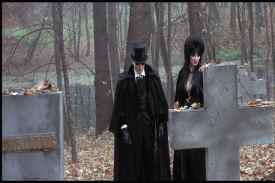
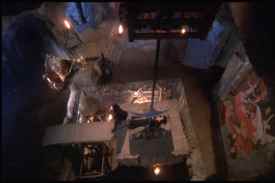
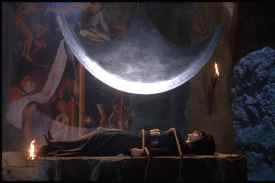
Elvira’s Haunted Hills Plot: A buxom lady is menaced in the mansion of a doomed family. Here’s something I didn’t expect to be saying: I loved this film. One thing that keeps the ardent video buff slogging through dozens and dozens of mediocre (or worse) movies every years is finding those all-so-rare gems. As unlikely as it seems, Elvira’s Haunted Hills was the most pleasant surprise I’ve come across in some years. Some caveats first, though. The film does not transcend what it is. As a horror comedy, it’s no threat to Young Frankenstein. (Although it is, unsurprisingly, much funnier than any Mel Brooks movie of the last twenty years.) Instead, and this is equally rare, it’s the best-case scenario of what you could possibly expect of such a picture. In this case, an Elvira (a.k.a. Cassandra Peterson) flick spoofing Roger Corman’s Poe-inspired films of the ‘60s. The movie it most reminds me of is Hollywood Chainsaw Hookers. That picture thoroughly remained a grade-Z comic/horror/T&A film, but maxed out those categories with nudity both profuse and high grade, hilariously over the top gore and five or six actual laugh-out-loud gags. HCH was the Fred Olen Ray/Jim Wynorski type of flick—it was, in fact, made by Ray--that actually lived up to what you wanted it to be. Considering how rare it is that such a film doesn’t completely suck, the film was a minor miracle. Or, to put it more simply, if you’re the kind of person who can’t imagine watching an Elvira film, and who finds bawdy or ribald humor unbearable, I doubt this film will change your mind. Moreover, I can’t imagine how the movie would come across to a person who had no knowledge of the Roger Corman Poe series. After all, I’m more or less the film’s perfect audience. While I haven’t seen the Corman Poes for some time, I knew enough to marvel at how precisely they were parodied. If you like Benny Hill type of humor, that alone might carry you through. However, it’s certainly an advantage if you’re the type to laugh out loud at seeing a character dressed up exactly like Vincent Price in Tomb of Ligeia. Let me also admit that I’ve never particularly been a fan of the Elvira character. Compared to wittier horror hosts like Chicago’s Svengoolie and Son of Svengoolie, Elvira’s reliance on boob jokes—of which there are indeed several dozen in this film alone—always struck me as tiresome. Nor was I much enthralled by her prior movie, Elvira Mistress of the Dark, which was made way the heck back in 1988. One big improvement here is that, rather than the earlier film’s conceit that Elvira was a person living in the ‘real’ world, this film plunks Elvira down in what is obviously a movie. This works substantially better. Moreover, my admiration for Ms. Peterson jumped several thousand percent upon learning she co-wrote this movie. She obviously really does know these films, and moreover how to spoof them in precisely the correct fashion. Another typical pitfall the film avoids is that it continues to get better throughout the proceedings. Often I’ll be intrigued by the first half hour of a movie, only to find myself increasing bored when it begins to stumble. Here some of the lamest stuff is in the very start of things. There’s a fairly tired "The Shining" gag, and if things had remained at that level I’ve been become rather more disgruntled. Another characteristic gag early on involves Elvira’s zaftig French maid pulling wackily large items from her sizable cleavage. (To be fair, though, the film’s very first gag—assuming one recognizes it as such--is entirely in keeping with the film’s better aspects. The opening credits are set against a field of swirling, oily liquid colors. This visual was taken directly from the Corman films. Another noteworthy aspect immediately on display is the movie’s orchestral score, which is simply a marvelous piece of work.) Soon after these scattershot gags, however, we get into the main plot, whereupon things improve steadily. It’s 1851. Elvira and her maid, fleeing from an angry, unpaid innkeeper, accept a ride from the suave Dr. Bradley. Bradley’s interest in the buxom Elvira is obviously lecherous in nature, but he also provides a hint to the film’s eventual quality by sporting the plummiest British accent I’ve ever heard. The guy made me chuckle every time he opened his mouth. Bradley invites them to spend the night at the mansion of his patient, Lord Vladimere Hellsubus. (In a nod to House of Usher, the mansion’s main chamber has a tremendous crack running through it.) Hellsubus proves a neat combination of Vincent Price’s characters from House of Usher, Tomb of Ligeia and Pit & the Pendulum. Which is fitting, as those are the three films most referenced here.
Hellsubus (extremely well played by Rocky Horror icon Richard O’Brien) is afflicted with the Hellsubus family curse. As a result, his senses are incredibly, painfully sharp. He’s also morose over the suicide of his beloved first wife, Elura. Who, it turns out, took her life exactly ten years ago tonight. And, amazingly, Elura’s portrait reveals her to have been a dead ringer for Elvira herself. Go figure. Hellsubus has a niece, Roxanna, herself a typically ailing example of the clan. Overly pale and given to bouts of tubercular coughing, Roxanna also naturally faints at the drop of a hat. For some reason, she also sports a heavy Romanian accent, as opposed to her Uncle’s silken British tones. Things go on from here, and continue to get deeper into the Corman vein as events proceeds. One gag that doesn’t reference a Corman, but which suits those film’s general time period, involves the mansion’s studly, Fabio-like groundskeeper. He proves to speak in the sort of overemphatic and ill-synced American accent familiar to fans of ‘60s Italian horror flicks, like Black Sunday, that had been dubbed into English. This remained probably my favorite running gag. The merging of this material with the crasser Elvira bawdiness works surprisingly well. Presumably the coarser material extends its welcome because it’s counter pointed by the subtler material. Aside from the boobie gags, however, there’re several funny scenes poking fun at broader genre conventions. The scenes where Our Heroine follows a mysterious figure to a nearby cemetery is a good example, and contains several funny bits. Petersen even gets a ribald, music hall-type song and dance number. As with the best parodies, Elvira’s Haunted Hills manages to assume many of the qualities of its models. For instance, the film is stunningly sumptuous, especially given what had to be an extremely modest budget. This certainly recalls the Corman Poes, which typically looked far more lavish than they actually were. And, as is often the case with the better horror movie parodies, there are also a few moments that are actually spooky. Tech credits are strong. The level of acting here is often flawless. Wisely, the actors generally mimic the over-ripeness of Price et al, rather than further exaggerating things to overtly farcical levels. Also, director Sam Irwin proves an able student of Corman’s directorial style. Also of note is a surprisingly well-made and thoroughly interesting ‘making of’ feature on the DVD. Lasting about twenty minutes, it provides a lot of interesting information. For instance, they actually wanted Fabio for the groundskeeper, but he was unavailable. (Which is a pretty funny thought right there. Perhaps he was shooting A Time for Romance II.) So they got Gabi Andronache, the "Romanian Fabio," instead. As he couldn’t speak English, they decided to dub him like a character from an "Italian Hercules movie". As noted above, this was my favorite gag in the picture, and a good example of how to turn a problem into an advantage. We also learn of the advantages and disadvantages of shooting in Romania. The cast is shown complaining about the food, and creature comforts were obviously hard to come by. However, the economic benefits of filming there are obvious. We watch as the simply gigantic castle sets are fabricated, and look upon the Russian Symphony Orchestra as they perform the film’s score.
If you’re a Corman buff, or enjoy old fashioned, vaudeville-style ribald humor—which in these days of the Farrelly Brothers and the Scary Movie series, comes across as almost tame—you might well want to give this one a look. Summary: There’s gold in them thar hills.
Ginger (1971)
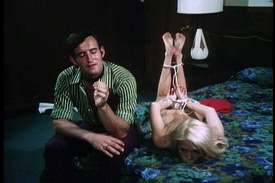
The ‘70s are widely considered the last golden age of American film. The Hayes office, Hollywood’s internal censoring apparatus, and a web of local censor boards had finally folded under social pressure. They were replaced by the Motion Picture Association of America, or MPAA, rating system in the late ‘60s. (Something similar is now occurring in the comic book industry. Marvel Comics has announced its withdrawal from the oversight of the increasingly toothless, Hayes-like Comics Code.) For a brief period following these events, the industry was more or less unshackled. 1969’s Midnight Cowboy, awarded the MPAA’s ‘X’ rating—this before the ‘X’ was hijacked by the porn industry—went on to win the Academy Award for Best Picture. Admittedly, by current lights Midnight Cowboy is more of a hard ‘R’. Even so, it was a wild and wooly time in the movie business. Midnight Cowboy, after all, was produced by a major Hollywood studio, the very Establishment of the cinema world. Meanwhile, the independent companies, which then were actually worthy of the name, produced stuff that really crossed all lines. Such vacuums don’t last, however. Eventually, what we today call ‘political correctness’ replaced the old, religion-based censorship rules. There was a real window there, though. Projects that couldn’t have possibly been made before that time or after it were produced. Such films range from Blazing Saddles—try to imagine that getting made today—to those like the Ginger McAllister series. Many elements date the Ginger series as being from this period. These include casual racial invective, some of it issued by the film’s heroine. That alone is sure to raise eyebrows amongst modern viewers, especially those who haven’t watched a lot of Blaxploitation pictures. What really shocks, however, is a blending of sex and violence that is unimaginable in anything resembling a mainstream movie today. Bondage themes, (enjoyed) rape and sexual mutilation are all on the menu here. And there’s none of the tut-tutting that seems obligatory in American films. Indeed, all this is portrayed in an extremely casual manner. I’m assuming the Ginger McAllister films are not as gross as, say, the Ilsa series. As someone easily grossed out, I have never watched any of those. Still, what audiences today would term the sexual politics of the McAllister films are, to say the least, all over the map. Ginger, the first of the three flicks, is probably the worst of the series in this way. (Or at least I hope so.) You watch the film expecting a bit of a lark, and then all of the sudden a really distastefully sleazy bit pops up and smacks you in the head. We open in classic ‘70s style, with music blaring on the soundtrack as a sports car rounds a curvy road. The film’s title actually rides on the front of the car (!), expanding to fill the screen as the vehicle approaches. Fittingly, though, the theme music is more along the lines of ‘60s spy music—lots of horns, etc.—than the funkier stuff associated with the decade’s B-movies. In any case, if you like watching a sports car drive down a road for minutes on end, this is the movie for you! The car (eventually) parks in front of an office building.
Emerging from her vehicle, we see the driver’s tight black blouse and
white mini-skirt, accessorized with the obligatory white knee boots. Since
her theme music hasn’t ended yet, she pauses to look upon said edifice
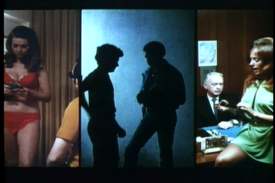
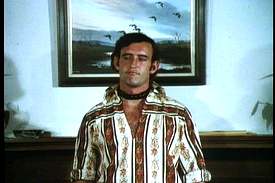
before moving towards it. A narrator fills us in: The oration continues as Ginger roams the building’s hallways, rides an elevator and roams more hallways. It’s like an extended version of the Get Smart opening credits. After minutes spent watching a car tool down the road and then viewing Our Heroine make her laborious way through a maze-like office building, it’s obvious already how ‘Ginger McAllister’ became a synonym for blistering action. One thing that immediately registers about actress Cheri Caffaro, especially given the circumstances, is that she really isn’t all that hot. Not that she’s unattractive in any sense either. Many, no doubt, would find her long blonde hair and slender, lithe body striking. However, some looks come and go, and Caffaro’s super-deep tan thing has definitely lost favor. Although only 26 when Ginger came out, Ms. Caffaro’s already leathery-looking skin makes her look much older than the script-indicated 23. I’d have guessed she was in her early thirties, myself. And given the venerable tradition of actresses lying about their age, she might well have been so. In sum, she looks a lot like fellow period sexbomb Regina Carroll (Al Adamson’s wife), minus the phony giant boobs. So at least she has that in her favor. Given this, one might wonder how Ms. Caffaro landed the headlining role of Ginger McAllister. It presumably wasn’t on account of her thespian skills, for her acting in this picture could best be described as robotic. Nor does she come across as particularly graceful or athletic, although perhaps she’s just awkward on camera. Obviously one must seek elsewhere for the answer. You might posit that even in the let-it-all-hang-out ‘70s, few actresses would have been willing to go to the seamy extremes the series required. The less chivalrous, meanwhile, might suggest Ms. Caffaro was cast because her husband, Don Schain, wrote and directed the movie. By the way, what’s with all these guys—Schain, John Derek, Al Adamson, et al.—who were constantly directing their wives in these squalid sex movies? What’s up with that? Ginger eventually enters an office where two men are waiting. It’s not really spelled out, but I’m guessing it’s the headquarters of a private investigation firm. Brad is the helmet-haired, straight-laced underling. Jason is the Boss Who Only Cares About The Job, No Matter What The Cost. He fills Ginger in on a crime ring operating out of Brighton, New Jersey. (!!) Yep, no locale promises exotic dangers like Brighton, New Jersey. Take that, Casablanca! The ring caters to various illegal appetites of the wealthy tourists who fill the area three months a year. The chief bad guy is a "tough kid" named Rex Halsey. His crew is comprised of seven underlings, four women and three males. Rodney is the jaded son of a socially prominent family. Jimmy is the tough black guy motivated by his hunger for white ass. (Welcome to the Ginger McAllister series.) He is, of course, the gang’s streetwise drug dealer. D.J. is, uh, the other guy. Of the women, Vicki is the tough one, Liz the bored socialite-analog to Rodney, Jean the hot number and Cathy the one who doesn’t really want to be here. The ladies comprise Rex’s stable of hookers. Ginger is provided with a file on the gang’s activities. "There’s enough sex in there," Jason observes, "to give Kinsey and Masters & Johnson a run for their money!" He explains that the police know what’s going on, but aren’t about to do anything about it. I’d believe this were Halsey just providing illicit services and drugs to the rich. Vacation towns aren’t about to go around busting those who keep the tourists happy, as long as a little discretion is employed. However, the gang also seems to kill quite a few people in attention-drawing fashion. That I can’t believe they’d get away with. Nor has the private sector been much more effective. Two other agencies have tried to break up the gang, resulting in a number of brutally slain operatives. One such, a female, had been gang-raped first. Again, viewers looking for charm should probably skip this particular series of films. In any case, with undercover agents habitually trying to infiltrate the gang, you’d expect them to be on their guard. Ginger, we eventually learn, has come to Jason seeking a dangerous assignment. The implication being that she’s a thrill-seeker who only feels alive, blah blah. Just to prove she’s no chump, though, she wheedles an offer of fifty grand, half the agency’s total fee, should she break the case. Admittedly, fifty grand was a wad of cash back in ’71. However, since Ginger presumably got half of her "wealthy" parents’ money after they died, this again can’t be her real motivation. Nor so with Rodney or Liz, who quite evidently are meant to be Ginger’s darker doppelgangers. This ‘theme’ is sort of put out there, although they don’t really do much with it. Ginger is provided with a rather low-rent edition of the obligatory Briefcase O’ Spy Gadgets: Handcuffs, revolver, mini-tape recorder, pocket camera, etc. She takes off and we get our most ‘70s moment yet, a multiple split-screen portraying various activities of the Halsey gang: Drugs, prostitution, blackmail, etc. Then we cut to Halsey holding a board meeting. He looks so horrifying that I won’t even try to describe him. Well, OK, I will. Think of a young, tanned, greasy, just-starting-to-bald Andy Kaufman wearing one of the world’s worst ‘70s shirts, accessorized with a leather choker. Sadly, however, the dude playing Rex evinces none of Kaufman’s subtlety as an actor. In fact, his method appears to a careful merging of the thespic techniques of Paul Lynde and Fred Gwynn. All in all, he’s just slightly more flamboyant than Tim Curry in The Rocky Horror Picture Show. Plus he wears more mascara. Anyway…yikes!! Sorry, the camera just pulled back to reveal the guy’s brown corduroy button-fly trousers. Good grief.
In any case, the scene is meant to portray what a masterful crime lord Rex is. Instead, it functions as a brilliant seminar on how to block and shoot a scene in the most awkward fashion possible. You can practically see the ‘X’s on the floor to which the actors woodenly stride to hit their marks. Once ensconced upon them, they visibly wait while the cameraman pauses three or four seconds too long before zooming in on them. Cut to a darkened room, as we watch a leather-clad cat burglar getting something out of somewhere. I think. Even on DVD this sequence is murky enough that you can hardly make anything out. Despite the valiant effects of some incessant staccato music to suggest that the scene is exciting, this all remains quite dull. In the end, the burglar removes a mask to reveal *gasp* Ginger. Wow. Next we go to the bar where Rex and his minions hang out. They watch a girl doing the Frug. Being the crime boss of Brighton, NJ is even more glamorous than I could have possibly imagined. Ginger enters, wearing her first really, truly atrocious outfit. (The fact that I’m not so accounting her first set of attire reveals just how stringent I’m being.) It’s a purple, er, well, there’s really tight slacks and a matching midriff bearing, long-sleeved top that covers from the bottom of her breasts up, accessorized by a purple paisley scarf and white boots. She orders a martini, presumably because that’s what spies drink. The girl doing the Frug is one of Rex’s stable. She’s engaged in some contest thing that involves a nerd standing against a post. She rubs up against him until…uh, something happens. Anyway, the woman loses. Anyone who’s seen a Ginger movie will immediately ken that Our Heroine will take her place and ‘win’ the contest. This hasn’t happened yet, but…yep, there we go. Ginger moves to the designated spot and points to Rodney. He assumes the pole position. (No, not that pole position. What are you, twelve?) She rubs her ass and crotch on him as she dances, and we realize that Paul Verhoeven must have seen this movie as a kid. Hey, how about a new series of Ginger McAllister movies starring Elizabeth Berkley? You know, I could actually see that. Ginger and Rodney are next seen strolling along the Brighton carnival boardwalk. We’re still early in the film, so this doesn’t really go anywhere; it’s just ‘character’ stuff. By the way, watch how awkwardly Caffaro walks here. She obviously has to go at a slow set pace so the camera dolly can match the couple’s perambulations, and she can’t manage a realistic gait. Next we cut to the beach, whereupon we witness an archetypical Ginger McAllister movie sequence. Our Heroine is lying on a blanket, clad in a teeny-weeny blue bikini. She soaks up the rays, apparently to ensure her skin maintains at least a seven on the Moh’s Hardness Scale. Or perhaps, given her all-too visible tan lines, she fell asleep and suffered some sort of horrible varnishing accident. In any case, she soon finds herself surrounded by Rex’s femmes, here to chase off the new competition. Ginger, of course, isn’t going to take this lying down. (Well, actually, she takes most everything lying down, if you know what I mean.) She and the gang’s toughest moll, Vicki, exchange some of the most stiltedly executed invective in movie history. It’s like watching a put-down contest between Al Gore and an Ent. During this, Ginger charmingly uses the term ‘jungle bunny’ in reference to Jimmy, the gang’s black dude. And Ginger, let’s remember, is our heroine. Ah, the ‘70s. Something to offend everyone. Ginger challenges Vicki to a match, womano-a-womano. Whoever first cries uncle will be adjudged the loser. Vicki’s response pretty much distills the McAllister movies down to their essence: "You don’t get off that easy! Loser has to be stripped and then say she quits!" And so they begin. To our general lack of surprise, the two women prove as woodenly inept in tussling physically as they were verbally. Eventually, though, Ginger gets Vicki’s bikini off and ties the woman up with it. Take that, Bettie Page! One of the other girls, Cathy, is secretly pleased by Cathy’s humiliation. When I say ‘secretly,’ I mean she smiles widely right in front of the others, but only we in the audience are suppose to see her doing so. In the next scene, she’s in Ginger’s hotel room, spitting out a massive unprocessed cud of *blech* Characterization. "I was just a secretary," she begins. "I wasn’t looking for any far-out, wild excitement. All I wanted to do was fall in love with some guy, have him marry me and make a home for me and have children." You know, that sort of thing. Instead, she fell in with Rex’s bunch. Now she’s a whore—actually, "a rotten, lousy, two-bit whore!"—and there’s no way out, blah blah. In fact, she’s even starting to *gasp* hate men. This dreadfully delivered soliloquy goes on at some length and ain’t helping things much. In the end, though, this too passes. Responding to Cathy’s pleas for help, Ginger offers her the, uh, Balm of Sappho. Apparently that’s just the ticket when one feels sexually degraded by men. During this, Ginger squeezes Cathy for information. (Among other things.) The, er, balming is portrayed at some length, as you may have suspected. On the other hand, we’re not talking one of those Seduction Cinema flicks or anything. If that’s your bag, you should probably stick with whatever film Misty Mundae is putting out this week. After that wraps up, Cathy’s heart is lightened. Ginger asks her to testify against her cohorts once they’ve been safely locked up. Cathy agrees. First, however, she seeks reassurance that their, eh, interlude doesn’t mean that while she’s in fact here, she’s necessarily queer. Ginger comforts her on that, uhm, score. "Cathy, you’re a normal, healthy young woman," she asserts. She then suggests Cathy remain in hiding. Cathy, however, has things to do—like getting gruesomely murdered, no doubt—and takes her leave. I think we all know the odds of her ending up with that husband and kids. Jimmy and D.J. are next seen entering…someplace really dark. I have to admit, they use very realistic lighting in this picture. So much so that in some scenes you can’t see much. Eventually you can sort of make out two other guys. Apparently they’re the gang’s drug suppliers. Jimmy, again, is the gang’s street dealer. I mean, he’s black, right? They examine a large bag of lawn trimmings. I mean, MARIJUANA. D.J. certifies what it is by laboriously rolling a joint and taking a hit. At this point I was wishing the editing were a bit tighter. The buy is made, with Jimmy almost walking away in order to get the price down. Yes, yes, he’s a hardnosed pro. I get it. This is one of those films where you actually resent its ambitions. Ginger is cheesy, low-grade exploitation fare. Yet occasionally it seems to consider itself a higher example of the breed, like Shaft or Superfly. Sorry, guys, not even close. Whenever the film wastes time trying to be all ‘gritty’ and everything it’s just annoying. I mean, once we got a look at Rex there was just no way you could take this thing seriously. Cut to Rodney attending a *cough, cough* ritzy country club function. He’s brought Ginger along as his date. This shows us that, like any good spy, Ginger can hold her own in any setting. Liz, the other gang member from the right side of the tracks, pops up for some catty ‘repartee.’ Example:
I’ve had some sport with Ms. Caffaro, but she did have an impressive schlock movie career. Of course, she’ll primarily be remembered for the three Ginger films. In all she acted in seven movies, usually as the film’s star. My favorite title of those being A Place Called Today, a ‘70s title if ever I heard one. She also, perhaps inevitably, appeared in a Women-In-Prison (WIP) movie entitled Savage Sisters. However, after an acting career spanning six short years, she retired. Perhaps she got tired of flashing her hooters on the screen. However, she added to her immortality by providing the screenplay for the much more jovial sex comedy H.O.T.S., a film remembered by many folks of a Certain Age. This is because, except for C.H.U.D.—something about acronym movies, I guess—there was no film that got so much play in the early days of Showtime and HBO. Seriously, it was on constantly. Perhaps because it starred Danny Bonaduce. Summary: The Jolt Cola of B-Movies.
Ice Crawlers a.k.a Deep Freeze (2001) Plot: Folks trapped at an Antarctic base (again) are menaced by giant prehistoric trilobites. I guess I’m not the only one to watch all these cheapo Killer Whatsit flicks going direct to video over the last several years. After all, companies keep churning them out. As I’ve noted before, after a while you start grading them on a scale. With that in mind, Ice Crawlers earns about a B. While it certainly has its implausible elements, stupid moments and the occupational reliance on genre clichés, it also has some (comparative) good points. Sadly, that’s enough to elevate it above most of its brethren. A team of college post-grads is sent to investigate possible environmental damage being done by an experimental oil drilling station on the Antarctic ice shelf. The base’s owner, the Geotech Corporation, wants its own report made before that of a UN team scheduled to conduct its own investigation. The base is a mostly underground structure, the lowest floor of which contains a borehole extending to the waters beneath the ice shelf. (I.e., a swimming pool.) Needless to say, the first victim is working alone down there when he hears something roiling the waters. He pokes into the opaque waters with a pole, and when something starts tugging on the other end, counterintuitively doesn’t drop his end and run for help. Instead, he gets pulled into the pool and is kacked by the film’s then unseen monster. In the end, the students learn that Geotech is an Eee-vil Oil Company. (This is, unsurprisingly, the film’s most rote and eye-rolling element.) It turns out the corporation wants to cover up the environmental damage they’ve done. Or something. Frankly, I had trouble following all this, despite the extensive exposition spit out by the cast. In any case, their stooges intend to blow up the base, with the team in it, and blame it on an accident caused by the inexperienced students. (Which is why a more experienced crew wasn’t sent down there instead.) For what it’s worth, this is at least a somewhat plausible plan, and again, that’s better than most of these things give you. Moreover, the base’s personnel are falling to a prehistoric, dog-sized trilobite. Given the size of the base, and the comparatively small amount of workers on hand, the fact that no one catches on to this for a while is at least somewhat more plausible then is often the case. In fact, in a touch I rather liked, a couple of workers have gone missing even before the students arrive. However, as these guys had a history of crawling into some remote corner to indulge in days-long benders, their disappearance at first causes more crabbiness than concern. As noted, there’s plentiful dumbness and hackneyed plot devices to be found here. The Eee-vil Oil Company gets my top vote. Then there’s the film’s hero, a young oilrig operator from Texas. Lest we forget his background, he comes equipped with a cowboy hat. More obnoxious is that every time he’s on screen they play steel guitar music on the soundtrack! That quickly became pretty tiresome. Another patently ludicrous moment involves the grizzly discovery of a victim of the trilobite, which burrows into people’s bodies like a mammoth tick. This results in one shock moment whose set-up is so completely ridiculous that you just can’t let it go. I won’t go into any further details, lest someone reading this watches the movie, but it’s a doozy of epic implausibility. The interior floors of ‘base’ itself, meanwhile, are obviously being filmed in a school or something. (Actually, it’s a water treatment center. See further on.) I found it amusing that the underground passageways of this structure would sport cinderblock walls and linoleum floors. Not to mention numerous "Exit" signs! Then there’s the fact that everyone is continually shocked and horrified to learn the workers have excavated the site using *gasp* explosives. Well, duh. How exactly would you otherwise dig eight stories down through solid ice? Even so, this is portrayed as further proof of how Eee-vil the oil company is. Also, when are these guys going to stop killing every character but the two leads. When you know going in that pretty much everybody’s doomed, it severely diminishes any suspense. I realize you want a number of deaths to please your audience, but I’d take a few less such if it meant I was at least somewhat unsure who was going to die and who wasn’t. Finally, the trilobite moves around with little attempt at continuity. Given that we eventually learn that there’s only one of the things skittering around, it would be impossible for it to show up in all the places it does in the time it does. However, as noted, there were several things I liked about the movie. First, the acting’s pretty good, especially for this sort of deal. Most everyone wisely underplays their role, which never hurts. The characters, while none too inventive, as least are distinctive enough that I could tell each and every one of them apart. Unfortunately, this is hardly a given with similar fare. Even the overplaying of one character is justified. Schneider, a worker on the verge of a breakdown after spending six months confined in the base, becomes the first to catch on to the oil company’s plans. Normally I’d be extremely impatient with the fact that he doesn’t immediately confer with the others. Especially as he actually has proof, via an admittedly overly convenient plot device. However, as he’s been previously established as being paranoid, a state exaggerated by his heavy usage of anti-depressants, I was willing to cut them some slack on this. Probably the thing I liked best about the picture is that it uses no CGI whatsoever. The exterior of the base is portrayed via stock footage (fans will immediately recognize footage from John Carpenter’s The Thing). Meanwhile, the trilobite is an actual, old-fashioned latex mock-up. This is unsurprising, given the film’s director. John Carl Buechler started out as a monster maker and special effects artist for Roger Corman’s New World, working on such classic as Troll. (Ice Crawlers was distributed here by New Concorde, Corman’s follow-up company.)
Admittedly, the title beastie isn’t going to put Them! or The Beast from 20,000 Fathoms to shame or anything, although it’s capable enough. At least the creature physically exists and can interact with the cast. And Buechler is savvy enough to keep the monster offscreen most of the time. I’m sure many of the kids out there will be unsatisfied by it, as the youngsters generally seem to prefer even outright bad CGI to moderately effective practical effects. Not me, though. I got a kick out of it, and even more so from the bit of miniature work seen during the film’s climax. It never fooled me for a second. Yet at least the effect is fun. Which is more than you can say about instance, the CGI creature seen during the climax of They Crawl or the animated beasties of Killer Rats. It should be noted that the other reviews I’ve read on this film tend to be much more scathing. For instance, there’s Scott Foy’s trenchant and much more exasperated critique. (Warning: It’s also chock full of spoilers.) So be advised. Unless you’re going to be renting something of this sort anyway, and merely want to get a reasonably watchable example of the breed as opposed to, you know, an actually good movie, you might find yourself agreeing more with them than with me. Still, I was reasonably satisfied and entertained, which is a sadly infrequent occurrence. The film’s DVD comes with a solid, if unspectacular, commentary by Buechler. Thus we learn that the film, despite the plethora of German names in the acting and production company credits, was shot in El Segundo at a water treatment center. Perhaps the evident German funding for the picture explains the film’s benevolent assurance in the UN. Amusing insights include the fact that Buechler was the director of the infamous softcore Sword & Sorcery epic Sorceress. Starring twin Playboy Playmates, the picture’s most infamous scene involved one sister being deflowered while her bewildered sibling, miles away, experiences the event via their Corsican-brothers like telepathic link. Amusingly, one of the actors here was the same guy who played the movie’s goat-man Pando. Oddly, it was the production company that dictated the film’s restrained amounts of blood and guts. This was fine with me, although I imagine the gore hounds will be rather disappointed. Buechler, too, reveals that he chaffed at the restrictions, having apparently wanted to amp the gruesomeness up quite a bit. Which is sort of weird, as he keeps talking about how he intended the film to be a ‘50s style big monster movie. In that case, the lack of overwrought gore would seem more in keeping with the film’s intent. Summary: If you’re going to rent a Giant Killer Whatsit
movie, you could do worse.
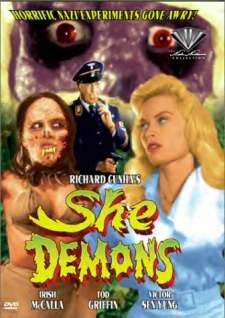
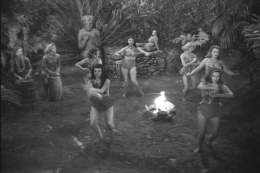
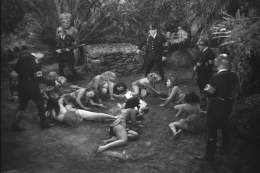
She Demons (1958) Plot: Uh… Of director Richard Cunha’s five films, four were classically cheeseball sci-fi horror flicks churned out in a fecund period spanning 1958 and ’59. (His other picture was 1961’s Girl in Room 13, a detective movie shot in Brazil.) The best—well, least inane—of these was Giant From the Unknown. Frankenstein’s Daughter, on the other hand, remains a truly laughable turkey. Missile to the Moon… Well, it’s a remake of 1953’s Cat-Women of the Moon. I think that about sums it up. Cunha’s first film, She Demons, was his goofiest, however. (Goofiest, yes; the most entertaining, no.) It’s like the product of a particularly ill-advised bet. Imagine a fellow boasting he could write a screenplay in less than 24 hours, one that incorporated every cliché element his drunken buddies could come up with. We open with actual stock news footage of a coastal town being wracked by a hurricane (Cliché #1). This, unhappily, will represent the film’s most interesting sequence. A news report establishes that a motor launch went missing in the storm two days earlier. The missing occupants include scientist / adventurer / somethingorother Fred Maklin, crewmembers Kris Kamana and Sammy Ching, and heiress Jerri Turner. Cut to a desolate beach, where we meet up with the referenced characters. Fred is the Studly Hero (Cliché #2). We can tell because his manly torso is currently shirtless, as was often the case with his ilk. Kris, meanwhile, is the superstitious Native Islander/Old Salt (Cliché #3). He’s undoubtedly going to eventually label the island ‘evil’ or ‘taboo’ or something. In any case, he’s sure to get whacked before the movie’s over. Sammy is the OCR, or Odious Comic Relief (Cliché #4). He’s also Chinese, and is duly given to interjecting Chinese food items in his sentences. (Cliché #5, the Ethnic Odious Comic Relief.) Oh, and at one point Sammy exclaims "Great Confusus’ Ghost!" Thankfully, after a short run of such material they mostly let it drop. Otherwise Sammy is merely the Inanely Wisecracking Comic Relief, of the sort usually represented by a Guy from Brooklyn. Finally, there’s Jerri. We can immediately tell she’s the Spoiled Rich Girl (Cliché #6). While the men strain to salvage supplies from their sunken boat, she sits on a towel brushing her hair. She then complains about how they didn’t rescue all her luggage. "Where’s my powder blue cashmere shortie?!" she sneers. "You might at least have thought to save me some toreador pants!" she adds later. Of course, all Jerri really needs is a Man to melt through her icy exterior (Cliché #7). In case you were wondering, it won’t be Sammy. Instead, big surprise, it’s the Shirtless Wonder. We can tell they’ll end up deeply in love, because they’re always fighting. Fred’s a pretty typical specimen of his breed. As such, he’s given to saying things like, "You know, if it wasn’t for your disposition, I might mistake you for a pretty girl!" Needless to say, this will prove exactly the sort of medicine Jerri requires. Modern viewers, however, especially of the distaff variety, might begin picturing her applying her foot to the Fred’s crotch. Sammy has managed to bring along the boat’s two-way radio. (No mean feat, since the thing’s the size of a large suitcase.) However, it’s been damaged. While it still receives, it won’t transmit. In other words, it’s Movie Damaged: It's working well enough to necessary provide plot information, but won’t help our characters get off the island (Cliché #8). Meanwhile, Fred and Kris are discussing the Mysterious Island they’ve found themselves on. Kris, a seasoned veteran of these waters, is completely unfamiliar with it. He opines that it’s most probably uncharted (Cliché #9*). As it turns out, Fred isn’t completely displeased by this information. It turns out the launch was searching for an island reputed to sport a population of "strange creatures" (Cliché #10), and this is probably it. [Jabootu Correspondent Bill Leary makes the following trenchant observation: "Why is it that the concept of 'uncharted' seems to be semantically equivalent to 'invisible' in these things? I mean, it's an ISLAND for crying out loud. Nobody ever notices it?" There's also the question of how it remains uncharted if the Navy knows where it is.] Suddenly, some stock footage military jets fly over the island in formation. They’re too high to see the castaways, but Sammy can pick up their radio transmissions on his set. (There’s some good military security!) It turns out that the island *gasp* is scheduled for a heavy test bombing. If the castaways don’t get off the island in the next day or two, they’ll likely be blown to bits. (Cliché #11.) By the way, if the island is "uncharted," how could the Navy be planning a bombing run there? Fred also notes that this means the island must be deserted, since the Navy would have investigated it for inhabitants before planning to bomb it. Not so, however, for Kris reveals that he’s discovered Mysterious Footprints (Cliché #12). Cue a bum bum bum music sting. By the way, Macklin’s right. There’s no way the Navy would dump huge amounts of ordinance on an island without clearing it first. They sort of try to explain this away later, but not too effectively. Mostly, the idea is ignored, despite the fact that they had their own main character bring it up in the first place. Kris brings them over there, and they discover the prints seem to go around in circles. "Maybe the natives down here are getting onto this rock ‘n roll kick," Sammy quips. (Kill him.) Given their small size, they deduce they’re women’s prints. But not, Fred cautions, necessarily human. "There’s a peculiar mark at the end of the toes," he notes, "that could be claws." Kris, meanwhile, starts chanting to appease any Evil Spirits in the vicinity (Cliché #13). "This is Island of Evil," he explains. That night, the group has made camp. By which I mean, they’ve built a small fire and assembled their gear around it. Sammy reports little progress on fixing the radio. "All I’ve got here is a bunch of Chop Suey!" he japes. Then things get worse, as Fred goes to sit by Jerri for a little character scene. You know, so we Care about them and stuff. Jerri decides she wants to bunk out a little distance from the men. (Yeah, that’s a good idea.) So she and Fred walk over to a really bad ‘jungle’ interior. From here on the film is generally shot on cheapie sets consisting of papier-mâché rock walls and plastic trees. The dubious quality of the sets is even more conspicuous since the beach scenes were shot on location. Jerri gets undressed behind a blanket—in the ‘50s, this constituted ‘sex’—as she and Fred engage in some rather lethargic squabbling. Fred thinks she should remain behind in safety when he and Sammy investigate the island in the morning, but she insists on going along (Cliché #14). Then he returns to camp. I found it kind of funny that Fred doesn’t mind Jerri sleeping alone in the trees, out of their sight, but thinks she shouldn’t go with them the next day. In any case, before the men turn in, they hear Ominous Jungle Drums (Cliché #15). The next day, Fred, Sammy and Jerri go exploring. I’m not sure how Jerri is keeping her whites so white, but it’s pretty amazing. Oddly, there’s a nice path running through these wild tracts. That’s fortuitous, however, since Jerri’s elected to traipse around barefoot. Our Heroine soon falls behind the men (Cliché #16) so as to smell some flowers. Huh, just like a girl. Turning, however, she finds herself ‘menaced’—sort of—by a none-too interested looking snake (Cliché #17). Frankly, she doesn’t appear to be in overmuch danger. Especially since they can’t even get the snake to look in her direction. On the other hand, perhaps she’s easily startled, has a manic fear of reptiles and suffers from a really bad heart condition. She screams and Fred runs back and ‘saves’ her (Cliché #18). Kind of. Basically he stands a few feet away and pulls her a further short distance from the supposedly dangerous beastie. I’ll say this, they got themselves a real snake instead of a rubber one. I’m assuming this is because the actress playing Jerri wasn’t afraid of appearing in shot with it. More on that later. The Moment of Spellbinding Tension behind them, they continue forward. There follows a woeful comedy bit where Sammy finds a college fraternity pin on the ground, and can’t figure out that it’s his. Fred clears up the mystery, suggesting he dropped it earlier and that they’ve been traveling in circles (Cliché #19). I’m going to be sort of generous here. The guy playing Sammy, Victor Sen Yung, earlier in his career appeared in a bunch of Charlie Chan movies as the detective’s Number #2 Son, Jimmy. Its possible this therefore is meant to be a parody of the scenes where Chan would explain the significance of some obvious clue to his dense offspring. "I'm surrounded by idiots," Jerri snorts. Assuming you can be ‘surrounded’ by two guys. She decides to get them back to the beach. Since they’re lost, Fred asks how she intends to find the way. (By the way, I can buy that maybe guns and whatever went down with the boat. Still, Explorer Fred doesn’t carry a pocket compass?) To the accompaniment of Wacky Music, she covers her eyes and eenie-meanie-minee-moes a direction. She then strides forward, while Fred and Sammy exchange a bewildered "Women!" look and follow after. Sure enough, when next we see them they’re back walking along the beach. Once they hit the camp however, they *gasp* find Kris missing and the remnants of their possessions strewn about the site (Cliché #20). As the men examine the scene, Jerri screams from off camera, having found Kris’ body. (Cliché #21.) Two bamboo sticks, or some damn things, project out from his torso. Fred observes that Kris’ knife is missing. Sammy notes a blood trail and begins to follow it. Fred cautions that they should stick together from now on. Duh. The path leads along the beach—back the way they came, but never mind—and they quickly locate the body of a Jungle Woman lying facedown in the sand. You can tell she’s a Jungle Woman, because she’s wearing an animal skin bikini. This is one of those deals. You know the kind. They’re trying to set up a surprise shock revelation, but the blocking of the scene is so awkward that you end up looking right where they don’t want you to. Here the guys grab the body and drag it out of the surf, and coincidentally end up right by the camera. You can’t help noticing that they’re laboriously maneuvering the corpse in such a way that its face remains unseen. So they caaarefully lower the body back down to the ground, still facedown. Then Fred stoops to flip her over, and…*gasp, choke*! She has a normal body but a goofy monster face; rough leathery skin, pop eyes, plastic fangs, et al (Cliché #22). (In a nice example of bad sound editing, the Obligatory Shock Music Blare sounds just before they flip the body, rather than as the face is revealed.) Everyone reacts with, shall we say, understated horror. "A woman’s body with the face of a demon!" Jerri exclaims. Maybe she works in advertising. "Demon?" Fred replies. "She demon!" (Hey, he said the title!) Later they’ve buried Kris in a pile of sand. Yes, that should keep nicely. "It’s funny," Jerri observes. "Kris has worked for Dad ever since I can remember. I only knew know him the two days." Well, at least you could turn his death into an opportunity for personal growth. If life gives you lemons, etc. Sammy wonders what they should do now. Fred replies that, given that more She Demons might be lurking around, they should take their chances in the jungle. Yes, I’d certainly rather try to defend myself in a dense, fetid tropical forest than on a stark beach, what with its eerily clean sightlines for hundreds of yards in every direction. Sammy concurs. "I’d rather be looking for the She Demons than have them find us," he adds. I’m not sure what advantage that would provide. Still, it at least partly explains why a drip like Fred is the team leader. Trekking through the trees—the real ones, we’re back to location shooting at this point—they stop upon hearing water running nearby. Stepping forward, they find a stream. In an amazing cinematic effect, the filmmakers have dumped an assload of dry ice into it. "Hey, look," Sammy exclaims. "That water’s boiling!" Well, bubbling, anyway. "Probably due to some volcanic action," Fred responds. If so, it’s the only time ‘volcanic action’ has ever been associated with this picture. Fred announces that they’ll follow the stream. Sammy agrees, nothing that at least they won’t get lost. (Guess he never saw The Blair Witch Project.) Fred looks disgusted at this statement, while Jerri smiles. I think the joke’s supposed to be that they’re already lost. On the island. Get it? Pretty soon they stop to rest their feet. Since it’s been well over a minute since the last major cliché reared it’s head, they have Sammy and Jerri engage in the Wacky "Imaginary Food" conversation (Cliché #23). You know the one, where somebody in a hungry group dreamily describes eating some luscious spread, until an equally starving companion tells them to knock it off. In this case that’s Fred’s job, because he’s the group’s designated Party Pooper. "I’m so hungry my stomach is doing back flips!" he moans. Of course, after a Moment of Hilarity, Sheer Terror is sure to follow. So the sound of jungle drums intrudes on their conversations. "C’mon," Fred exclaims, hurrying off towards the racket, "this is what we’ve been waiting for!" Uh, I guess. We cut to a clearing where we see the your classic tribe of Jungle Women (Cliché #24). You know, a small number of attractive women, all in their early twenties, clad in tanned skin bikinis, lean and unscarred, hair clean and nicely done up, good teeth, plenty of make-up, several of them blondes…you know, savages. Anyway, they’re performing a ritual dance, as their kind often are. (Not much else to do in the Jungle, I guess.) Two of the ladies are beating away at drums, accompanying the dancers. Said instruments sit low on the ground, obligating them to hunch way forward and give us a good look at their cleavage. Meanwhile, six others are performing what I guess you could refer to as a ceremonial dance (Cliché #25). By that I mean they sway a lot and circle around a campfire while making clawing gestures with their arms. And sometimes they shoot their arms up in the air. Often they’ll stare directly into the camera as they circle past, no doubt thinking, "This is it! I’m going to be a Star!" Eventually the six dancers make way for another young lady, who performs a solo dance. Since she’s not noticeably a better dancer than her Jungle Sisters, I can only assume some sort of rotation system was involved. According to the credits, the ladies are played by the Diana Nellis Dancers, who display the exact grade of terpsichorean finesse you’d expect from such an august ensemble. Perhaps the most impressive thing about them is how seldom they perform their rudimentary steps in any sort of sync. As to whether they’re better than the Hollywood Cover Girls, who played the Cat-Women of the Moon, well, my friend, we could argue that until the cows come home. The dance ends and the dancers fall to the ground, exhausted from their efforts. It’s here that the movie really earns its stripes, for into the clearing steps…a group of Nazi Gestapo soldiers in full dress uniform. (!!) That's Cliché #26, for those keeping count, although I really am tempted to award them double points for that one. Amazingly, though, the guy armed with a pistol isn’t carrying a Luger. Instead, it’s a Walther.
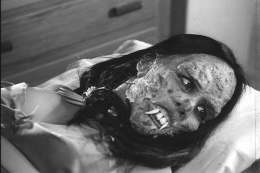
The first thing I noticed about this fellow was that, after nearly fifteen years spent on a remote tropical island, their uniforms remain immaculate. After their mighty force of four guys surrounds the Jungle Woman, their superior steps into view, armed with a bullwhip (Cliché #27). At his barked order, the JWs are herded off. From their compliant response, it’s clear they been through this drill before. As you’d expect, the portrayal of the aforementioned Nazi soldiers is extremely well research and scrupulously accurate. For instance, although they generally speak English—no doubt a clever ruse in case they’re ever accidentally observed by civilians—at various times we’ll hear them say Herr, Fraulein, Schnell, Raus, Schweinehund and other authentic German words (Cliché #28). Plus they often act like jerks. The JWs are led through a rock passage leading into another clearing. Fred manfully follows after so as to see what’s up. Before he makes to leave, though, he and Jerri have the following highly original exchange:
(I think those lines earn the designation of Cliché #29.) On the other side Fred sees some bamboo cages holding more JWs. The prisoners are also marched into then. Then we cut to an evident Mad Scientist, decked out in full surgical gear (Cliché #30) and readying a hypodermic needles. His MSL—Mad Scientist Laboratory—comes complete with miscellaneous radio equipment, some lab tables and an array of metal scaffolding holding numerous Conical Flasks filled with Mysterious Colored Fluid, which are presently expelling dry ice smoke. (This set-up surely rates a collective Cliché #31.) Oh, and the Lab also boasts the obligatory jail cell. You know, to hold future subjects of his mad experiments. The MS is Karl Osler. Seated before him is a woman with a veil over her face. At this sight any halfway knowledgeable schlock movie buff will instantly intuit that the woman’s his wife and that Osler’s experiments are aimed at restoring her beauty, which has been erased by some horrible disfigurement (Cliché #32). This impression is confirmed when the camera pulls back and we spot a JW stretched out and bound to a nearby gurney. The senior, bullwhip-carrying Nazi Soldier enters the room. This is our first good look at him, and amusingly he’s played by Gene Roth, an extremely familiar character actor. Not only did Mr. Roth appear in numerous Three Stooges shorts, but he also popped up in many other crappy movies. For instance, he played town sheriffs in both Attack of the Giant Leeches and Earth vs. the Spider. It turns out that his character’s name is Igor (Cliché #33), not a particularly good name for a Gestapo officer, but apparently an obligatory one for the henchman of a Mad Scientist. At his entrance, Mona, Osler’s wife, turns away in a panic. No one but her husband must ever see her ruined face (Cliché #34). Osler is also angry at the interruption. "I told you never to come into this laboratory when I’m busy," he fumes (Cliché #35). Igor makes his report and leaves. Osler approaches the woman on the table. He injects her with the serum in the hypodermic, and then Osler inserts a blood transfusion tube into her neck. The other end of this, we see, leads under Mona’s veil. He then squeezes an air pump ball (??) and looks at some Generic Equipment Gauges. After a bit he removes the tube from each woman.
Seconds later we see that the JW has become a She Demon, complete with plastic Howard Hughes fingernails. Cue blare of music to emphasize this shocking turn of events. "Hmm," Osler nonchalantly notes. "Same reaction: A mindless animal." In an odd bit, Osler mentions that she’ll return to normal in a few days. Uhm, OK. Back outside, Sammy and Jerri have joined Fred in the passage. Over in the camp, Igor is bullwhipping a JW who’s been tied to a tree. From her screams she sounds surprisingly healthy, considering the damage this sustained lashing would inflict. After a while Igor finishes up and heads off, leaving the woman hanging as she is. Our Heroes sneak forward and untie her, but the woman’s dead. As they huddle near the JW cages, Jerri announces, "I’m frightened." Thanks for the update. (She said something similar after stumbling over Kris’ body.) This setup allows for a fairly lame shock shot, as the threesome somehow don’t notice the numerous She Demons inhabiting the cage they’re squatting next to. Until, that is, one of them grabs Sammy around the throat. They pull him free and then sit there, easily within the creatures’ reach, as the SDs leisurely pretend to swipe at them with their plastic finger claws and make halfhearted and quite restrained "Raahr" sounds. "This noise will attract the guards," Fred worries. (Only if they have extremely fine hearing.) This leads to one of the more dubious conclusions I’ve seen in a movie lately. Seeing a door set in a rock wall before them, Fred exclaims, "There’s an entrance leading into the mountain. You game?" Huh?! Oh, yeah, that’s a much better idea than just turning around and leaving the area before the Nazis even learn you’re on the island. Morons. "It couldn’t be any worse than this," Jerri replies, gazing upon the goofy pack of ‘she demons’ lackadaisically miming clawing gestures at them. (You know, for once I’ve got to agree with her.) Again, not to beat a dead horse, but the door and the demons are not the only two options here. This isn’t Let’s Make a Deal. The door opens onto a stairway leading down into a complex that’s not entirely convincing as being hewn into the interior of a mountain. I especially liked how the staircase is lit with torches, as the rest of the facility sports artificial lighting, not to mention Osler’s hodgepodge of electrical equipment. Trying to stay a step ahead of the audience—way, waay too late for that—Sammy notes that it must have been a prodigious task to carve all this out of solid rock. Fred disagrees. "All these islands are of volcanic origin," he expounds. "I suspect these lava tubes were converted into room." Yes, I guess that really does explain it. In a rather counterintuitive move, Fred decides to lead them further into the complex. Am I the only one who thinks this is a bad idea? Anyway, a nearby door opens onto Osler’s lab. Luckily, no one is in it at the moment. Oddly, the room contains a cage full of pigeons, although this is never explained. Startled by this, Jerri throws herself into Fred’s arm. (??) You’d think maybe the discovery of Kris’ body, or the dead She Demon, or witnessing a woman being whipped to death might have more logically warranted such a reaction. I don’t know, maybe she just really doesn’t like pigeons. This all leads to a typically nauseating scene where the two Bare Their Souls to one another and Acknowledge Their Love. Of course, a lot of Jerri’s end of things involves confessions of the "What A Fool I’ve Been" variety, for being all standoffish and unwomanly and stuff. I have to admit, though, as the scene progressed I found it increasingly funny they were having this drawn out conversation while nonchalantly standing around in the Osler’s lab, to which, for all they know, someone could return at any moment. Back outside, Igor returns to the cage area. There he notices that someone has untied the dead woman from the whipping post and laid her on the ground. Anyway, Igor calls his men—two of whom happen to be named ‘Otto’ and Fritz’, in case you were wondering (Cliché #36)—and sends them off to patrol the area. Then, just when I was thinking about how stupid Our Protagonists must have been to leave the dead woman behind like that, Igor looks over and sees the door leading into the mountain hanging widely ajar. (!!) Cripes, these guys have done everything but walk through paint and left a trail of neat white footprints behind them. Morons. Despite everything, Igor at first merely closes the door and turns away. (!!) However, he then thinks better of it—yeah, you’d think—and heads inside for a little look see. On his way down the stairs, and for no good reason, he grabs the lit torch and brings it along. Entering the now darkened lab (I guess they had him take the torch so as to explain why he wouldn’t switch the lights on), he begins to look around. This results in a drop dead hilarious sequence. Fred turns out to be ‘hiding’ behind the other side of an open shelving unit. Somehow, Igor manages to avoid seeing him over the bottles and such obscuring maybe 25% of the guy. Igor even peeks around the shelves, and yet somehow still doesn’t spot him. Then he walks past Sammy and Jerri, both of whose hiding postures basically involve pressing their backs against objects that leave them otherwise fully in view. For some reason, perhaps having noted Igor’s powers of observation—one that would have embarrassed Helen Keller—Jerri decides to move around for a better look (!) as the guy ambles around the room. Of course, she immediately manages to knock over a beaker. This makes only a slight sound, however, and Igor eventually makes to leave the room. At which point, naturally, the upended beaker rolls off the table and smashes itself on the floor (Cliché #37). This proves beyond even Igor’s ability to ignore, and he comes charging over. Igor is, as you’d expect, somewhat surprised to find a statuesque blonde huddling in the lab. Diligent as always, he asks her if she’s alone, which I guess is easier than actually turning the lights on and having a better look around the one mid-sized room they’re in. Seeing what a babe she is, Igor leers and exclaims that he’d trade his "medal of honor" for her. (Did the Nazis have a "medal of honor", as such? I’ve never heard of it.) He begins to question her, and we get a fairly excruciating example of the standard trope where he’s confused by her American slang (Cliché #38). You’d think he’d just beat her for her smart mouth, but I guess the scene is meant to show what a cool customer Jerri is. Eventually she calls him Fatso, though, and that does the trick. Of course, Fred comes charging out to defend her. Of course, Sammy just stands there and watches (Cliché #39), since no Real Man would need help with a dirty Ratzie. Only when Fred tells the two to leave the room does Sammy pretend he was planning to jump in. This all leads to a fight scene built around some of the most awkward choreography I’ve ever seen. Not to mention just about the most obvious stuntmen I’ve even seen in my life. Seriously, this is like those Benny Hill comedy routines where the obviousness of the stuntmen is the entire gag. You know what I mean. Close-up shots: Actors. Far shots: Obvious Stuntmen. The best part is how they attempt to disguise Fred’s substitute by having him keep his face away from the camera. The problem being that the actor playing Fred has dark hair and the stuntman is blond! After a less than titanic tussle—at one point Igor rushes towards the camera with his torch, leading me to wonder if this was shot in 3-D—Fred emerges triumphant. (Sorry to spoil that for you.) Whereupon he turns and leaves his opponent woozy but alive. I may be coldhearted, but when I jump a Nazi soldier in his secret island base where woman are being turned into monsters, I would myself probably decide to finish the guy off when I had the chance. Also, despite all the furniture and equipment that gets smashed, I was wondering how it was nobody had showed up to investigate. Reaching the door outside, Fred orders his compatriots to leave while he remains behind to physically hold the door shut so that Igor can’t follow them. (!) Igor forces his way out, though—probably because Fred didn’t kill him when he had the chance—and their epic donnybrook resumes. Whew, The Quiet Man had nothing on this picture! However, a mighty blow sends Igor reeling into the surprisingly flimsy door to the She Demon pen. His momentum carries him inside and, in a scene ironic and yet apt, dies at the hands of the very creatures he so tormented (Cliché 40). "He got everything he deserved," Sammy sagely observes. Anyway, this leaves the purportedly animalistic She Demons free to wander about. Whereupon Our Heroes (eventually) decide to beat it. Maybe they shouldn’t have stood there bantering first, though, as they find themselves captured by a Nazi guard. They are taken to meet with Osler, who outside the lab proves a suave aristocratic type whose veneer of culture hides a sadistic streak a mile wide (Cliché 41). One of the ways we can tell how debonair he is, for instance, is that he smokes his cigarettes through a holder (Cliché #42). Amazingly, never in the course of the film does he don a monocle. It turns out that Osler is a famous Nazi bigwig who escaped after the war (Cliché #43), big enough, anyway, that Fred instantly identifies who he is. He also reveals that Osler was known as "The Butcher" (Cliché #44). Now, you’re always in danger of being in bad taste when using Nazis as your villains, especially in junk like this. Here, however, Osler is identified as having experimented on humans in the concentration camps. Sorry, but basing your head villain on Josef Mengele is just way over the line. Seriously, that’s just gross. Fred continues his righteous spiel. I have to admit, for a sadistic Nazi Osler lets him jabber on at some length. (Of course, this is all vital exposition, so what are you going to do?) Eventually, though, the subject turns to Osler’s current work. He proves inexplicably amused upon hearing them described as She Demons, though, so at least he has a sense of humor. Osler decides to spill the beans on his work, since, after all, Our Heroes will never be leaving the island…alive (Cliché #45). With thirty-five minutes of the film’s expansive seventy-five minute running time left to go, they need to waste some time here. Therefore we’re provided with some of the most ludicrous ‘scientific’ theorizing I’ve heard in some time. See IMMORTAL DIALOG below for the full transcripts. Some of this almost approaches making sense, including the basic idea of geothermic power, but even then it’s buried in a pile of ridiculous gobbledygook. And where they take the concept from there…hoo, boy. After Osler casually reveals that he’s made the greatest scientific discovery in the history of the planet (again, see below--oh, and that's Cliché #46), we move on. Fred mentions the fact that the Navy plans to bomb the island soon. Osler is aware of this, but unconcerned. He feels his compound, buried several feet in a hollowed out section of a volcano, is safe from harm. In fact, he notes, they’ve bombed several times before. (Good thing his test subjects, kept on the surface, haven’t been blown to pieces then.) Said exposition delivered, Mona, complete with mummy mask, enters the lab. Osler is surprised by this, but it’s obvious that the woman is desperately lonely. "Oh, you’re so beautiful," she coos upon seeing Jerri, to Osler’s evident exasperation. Apparently annoyed that she’s interrupting his mandatory Mad Scientist Ranting he shuffles her off. However, her appearance allows for another round of technojargon, again recorded below. If anything, this batch is sillier than the stuff before. As the ghostly apparition leaves the room, Osler declares "I see you’re wondering about Mona." (!) He explains that she’s his wife. (Proving that the scriptwriter learned his German from previous war pictures, Igor earlier called her ‘Fraulein’, which is ‘Miss’. He should have addressed her as ‘Frau’.) "She once was a very beautiful woman," he adds. Well, of course. Anyway, she was helping him in his experiments when she was scalded and sustained horrific facial scars. "I vowed to spend the rest of my life to make her beautiful again," he exclaims. Yes, that’s pretty much par for the course for your movie Mad Scientist. Hell, if he didn’t have a horribly disfigured wife to fix, he’d probably have assembled a grotesque monster kept in a closet somewhere. The guys need some sort of hobby to fill their spare hours. When you pare away the verbal overgrowth, Osler’s experiment involves trying to exchange the JW’s healthy genes for his wife’s unhealthy ones. In a typical ‘50s misuse of gene theory, it’s assumed that because we derive our appearance from our genes, that a disfigured face means your genes have also been disfigured. Exchange them for new ones and bam, new face. This particular concept was the basis for quite a few cheesy Mad Scientist flicks. Therefore Oslar is attempting to transfuse Mona with the genes of the unblemished JWs. Except that it works the other way as well, which is why the women end up with monstrous faces of their own. Even that half-assed explanation doesn’t cover the claws, fangs and purportedly animalistic behavior of the subjects, however. So they have Osler further clarify that the genes have to be reinforced with animal ones, or something. Look, the exact dialog is below. You figure it out. In any case, I was amused by the fact that Michael Crichton’s Jurassic Park, whose scientific basis was much more rigorously thought out than that displayed here—admittedly, not the boldest of statements—employed a similar concept. The cloned dinosaurs, we’re told, have genetic information from frogs and such used to calk up any missing bits in the retrieved dino DNA. The process is at this point temporary, however, since the genes rebuild themselves in a matter of days. So the SDs turn back into regular JW in short order. To be fair, they do have Osler note the convenience of one aspect of this fact, since it means his supply of guinea pigs is reusable. I’m not entirely following the action here, though. The fact that the SDs end up with disfigured faces, I’m assuming, is because they’ve received Mona’s genes in the transfusion process. In other words, it’s not really a transfusion so much as an exchange, although the terms are used interchangeably. Here’s some points I don’t understand. First, why must the genes be exchanged rather than transfused one-way? (OK, because then the film wouldn’t have any monsters.) And if the JW get a disfigured face, does Mona get a pretty one until her own genes reassert themselves? That seems to follow, but this never occurs. Mona remains bandaged throughout. Perhaps Mona’s facial tissues are so damaged the therapy is it stands is ineffective? Then why not just say so? (Probably because they really didn’t think all this through.) Or maybe the disfigurement is the result of the animal genes, although that makes even less sense. Even so, if the two women are exchanging genes, how does the subject Jungle Woman end up with a dose of animal genes but Mona doesn’t? My head hurts. Moving on. Anyway, all this blather about the geothermics and the gene therapy eats up what must be a solid ten minutes or more of screen time. One can only assume this was dictated by the movie’s paltry budget, as there’s little cheaper to film than people just yakking to one another. Kids seeing this in a matinee run must have been running all over the place during all of this, wondering when the ‘good’ stuff was going to come back on. Apparently I’m not the only one who thinks it’s time to get things going. Olser orders Jerri to be taken to a room, while Fred and Sammy are to pay a price for Igor’s death. Fred manfully accepts whatever fate is coming his way, but demands that nothing happen to Jerri (Cliché #47). The jovial guards are soon seen (sorta) torturing the two men. Mostly this involves making them carry a wooden beam across their shoulders while forcing them to circle a post. The word ‘schwein’ gets dutifully employed a lot here. After this session the captives are tossed into their cell to recover. The two then waste several more minutes yakking. Eventually, the topic turns to Jerry. Given Osler’s history, Fred is extremely concerned with her fate. "There no telling what torture she’s going through," he exclaims. Cut to Jerri, in a formal gown and being served Champagne by Osler (Cliché #48—the line of dialog leading to an ‘ironic’ scene segue.) The latter has cunningly donned his spiffy SS uniform to impress his guest. Yeah, that Nazi regalia gets to them every time. Osler’s obviously planning to put a move on Jerri (Cliché #49), despite her evident disinterest. He’s obviously displeased to have his attentions rebuffed. Desperate, he makes a final plea. The island is his kingdom, he explains, and Jerri will be his queen (Cliché #50). However, what they don’t know is that Mona is secretly listening at the door and hears her husband making his offer (Cliché #51). Eventually Jerri does indeed offer him her hand, although not quite in the manner he was hoping. In the end, he threatens to use her in his experiments if she continues to spurn him. Jerri answers by breaking the Champagne bottle over his head. (If you’ve ever hefted such a thing, you’d have to figure it would do more than provide him with the minor scratches he receives here. Also, the bottle noticeably alters color between her feeling for it and her shattering it across his brow.) Running from the dazed Osler, Jerri ducks out of sight from a posted guard. Well, not out of sight, really. It’s just that Igor must have trained his men in observation techniques, because he runs right by her when he hears Osler call out. Now I know why the Nazis lost the war; not a man jack of them had any peripheral vision. As she runs outside, Jerri pauses to toss aside her high-heeled shoes. That this is leaving a bit of a trail for her pursuers seems not to have occurred to her. As she leaves the complex, Fred spots her from their cell, all of maybe fifteen feet away. "Jerri!" he calls. "Over here in the cage!" I’m not sure how she would have missed them, but better safe than sorry, I guess. Than, after getting her over there, he basically tells her to leave them behind and go hide in the jungle. Uh, wouldn’t she have done that if you hadn’t called out to her? Whatever. Hearing Olser coming, she reluctantly leaves, after promising that she’ll return for them later. Now follows a ‘supspenseful’ scene where Jerri seeks to elude capture. Shots of her and the pursuing parties are generally tightly framed, so as to ‘disguise’ the fact that they’re marching through the same small jungle set over and over again. Then *gasp* Jerri sees one of the escaped She Demons stalking her. So we go, from Jerri to Nazis to She Demon. Hearing the soldiers, the SD beats a quick retreat. Meanwhile, Jerri avoids being seen by leaning back against a rock. Boy, these are some of the worst guards I’ve even seen. After one dangerously close Nazi takes his leave, Jerri is breathing a sigh of relief when…someone grabs at her arm!! (Cliché #52). But it’s only Mona, who explains that she wants to help Jerri escape. That way Mona can keep Osler to herself (Cliché #53). They share some girl talk, which is pretty funny under the circumstances. You know, the imprisoned friends, the impending bombing raid, the mutated She Demons, the Nazis, the disfigured mummy woman…all in all, this is the chattiest bunch of characters I’ve seen in some time. Mona, after waxing moonily on the past, tells Jerri where a rowboat can be found. Of course, Jerri refuses to leave until Fred and Sammy are freed. Luckily, Mona just happens to have the keys to their bamboo cage on her and hands them over. Jerri further asks for her regular clothes, since the cocktail dress she’s currently wearing isn’t actually top-notch escape gear. I have to say, Mona certainly is the helpful type. Clad back in her old (blazing white) outfit, Jerri sneaks back into the camp. There’s a guard that occasionally walks through, but at this point we’re pretty much ignoring them. However, they’ve no sooner been sprung than they run into Osler, waiting with a pistol. Oddly, the scratches from the broken Champagne bottle are now completely missing. Cut to Osler’s lab, the following morning. Sammy and Fred are in the lab’s barred cell. Mona is sitting in her chair while Jerri is strapped to the nearby gurney, like the Jungle Woman seen previously. Osler is obviously planning to use her for one of his gene transfusions. However, he gives her one last chance to accede to his demands. When she again refuses he gloats over how she’ll soon herself be a She Demon. "In a few days you will be normal again," he admits. "But unfortunately, you will never remember who you are. For the rest of your life you will live without an identity." This idea has never been mention up to now, and frankly it seems a little late in the game to be tossing new material in like this. Then, just as Jerri is about to suffer her Dire Fate, the sound of jet planes is heard (Cliché #54). Although Osler’s complex has supposedly survived several previous bombings without incident, this time his facility sustains massive damage. Maybe it’s because the movie is almost over. Osler decides to proceed anyway, but finally Mona stands up to him, telling him he must end his Evil Ways. Man, these people start gabbing at the weirdest times. Anyway, the bombs continue to fall. The lab takes a beating, and a panicking Osler runs over to the equipment bank to turn various wheels. Luckily, the bombardment has loosened the door of Fred and Sammy’s cell (!), and they push the barrier over. They then free Jerri. Meanwhile, the powerful explosions have triggered a massive volcanic eruption (Cliché 55). This causes a wall to burst and Osler is inundated with what I guess is probably supposed to be lava. He obviously dies, albeit while evidently free of any sign of being burned. Ironically, Osler was destroyed by the very forces he tried to bend to his insane will (Cliché #56). Several more stock footage explosions are seen, followed by boxes of prop debris being tossed onto the set by the unseen grips hiding up in the rafters. Our Heroes prepare to make their escape, begging Mona to come with them. However, Mona has no place in the outside world, and elects to stay behind and share her husband’s fate (Cliché #57). Oh, and she whips part of her bandaging aside to reveal a horrible skeletal visage (Cliché #58). It’s the area around the eyes we see, and admittedly the make-up job is pretty authentically gross. However, I wondered where the eyelids that have been consistently visible under her mask had suddenly gone. Sent through a secret tunnel (Cliché #59), Our Heroes race against the clock to escape the island before it sinks into the sea (Cliché #60). Sammy gets pinned by a falling timber, and begs them to go on without him. But they refuse, and manage to pull him free just before he’s killed by some insert shot lava (Cliché #61). That was…too close! "Let’s blow this crazy firetrap," Sammy quips. Eventually the three find themselves being fired upon by the remaining Nazis. You’d really think they’d have something better to do, what with the island falling to pieces around them and all, but I guess not. Despite the fact that they are crack troops armed with rifles, they prove little match for Fred’s amazingly accurate pistol (Cliché #61). At one point he magically shoots a guy a good three or four hundred yards away and hits him right between the eyes. I wouldn’t even have thought such a thing possible if I hadn’t seen it myself. Oh, and then the guy turns into a bad manikin and tumbles down a cliff face (Cliché #63). Soon all the Nazis are dead—and the Jungle Women too, I suppose—and then we cut to some stock earthquake footage taken from, what else, 1940’s One Million B.C. (Cliché #64.) In the end, though, the three make it to the unsecured rowboat just sitting down on the beach. Fred and Jerri embrace (Cliché #65). Seeing this, Sammy wisely exclaims, "I’m going down to the boat!" We see them cast off, and…THE END. The cast of She Demons sports three somewhat familiar faces. Ed Roth we’ve already covered. Jerri was played by the film’s big star though, Irish McCalla, a.k.a. TV’s Sheena: Queen of the Jungle. (This presumably explains why Ms. McCalla was comfortable working with a large snake, as mentioned above.) Ms. McCalla was a strikingly tall blonde—she was a Vargas girl—and one of television’s first sexpot fantasy figures. Although her show lasted only a year, she retains a fervent fanbase to this day. She remained quite realistic about her thespian skills, once noting, "I couldn’t act, but I could swing through trees." After Sheena she appeared in only a handful of cheesy B-movies, and only in She Demons did she even get the lead role. She retired from acting in 1962. Third-billed Victor Sen Yung, playing Sammy here, had a long career playing ethnic roles. When Warner Oland (who was Swedish!) left the Charlie Chan series, actor Keye Luke’s Number One Son Lee Chan with him. The inferior Sidney Toler took over for Oland, and Sen Yung was hired to play Number Two Son Jimmy. Until, that is, the character’s name inexplicably became Tommy late in the series. (!!) His run in the Chan series lasted a healthy nine years and 19 movies (!). From there he continued working steadily in generally crappy B-movies. In 1959, Sen Yung got the other role he would be remembered for, Chinese cook Hop Sing on TV’s long-running Bonanza. He played the character for 14 years. Mr. Yung continued acting until 1980, with his final appearance being in The Man With Bogart’s Face. He died later that year. Actor Tod Griffin (Fred), had exactly the sort of nondescript career you’d expect from his appearance here. He starred in 1953’s short-lived Operation Neptune, a kiddie sci-fi TV show. After that he got mere bit parts in three films until his starring role in She Demons. It appears he quit acting directly afterward. Rudolph Anders, who played Olser, was a German emigree who was especially busy in the ‘40s and onward playing Nazis. Appearing in nearly a hundred movies, Anders will be best remembered by Jabootuites for playing the deliciously named Dr. Albert Fuss in 1954’s Magnificent Obsession. During the ‘50s especially he appeared in a lot of junk, including Phantom from Space, the atrocious costume drama King Richard and the Crusaders, Snow Creature and Frankenstein—1970.
Igor finds Jerri in the lab and interrogates her. Osler explains his work back in the good old days: Later… Osler explains how he intends to fix Mona’s face: Our Hero throws his pride to the wind and pleads with
Osler for Jerri’s safety Summary: No classic—one way or the other—but it has its moments. -by Ken Begg |