Another feature of... |
|
Another feature of... |
|
|
for
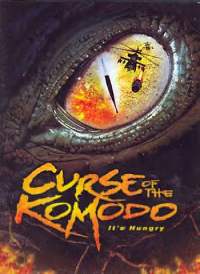
Curse of the Komodo Plot: Giant Komodo Dragons, what do you think? For good or ill, I don’t have much to say about this latest Sci-Fi Channel premiere motion picture, now on DVD, from the ubiquitous ‘Jay Andrews,’ (aka, Jim Wynorski). Are you folks getting sick of reading what amounts to a monthly review of whatever latest DTV killer shark/giant whatsit flick I come across? I seem helpless when it comes to watching these things, but should I keep writing about them? You tell me. (However, I already ordered a disc for an older and incredibly obscure shark movie somebody told me about, so that will be popping up here regardless.) Curse of the Komodo, which indeed features giant komodo dragons, if no apparent curse, is pretty standard fare. There are the inevitable lumps of stock footage (anything involving helicopters, ships, big explosions, etc…in other words, anything expensive looking), the casting of familiar Wynorski/Fred Olen Rey veterans (Melissa "Raptor" Brasselle, Jay "Hollywood Chainsaw Hookers" Richardson, Robert "Attack of the Party Nerds" Gabai), in-jokes and a lot of clichés. The most horrifying of the latter is that the colossal komodos are, sigh, the result of a military bioweapons experiment gone awry. Please. Please, somebody, outlaw this idea. I swear, I all but weep when I see it employed again. At this point in time, it’s about the single laziest plot device I can think of. I remember how bored I was when this idea was used in the remake of The Blob, and that was nearly twenty years and around five hundred crappy movies ago. This time around the culprit is a typically amoral naval Admiral. (Huh? What use is the Navy going to find for dino-sized komodo dragons? At least last month’s Dark Waters had the Navy developing killer mutant sharks.) He explains to his subordinate, played by Robert Gabai, that he got the idea after seeing a movie called Dinosaur Island. "Have you ever seen it, it’s pretty good," he opines, indicating that he’s probably better suited to be an Evil Military Guy than as a film critic. Anyway, the gag is that Dinosaur Island was directed by Wynorski and starred Gabai. Gee, that’s rich, I’ll say. Upon viewing this classic he immediately decided that truck-sized, man-eating lizards would be a neat-o-keen military weapon. I realize these guys are supposed to be eee-vil and/or insane. Really, though, where’s the logic in this? Why would a genetically modified killer whatsit be a more efficient weapon than, say, a rifle, or a tank, or a helicopter gunship, or whatever? And how many of these black bag bioweapons research projects is the government funding? It must be thousands. Good thing these advanced experiments generally only require a scientist or two to run them. Speaking of, the scientist running the project is shocked, shocked, to discover that a military application is his sponsor’s goal. Our idealistic innovator intended his work to be a means to—here we go again—create giant animals so as to help feed the world’s population. Sigh. First of all, giant animals would require giant amounts of feed, so the ‘extra food’ benefit seems doubtful. Second, agricultural progress has us at the point where we can already pretty much feed everybody. Any problems doing so usually involve regimes intentionally keeping their people from being fed, more than a simple lack of food. In any case, the Eee-vil Admiral smirks at the scientist’s naiveté. The military, he avers, is in the business of killing people, not feeding them. This will undoubtedly surprise many of our troops over in Iraq, since most of them have in fact spent more time doing the latter than the former, not to mention rebuilding schools and hospitals, setting up water filtrations systems, getting electrical grids working, etc. I don’t want to beat a dead horse here, but an alternate strategy involving sending a bunch of gigantic komodo dragons into the area doesn’t seem very mission effective. [Actually, as Jabootu proofreading maestro Carl Fink points out: "Even though everything you say about Iraq is correct, that's actually the worst example. Look at Bangladesh, or Liberia, or Haiti ... in all those places we are or were basically there to prevent starvation."] Anyhoo, the scientist and co-worker are sent to their remote base island to wipe out all evidence of the experiment. This follows the inevitable teaser opening wherein a squad of *cough, cough* ‘elite’ soldiers are sent onto the foggy island, without being told what their mission is--another truly moronic idea that is much overused in these things--and sans adequate weapons. Needless to say, after running around in a distinctly unmilitary fashion, they are wiped out to a man. I will say that at least this scene was filmed outdoors (or on an outdoor set), rather than taking place in a power station or water filtration plant somewhere. Watching more laughably train ‘special forces’ operatives skulking down concrete hallways I can do without.
Another plot thread that had me tearing my hair out was when we again get the Murderous Criminals on the Lam who End Up in the Middle of It All. We meet them during a hilariously cheap ‘casino’ robbery, which was filmed in the lobby of some office building, after a fleeting stock shot of slot machines to ‘establish’ the locale. Such miscreants pop up in way too many of these things (Red Waters, Crocodile II, etc.), and I wasn’t exactly reassured when they trotted out the "You said my name, now I’ve got to kill the witness" trope. (The robbery scene is also used to provide a strangely elliptical cameo for B-movie icon George "Buck" Flower, who appears on screen for literally about five seconds. Hours before I saw this film, coincidentally enough, I had read that Mr. Flower had passed away. Rest in peace, Buck.) The inevitable storm forces the crooks and their hired helicopter pilot to land on the island. I was a little confused as to where the casino was, because they establish the island as being in the general vicinity of Hawaii. As they don't have casinos there, the matter is apparently something we're just meant to just pass over. In any case, at this point our cast is as follows:
The action is pretty routine, and pretty much everyone you suspect will get whacked does. Meanwhile, the characters not only have to contend with the giant komodos, but also with the double-dealing Admiral. Unsurprisingly, he decides it would be better if everyone who knows anything were taken out of the picture. Since they had stock footage of military jets and massive firebomb explosions on hand, this is incorporated into the end of the movie. The idea is that the bombing run will wipe out everything on the island, including any inconvenient witnesses. The problem is that the two planes we see could at best destroy but a teeny fraction of what seems a fairly sizable island. Moreover, they use one shot of gigantic fireball blasts destroying a bunch of jungle huts several times over, even though we don’t know why there’d be such structures on the island anyway. In any case, this provides the film with one of its numerous echoes of earlier schlock pictures. The napalming recalls, suitably enough, the climax of The Navy vs. the Night Monsters. Meanwhile, the kodomo’s saliva not only is highly infectious, as it is in real life, but also here turns those exposed to it into murderous quasi-zombies before killing them. (!!) This ‘poison’ element, along with the whole set-up of the pilot, the scientist and the daughter finding themselves besieged in a remote island home by mutated animals, suggests The Killer Shrews. There are also the inevitable Jurassic Park nods.
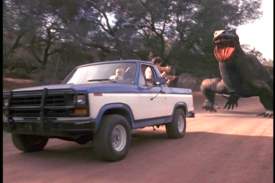
These include a scene where a komodo chases after a jeep. Another involves
the scientist having a fortified compound on the island, but keeping all
his spare ammo and supplies in a rickety hut miles away. This leads to
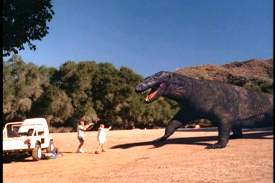
several dynamic scenes of our characters hiking through fields. Indeed, despite the generally depressingly unoriginal script, there are at least some decent moments. For instance, at one point the scientist decides they should call in the authorities. I naturally expected that the crooks would react to this by pulling their guns and shooting up the radio. I was instead amazed when the thieves were actually smart enough to realize that being arrested beat being et by giant lizards. So I’ll give them that one. There are also a couple of moments between the pilot and the scientist’s security guy that manage to suggest two guys who know what they’re doing. However, there’s only one real reason to watch Curse of the Komodo—unless you’re like me, and labor under a geis that requires you to watch every dumb giant monster movie you come across—and that is that the komodos themselves are pretty damn neat. This is easily some of the best CGI work I’ve seen in a low budget monster movie, and I’ve seen a mess of ‘em. Especially nice is that, unlike creatures in even moderately expensive movies (Deep Blue Sea, The Relic), here the dragons move in such a way as to suggest they have mass. In Anaconda you had multi-ton beasties whipping around and defying gravity at will. Needless to say, this isn’t conducive to fooling the eye. Of course, there are still some pretty severe budgetary constraints to deal with. Therefore the monsters’ appearances are few and far apart. Worse, they often have to have a komodo just stand around. This results in several really dumb scenes—rather like ones in Dinosaur Island, now that I think about it—wherein the characters stand about five feet in front of a monstrous dragon and shoot up at it with a variety of firearms. This will ensue for several minutes, with the creature taking no apparent damage (which is mighty unconvincing right there), yet also failing to just step forward and nosh on a tormentor or two. Meanwhile, the only truly poor effects shot portrays the inevitable 'monster being blown up' moment. The CGI rendering of bits o’ creature flying around is still pretty primitive, it seems. The one scene where a dragon really gets to move around is during the jeep chase, and the animation during this is quite impressive for a low-budget movie. The sequence is shot and edited together well, and they do a pretty good job of capturing a komodo’s awkward lope. Such effects, presumably, will only keep getting better and cheaper. Surely, some smart production company will eventually decide to start yoking them to scripts that at least don’t outright insult one’s intelligence. In the long run, obsessive fans will start making their own films, and take an amount of care with them that probably isn’t strictly called for from a financial perspective. At that point, the sky’s the limit. Let’s see, script, special effects…OK, let’s hit the acting. Most of the ‘name’ actors here aren’t very good. Brasselle, Gabai and Richardson certainly don’t show much indication of having honed their craft over the years. However, the actors playing the pilot, the security guy, the scientist and the female co-scientist range from decent to surprisingly good. I guess I’d give the scientist guy top honors. He actually seems smart enough to be a scientist, and also a capably tough individual at the same time. The only really embarrassing acting, meanwhile, is by the woman playing the daughter. The numerous close-ups of her generally insipid expressions often had me literally wincing. I don’t want to be mean, but it’s pretty apparent she got the role because of her willingness to appear topless. I’m glad, I guess, that she’s seeing some return on her chest augmentation surgery…well, no; actually, I’m not. In the end, this is a standard DTV cheapie that is somewhat better than a lot of similar stuff (Sabretooth, Beyond Loch Ness, etc. and so on and so on) by dint of a few minutes of cool giant monster stuff. That’s not much to recommend a film on, but it’s something. By the way, Jim Wynorski has provided equally prolific in
providing some of the most candid and funniest DVD commentaries out
there. Sadly, there isn't one on this particular disc.
The Last Samurai
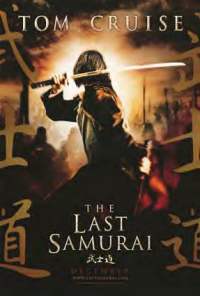
[Warning: This piece contains spoilers about the movie Glory.] Note: Obviously, this film is a little off the beaten track for our site. However, I had some thoughts after watching it, so I thought I’d write them up. Yes, that’s right, I’ve gone mad with power! Mad, I tells ya!! Even so, feel free to move on. Imagine you saw a well-mounted Japanese film set in America a few years after the end of the Civil War. The narrative would follow a proud Japanese warrior who ends up finding a temporary home amongst a once-wealthy and powerful Southern family. The warrior finds his general xenophobia whittled away as he comes to admire the aristocratic values the family struggles through their adversity to adhere to: Extreme physical courage, courtly civility, an iron sense of personal honor that puts God, family, country and community above the self, a deep respect for martial skills, etc. The film, through the eyes of its outsider protagonist, contrasts the enlightened values of the Old South, as represented by the clan who’s taken the hero into their home, against that of the New America, a society marked by ugly commercialism and crass vulgarity. In a pivotal scene, the Japanese man stands by helplessly as grossly uncouth Negro troops harass and humiliate members of the proud family in the streets of the local town. Imagine all this, and now imagine that this film never mentions slavery. That’s The Last Samurai in a nutshell. I can’t remember the last time I saw such a blatantly anti-democratic film. The picture presents Tom Cruise as a haunted Civil War vet hired to help the Japanese create a modern, westernized army. The immediate purpose of this army is to bring down the remnants of the Samurai, the traditional warrior caste of Japan. Cruise is severely wounded when his still largely untrained troops are forced into battle and massacred. However, his personal valor wins him his life, and he spends the following winter living with and learning the ways of his putative enemy. Suffering from deep emotional scars, the result of having once taken part in the extermination of a helpless Indian tribe, Cruise is rejuvenated upon finding himself among people who have a deeply ingrained and rigid system of honor. In the end, he joins the samurai in their futile but glorious final battle. The scene with the family being harassed by troops actually takes place; only here the soldiers are not blacks, obviously, but peasants. The film presents a ludicrously rosy presentation of the samurai class, who here are virtually without any manner of fault. They are learned, brave, loyal to the feckless Emperor who is betraying them, kind, skilled, etc. What the filmmakers don’t bother to mention is that the samurai class had been the scourge of the peasants for centuries. As a member of the aristocracy, any samurai could kill any peasant at his will and whim. If killing too many of them was frowned upon, it was largely because somebody had to do the manual labor necessary to grow food and whatnot. In theory, the samurai were the protectors of the peasants. I think you can imagine what the reality of the situation was. If a modern American film uncritically presented saintly Southern former plantation owners, and the filmmakers afterward responded to criticism by declaring, "Well, there were plantation owners who treated their slaves with kindness and were committed to their welfare," well, you could imagine the reaction. The statement is probably even true. However, it would be considered so grotesquely wrong in the larger sense that it would inspire widespread outrage. Yet this is how the samurai are presented here. The peasant army, part of Japan’s drive to modernize in the late 19th century, marked the beginning of the collapse of the caste system that wouldn’t be really achieved until the end of WWII. Therefore the film is siding against the coarse masses in favor of a privileged aristocratic social class, which strikes me as a bit weird for an American mainstream film. Making this even stranger is that Edward Zwick, whose most prominent earlier picture was Glory, directed The Last Samurai. Glory followed the struggles of a similarly dispossessed class, American blacks, to demand a right to fight for their own destinies during the Civil War. It is the closest thing we’ve seen for a while to a pro-war film, in that its central point was that denying the right of men to wage war in their own behalf was more dehumanizing than war itself. The ultimate victory achieved by its protagonists comes not from winning a battle, but from establishing their entitlement to fight, even if the result is their own deaths. The Last Samurai is, ironically enough, that movie turned upside down. In the end, the aristocracy is destroyed, and the peasants who have destroyed it kneel in grief and shame at what they have wrought. I don’t remember Denzel Washington expressing similar doubts about destroying the Old South. The film is further handicapped by the fact that it seems Frankensteined together from numerous earlier and better movies, primarily Glory and Dancing With Wolves. In the end, the film keeps Cruise from dying alongside his samurai comrades, which emotionally is the only correct ending, presumably because such a climax was considered too similar—as in ‘exactly’—to the conclusion of Glory. Tech credits are predictably top notch. The acting is good across the board, especially the stellar performance of Ken Watanabe as the titular character. Cruise, however, seldom convinced me that he was a character from another time. The battle scenes are well mounted, and there’s an extremely cool ninja attack scene that might in itself justify renting the movie. Other elements, however, also detract from the proceedings. I found Cruise’s burgeoning romance with the widow of a man he killed entirely robotic. However, his scenes with the man’s young sons are entirely effective, mirroring how Cruise’s relationship with the adorable Jonathon Lipnicki in Jerry Maguire was actually more involving than his wooing of Renee Zellweger. There are other crudities. Cruise’s commanding officer in Japan is none other than the vile individual who forced him to massacre the Indians. Needless to say, Cruise gets the opportunity to personally dispatch him during the final big battle, whereupon we’re all supposed to go ‘Yay!’ Meanwhile, the epilogue features the commercial interests of both Japan and America being heroically frustrated, because commercial interests are always bad (except for the ones involving putting down a ten spot to buy a movie ticket). Again, we’re meant to cheer. This is tedious stuff. The film ultimately hints darkly that America’s base attempts to force Japan to modernize (purely for our own selfish commercial ends, of course) would turn and bite us on the ass later on. This is true, to an extent. What isn’t addressed, however, is that the Japanese military of the World War II era, perhaps the most murderous and genocidal such this side of Nazi Germany’s, was the product of Japanese leaders’ declared goal of reawakening and fostering anew the country’s glorious samurai past. You certainly wouldn’t have figured that out from this movie. Summary: A beautifully mounted film best suited for those lacking a basic knowledge of history.
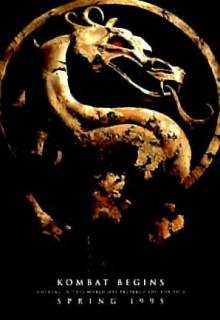
Mortal Kombat Plot: "MORTAL KOMBAT!!!" This forthcoming weekend, beloved Jabootu authoress Eva G. Vandergeld, with the able assistance of the perspicacious Patrick Coyle, returns to these pages with an evisceration of 1997’s lunkheaded Mortal Kombat: Annihilation. Certainly the film annihilated what once seemed a promising motion picture franchise. In view of this, it seemed apt to pay homage to the original film. I am, I believe, quite suited to this task, since I quite simply love Mortal Kombat. I saw it opening night when it came out, went to see it a second time whilst it was in the theaters, and have watched it several other occasions since procuring the DVD. To me, Mortal Kombat is that all too rare object, the B-Movie done absolutely correctly. I find even its limitations endearing. To me no film has come closer to capturing the spirit of the old Harryhausen Sinbad movies. Mr. Coyle in his Afterthoughts to the above-sited review keenly discerns one key flaw of the second film as compared to the first. I’ve no wish to steal his thunder, but I will note that I am not a video game person and knew no more of Mortal Kombat the game than I may have gleaned from watching the occasional TV commercial. Despite this fact, as noted above, I simply adored the end result. This in itself marks the correct way to craft such an adaptation into another medium: Worry about placing the key elements into a structure appropriate for your new format, in this case a movie. In other words, choose wisely those elements that will work cinematically, and only then leaven in more obscure aspects as winks and nods for the amusement of the hardcore fans. (Note that Eva’s previous review subject, Dungeons & Dragons, failed in both of these areas. As a film, the movie sucks, yet moreover its adherance to the D&D gaming rules was intermittent at best.) In this case, the scriptwriter—unlike the sequel, the first film boasted but one of these, rather than several, and that probably sums up a lot of the differences between the two—naturally concluded that the tournament aspect of the game was its most important characteristic. Therefore, he found a film template that the game could gracefully be dropped into. In this case, Mortal Combat the movie is basically a redo of the venerable Enter The Dragon. Not that there aren’t a billion other tournament chop-socky movies (Master of the Flying Guillitine, Blood Sport, Kill Or Be Killed, etc.), but Bruce Lee’s contribution to the sub-genre remains its acme. Again, to me this film is almost a textbook example of how to make a genre film. Here’s some reasons why:
In sum, I'm in no way arguing that Mortal Kombat is some sort of classic or anything. It's just a movie, like Smokey & the Bandit, that exerts a strange hold over me. However, looking at you makes you wonder what the hell is wrong with Hollywood. Here's a film that knows exactly what its audience wants, is committed to providing it, spends enough money without going crazy about it, and manages to be simply a well-crafted piece of work, with the odd bit of flair, that doesn't insult the intelligence of the people watching it. So why, I mean, why, do movies like this come around so rarely? Summary: "MORTAL KOMBAT!!!!!"
_______________________________ Note: Since I feared that the absence of Should Jabootu's Bad Literature Dimension be explored further? Only YOU can decide. ____________
Wow, this dude is a bad writer. (I know, rocks and glass houses.) I don’t mean his plot construction or characterization or any of that more advanced stuff. I mean the way he puts words together. Here follow some examples taken only from the novel’s first few pages. The setting is a submarine sitting on a conveniently small underwater ledge above a deep-ocean trench. "The slightest vibration could nudge us off of here!" one character helpfully declaims. Three guesses where this is going.
Wow. And there’s a lot more where that came from. Sadly, as we’ll discuss later, I can’t with total confidence dub Brown the worst author to write novels about Megalodon sharks. He’s certainly in contention for the crown, but no shoe-in by any means. Perhaps I’ll explore his competition at greater length in the months ahead. Anyhoo, the sub is sitting precariously upon the ledge because it lies over a deep ocean trench that contains a superfantiscifavulicious ore field. How they think they're going to get to this ore isn't worth getting into. In any case, as you may have figured out by now, there's something more ominous than ore down at the remote bottom of that trench. And I'm not talking about boredom...wait, yes, actually, I am. Quite quickly the title beastie—although kept off-camera, as it were, for the moment—comes up for a looksie and sends the ballistic missile submarine USS Jules Verne (!) down to Davy Jones’ Locker. Or so I assume, although later the damaged sub has been mysteriously retrieved in some fashion (from a deep-ocean trench that no submarine could enter?), and we never really learn what happened to the crew. Unaware of what attacked the boat, the government calls on the services of scientists Frank Acreman and Barbara Monday, as well as their picaresque boss Harry Asquith. Acreman’s research has developed a mechanism allowing humans to communicate with dolphins. (!!) This should also work on whales, Acreman insists, as they are basically "big dolphins." (!!!)* [Carl Fink clarifies: "Dolphins are a type of whale. Saying that whales are basically big dolphins is weird, like saying "canines are basically big jackals", but it isn't actually that far off. Orcas, now, are in fact a type of big dolphin." Given that, I can only accept Mr. Brown's claims as to the sea mammals' mental superiority to man, as the awesome brain power of the Orca has already been established by other highly respected scientists.] I guess one strategy for making the sudden reappearance of the Carchardon Megalodon seem more reasonable is to include an even more outré plot device to contrast the notion with. Talking ala Dr. Doolittle with dolphins, who prove to be the full intellectual equal (at least) of humans, certainly serves. The dolphins' unique skills and higher intelligence will prove invaluable in solving the mystery of the downed sub. Acreman explains the rationale behind his research: "[Doris the Dolphin] could tell you [the presumed enemy ship’s] exact size to within one-millionth of an inch. She could tell you how fast it was moving through the water. And reading variations of sonar echoes one-thirtieth of a second apart, she could tell you what kind of metal the object was made of, and whether it was hollow or solid, or both.*" However, we’re presumably all here—by which I mean the several dozen people who may have read the book over the years—for the giant shark. Megalodon’s example of the breed is the largest found in any of the various such novels I’ve read, a somewhat excessive-seeming 100 feet in length. This puts it half-over large again as most of its peers, as Mr. Brown’s novelist competitors deemed a sixty to seventy foot monster well large enough. The book’s human characters, meanwhile, are right out of the Pulp Writer’s Handbook. Acreman is the stalwart Man of Science, all too aware of Man’s Unwarranted Arrogance. "He had his own considerable reservations about man’s inexorable inquisitiveness," we’re told. Then there’s Barbara, Acreman’s girlfriend/colleague, and Asquith their boss, who inevitably proves a little too concerned about the old filthy lucre. The military and gov’ment spOOk types, of course, range from the outright villainous to, at best, being merely stupid, small-minded jerks. The author’s hilariously misanthropic ‘green’ politics—the frowning designation of ‘naked ape’ is used to describe us humans more than once, and Brown rhapsodizes on the myriad ways in which dolphins and whales are better, smarter and more moral than us (for instance, they apparently don’t write books like this one, much less expect others of their kind to pay to read them)—require Man to be the problem, rather than the big sharks. Thus, rather than having the sharks invade our territory, we invade theirs. And so the U.S. Navy continues to send down one Ohio-class nuclear submarine after another, despite the mysterious accidents which continue to afflict them. (It must be a hell of an ore field to justify the loss of a series of advanced submarines and their highly trained crews.) This scenario also conveniently allows for some purely environmental danger to the craft. Even when the subs are resting upon the aforementioned ledge, they’re down past their normal depth limits and thus quite vulnerable. Acreman and his team capture (following much ethical hand-wringing) a sperm whale. This being can go deep enough to investigate the trench and investigate what’s causing the mishaps. Transporting the beast to the locale of the trench involves the use of a dirigible, the only craft capable of ferrying the massive creature. As you’d guess from this description, the action here grows increasingly outré and cartoonish. More so, I mean, than you’d expect from a giant prehistoric shark novel. In the end, the bad humans reap their inevitable rewards, and we are threatened with the possibility of a sequel. However, it would take another author entirely to turn out an actual series of bad prehistoric shark novels. From the Pen of the Bard:
Plot Points:
[Mr. Fink, once more: "Dolphins nonviolent? Did you know that aside from us humans, dolphins are the only mammal I'm aware of that engages in violent gang rape? No, I'm not kidding nor even anthropomorphizing much. Gangs of adolescent male dolphins surround calves and force sex on them. I'll leave aside the risible idea that the oceans contain no threats to dolphins."] For the record, I tried to make this
piece longer. However, nearly every individual scene in the book was so tedious (and
this in a book just over a scant 200 pages) that frankly I couldn't force
myself to continue.
-by Ken Begg |