Another feature of... |
|
Another feature of... |
|
|
for
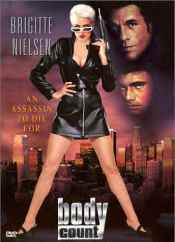
Plot: A betrayed assassin seeks revenge. You’ve got to love a B-Movie with an all-star cast. (Don’t you?) Of course, it helps if you consider Brigitte Nielsen, Robert Davi, Jan-Michael Vincent and Sonny Chiba as constituting such. And that’s just in the feature presentation. The parade of stars continues in the trailers showcased at the beginning of the Body Count video tape. Costas Mandylor stars in Crosscut, a Mafia vs. hicks flick. Terence Hill, meanwhile, returns to his comedic Spaghetti Western roots in Lucky Luke. And Nicole "Clan of the Cave Bear" Eggert is the Robocop-esque Demolitionist, opposite mad dog killer Richard "Die! Die! Die!" Grieco (!). Our film proper opens on two guys in a car. Gianelli, an obvious hood, delivers unto his tethered compatriot the Kiss of Death. (Does that count when the recipient is wearing a duct tape gag? Or is this just the Mafia’s way of adjusting to the era of AIDS?) Then he exits the car and walks away from it. This is shot in slo-mo, with his jacket Billowing in an Artistic Fashion as he strides forward, the car strategically centered behind him. Of course, it’s a Movie Law that whenever a guy nonchalantly walks away from a car in slow motion that said vehicle will explode in a huge fireball. And so it does. We cut to Chiba watching your classic ‘Unjustly Acquitted Smirking Hood Gets Swarmed by the Press on the Courthouse Steps’ news broadcast. The subject of this is Gianelli. As Chiba half listens to the newscast, he carefully assembles a pair of homemade rifle bullets with ice slugs (!). At this point I was pretty sure I was going to enjoy the movie. Chiba, however, has seen better days. Although considerably more fit, his long, greasy hair lends him a definite late-period Steven Seagal vibe. Luckily, he should be able to dispel this at some point by making a facial expression, or perhaps projecting some charisma. That night, Gianelli holds a gaudy riverfront bash to celebrate his unwarranted freedom. Hookers are provided for some of his guests and to allow for a gratuitous boob shot or two. Meanwhile, we see Chiba setting up with his rifle on a passing ferry. When the craft comes alongside the party, Chiba takes his shots. Gianelli is whacked with the first, right after toasting "American justice." (The irony!) His brother, cavorting with the aforementioned hookers, takes the second. Detectives from the Special Crimes unit are on the scene the following morning. The head detective, to my lack of surprise, is played by Davi. (Although given his cinematic career, he just as easily have been the head bad guy.) Davi is puzzled by the lack of a bullet, since, of course, they melted after entering the bodies. He and his partner Rizzo also muse on how, after they spent eight years trying to put Gianellis away themselves, somebody else finished the job in one night. "We should put [the killer] on the payroll," Davi joshes, thus fulfilling one of the Cynical Movie Cop union rules. Meanwhile, the go-between bringing Chiba his fee learns that the assassin expects a larger amount. The bone of contention is whether the two victims represent separate hits, thus requiring discrete fees, or just one, since they were killed at the same time. Really, shouldn’t this sort of thing have been spelled out in the pre-hit assassination contract? Somebody needs to hire a better contracts lawyer. Now I guess it’ll have to go to arbitration. Or maybe not. In the end, the go-between figures that pissing Chiba off isn’t a good idea. He sets up a second meet that night, whereupon Chiba will receive the full amount he demands. Cut to the police station. Davi is about to leave, as he has a wedding to attend. He’s therefore less than pleased when his Lt. orders him and Rizzo to check out a lead on Chiba’s whereabouts. Cut to a strip club, thus providing for an extended series of gratuitous boob shots. (I was amazed to learn the picture was made in ’95, because everything about it screams of being an ‘80s action flick.) A number of detectives are seeded throughout the place. Soon Chiba makes his appearance. Since he’s a Hit Man with Ice Water in his Veins, however, it’s made apparent that he isn’t interested in looking at the nekked ladies. The film takes place in New Orleans, by the way, so the strip club sequence is a mere part of the movie’s Obligatory French Quarter Scene. To my frank amazement, however, the film lacks the even more de rigueur Chase/Shootout in Lafayette Cemetery. Apparently aware of this glaring omission, however, the filmmakers provide some compensatory New Orleans-y goodness during the movie’s climax. Chiba gets his dough, but sees Davi and makes him as a cop. The assassin uses a stripper as a shield and opens fire. In the confusion he makes it outside, with only Davi and Rizzo on his tail. A running gun battle ensues, allowing the film to further showcase scenic New Orleans. At one point, believe it or not, Chiba’s gun actually ran out of bullets. He manages to reload, though, and pops a bullet into Davi’s leg. Since he obviously could have killed Davi, I assume Chiba’s your Honorable Movie Hit Man Who Doesn’t Murder the Innocent. [Future Ken: Or not. See below.] Rizzo follows Chiba across some canted rooftops for a brief but fairly decent chase sequence. Chiba gets the drop on his pursuer, but instead of shooting just Kung Fus him. However, Davi makes it up after them—which doesn’t seem very likely, given that he just took a pointblank pistol shot in the meat of his thigh—and shoots Chiba in the shoulder. Cut to the following morning. Davi, whose wound has
resulted only in a slight limp*, gets into the standard Fight With the
Wife About How The Job Always Comes First. She’s thrown all his stuff on
the lawn and then drives off, never to be seen again. Which, I thought,
made her throwing his stuff outside a bit strange. Don’t you do that
when you want the other person to leave? Skip ahead to "18 Months Later." In the joint, Chiba is reading a letter from a woman named Sybil. We hear her voice narrating the letter. The voice acting is really bad, so I’m going to take a flyer and assume Sybil’s being played by Nielsen. Then we see Chiba working out, and I have to admit, he was in pretty good shape for a guy nearing sixty. Next we see Chiba working on a chain gang. He’s casually beaten with a shotgun stock by one of guards, because that’s the sort of thing Southern prison guards in movies do. (Although the prison guard is black, so it’s not so much of a racial thing.) Then a pickup truck appears. In perhaps the film’s most clichéd moment—which, as the text above might indicate, is saying something—we cut to a low level shot of the truck door. To the accompaniment of some ersatz Ry Cooder blues chords, the door opens and a pair of shapely female legs emerges. The senior prison guard goes up to help the apparently distressed driver. The camera, meanwhile, plays around with showing us only various glimpses of the woman. I found this elaborate introduction kind of amusing, given that we’re talking Brigitte Nielsen here. (I mean, who else would it be?) Still, if you ever wanted to see Nielsen in some butt-cheek revealing Daisy Dukes, here’s your chance. Although I didn’t know short-shorts and high-heeled shoes went together, even down South. Eventually we do get a good look at the former Mrs. Stallone. This confirms that the ravages of time were becoming apparent. She’s gotten a bit stocky, and while she’s not unattractively so here, she does seem to be heading into Anna Nicole Smith territory. According to her bio, Nielsen was 33 when this movie was produced. If so, they were a hard 33 years. Needless to say, the guards fail to live up to their job description and are soon bloodily dispatched. Then, in a truly ridiculous moment, Nielsen uses a shotgun to blow the leg shackles off Chiba from a distance of at least a hundred yards. It’s not the laughable accuracy of her shooting I had a problem with. It’s that over such a distance the buckshot would spread something fierce and most likley have taken Chiba’s legs off*. [Note: Mr. Fink also wonders if the force of the shot wouldn’t have been completely spent after such a distance. I’m no expert on firearms, but I suspect that might well be so. Either way, the scene is pretty silly.] I was half-expecting Chiba to chastise his associate over her profligate death dealing. However, if he was meant to be coolly reserved in his violence earlier, that particular character trait has gone by the wayside. At this juncture the film starts living up to its title, as Chiba seeks revenge for whoever it was that ratted him to the cops and got him incarcerated. Back to New Orleans. I was pretty amused by how Davi and his mates don’t hear of Chiba’s escape until the killer makes his presence known. Maybe they’re a lot more jaded down in N’yawlins. I mean, up here in Chicago a prison break by a foreign Hit Man during which five or six guards were murdered would be a fairly big story. Then, after the squad receives a mysterious gift (from Chiba), Davi asks his partner and Lt., "Remember that bust we had about a year, year and a half ago?" What, the one involving the Japanese assassin who killed two of the city’s biggest gangsters with bullets made of ice and then shot a couple of cops, including Davi, during his arrest? Oh, yee-aah, that guy! The corpses start stacking up. Nielsen visits the bagman for the Gianelli hit and feeds him a bullet (literally). She pumps him for information first, but all he knew about the man who hired Chiba was that the guy was…bum bum bum…a member of the Special Crimes unit. That Chiba’s employer would keep his identity a secret from the go-between seems logical. That he would let slip not only that he’s a cop but what squad he’s in struck me as a trifle unlikelier. One of the cops is a briefly seen Jan-Michael Vincent. This was shortly before his near-fatal car accident. Therefore he seems mostly bored here, rather than exhibiting the distressing fragility and damaged vocal chords he evinced in subsequent years. In any case, I instantly assumed that Mr. Vincent would turn out to be the crooked cop. Which would, of course, follow the Murder, She Wrote Rule: The most prominent guest star will turn out to be the killer. Instead, Mr. Vincent makes an early exit. Either his casting was a canny red herring by the film’s producers, or else they wanted another ‘name’ to put on the video box, or both. Anyhoo, he and his partner thoroughly violate Ken’s Rule of Guns while arresting Chiba, with predictable results. (Given that Chiba was wearing a long coat—with his hand in his pocket yet—I found it laughable that experienced cops would leave him standing while approaching to apply the cuffs.) In a sadistic bit, Chiba tosses the acrophobic Vincent off the roof of a tall building. Perhaps the film’s most risible character is FBI agent Janet Hood (JAG regular Cindy Ambuehl), who exhibits a taste for preposterously short skirts. Needless to say, she proves a romantic foil for Davi. One ‘meet cute’ scene features her joining the wary detective in a sauna—the women’s spa room being conveniently out of order—and allowing Davi a gander at the crudely drawn FBI tattoo on her ass (!!). This is pretty much par for the course for Hood, who takes over the detective’s squad room while draping her mini-skirted legs over the furniture. Later the two will have a sex scene so far out of left field that we actually picture the scriptwriter winking at us and saying, "I was contractually obligated to toss this in." The film reaches its peak of inanity, meanwhile, when Davi is puzzled by the disappearance of Hood’s ass tattoo. "I have a confession," she replies. "It was a stick-on." (?!) By the way, would it be overly picky of me to note that Davi looks for the tattoo on the wrong butt cheek? Chiba proves predictably inept at fingering the correct cop, and the squad’s population suffers a severe decline. (The various confrontation scenes quickly establish why Chiba didn’t have a bigger American film career—his command of the English language makes Arnold Schwarzenegger and Jean-Claude Van Damme sound like George Plimpton.) To the film’s credit, the ultimate revelation of the guilty detective and his motives in hiring Chiba far transcend the standard Crooked Cop clichés I was anticipating. One Jabootuish highlight occurs when Nielsen pops up in a simply atrocious outfit consisting of a ruffled floral top and (unfortunately) skintight red-and-white-striped pants. For some reason she seems ten pounds heavier here than elsewhere, making the comparison to Anna Nicole Smith literal rather than speculative. Either she gained weight during filming or it’s just the pants. In the end it’s (surprise) down to Davi and Chiba, who duke it out on a runaway trolley car. I’ve seen the trolley cars in New Orleans, and vehicles that go three or four miles an hour don’t make for pulse-pounding cinematic thrills. In the end, the trolley smashes into a petrol truck (!) that just happens to park across the tracks. I’ve seen Secret Squirrel cartoons with more tenable climaxes. The inadvertent humor level is heightened since they lacked the sort of budget that would allow for a real trolley to smash into a real truck. Instead, the collision and the resultant conflagration are portrayed with miniature surrogate vehicles, which despite their extremely brief usage are patently identifiable as toys. Hood’s presence, meanwhile, provides someone to fight Nielsen, since action movie rules dictate that only women can fight women. Hood spends much time hoofing it, since Nielsen is armed and she isn’t. (Watch Nielsen’s footwear during this extended sequence, and count how many times her thigh-high black boots morph into short black pumps and back again.) In the end it comes down to fisticuffs, as the far more petite Hood counterintuitively holds her own against the much taller and beefier Nielsen. In the end, however, justice triumphs and Brigitte is dealt a typically cartoonish demise.
IMMORTAL DIALOG: Davi describes his encounter with Hood in the sauna: "I haven’t seen drumsticks like that since Thanksgiving!" Summary: Some good stuff, some dumb stuff, ample servings of gratuitous violence and nudity; what more could you want? _______________________ (1999)
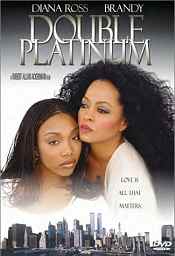
Plot: A singer abandons her infant daughter when fame beckons, then attempts a rapprochement years later. All right, ladies, time to break out the hankies. (People hoping for a good movie might want to do so also.) Double Platinum is a made-for-TV flick that again instructs us on the heartbreak associated with fame and fortune. Well, boo-frickin’-hoo. We open in Atlanta, 1981. Olivia Harris is singing in a small jazz club. Since she’s played by Diana Ross, Olivia unsurprisingly proves a talented vocalist. On the other hand, Ross is clearly much older than Olivia’s supposed to be here. Nor are the wig and heavy make-up employed to fudge this helping much. (Ms. Ross’ official birth date indicates she was 56 at the time this was filmed. I’m figuring she was somewhat older than that.) Her rapidly-approaching dotage leads to some guffaws when her manager exclaims, "Geez, girl, you are green!" Given the sort of movie this is, we’re less than amazed when Olivia is offered a job in NEW YAWK CITY that will make her a Major Star. She worries about her husband and baby daughter, though. She also makes clear that "it’s not about money." See, otherwise we might find her subsequent actions a tad selfish. She goes home and informs Adam, her somewhat exaggerated jerk of a husband (or so he appears right now, anyway) of her opportunity. He wants no part of it and angrily orders her to forget the idea. Late that night, Olivia tearfully says farewell to her baby. "Maybe one day you’ll know," she whispers, "you should go for your dreams." I assume the remainder of the line, "and tell anyone that gets in your way, like your husband or children, to screw off," was cut for time purposes. Cut to "Eighteen Years Later." We meet young woman Kayla (singer/actress Brandy). She is, needless to say, Olivia’s abandoned daughter. She’s hanging with a buddy, allowing us to see how fun and vivacious she is. The two work at the small neighborhood laundry owed by Adam, thus establishing Kayla’s lower-middle-class status. Given the film’s abbreviated 90 minute running time—which is actually shorter than it sounds, given the numerous musical numbers—Kayla is almost immediately served with a winning contest invitation from popular local DJ Party Artie. The playful invitation tells her to be ready that night (good thing she wasn’t out of town for the weekend, or had prior plans!) to "meet royalty." Kayla is more than a little excited, as the winners of these contests traditionally get to meet big stars. Later a studio van comes to pick her up. She’s deposited in front of a theater, where she is greeted by Artie himself. An ecstatic Kayla learns that she’s won "VIP Seating" to her idol Olivia King’s concert. (King…"meet royalty"…get it?) "She is the bomb, Artie!" Kayla trenchantly observes. After the show, moreover, she will go backstage and meet Olivia in person. Cue an elaborate stage number performed by King (Ross, of course). Then we cut backstage. Unsurprisingly, Olivia has set this whole thing up so as to meet her daughter. She’s desperately nervous—a situation that starkly illustrates the, er, borders of Ms. Ross’ dramatic range—but receives encouragement from Peggy, her Loving Yet Irascible Personal Assistant. During this scene Ross strips down to a lacy corset and panties, which frankly I could have done without. I suppose she wears them well, considering her age, but still. Kayla, for her part, has no idea of the Larger Truth. She thinks she’s just getting to meet Her Most Favoritest Star in the Whole Wide World. The two go out for dinner, where Kayla (surprise!) reveals that she’s a budding singer herself. The conversation soon turns to Kayla’s having grown up without a mother. (Adam, of course, never remarried. If another woman had raised Kayla, then Olivia’s sudden return would seem even more selfish.) "Any woman who could leave me," Kayla laughs, "doesn’t deserve to have me." Despite her cheerful façade, however, we sense the pain hidden in her soul. Olivia’s ‘anguish’ at hearing this statement, again due to Ms. Ross’ thespic limitations, is a bit more obvious. Kayla will be singing at a local club the following night and Olivia promises to come see her perform. I thought touring superstars had a pretty tight schedule, but I guess not. Next we see Kayla arrive home and greet her father. Adam has been, shall we say, remarkably untouched by the ravages of time, except for some chemical graying of his hair. As you might expect, he’s rather taken aback to learn who his daughter spent the evening with. Unwilling to tell Kayla The Truth, he pleads weariness and retires for the evening. The following day an irate Adam confronts Olivia at the theater before her show. (How an obviously enraged male managed to get inside, much less up on stage and within three feet of a big celebrity, is left to our imaginations. It doesn’t indicate very good security, though.) He angrily orders her to stay away from Kayla. "I’m her mother," Olivia responds. "I need to see her." She also tells Adam "You can stop punishing me." (!!) It bewilders me that anyone at this point wouldn’t like to spend the next hour and a quarter just watching Olivia getting slapped in the face, and then maybe mauled by a bear. Despite this, I think we’re actually meant to find her somewhat sympathetic. Cut to the Chicago Blues Club. (Going back, I see that Olivia’s performing at the Orpheum, which is a venerable Chicago theater.) Kayla is waiting to go onstage, and hugely disappointed that Olivia hasn’t arrived as promised. Cue her first number, which is naturally amazingly good. However, the illusion of the lip-syncing is somewhat compromised when Olivia enters the club and an excited Kayla covers her mouth mid-note. Oddly, nobody in the small venue’s audience seems to find the appearance of an internationally known musical superstar in any way noteworthy. Cut backstage. Kayla, in a happy daze at her good fortune, hugs her visitor. Then Olivia turns serious and says she has something to tell her. "This is very difficult for me," she begins. (At this point I substituted the fantasy bear in my head with a swarm of bees.) After some hemming and hawing, she finally gets to the point. "I’m your mother," she reveals. "Please don’t get mad at me." Kayla runs off, though, despite Olivia’s pleas to "let me explain." Boy, that Kayla’s a real jerk. Really, is that any way to treat one’s mother? Caught up only in her own self-centered needs, however, Kayla goes home and has a good cry. The next day Kayla leaves her house and finds Olivia standing outside. Again, no one seems to have noticed this putative superstar’s presence on the street in broad daylight. Olivia reacts to Kayla’s anger by saying "I don’t know what your daddy’s said to you." Yes, because if Adam hasn’t been badmouthing Olivia, then how could Kayla possibly be upset with her? Meanwhile, we know we’re in Lifetime Channel territory when Kayla bitterly retorts, "Was there a hole in your schedule? Was there a blank page in the calendar where you penciled in ‘motherhood’?" You just know someone high-fived themselves after coming up with that one. Here they mention that Kayla and Adam live in St. Louis, which I found pretty weird. Why would St. Louis have a club called Chicago Blues? Especially given that the two cities are traditional and often fierce Midwestern rivals. And why then set part of the movie in a theater that corresponds to one in Chicago but not to St. Louis? Perhaps the script was originally set in Chicago, but the production got a better tax break or whatever by moving it to St. Louis. Anyway, Olivia offers to help Kayla become a singer. "Just come to New York with me," she pleads. Seriously, if Adam came out right now and killed her with an ax, it would be justifiable homicide. In fact, I think he’d get a medal of some sort. Then we get more of the selfless dialog that made Olivia King a character beloved by millions. "My heart is broken." "It’s been very painful for me, too." "You don’t understand. I’ve always missed you, see." Somehow, though, Kayla continues to see the situation as revolving around her. What a bitch. Kayla returns home and lays into her father rather more severely than she did Olivia. Which is probably psychologically accurate, actually. On the other hand, the film really seems to be judging him as harshly as Olivia, which is insane. Kayla accuses him of hiding Olivia from her for fear that Kayla would decide to go off with her. Which, even if true, seems pretty understandable. After single-handedly raising Kayla since she was a baby, why wouldn’t Adam worry that the enticements Olivia could offer would seduce Kayla away? Meanwhile, we cut to Olivia freaking out in her dressing room. It’s obvious her daughter’s anger is taking a toll. Finally she settles down by telling herself, "Everyone’s here for you." Yes! Yes, Olivia! We’re all here for you. You and your needs are what’s important. Never, ever forget that. (Not that I imagine she will.) Cue another musical number as we see Olivia onstage. I have to confess, I pretty much fast-forwarded though all these, thus saving myself much time. Admittedly, these are easily the best parts of the film, from an objective sense at least. Still, that’s not why I’m here. And frankly, none of the songs are good enough to draw my attention in a positive sense. After the show Kayla appears in her dressing room. (I’ll be charitable and assume Olivia left orders to have her let in.) She’ll go with Olivia to New York, but only to pursue her own singing career. Olivia isn’t to act like her mom, and in fact must tell no one that Kayla’s her daughter. By the way, assuming Kayla was right about why Adam didn’t tell her about Olivia, then his fears appear to have been entirely justified. In any case, at this point I realized I deeply disliked both of the film’s lead characters. This somewhat diminished my enthusiasm for describing the rest of the picture in any great detail. So here we go: Having arrived in the Big Apple, Kayla is soon on the road to stardom. Olivia learns that being a Mom doesn’t entirely consist of good stuff. Olivia’s attempts to control Kayla’s budding career cause further turmoil. Harvey Fierstein shows up as Olivia’s manager, acting cartoonishly broad even for him. Kayla hooks up with a young man her mother doesn’t approve of. A leak to the papers reveals Kayla and Olivia’s secret relationship. (The ‘mystery’ of who’s behind this is resolved in one of the laziest bits of scripting I’ve seen in a while.) On Kayla’s first night touring, Olivia comes on stage and steals the show. Yada yada yada. In the end, they’re both huge stars, they have a ‘heartwarming’ reconciliation, Olivia is artistically revitalized by her emotional reconnection with her daughter, and Adam, the least obnoxious of the lead characters by far, is basically ignored because he’s not played by a big celebrity. The last scene, and I hope you’re sitting down so you don’t keel over in amazement, has the two women singing together onstage to thunderous applause. Adam, meanwhile, is regulated to a shot of him in the audience clapping madly. Basically, the film treats him the same way the women in the movie do. In an effort to be fair, I’ll note the final confrontation scene between Kayla and her mother isn’t bad. This is partly because Brandy really is a fairly decent actress. More so, though, it’s because the script doesn’t suddenly go all mushy on Olivia, who admits if given the choice she’d still make the decision to leave Kayla in order to pursue her career. I liked the moment of honesty, although I was faintly appalled to see Olivia awarded for it. I doubt I really need to point this out, but obviously I’m not the target audience for this film. Watching it, I had no idea why I wasn’t supposed to find the main characters repulsive, much less care about their various tribulations. (Which are, after all, almost entirely of their own making.) Also, since I’ve never really wanted to be rich and/or famous—good thing, too, I guess—I found Kayla and Olivia’s pursuit of same more distasteful than anything else. I’m also not much of a music person, and thus I didn’t get a lot out of the constant song performances. Maybe if Ross had done some of her old Motown stuff I’d have been more attentive. In the end, the only thing I took away from the picture was the wish that I’d had the glycerin concession for all of Brandy’s crying scenes. Diana Ross started out with a real shot at a decent film career. Her first movie was the 1972 Billie Holliday biopic Lady Sings the Blues. Directed by Sidney J. "Superman IV: The Quest For Peace" Furie just before his own career plummeted, the film netted a batch of Academy Award nominations. Ross herself was nominated for Best Actress, and she won the Golden Globe for Most Promising Newcomer (Female). However, her cinematic career declined precipitously after that. For whatever reason, she didn’t make another movie for three years. When she did, her next project was the widely mocked soaper Mahogany. Still, the film netted another Oscar nomination. This was for Best Song, for the "Theme from Mahogany (Do You Know Where You’re Going To)." It was beaten, however, by Keith Carradine’s "I’m Easy," from Nashville. After a second three-year hiatus, Ross finally picked her comeback feature. This, unfortunately, was the less-than-critically-acclaimed The Wiz. A jazzy ethnic update of The Wizard of Oz, the film fared poorly. In retrospect, the ominous portents are evident. First, the film was directed by Sidney "A Stranger Among Us" Lumet. (Lesson #1 for Diana Ross: Stay away from veteran directors named Sidney.) Lumet was primarily known for gritty urban flicks like 12 Angry Men, The Pawnbroker, Dog Day Afternoon and Serpico. With Harlem replacing the original Dorothy’s Kansas, this may well have been why Lumet was hired. However, musicals are delicate things, and require a director with a touch of whimsy. Lumet has seldom evinced such. Also, given that the entire musical was meant as a ‘black’ version of Oz, couldn’t they have dug up a black director? Especially in the absence of a veteran musical director? There were further problems. In 1939, MGM worried that the 17-year-old Judy Garland was too old to assay the novel’s pre-teen Dorothy. In a famous piece of film trivia, Garland’s already womanly breasts were strapped down to help disguise this. (MGM’s first choice for the role was the age appropriate Shirley Temple, but she worked for another studio.) Ross, meanwhile, was fully twice as old—even if her official birth year is correct—as Garland when she played the role. Finally, the whole idea of screwing around with a film that remains one of the (debatably) two or three best-loved pictures ever made seems inherently dubious. In any case, The Wiz received mixed reviews and did poorly at the box office. With a $24 million dollar production budget, it reaped an anemic $13 million at the box office. (Remember, the studio itself would have only gotten maybe half of that sum, with the rest going to the theaters showing the movie.) The one element to earn universal accolades was the performance of the nineteen year-old Michael Jackson as Scarecrow. Ah, the days before Jackson became the biggest show biz freak since Howard Hughes. Following this debacle, Ross abandoned the silver screen. Sixteen years later, she made the telepic Out Of the Darkness, in which she played a troubled schizophrenic. Apparently the Golden Globes, like the Academy Awards, have a taste for such gaudy thespian endeavors. In any case, Ross was nominated for—take a deep breathe—Best Performance by an Actress in a Mini-Series or Motion Picture Made for TV. Five years after that, Ross appeared in Double Platinum, which premiered on ABC. It is, to date, her last film or television appearance as an actress. Her co-star, Brandy (a.k.a. Brandy Norwood), also has a currently stalled screen career. First coming to public attention as a young singer, Brandy moved on to acting. She remains best known as the star of the TV series Moesha, which ran from 1996-2001. In 1997, she starred in a well-received musical televersion of Cinderella. This premiered on NBC, and the film’s producers hedged their bets by surrounding her with familiar faces, including Bernadette Peters, Whoopi Goldberg and Jason Alexander. Moreover, as with Double Platinum, Brandy was teamed with a more established singer. In this case it was Whitney Houston, who played the Fairy Godmother. Brandy’s career momentum was dealt a vicious blow the following year, however, when she co-starred in the much-maligned I Still Know What You Did Last Summer. Her follow-up was Double Platinum, which didn’t exactly help matters. An appealing actress as well as a talented singer, Brandy’s career has no doubt been hurt by the current disfavor for musicals. Her last thespian appearance was as a voice in the failed theatrical feature Osmosis Jones in 2001. On to the supporting cast. Adam is played by Brian Mitchell, who’s a better actor than indicated here. (I’m assuming director Robert Allan Ackerman encouraged a certain, shall we say, breadth of performance from his cast.) Mitchell himself is a singer—a talent oddly not exploited here—who won a Tony for Best Leading Actor for Kiss Me Kate in 2000. He’s also been nominated for Best Leading Actor on two other occasions. Mitchell was probably most widely seen as the snobby and priggish Cam Winston, Frasier Crane’s doppelganger antagonist on the Frasier TV show. Peggy, Olivia’s personal assistant, is played by actress and SNL vet Christine Ebersole. Aside from roles in a number of short-lived TV shows, Ebersole has had a prolific career as a supporting actress. On the high side, she appeared in such films as Tootsie and Amadeus. However, she’s also acted in more than her share of Jabootuish fare. Most prominently, she was the mom in the supremely atrocious Mac & Me. Further cinematic debits include Ghost Dad, Richie Rich and the My Favorite Martian remake. Summary: Right cast, wrong script. _______________________ (2001)
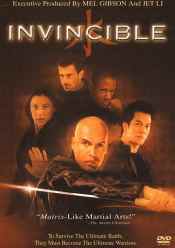
Plot: Random people learn they are mystic warriors fated to save the Earth. A failed pilot for the TBS cable station, Invincible is one of those deals where you spend a lot of time cataloging all the stuff stolen from other movies. Characters, situations, plot points, specific shots and camera angles, dialog, special effects…practically every element in this movie is filched from a better (and better known) genre flick. I’d say Highlander and Mortal Kombat were the two biggest donors. As usual with these Frankenstein stitch-up jobs, our subject doesn’t exactly hang together in a seamless fashion. Exacerbating this is the whole ‘pilot’ thing. By definition, this means that various and sundry plot threads are left dangling at show’s end. More succinctly, the movie’s a bit of a mess. In the end, I can’t say I thought it very good, but there were parts of the film that I at least found amusing or interesting. Sadly, that’s more than I’ve gotten from many of the movies I watch. We open with Billy Zane in full whackjob mode, which for him is saying something. Dressed entirely in a shiny black leather suit (or maybe it’s satin) and sporting a particularly egregious inky black wig, he runs down an alley at night. This footage is accompanied by Zane’s narration, which will prove a constant throughout the proceedings. Said spiel mentions his thousands of years on Earth. And he’s eye-poppingly maniacal, and carrying a samurai sword. Hmm, this reminds me of something, but I can’t quite put my finger on it… Zane is playing Os, which is pronounced with a long ‘o’ sound, as in ‘exes and ooes.’ (Had the pilot led to a series, I’m sure there would have been a Very Special Episode where we learn that his first name was Hunninutcheeri.) He’s an Evil Immortal, who suddenly finds himself challenged to a swordfight—hmm—by a warrior woman glowing a blinding white. This, the narration informs us, is the wittily monikered White Warrior, who Os had believed merely a legend. A very Highlander-esque battle ensues, including wirework flips and shakycam shots and a bit where Os runs his sword along a wall and it trails sparks. In the end he’s defeated, but the White Warrior spares his life. Laying the point of her sword to his forehead, she fills him with Love—the movie’s very big on Love—for everything in the Universe. Or some damn thing. Anyway, he’s suddenly transformed into a Good Guy. This sets him against his old crew, the Evil Immortal Shadowmen. Their leader is Os’ former best friend, Slate. The Shadowmen have been consigned to Earth for several millennia for "crimes against Cosmic Evolution" (!), passing the time by torturing and tormenting us humans. (Shades of Highlander II.) They can only be freed if all life on Earth is destroyed. To achieve this end Slate seeks an ancient Tablet that will allow him to open the "Vortex." Gee, that’s original. Conveniently, the Tablet is just that moment being jackhammered out of solid bedrock by a construction crew prepping a work site. (Which is odd, since according to a later dialog exchange the artifact had surfaced as recently as a decade or two ago.) Of course, it’s brought to the office of a Greedy Capitalist. At this juncture Slate and his Shadowmen flunkies teleport in and grab the artifact. However, Os pops in too and manages to make off with half of it. Aside from teleportation, the Shadowmen and Os also have telekinetic powers, which are visualized with your standard Blurring Warp Effect. Os in his current incarnation is kind of a Super Hippie. He’s now shaved bald—a look Zane was sporting at the time anyway—dresses in a white karate outfit and talks about Love a lot. He can’t stop the Shadowmen himself, but four mystical human warriors can. Os collects the quartet one by one, and they are identified as The Soldier, the Detective, the Bodyguard and the Thief. (The latter steals to support the orphanage that raised him as a child.) As he introduces himself to them, he indicates that each is fated to suffer an immediate dire fate unless they go with him. This is another plot thread that doesn’t really go anywhere. By now the film’s following the Mortal Kombat template, featuring a group of mystical human warriors charged with saving the Earth by a Lord Rayden-like god figure. As you’d expect, the four eventually end up assembling at Os’ pad, which is basically a huge warehouse space featuring a large three inch-deep pool. The construction of this obviously ate up a fair amount of the production budget, and the characters spend quite a lot of time doing various things in its waters. In one scene, for instance, Os rides a bicycle around through it (!), throwing up sheets of water as he lectures his students. Each of the humans bear a patterned birthmark, and each represents an Element (gee, that’s a new one): Fire, Air, Water and Metal. We get long narrated descriptions on the properties of each Element. If the four of them can learn to work together as a team, Os explains, they’ll be—three guesses—invincible. The make-up of the team, meanwhile, is cookie-cutter in the extreme. There’s the Asian, the black guy, the woman and the white dude. Moreover, the traits assigned each of them are eye-rollingly stereotypical. The black guy is angry to the point where he barely can control his rage (lest we fail to connect this trait with his race, he’s introduced being taunted by a white Army officer with a really overblown Southern accent); the woman is so intent on being tough and independent that she has trouble asking for help; the Asian guy is the dutiful one and the white guy’s the wise-ass/doofus. As an added treat apparently intended for Liz Kingsley, the white guy/thief is Australian. We can tell because he sports a thick Ozzie accent and calls everyone ‘mate.’ A lot. I knew I recognized the actor playing this character, but I couldn’t place him. A trip to the IMDB identified him as Dominick Purcell, who recently played on the titular character on Fox’s now-cancelled John Doe. Anyone who thought he overdid the tics and quirks in playing that part didn’t know the half of it. You should see him here. In the end, the team takes on the Shadowmen henchguys while Os confronts Slate. Despite being able to teleport, the henchguys always appear a good distance from their opponents. This allows them to run together in slow motion towards their foes, all the while pumping their crooked-at-the-elbow arms up and down, ala Robert Patrick in Terminator 2. Meanwhile, Os and Slate engage in a sword battle while hovering in mid-air, a combination of the climaxes of Highlander and Dark City. The film ends with indications of where the series would have gone. Slate, in defeat, becomes human. We never learn why this is so. Like much of the stuff here, it just sort of happens. Moreover, as the situation is conveyed by a single line of Os’ narration, you could easily miss catching this. However, this sets him up to be the heroes’ regular antagonist as he would no doubt attempt to regain his immortality. Os says his farewell, meanwhile, as Zane is presumably too expensive an actor to be a regular. Presumably he would have popped up on occasion for ‘big’ episodes. Invincible captures the feel of an Asian genre film in a way that few American movies do. By which I mean it has that same manner of hopping around wildly, in both a plot standpoint and in its emotional content. Western films tend to be more linear, more concerned with making things make ‘sense.’ Rather than being designed to construct a logical whole, scenes in Asian movies often seem more concerned with achieving a certain feel or effect. Invincible is like that. This really isn’t a very good flick. The fights are filmed in that annoying MTV style that keeps you from getting much of a sense of what’s happening, while also suggesting that the actors aren’t really very expert at the martial arts stuff. And as noted, the film is disjointed in the extreme. You could validly say the entirely running time is one long wad of exposition, usually through Os’ narration. On the other hand, I’ve seen worse time-wasters. And if things never jell correctly, there are still amusing elements. In particular there’s Zane’s blissed-out hippie character. Like Christopher Lambert’s Rayden in Mortal Kombat (probably the only part I ever really liked him in), Os does seem to have a legitimately non-human perspective on stuff. Zane really helps sell all the goopy Love and Cosmic Stuff by delivering it in a way that cheerfully acknowledges how goofy all of it is. Moreover, the film does go off in odd directions. For instance, the Greedy Capitalist tells Os he wants revenge against Slate. Normally, he’d try to get it and would be killed. Here, Os talks him out of it, and even into examining the worth of his material possessions. (Although, I couldn’t help notice, Os does this while suggesting the guy take his wife on a presumably expensive vacation to Tibet.) Summary: Acceptable, although I didn’t end up mourning
the TV show that never came about. (1975)
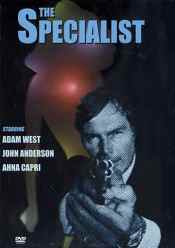
Plot: A lawyer schemes to destroy a fellow attorney’s career. For some reason—hint: I’m an idiot—I recently bought a box of videos off eBay. (And now have just bought another box!!) You might think I’d be content with the hundreds of other videos I’ve already purchased and never watched. You’d be wrong. Anyhoo, I did get some weird stuff. For instance…this. By the time I finished watching the film, I was mostly confused as to who they thought would want to see it. The Specialist is sort of interesting (sort of), in that it’s a cheapie B-movie that doesn’t belong to any identifiable genre. It’s not action or horror or sci-fi or…whatever. In modern parlance we’d probably call it sort of an erotic / legal thriller. Admittedly, it’s not very erotic, and the legal aspect involves a squalid fight over who will represent the local water company. John Grisham, eat your heart out! Lest we’re confused about which decade this film was made in, the theme song is a bad funkadelic tune sung by Lou Rawls.
And so on. Meanwhile, a series of eccentric and increasingly Jabootuish credits proceed. The production company for this epic is the not-very-aptly named Renaissance Films. Uh, yeah. Our star, meanwhile, is Adam West. There’s a good sign. Also appearing are John Anderson, Ahna Capri and Alvy Moore. Anderson is a familiar face to anybody who grew up watching TV shows in the ‘60s and ‘70s. His specialty was grumpy and hubristic Men of Importance. Imagine a TV version of John Carradine and you’ll be in the ballpark. Ahna Capri, a fleshy blonde, fills the titular role here. She was most famous as the sadistic henchwoman of the villainous Dr. Han in Bruce Lee’s Enter the Dragon. If it helps, she’s the one the John Saxon character took as a lover. Alvy Moore, of course, was the eminently discombobulated Mr. Kimble on TV’s Green Acres. Oh, and Ms. Capri’s typically atrocious ‘70s attire was, of course, provided by The Pleasure Dome Boutique of Hollywood. The film itself, meanwhile, in an adaptation of Ralph B. Pott’s acclaimed novel Come Now the Lawyers. As you’d have immediately recognized when you read the plot summary below. The first thing that caught my eye was one of those heavenly, block-long ‘70s Lincoln Continentals. Man, they had huge cars back then, a fact evident throughout the proceedings. The aforementioned monstermobile is owned by Pike Smith, Attorney at Law. A typical role for actor Anderson, Smith is a bombastic martinet. He’s been the town power broker for decades, as were his father and grandfather before him. He enters the offices of the San Clemens Water and Power Company, which oddly are clearly situated in a pair of motel rooms. I suppose it’s possible that someone, somewhere, might not have noticed this. Just in case this happened, though, they left the curtains in the main ‘office’ parted. The view revealed is patently a motel hallway. Smith barges his way past the secretary and into the office of Charles Farley. Farley is a young man in the Tom Selleck mode, sporting a necktie so wide you could land a 747 on it. Smith is enraged because he’s been replaced as the firm’s attorney. Farley attributes this to pressure from the stockholders. (The local power and water company has stockholders?) Here’s the deal: Smith wants to keep the town as it is, i.e., contained and under his thumb. Meanwhile, a younger generation wants to encourage municipal growth. To this end, Smith is being replaced with hotshot lawyer Jerry Bounds (Adam West). Smith stalks out. Right after we notice that the window in Farley’s office door is a particularly cheap pane of candy glass, Smith smashes it in with his cane. This is so awesome a sight that it’s shown in slo-mo. Today, of course, this would be even cooler. Smith would not only smash it up in slow motion, but with a cane in each hand as he leapt sideways through the air. With lots of CGI. We cut to the abode of Jerry Bounds. The sunny music and setting indicate that his is a charmed life. He has a beautiful wife, Elizabeth, and two children. And, of course, a huge automobile. Much effort is expended to establish that Bounds carries a revolver in his briefcase—they do everything but have blinking cartoon arrows pointing at it—and that said situation makes Elizabeth nervous. Gee, I wonder if this weapon will come into play at some juncture? Smith goes to visit Sharkey, a private eye. Smith is suing the Water Company in an attempt to regain control of it*, and the case is due to be heard in two weeks (!!). (The local court must not have a very crowded docket.) Perhaps this is meant to be some time after Smith’s confrontation with Farley. However, the way the film plays it seems like this is later in the same day. Anyway, Smith wants Sharkey to spy on Bounds, who’ll be representing the company. Any dirt the PI can dig up would be most helpful. [Note: Mr. Fink asks, "I thought he was their hired lawyer? In any case, how can he sue a company with stockholders to "control" it when he doesn't own it?" Uh…well…Look! A dog with a fluffy tail!!] Sharkey’s a shady operator, however, and suggests a more proactive strategy. He knows a professional honeypot named Londa Wyeth. She’s irresistible, he maintains, able to seduce any man. "Except maybe a [derogatory slang for a homosexual male,]" he helpfully clarifies. Ah, the ‘70s. Anyway, his scheme involves Smith using his connections to get Londa on the jury (!). She’ll seduce Bounds, and he’ll be disbarred for improperly fraternizing with a juror. This would not only throw the case Smith’s way (uh, supposedly), but permanently remove his biggest rival. We cut to Londa’s house. She’s sleeping heavily in her bedroom. I guess this is meant to be a commentary on her character, given that it seems far into the day. Her indolence is further communicated by how long it takes the ringing phone to rouse her. Eventually, though, she sits up and answers it, giving us a good look at her ample and somewhat pendulous naked bosom. The caller is Sharkey, of course. He describes the job, but Londa resists taking on the assignment. Until, that is, Sharkey offers her $5,000, or half what Smith’s paying him. $5,000 doesn’t seem like such a huge sum, even in 1976 dollars. But I suppose people in real life do worse for less. Next we meet the film’s most obnoxious character, who would be Hardin, Smith’s dissolute son. Admittedly, I might have found him even more annoying than your average viewer would. As it happens, I have a bit of a grudge against the actor playing him. More on that later. Anyway, Hardin is a bit of a screw-up. In the main he’s a hippy-ish artist specializing in painting nudes and gettin’ it on with the chicks. (In fact, he’s painting one buxom lass even as Smith arrives, allowing for some not-utterly-essential boob & butt shots.) Ah, the ‘70s, when a nebbishy dude who looks and acts like a cross between Gilligan, Bobby Van and Ron "Horshack" Palillo could be a major ladies’ man. Smith has a job for his son. Seems one of Hardin’s numerous ladyfriends is the county registrar. She could add Londa to the voting rolls, which then would make her eligible for jury duty. Hardin, eager for his father’s approval, agrees to arrange it. He’s also assigned to pick up Londa at the bus station (!)—ah, the life of the Jet Set—and take her to her rented house. The biggest problem with this film (well, maybe) is that none of the major characters make much sense. Let’s start with Smith. Here’s a guy who’s supposed to be the longtime powerbroker in this town. Yet he needs his dissipated son’s help to get Londa on the voter rolls. Why? Isn’t Smith tied in with the local governmental types? And why is he such a moron that he enlists his skirt-chasing offspring to ferry ‘sexpot’ Londa around? Isn’t that just asking for trouble? Moreover, he keeps talking about how he doesn’t want anyone learning of his connection to Londa’s scam. Well, then, should he really enlist his own son, presumably well known about this apparently small town, to drive this woman around? What the hell? Also, Smith turns to Sharkey, a scurrilous fellow he knows only by reputation, for help. Again, huh? If this guy’s family has been running the town for three generations, why doesn’t Smith have access to more resources? I suppose the source novel might have better established Smith as being in desperate straits. Here he just seems like an idiot. Londa’s problem is easier to sum up. She’s just not that sexy. Her irresistibility is definitely an Informed Attribute. I’m not saying that actress Capri isn’t a marginally attractive woman. More relevant is that she has little apparent sexual charisma. Which, after all, is the notion that the film’s largely predicated upon. Moreover, Londa’s supposedly a "real pro." Then why does she so readily take up with a schlub like Hardin? (Which is what she does.) If she’s such a professional shouldn’t she keep her knickers on when she’s off duty? Besides, the whole ‘arriving in town on the bus’ thing isn’t exactly setting her up as a world-class Jezebel. Cripes, can’t she even rent a car while she’s in town? Again, why is Hardin even being brought in here? Anyhoo, Hardin picks up Londa, an act accompanied by further bad ‘70s funk music. Hardin’s vehicle, moreover, is…what else…a groovy make-out van. All he needs is a dog named Boo. The two exchange some markedly lame banter and then take off. There follows a conversation that I wasn’t entirely convinced was taking place in a moving vehicle. Soon Londa’s ensconced in her rental house. Hardin, meanwhile, continues putting moves on her. As noted before, Our Temptress proves not entirely unreceptive to these. Bleech. One line I really liked follows Hardin opening the place up for her. It proves to be a pretty nice little house. (It looks like a real home, so it’s probably the director’s or something.) Anyway, Hardin notes, "It’s not really as glamorous as you’re probably used to." Uh, excuse me, but didn’t she just arrive in town on a Greyhound bus?! How ‘glamorous’ does he think her life normally is? Cut to the modest Bounds bedchamber. A shirtless Bounds stands before the camera, a cigarette dangling from the corner of his mouth. Even when West was playing Batman, he was never particularly buff—which was part of the gag—and the decade between that and this hadn’t been entirely kind. Now, West is hardly a blob or anything. He’s actually in fairly good shape. Still, he’s got one of those bodies that look quite trim when he’s standing straight, but begins to sag in unfortunate places when he relaxes his posture. Because he’s a lawyer in a movie, he’s practicing his putting. Because he’s a man in a movie, he fails to pick up on the heated glances wife Elizabeth is sending his way. Which, maybe, makes the footage of his gold balls being knocked into a glass a small bit of mirthful Freudianism. Finally she speaks her mind. "I’m sorry, baby," he answers. "My mind’s in court right now." "I wish your body were in bed," she replies. Yuck. I wish the camera were somewhere else. Anywhere else. The décor of the room, meanwhile, is pretty bad. The purple flowered bedspread over pale lime sheets certainly draws the eye, however much it struggles against it. The patterned tablecloth that clashes with the overly busy wallpaper isn’t helping much either. And it’s funny, but a guy standing in his pajama bottoms smoking a cig and swilling a highball just screams of the ‘70s. You just know Bounds is a guy who grew up with the Playboy Philosophy as his guide to life. There’s a bit of dialog here meant to establish Bounds’ generally altruistic nature. His struggles to break Smith’s hold on the town is, he says, on the part of the Little Guy. This, presumably, is meant to make his downfall (oops, sorry) all the more poignant. It’s not nearly enough, though, given later events. Cut to Smith’s home office, which is rather cheaply furnished and sports dingy mock wood paneling. Hardin walks in, wearing a canvas fishing hat. Both he and the old man are clad in really bad safari jackets, which isn’t helping any. Hardin enthuses over Londa’s supposed hotness—"She’s dynamite!" he inevitably exclaims—while Smith again warns him off of her. I think part of the old man’s ‘characterization’ is a groping attempt to reconnect with his estranged son. "How about some beer and cheese," he convivially offers. This princely repast is turned down, however, as Hardin has a date. Cut to Hardin’s place. He’s hanging out with an already-blitzed Londa. She’s attired in a bad orange dress, he’s wearing a comparatively tasteful—comparatively—dashiki (!). If anything, his neckline plunges more than hers, revealing way too much chest hair along with his current array of gold chains. She asks whether he’d paint her clothed or nude, had he the chance. This sets up Hardin’s purportedly comic dissertation on Goya’s "The Naked Maya." (It’s probably best for all concerned that Goya was long dead at this point.) The pair’s bantering just goes on and on, making me wonder if there wasn’t something else which the film could have more profitably turned its attention to. Moreover, Hardin’s Stuttering Schlub act was really starting to get on my nerves. Eventually, however, we do get to the point of the scene. Removing a ponderous necklace that appears to have been fashioned from a gutted chandelier, Londa proceeds to disrobe entirely, so as to pose for Hardin’s sketchbook. The obviously-inadvertent echoes from James Cameron’s Titanic might well provide the film’s peak of entertainment. Said heights are quickly abandoned, however, when beefy Londa and the rubber-lipped nerd start doing the deed. Cut to the Big Trial. You know, the one that will determine who will be the counsel for the town’s Water and Power company. Sure enough, Londa’s on the jury*. Moreover, Alvy Moore is Humbolt, the court bailiff. We aren’t exactly provided with any crackerjack courtroom dynamics, despite the film’s attempts to provide same. Mostly I spent the scene wincing at the awful clothes worn by the extras in the viewer’s gallery. [Note: Mr. Fink wonders how, even if no one in this small town found the presence of newcomer Londa noteworthy, she could have successfully negotiated voir dire without perjuring herself. I suspect it’s because no one who worked on this film knew what voir dire was or had even heard of it. Besides, stuff we don’t see on camera is just supposed to be taken on faith.] The purportedly high-tension exchanges between Bounds and Smith, however, are a hoot. The dialog is so weird that I can only assume it’s mostly taken directly from the source novel. One long stretch—it lasts nearly a minute straight—involves Bounds’ folksy dissertation on why he inaccurately refers to the local Sutter Mountains as the Sunset Mountains. (If this is a demonstration of what the Young Turks want to do in the courtroom, than I entirely agree with Smith that he should keep running things.) You might as well conduct your case while calling your client Mr. Honesty Fairness, and when challenged reply, "And let me explain why I call him that…" Recess is called after Bounds’ rhetorical triumph. As the jury very sloooowly filters out of the courtroom, the impatient Smith buffaloes his way through their ranks. Bounds is extremely agitated by this. "You bully!" he cries. "You know it’s our custom to let the jury out of the box before we leave the courtroom!" During this harangue, Bounds manhandles his opponent. Which, technically, is assault. Smith could reasonably have Bounds arrested at this point. Of course, Smith had just pushed Bailiff Humbolt into a juror, so I guess he’s in no position to do so. Better is that Smith responds by yelling, "I don’t give a damn about your customs!" While, let me be clear, a number of the jurors are still milling around. Way to get them on your side there, Chief. The argument becomes heated, kind of. Smith finally calls Bounds a "damn shyster" and slaps him in the face before stalking out. Londa takes the opportunity to step forward. "Excuse me," she simpers, "I think you better put some water on here before it swells."(!!) Now, having a purportedly attractive woman approach and express concern can certainly get one to play up an injury. On the other hand, I’m not sure you’d want to suggest that a senior citizen’s slap to the face has knocked you for a loop. In any case, Bounds walks off to the water fountain with Londa, as Humbolt looks on significantly. And so he should, because Bounds is already guilty of consorting with a juror. Speaking with such when court isn’t in session is a serious violation of professional ethics, one that potentially could get you disbarred. Even I know that, and I’m not a lawyer. Any sympathy I might have had for Bounds went out the window when he left the courtroom conversing with Londa. And that’s just the start of things. As Londa applies the aforementioned water to Bounds’ face, the two disparagingly discuss Smith. Who, need I emphasize this point, is the opposing counsel in the suit they’re involved in. At this point, Bounds is dangerously close to engaging in jury tampering. Londa, for her part, starts rubbing his hand, and suggesting he take her up to the lake so she can see the "Sunset" mountains. "Look, I shouldn’t even be talking to you," Bounds replies. "I could get disbarred for this." Uh, yes. Yes, you could. Bounds disengages himself, but Londa already is wearing a triumphant look. Moron. Further courtroom shenanigans ensue. As the day comes to an end, Londa makes a request of the Judge. It seems the jurors would like to see Lake Desire, which lies under the aforementioned "Sunset" Mountains. I guess the lake is somehow part of the Water & Power Company suit, although in what manner is never even remotely explained. Near as I can figure, Smith wants to do something eee-vil with the lake—what, exactly, I have no idea—while the Water Company wants it preserved for aesthetic reasons. Smith sputters that this would be a waste of time (and he’s dead right), and that county experts will be testifying as to the area’s value. Londa, however, explains that they want to "see the beauty of the lake, as it has been described to us by the Counsel for the Defense." Having a juror casting moony eyes at one of the counsels seems pretty solid grounds for a mistrial, but never mind. OK, now I’m really confused. Bounds is arguing that the lake area could be turned into a park. Smith responds, "We are condemning a water system." Huh? I thought this suit was over Smith’s being replaced as the Water Company’s attorney. That’s what we were told before. This sounds like an entirely different case. Who is Smith representing? By which I mean, if the present board of the Water Company wants Lake Desire preserved, who wants it "condemned"? Also, Bounds seemingly argues for the idea of the Jury seeing the area, but when asked if his client, i.e., the Water Company, wants to pay to transport them there (and how much could that cost?), declines. In any case, the requested trip doesn’t take place. Later, Londa visits Bounds at his ‘office.’ This set was pretty clearly created by moving a desk and file cabinet into a small academic law library, as the law books in the background all sport Dewey Decimal Code labels. (Sure enough, the end credits offer thanks to "Glendale College of Law" for allowing them to shoot on their premises.) Bounds greets Londa with a smile, rather than the shriek of horror the situation merits. Admittedly, he does ask her to leave, but only after bantering with her a bit first. "Oh, damn it," she responds when he eventually does. "Why don’t you trust me?" Hmm. Maybe because you appear to him to be a loony stalker who’s putting his entire legal career in jeopardy? Londa even tells him that she only stayed on the jury because she was interested on him. At this point, Bounds has an obligation to call the Judge and report on Londa coming to his office and indicating that she intended to take his side in the case. That he doesn’t violates his obligations as an Officer of the Court, and means that he really, truly should come up on professional charges and most likely be disbarred. In other words, he’s no longer a very sympathetic protagonist. He mostly seems concerned that he’ll get caught with Londa, not that she’s there to start with. Anyway, she starts rubbing his hand again, an activity that seems to grant her magical properties. Sure enough, he breaks down and promises to take her on a field trip up to Lake Desire ("Lake Desire"—get it?) that weekend. At this point it’s kind of hard to care very much about what happens from here on out, as both Smith and Bounds are pretty despicable characters. If anything, Bounds comes off worse. He’s not just betraying his professional obligations, as Smith is, but also his wife and children. Part of the problem, I have to admit, is the casting. Actress Capri, to be perfectly blunt, just isn’t convincing as an irresistible femme fatale. Therefore Bounds doesn’t seem trapped in a situation beyond his control, but rather just scratching an itch. (And not a very itchy itch, at that.) If Bounds were being tempted by Halle Berry, you might have a little more sympathy for him. Of course, the problem isn’t all on Capri’s part. Adam West simply lacks the chops to convince us of Bounds’ supposed helplessness before this woman’s wiles. He’s a callow actor, and thus Bounds is a callow character. As usual, I’m sort of letting this piece get away with me. So let’s skip to the highlights.
AFTERTHOUGHTS: The main character, Brian, was your classic noir schlub who falls under the erotic spell of femme fatale Carol (B-movie starlet Edy Williams). He starts sleeping with her, and ends up helping her kill her abusive boyfriend, played by William "Big Bill" Smith. However, Brian has a loser friend named David who spends the entire film whining about how Brian doesn’t hang out with him anymore. Once David figures out Brian’s into something dodgy, he decides to play detective. Literally. He dons a trench coat and spends the entire rest of the movie doing the worst Columbo impression you’ve ever seen. In the end he draws enough attention Brian’s way to get the guy killed. About an hour in Jeff and I were praying for the movie to end. When it did, with much of the cast dead but David left standing, we instantly developed a seething hatred for the picture that remains largely unassuaged to this day. I’m sure you won’t be surprised to learn that David was played by Harvey Jason, who here plays Hardin. When I saw the dreaded Jason had been allowed to appear in another movie, I was, shall we say, a tad nonplussed. Actually, it turns out, Jason had a screen and TV career that lasted some decades. Including, I might add, an appearance on an early episode of Columbo. Having seen Dr. Minx, I can testify that he didn’t learn much. The link is that both films were written and directed by Howard Avedis, aka Hikmet Avedis. Given my sampling of Mr. Avedis’ oeuvre, I’d say his films are typified by their uniformly unlikable characters. He also preferred stories built around gullible young men who are seduced by large-breasted blondes. Some of the latter included Angel Tompkins in The Teacher (1974), Capri here, Williams in Dr. Minx (’75) and Connie Stevens in Scorchy (’76). If I had to guess, I’d say making movies was his way of seeing these woman naked. Making films into the ‘80s, he inevitably cast Sybil Danning in this role in They’re Playing With Fire (’84). This was rather sleazier than his ‘70s fare, with much more explicit sex and violence. Still, if you ever wanted to see a guy in a Santa Claus suit beat a young woman to death with a baseball bat, this is the picture for you. Danning’s very enthusiastic sex scenes, meanwhile, remain a legend. See the slobbering viewer reviews posted on the IMDB. Why Avedis would work with the Lovecraftian Harvey Jason twice remains a mystery; my guess is that the actor had photos of Avedis screwing a donkey with a midget. Or maybe the other way around. It is true, however, that Avedis liked to reuse actors. Alvy Moore, for instance, can be seen in four Avedis films altogether. John Anderson and Bill Smith were in a couple. There are many other such examples. Marlene Schmidt, who played Elizabeth here, appeared in nearly all of Avedis’ movies, produced most of them, and even co-wrote three of them. Which suggests to me that she and Avedis were married, although biographical info for either of them remains sketchy. Still, even if I don’t particularly like Mr. Avedis’ films, I’d love to read his autobiography. He’s one of those unheralded guy who worked with literally dozens of prominent B-movie actors. Aside from all those named above, the roster would include Claudia Jennings, Alejandro Rey, Larry Linville, Jay North, Barry Atwater, Cesare Denova, Greg Evigan, Bo Hopkins, Robert Shayne, Patti D’Arbanville, Robert Englund, Mel Ferrer (of course), Priscilla Barnes, Cameron Mitchell (of course, again), R. G. Armstrong, Karen Black, Tony Lo Bianco, David Naughton, Jack Carter, Bill Paxton, Christopher & Lynda Day George, Andrew Prine, Barbara Crampton, Charles Napier and Jimmie Walker. So Mr. Avedis, if you’re out there, I hope you’re working on that book. IMMORTAL DIALOG: Bounds ably demonstrates the concept of ‘smarminess’ when he responds to Smith’s grumpiness over Bounds penchant for renaming local geographical fixtures: Smith, falling into Bounds’ devious trap: "I
object! What do you mean, the ‘Sunset’ Mountains? You look at any map,
you’ll find the lake is under the ‘Sutter’ Mountains. Now you may be
crazy, but I certainly am not!" The Jury breaks out in applause. (!!) Bounds wraps up his final summation to the disbarment hearing panel. The verdict, presumably, is insanity: "The Law is my livelihood. The Law…does not give
life. God does. Should the Law take life? [Huh?] I leave my
future in your hands." "Well, I'm an attorney, as you stated, this movie is
WAY off base in so many areas, it's astounding. I do public utility
law (not water, though, so I'm no help there), and even in this isolated
little bit of the biz, I know enough to know how stupid this movie is. Summary: Uhm, I’m supposed to be rooting for who now? -by Ken Begg |