Another feature of... |
|
Another feature of... |
|
|
|
Monk
I was an early subscriber to Netflix. Even in the primordial days of the DVD format, I realized that I probably couldn’t afford to buy more than 10 or 15% of everything released. My solution was to join Netflix and rent the other 85%. This kind of worked for a while, until they starting releasing so much stuff that now I’m lucky if I can buy even 5% of it all. (I make a noble effort at it, though, if I do say so myself.) Netflix has evolved over the years, since in the beginning it was so cheap and so outgoing that they would have soon gone out of business. For instance, you used to tell them when you mailed your discs back, and they’d send the replacement out immediately. Now they wait until they have the returned DVD in hand. Also, the prices has risen fairly high, about the cost of basic cable TV for the middling, five-disc-at-a-time option. Even so, the fact that I don’t have to personally buy every stupid DTV killer animal movie I review has kept me a happy customer. However, after several years of tossing movies into my ‘queue,’ more than I could ever get around to watching—and certainly while running this website—I hit the 500 queue limit. I killed a small amount of titles, but I was still nearly topped out. So I decided to do what I could in a short amount of time: Ramp up my disc limit to the highest, ‘eight at a time’ limit, for one month (since the cost of this is around $50), going with July as it had 31 days, and watch as many discs as I possibly could. If things go well, I should be able to burn through around 40 DVDs, or even a few more than that, depending on things like turnaround time. I then had to decide whether to shutter the site for a month. Instead, I decided to post daily (or near daily) short riffs on whatever I ended up watching. The problem being that I won’t be watching the most interesting stuff on my list. Since the idea is that I watch as many DVDs as possible, I can’t afford to watch anything so good or bad that I spend a lot of time writing about it. (And I’m a slow writer.) Obviously, short movies are a plus. Also, discs with a lot of bonus features, especially commentary tracks, are a problem, lest I spend two or three days on one disc. For instance, when I rented Cabin Fever I watched the film, some ‘making of’ documentaries, and then sat through the disc’s five commentary tracks. That ate up an entire weekend. No thanks; I want to maximize my fifty smackers. This means that the following month’s menu will consist of a truly weird hodgepodge. Middling mainstream films I never got around to seeing. Old movies I never got around to seeing. TV episode compilations. Cartoons. Documentaries. Art house stuff. Other than giving the reader a sense of my personal tastes (and wow, how exciting will that be?), I can’t promise much. I've also had a philosophical problem with writing about good movies, which is that I hate to blow good things about the movie. I'm the kind of guy who likes to know as little as possible about things I intend to watch. Therefore, I'm more than a little reticent about giving away plot twists and the like, even minor ones. I'll try not to give anything dire away, but I can only suggest that you don't read a review of anything you yourself intend to see. Finally, I can’t be sure this experiment won’t prove to be a complete debacle. All I can hope is that anyone who decides to give us a pass during this spell will return in mid-August, when we resume our regular mode of business.
Saturday, July 17, 2004
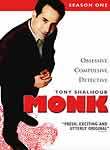
I’ve always been a mystery fan. I read Conan Doyle’s Sherlock Holmes stories as a kid, and reread the Canon about once every five years, as well as reading the zillions of Holmsian pastiches that come out like clockwork. I progressed to Dashiell Hammett and Raymond Chandler, and still enjoy the hardboiled PI school. (Never became a fan of the police procedural, however.) Right now, I read a fair amount of historical mysteries, the hottest sub-genre, and enjoy them greatly, as long as they allow the past to be the past. In other words, don’t put contemporary thoughts in the heads of people living in the past. ‘Puzzle’ mysteries, however, the classic ‘whodunits,’ I could take or leave. I enjoy Ellery Queen, but not Agatha Christie. (I do like the old Margaret Rutherford Miss Marple movies, however, and am waiting for them to hit DVD.) I love and adore Rex Stout’s Nero Wolfe books. It’s probably my favorite series of books ever. I mourn the cancelled Timothy Hutton / Maury Chayin A&E program something fierce. This is even truer after, earlier this week, I watched a disc of the just released second, and final, season. Damn, the show was actually getting better. If anyone out there ever bumps into Tim Hutton (whose late father, Jim, memorably played Ellery Queen in a series that was quite nearly as good), please shake his hand for me and let him know his work as Archie Goodwin will never be forgotten. Mysteries have died out as a movie genre, a subject I discussed a bit in my A Stranger Among Us review. In essence, classic whodunits challenge you to solve the mystery before the detective did. That meant, well, thinking. Since audiences today don’t expect to think much while watching movies—more intellectual stuff like The Day After Tomorrow aside—the genre has withered away. TV has kept it going to some small extent, although its heyday has clearly passed. Is there even a private eye show on the networks at this point? If so, it’s pretty lonely. There are the CSI shows, although those are more concerned with science than odd-fashioned sleuthing. (Even so, the idea of attention to seemingly insignificant details is the same in both.) A sign of the genre’s distress is that the two last such programs that were really successful were CBS’ Murder, She Wrote and Diagnosis Murder. Both were nostalgia shows for people so old that they actually remembered and enjoyed mystery shows. However, the series were careful to make their ‘whodunits’ really easy to solve, with grossly obvious clues, so as to avoid frustrating their viewers. For those of us who like to cogitate at least a little, or at least not feel like total morons if we don't solve the crime, these weren’t of much use. The best (only?) old-fashioned mystery series on right now is Monk, a show on the USA network just now entering its third season. It even popped up as a replacement series on ABC for a short period. I rent a lot of TV shows from Netflix (such discs already account for a full 10% of their business, I’ve read), especially cable shows, since I don’t have cable. In case you’re wondering, it’s because I’d waste too much time watching TV if I had it and would never get any writing done. TV veteran Tony Shalhoub is Adrian Monk, who suffers from obsessive-compulsive disorder. Remember Jack Nicholson in As Good as It Gets? Like that. He also suffers from numerous intense phobias. His disability was triggered by the death of his beloved wife, who was murdered three years before the series began. Monk was a cop, a brilliant detective of the Sherlock Holmes school who solved crimes by the observance of tiny details. Basically, his inability to solve his wife’s murder, the only crime that ever meant anything to him personally, drove him nuts. Monk’s primary goal is to get back on the force. However, he can barely function in the outside world, and is highly reliant on his long-suffering full-time caregiver, Sharona. Monk is in therapy and trying to regain control of his life. However, the series is smart enough to occasionally show that he has real problems. His illness isn’t solely a comic device, although obviously it usually is used as such. Monk’s occasional setbacks are heartbreaking for the show’s fans. As a step towards getting reinstated, Monk has become a consultant on more perplexing crimes. This situation proves both useful and highly exasperating to his old boss, Capt. Stottlemeyer (extremely well played by veteran character actor Ted Levine). Stottlemeyer truly wishes the best for Monk, but also knows that he’s nowhere near ready to carry a gun again, and won’t cut him any slack when it means that other cops or your average citizens could be put in danger. In the meantime, Monk is a civilian, and Stottlemeyer at times can’t stand having to rely on him. This character could easily come off as a jerk. It's therefore to the series’ credit that he remains an admirable and usually likable character even when he frustrates Monk’s most cherished hopes. Sharona, meanwhile, is the streetwise woman who counterbalances Monk’s nuttiness. Her boss quite often drives her almost crazy, too. However, she also has caught the crime-solving bug, and that helps bring her back whenever she quits. This occurs a couple of times in the first season, and hopefully won’t be used too often, since we know she’ll have to come back. After all, it’s a TV show. Monk is often compared to Columbo, presumably because both feature ‘quirky,’ clue-oriented detectives. However, the formats are completely different. In a Columbo show, we see the murder, and then wonder how Columbo will finger the murderer. In Monk, the format is the classic whodunit. The mysteries are good, but not great. I’m no Einstein, and I can usually figure out the killer’s identity. Still, they do a lot better than Murder, She Wrote, and writing a bunch of really nifty mystery plots each season, after hundreds of similar shows have been on the air, is no easy task. I’d give the show a ‘B’ on this aspect. This particular disc has three episodes. (FYI: If you intend to catch up on the entire series, you can skip renting the separate DVD for the series’ two-hour pilot movie. It appears as well on the first disc of the season one set.) In Mr. Monk Goes to the Carnival, a cop with a violent reputation seems to have murdered a man in front of numerous witnesses. There’s some great comedy here, as when Monk is horrified by the grime of the carnival. There’s also a great moment when the killer, who isn't one of your masterminds, is unexpectedly cornered due to his own gross stupidity. ("No wonder he’s spent half his life in jail!" an aghast Monk exclaims.) This is counterbalanced by Monk’s dashed hopes of getting back on the force. The mystery aspect is pretty good, as the clue that Monk uses to solve the crime is there for us to see, but niftily non-obvious. Some might feel it’s too obscure, but it definitely falls into the ‘fair play’ rules. Mr. Monk Goes to the Asylum sees Monk sent briefly to a mental hospital following a particularly unfortunate (and quite sad) incident. There he comically interacts with several other wacky patients, including a guy who believes in Santa Claus and a Zelig-type (Kevin Nealon) who spins lies to mirror the life of anyone he talks too. "I used to be a detective, too, "he tells Monk upon meeting him. As you might expect, Monk begins to suspect that something shady is going on at the hospital, although even he wonders if this is just a sign that he’s just getting crazier. The mystery is so-so, although Monk’s predicament in this one is convincingly dangerous. Mr. Monk and the Billionaire Mugger finds Monk adrift after Sharona quits her job, due to the fact that her paychecks have been bouncing. (Monk is great at solving crimes, not so good at collecting his fees.) This contains a really wince-inducing moment, as we are again reminded exactly how screwed up Monk is. The mystery, though, is way too obvious. I figured out the situation about three minutes into the show. A good detective show will work even when the mysteries aren’t great. This is one of those. Tony Shalhoub has the role of a lifetime as Monk, and must truly be thankful for the chance to stretch his acting chops after lame sitcoms like Wings and Stark Raving Mad. While the supporting cast is really quite good—again, I especially like Levine’s work--this is Shalhoub’s show all the way. Indeed, he’s already won an Emmy and a Golden Globe for the role, and no doubt will pick up further accolades as the show continues to air. Ken’s Rating: 8 of 10.
The Lost Skeleton of Cadavra (2001)
Note:
There are quite a few spoilers in this review, and many gags are
blown, so you really shouldn’t read this unless you have already seen the
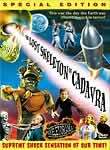
film, or have absolutely no wish to. Don’t get me wrong, I still had a pretty good time watching it. The last film like this I saw was Bubba Ho Tep, and apparently I completely missed the boat on that one, because I really didn’t get much out of it. (I saw that one in a theater, and wish I’d seen LSC at one, too. Comedies are greatly enhanced by watching them with an audience, more than any other genre save perhaps horror films.) LSC is a spoof of grade-Z ‘50s sci-fi / horror movies. I didn’t think they always got the tone of the period right, which was one of my initial problems with it. Still, for a film that could have been a bad Saturday Night Live sketch dragged out to ninety minutes, it’s pretty decent. And if I weren’t constantly rolling on the floor, I did laugh out loud a good dozen times or more. For what it’s worth, generally the less obvious the humor was, the funnier I found it. Filmed in black & white on video, which often lends the film the grainy appearance of a bad TV print (which is how people of my age generally saw these things, before the age of digital media) and in only ten and a half days (which is actually a more expansive shooting schedule than that of many of the films it mimics), LSC manages to get a lot of things right. Dialogue especially was dead on, and when I was really laughing, it was usually at some spot-on horribly scripted line. Our Heroes are Dr. Paul Armstrong and his wife Betty. As a scientist, Paul works the word ‘science’ into nearly every sentence he speaks. He’s stalwart, square jawed and amiable, but more than a little dense. Betty, meanwhile, is what we think of when we say ‘a ’50s housewife.’ Paul is searching for a meteorite he hopes contains atmosphereum, a rare but extremely powerful element. "Betty, you know what this meteor could mean to science?" he muses. "It could mean actual advances in the field of science." Meanwhile, evil scientist Roger Flemming—we can tell he’s evil, because he has a beard and tends to break into maniacal laughter—is searching for the titular Lost Skeleton of Cadavra. He finds it (one of the funniest jokes is that its none-too lost) and we learn that it’s sentient, with a huge bombastic voice. However, it has been badly enervated by lying under a sheet slightly inside a cave all these years. "Only my skeleton brain lives," it booms. "The rest of me is just lifeless bone." What he needs for complete animation is…a hunk of atmosphereum. Also seeking the rare element are too aliens, Kro-Bar and his space wife Lattice. They have crash landed their space rocket nearby, and need the substance to recharge their engines. Meanwhile, their pet Mutant has gotten out of the ship. Lattice fears that "untold millions will die by its hands!" This line killed me, as it accurately captured the way the lumbering, cheesy monsters in these things were treated, as if, despite all evidence, they were world-threatening menaces. Another instance of this occurs when the Skeleton promises Flemming, "When I am brought to life, together you and I will rule the world, together!" How a skeleton, even a walking, telepathic one, will come to ‘rule the world’ is left to our imaginations. Still, it’s accurate of the period. See the trailer for Missile to the Moon, in which a three-foot tall spider that lurks in a lunar cave is described as "the black menace that threatens the Earth!" Following this statement, by the way, we see it gunned down by a couple of guys with .38 caliber revolvers. Kro-Bar, meanwhile, portentously responds to Lattice’s remark by direly noting, "If only it did have hands, my woman. If only it did have hands!" Of course, that line makes no sense, and that’s not even taking into account the fact that when we eventually see the Mutant, it does have hands. After Paul finds the meteor, the aliens and Flemming separately scheme to get it. Kro-Bar and Lattice decide to disguise themselves as humans, and use their "transmutatron" (a gussied-up caulking gun!) to alter their appearance. "We will look entirely like human beings," Kro-Bar promises. Since they already do, actually, look entirely human, all the transmutatron does is change their ‘space’ uniforms into a suit and dress. Kro-Bar, as all male aliens do, then pauses to complain about his necktie’s lack of functionality. Properly attired, they show up at the Armstrongs’ cabin and are invited in for dinner. However, this has been witnessed by Flemming, who quickly pegs the visitors as being "Aliens…from outer space!" Theorizing that turning up at the cabin stag will draw attention to him (a properly weird b-movie conceit), he uses the left-behind transmutatron to transform four unidentified forest animals into a woman right out of Cat-Women of the Moon, tight black body stocking and all. I’ll say this, it never hurts to have a sexy woman in black tights acting like she’s a cat in your movie. Flemming dubs the spottily feral creature Animala, and gives her a quick lecture on table manners. Then they, too, get themselves invited to dinner. He passes Animala off as his wife Pammy, although nobody notices that she’s rather oddly clad in a leotard, so he probably didn’t need to bother. The woman playing her is the writer / director / star’s wife, by the way, and certainly every nerd worth his pathetic, dateless salt will wonder if he kept the Animala costume suit for her to wear at home. Eventually Flemming teams up with Kro-Bar and Lattice, but inevitably betrays them. "I have a skeleton to bring to life," he crows. (Here we hilariously cut to the prone Skeleton in its cave. "That would be me!" it booms, just in case we were wondering.) The Skeleton, fueled by the glowing hunk of atmosphereum, comes back to life. He gains control of the aliens and makes them dance for his amusement (out of nowhere, by the way, he suddenly acquires a wooden, throne-like chair to sit in). This scene plays suspiciously like Orgy of the Dead, especially when the seated Skeleton overlord waves his bony arm and commands his captives to "Dance! Dance!" The resemblance is heightened by the fact that Paul and Betty are watching from some nearby bushes, that the Skeleton has two henchpeople standing around him, and that Paul heatedly calls the Skeleton a "fiend," a word that gets quite a workout in Orgy. Following movie logic, the Skeleton suddenly declares that Lattice will become "The Bride of the Lost Skeleton!" Why a skeleton would want a woman, especially one that isn’t Calista Flockhart or Lara Flynn Boyle, for a wife is, naturally, glossed over. However, the ceremony is broken up by the sudden appearance of the Mutant, who’s popped up occasionally to kill a minor character. The Skeleton is enraged by its interference. "You shall pay dearly for ruining my special day!" it promises. (Man, I love that line.) This leads to an, er, epic battle, which sees both creatures destroyed. The Skeleton vows to return, though. Kudos to Larry Blamire, who gets the job done as a writer, a director and an actor. The fact that he wants to make more such films is extremely cheering. Kudos also to his wife Jennifer Blaire, who (as noted above) not only looks great in a body suit, but is always in character, even when she’s in the background. Animala is the film’s best character, and hopefully she’ll be back in a sequel some day. Andrew Parks seems to be channeling Dudley Manlove as Eros from Plan 9 From Outer Space, although his performance is still restrained by comparison. Other highlights include a bitchin’ animated credit sequence; the fact that the film is shot in ‘Skeletorama’; the fact that the movie was partly shot in (where else?) Bronson Canyon; the fact that they bought the titular menace on eBay (!) for about a hundred bucks (!!); the on the nose continuity errors and rotated props (watch for the microscope and kid’s chemistry set); the classic ‘rocket ship on a string; the ‘space’ uniforms, complete with shoulder fins and the planet logo on the tunic’s breast; the visible wires on the Skeleton, and the soundtrack made up of authentic cues from ‘50s b-movies like The Brain From Planet Arous. Meanwhile, the best piece of trivia regarding the film is that the use of the epithet "jackass" got the film rated ‘PG’ (!). The disc includes two informative and amusing commentary tracks, one for the cast and another for the crew. There’s also a pretty good question and answer session conducted by the cast during an early theatrical performance. Finally, even if you skip all the other extras, make sure to view the mock "skelectables," including the inevitable Lost Skeleton of Cadavra lunch box and Colorforms set. (These can also be viewed here.) The gut-busting trailer, which condenses all the joys of the film's strengths into a lean couple of minutes, is also a must. Ken's Rating: 7 out of 10.
Pickup on South Street (1953)
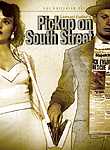
We open on an attractive woman, Candy, standing inside a crammed subway train. A couple of FBI agents are also in the car, surreptitiously watching her. However, everyone’s plans go awry when a pickpocket manages to purloin an envelope from Candy’s purse. By the time Zara, the head FBI agent, realizes what’s happening, the pickpocket is off the train. As most film buffs realize at some point, it generally isn’t original material that makes a movie work. Even the most clichéd plot devices can be made to work if the execution is right. The setting of the cramped subway car, filled with cranky, overheated passengers—even Candy is sweating, which was probably considered a shocking piece of verisimilitude at the time—is well realized. The scene progresses methodically and completely sans dialogue, which along with the claustrophobic setting and the serial use of severe close-ups, serves notice that the film is being made by someone who knows what he’s doing. Candy only realizes that she’s been robbed when she approaches where she was to deliver the envelope. She calls Joey, on whose behalf she was running this errand. He nearly panics upon hearing the news, and tells her to return to his apartment. Meanwhile, Zara goes to the local cops and contacts Capt. Tiger, head of the street crime unit. The envelope contained, that’s right, a MacGuffin. Microfilm, if you must know. The point is, that it was stolen by Communist agents. Zara wants the film, and he wants to capture the spies. Candy, for her part, is unaware of the stakes, and is only trying to repay some unexplained favor Joey did for her in the past. Joey pushes her to use her, uh, street contacts to identify the man who robbed her. Candy wants out, but Joey has some hold over her. In the end, both the cops and Candy go to Mo (Thelma Ritter), a middle-aged informer so colorful that she seems to have stepped right out of a Damon Runyan story. She identifies the pickpocket as one Skip McCoy (Richard Widmark). McCoy is a three-time loser, which means that if he goes up again, it’s for good. He’s but a week out of prison, and has a long and markedly adversarial relationship with Tiger, the cop responsible for his various incarcerations. Tiger’s itching for the forth and final bust. The film is ultimately an update of those "I may be a rat, but I’m not a Nazi!" flicks popular during World War II. "There’s a difference between a pickpocket and a traitor," Zara avers, and the only question is whether McCoy will realize this is true. Candy falls hard for McCoy, after he’s slapped her around a couple of times—which explains why the film was so popular in France—and spends the film trying to get him on the right side of the tracks. It’s to the film’s credit that we’re not sure whether McCoy will wise up or not. At first all he sees is the opportunity for a big score, and he’s so cynical that he never believes Candy’s professions that she’s fallen for him. Candy, in contrast, is immediately repulsed by learning that Joey’s a Red agent. She quickly agrees to work with the cops, but at the same time places herself at some risk to frustrate McCoy’s schemes, hoping that given enough time he’ll see the light. The communism aspect is interesting, in that I would expect that most people who would bother to dig the film up are going to react with a Pavlovian sneer to the talk of ‘Reds’ and ‘Commies.’ (And there would be some. Although I didn’t know anything about the film going in, it must have a rep, as the DVD was put out as part of the prestigious Criterion Collection.) Again, if the film was about Nazi agents, most people would buy the characters’ horror without question. However, there’s been a largely successful attempt at cultural indoctrination over the last fifty years, to the effect that there never was a communist threat to this country, and that it was all a hysterical hallucination in the minds of political thugs like Joe McCarthy. The common meme, advanced most bluntly in Arthur Miller’s allegorical play "The Crucible," is that the attempt to uproot communist spies and influences was a ‘witch hunt,’ i.e., a search for something that never existed in the first place. This idea was advanced on another front by concerted efforts to deny the guilt of Soviet spies like Alger Hiss, the Rosenbergs and Harry Dexter White. Only recently have such attempts completely failed, due to the publication of the Venona papers and the access to secret Soviet documentation given to historians for a brief period following the collapse of that government. The irony is that, as pulpy as it is, Pickup on South Street is more accurate about communist espionage than the vastly more typical revisionist films of the last several decades, including Woody Allen’s The Front, Robert DeNiro’s Guilty By Association and Jim Carrey’s The Majestic. In all these film, it is advanced that there never was a communist threat to this country, that the ‘Red Menace’ was a paranoid delusion that was more dangerous to our citizenry than Soviet espionage itself. If one can get past the communism issue, however—or, like myself, basically agree with the film about how things were—Pickup is a pretty entertaining movies. It runs a lean 80 minutes, which lends it a muscular quality seldom found in modern pictures. As with many crime films of the ‘30s through the ‘50s, it seems less ‘realistic’ than flicks made today, but at the same more believable in some odd way. Mo sums up this dichotomy; she’s so ‘colorful’ a character as to scream artifice, but remains oddly credible as a person. There are several reasons for the film’s odd authenticity. First, there’s the typical effect of being shot in black & white, which tends to (oddly, when you think about it) add a documentary feel to movies. Second, although largely shot on sets, there are several scenes shot out on the streets. McCoy, meanwhile, lives in a shack built up over New York’s East River. This was actually constructed, and it works pretty well. One nice touch is that, although the shack doesn’t have electricity, McCoy’s beer is always cold. He keeps it in a box rigged to be lowered down into the river’s frigid waters. Widmark’s performance as McCoy also helps greatly. Except for Peter Lorre, it’s hard to think of many other star actors so constitutionally designed to play neurotics. Widmark played a wide array of heels, nutbags and outright psychos over the years. Even when he played heroes, they were the type constantly on the verge of some violent outburst. If played by another actor, we would probably assume from the start that McCoy would eventually join the angels. With Widmark, we’re kept guessing. It also helps that McCoy isn’t just a lowdown thief, but a pretty savvy guy, too. Mo sells cheap ties as a cover for her informer sideline. When McCoy finds Candy in his shack, he ransacks her purse to steal any money she might have. He also pulls out a tie and smiles, knowing that Candy learned his whereabouts from Mo. "It’s OK," he later shrugs. "Mo’s got to eat, too." Speaking of Mo, she’s played by Thelma Ritter, a veteran actress who I naggingly recognized from something. It turns out I was remembering her from a two-minute appearance in Miracle on 34th Street. It’s funny how a voice will stay with you over the years, even from a small role. However, the film is ultimately the work of its director, Samuel Fuller. I’ve always thought one reason old films remain so, well, ‘right,’ despite laboring under content restrictions that filmmakers don’t have to worry about today, is that the (largely) men who made them lived actual lives. They lived through the Great Depression. They saw and often experienced actual poverty, of a sort that people living in this country today can’t imagine. They fought in wars that raged across continents, ones in which the fate of the world was literally at stake. Many, like directors Fritz Lang and Ernst Lubitsch, were expatriates who fled Europe because of the Nazis. These guys were men, in a context that is almost impossible to find these days. Fuller lived such a life. As a seventeen-year old, he became the youngest crime beat reporter in New York City. (This certainly helps to explain why the characters in this film maintain a sense of authenticity.) He went on to become a novelist and a filmmaker, primarily as a director and screenwriter. Most importantly, in World War II Fuller was an infantryman. His unit stormed the beaches of Normandy on D-Day, fought in several of the worst battles of the war, and was among the very first American troops to come across a Nazi death camp. Fuller’s experiences in the war were later portrayed in his movie The Big Red One (1980), the most prominent of his later works. Later in life, Fuller became a bit of a character. He was always jawing away in a tough guy vernacular, identifiable by this trademark shock of white hair and puffing on an omnipresent gigantic stogie. However, he could get away with it. It’s hard to deride a man who’d seen what he had. I hadn’t seen any of Fuller’s work before this, but his Shock Corridor (1963) and The Naked Kiss (1964), both also released by Criterion, are legendarily lurid schlock films. So much for clearing stuff out of my Netflix queue. This film is removed, but now I’ll probably end up adding those two in its place. Fuller never fit in well with Hollywood as it later evolved, and even decades later still turned out highly controversial films. In 1982 he made White Dog, a film about a dog that had been trained to viciously attack black people. Even though it was quite obviously antiracist, the film was too much of a hot potato to be released, and only recently was afforded a brief art house run. It’s still not available on home video or DVD. Fans of pickpocket movies should also look out for Harry In Your Pocket, with James Coburn. Watch for it on your cable movie channels, however. It hasn’t hit home video yet, either. Ken’s Rating: 7 out of 10.
Samurai Jack, Season 1, Disc 2
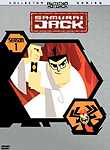
As I mentioned earlier, I don’t have cable. Therefore I didn’t catch Samurai Jack during its acclaimed run on the Cartoon Network. That’s why one great aspects of the DVD revolution has been complete season sets of television series. I might have missed the boat earlier, but now in a night or two I can see what the fuss was about. Here I watched the second disc of a two-DVD set, collecting the show’s initial thirteen episodes. I had, obviously, watched the first disc on an earlier occasion. The second features episodes VIII through XIII. As far as I know, no further releases have been announced. Also, I know there’s a ‘movie’ that set up the series, but the first episodes in this set also cover his origin. Was the movie split up into the first three shows, or is it a separate entity? If so, is it different enough that the movie is worth renting on its own? Please leave a message on the board if you can clear this up. The background of the show sees a mighty and benevolent Japanese ruler of ancient times, one who defeats the powerful, shapeshifting demon Aku (voiced by Japanese actor / cult icon Mako) with the benefit of a magic sword. Years later, Aku returns and destroys the ruler’s kingdom. As arranged, the ruler’s infant son is whisked away. In the show’s first episode, we watch as he travels from land to land, around the world, learning various fighting disciplines from the masters of each continent. Finally, having reached manhood, the Samurai reclaims his father’s sword. He confronts Aku, and after a fierce battle is on the verge of destroying it. However, the demon creates a timewarp to suck the Samurai into the distant future. The Samurai finds himself not only in a world with space travel and abounding with strange aliens, but one that’s been ruled by Aku for thousands of years. Dubbed "Jack," by the locals, the Samurai quests for a way to return to the past. He seeks not only to end Aku’s evil reign, but to do so before it ever began. As he travels hither and yon, he pauses to help those who have fallen under evil’s sway. Watching the show made me ponder the human need for stories, and why we get so wrapped up in them. The animation in Samurai Jack is brilliant stuff, but it’s also limited (by which I mean, there isn’t much movement) and extremely stylized. I’m not sure how accurate this is, but it reminds me of the stuff you’d see on the Rocky & Bullwinkle show, especially the Fractured Fairytale and Mr. Peabody segments. Some people just can’t get into cartoons, although I don’t see that they’re that much faker than stuff acted out by human casts. For those of us who can get past the animated aspect of the show, however, Jack’s plight remains quite affecting. This remains true even if the show’s animation technique pushes it yet another level further from reality. Our need and ability to feel so deeply for characters we know to be artificial constructs remains a mystery to me. This show again highlights that everything is execution. Again, the show’s animation style is aggressively stylized; the characters extremely simplistic. Jack is specifically a Samurai, and there are a lot of Japanese cultural notes occurring in the show. However, in the end he’s the universal hero (as symbolized by the generic name ‘Jack’), entirely the good guy, while Aku is purely evil. There’s not a lot of shading here, which some will tell you is the mark of a sophisticated outlook. So why does the show work, and for adults at that? Naturally, it’s largely due to the talent of the people who made it. More importantly, though, it’s because they believed in it. Director Roland Emmerich publicly lamented the ‘cheese factor’ surrounding Godzilla, distancing himself before his movie was even made from the material he was given a hundred and fifty million dollars to bring to the screen. The result was a markedly unsatisfying feature, and one that made much less money than it should have. Meanwhile, a director named Shusuke Kaneko, on a fraction of the money, created one of the most brilliant sci-fi trilogies in film history, one which is built around a giant, flying, flame-spitting turtle. Joel Schumacher makes Batman Forever, Sam Raimi makes Spider-Man 2. Talent is still, obviously, important. However, a belief is the material is equally essential. Interestingly, storytelling is deeply ingrained in Samurai Jack itself. Jack, perennially seeking a means either magical or technological to return to his proper time, regularly sits quietly in some bar or eatery and hears a tale or legend that might hold the key for his doing so. A defeated warrior speaks of a mystical well, guarded by three mighty archers, that will grant the wish of anyone who wins his way to it. A salty old sailor speaks of an underwater kingdom and the time travel machine that can be found there. Moreover, as Jack comes across various pockets of people requiring his aid, he is told one story after another. Some are true, others are attempts to deceive him. In the end, Jack is always guided by his heart. He will do the right thing, no matter the cost to himself. He more than once chooses to save others rather then obtain his goal, certain that in the end he will fulfill his destiny. The importance of storytelling is most directly addressed in the thirteenth episode, the final one featured in this set. Jack’s presence in the land is, in itself, undermining Aku’s power. The Samurai has become a hero to young children, who openly act out his adventures. Aku, as the villain, risks becoming an object of derision rather than fear. The rest of the episode concerns Aku assuming (as best he can) a kindly aspect and telling a horde of youngsters tales designed to make himself their hero and Jack the villain. Attempting to effectively reach his target audience, these are adaptations of classic fairy tales. In the end, however, he is defeated when the kids instinctively resist his revisionism. They are still of an age where repetition in storytelling is vastly important, and in which even minor changes in a well-loved story must be insistently corrected. They’ve absorbed the idea of Jack as a hero, and even the devious Aku can’t overcome their embracement of this meme. Although often beautifully written, the show remains best known for its amazing and frenetic action sequences. The animators reproduce many editing techniques regularly used in live action films—slow-motion, close-ups, split screens, etc.—and the battles are often incredibly exciting. One irony, however, is that the programs keeps its ‘violence’ level down by using the same shtick the old He-Man cartoons did: Almost all the foes Jack slices apart are robots. Jack’s fighting prowess edges into the superhero category. His sword, meanwhile, proves able to bounce away bullets, arrows and laser beams, as well as to effortlessly slice through feet of steel or rock. Therefore, to keep the fights ‘even,’ Jack often faces large hordes of foes. Despite the advanced technology regularly on display, however, Jack is generally confronted by enemies who are themselves armed with swords and arrows and such. It’s a conceit, but an enjoyable one. After all, it’s not too far off from other shows, like Joss Whedon’s Firefly. One thing I found especially clever about Jack’s origin story was how he grows up moving from country to country and continent to continent. The fact that he spent his youth living in a vast variety of radically different cultures makes his ability to remain sane after being teleported into the Future a lot more credible. It also explains why he so totally lacks the common Japanese trait of extreme xenophobia. It’s always the little details that tell. The first disc, as I recall it, features episodes that were more somber and action oriented. By the final three or four episodes here, however, the show’s sly sense of humor has become much more prominent. Characters start showing up who have joke voices, including a pair of amphibian creatures who are voiced to sound like Ringo Starr and Sean Connery. One nice chapter features Jack running into a comically loudmouthed Scottish warrior who proves fully as doughty as our hero. Eventually each learns that the other is also an enemy of Aku, whereupon they team up before parting ways. I kind of hope this guy returns later in the show’s run, as he’s a great character. It was especially interesting to see somebody who was fully Jack’s equal as a fighter. We also learned an important aspect of Jack’s personality that makes him even more likeable: He hates bagpipe music. Another great show features a ’20s-style gangster who inevitably speaks in a bad Edward G. Robertson imitation. I really enjoyed this episode, which sees Jack infiltrate his gang in order to be taken to Aku’s secret lair. As part of the crew, "Jackie the Blade" trades in his trademark kimono and wooden sandals for a sharp pinstripe suit, snap brim fedora and wing tips. It’s a neat look, and Jack seems to derive much enjoyment from acting out the part. Being a TV show, of course, and one still rather early in its run, each episode necessarily concludes with Jack and Aku being roughly where they started. I’m not sure how static the premise will remain, or what changes will eventually occur. (And please, correspondents, I don’t want to know.) I hope further sets of the show are released soon, so that I can find out. Ken’s Rating: 8 out of 10.
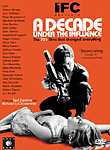
A Decade Under the Influence (2003)
The opening credit montage, accompanied by ‘70s-esque funk music, features brief snippets that remind the viewer of all the classic films turned out by Hollywood and various independents during that period. The truly scathing opening consists of news footage from the star-studded Hollywood premiere of Hello, Dolly, just the sort of lumbering, passionless fare that came close to killing the movie industry in the latter half of the ‘60s. It’s a canny means of indicating just how revolutionary the films of the ‘70s were to be. This leads to a brief discussion on the breakup of the Studio System, when the talent were employees bound by contract to the studios. In the era portrayed, of course, talent (the favored word here is ‘artist,’ but I hesitate to employ so pompous a term) worked for the studios on a free-lance basis. The balance of power shifted from those who paid for the movies to those who made them. (Around about here we get one of our first clips, a scene from Bob & Carol & Ted & Alice. I thought this an odd choice, as unlike many films of the period, this groovy examination of the sexual revolution has dated badly. Frankly, it hasn’t aged any better than Hello, Dolly.) Sidney Pollack, one of the more used interview subjects, provides a basic insight by noting that films of the classic Hollywood period gave audiences glamour. Set in beautiful locales and starring beautiful people, they provided escapism. The classic films of the ‘70s, however, offered reality to a younger and vastly more hip audience. Certainly it’s hard to imagine another decade in which unphotogenic actors such as Dustin Hoffman, Bruce Dern, Al Pacino, Gene Hackman, Peter Boyle, etc., would have become movie stars. In an interesting montage, we see the interview subject names their influence. These tend to be foreign directors, especially from the French New Wave moment, who were experimenting with a more personal cinema. The same names are sounded again and again: Truffaut, Bergman, Fellini, Renoir, Kurosawa, etc. The irony, of course, is that many of these directors, most notably Truffaut and Kurosawa, were strongly influenced by Hollywood films of the classic era. Robert Towne (who could double for director John Carpenter, by the way) notes this dichotomy in reference to the seminal Bonnie & Clyde, which he notes was influenced by European films that were themselves influenced by the Hollywood gangster pictures of the ‘30s. There were burgeoning influences here in this country, too. Director John Cassavetes famously began making slice-of life, guerilla (i.e., non-union, no location permits) movies featuring friends and associates, shot with handheld 16mm cameras at whatever locations were available. More practically, producer Roger Corman famously hired much of the talent most associated with the following decade to make his low-budget genre films. Corman was notoriously, er, thrifty, but he had an extraordinary eye for talent, and was willing to let his employees make the film they wanted, as long as they provided the exploitation elements he wanted and, more importantly, stayed within budget. He also pushed his employees to expand their horizons, albeit again often as a cost-cutting move. The tale of Peter Bogdanovich’s Targets is trotted out. Basically, Corman had hired Boris Karloff for a set number of days to star in a gothic horror film called The Terror. The film finished early, and Corman had Karloff for two more days. Bogdanovich was hired to whip up a cheapie project that would utilize the star. Bogdanovich and cowriter Polly Platt (with uncredited script assistance from Samuel Fuller) decided to make a film based on the infamous Charles Whitman, who climbed a bell tower on the University of Texas one day and over a bit more than an hour and a half, killed 16 people and wounded 30 more. The idea was to contrast Karloff, who played an old horror actor clearly based on himself, with the real life random horrors of the modern age. (This is a brilliant film, by the way, and all too relevant nearly forty years later. It’s out on DVD.) When Bogdanovich saw the assembled film, he thought the editing was screwing the picture up. Corman told him to re-edit it himself. Bogdanovich replied that he didn’t know how to work the equipment, whereupon an impatient Corman told him to get instruction from Dennis Hopper. Fifteen minutes or so of this, and Bogdanovich is an editor. That’s what working for Corman was like. Next we get a longish section on Easy Rider. An influential film, no doubt. However, unlike Targets, it doesn’t have much to say to people born after the ‘60s. Frankly, it hasn’t aged much better than Tom Laughlin’s Billy Jack movies. The documentary’s second chapter starts with a lot at Robert Altman’s M*A*S*H, one of the decade’s pivotal early movies. This is the section where we really get into the change that was happening at the studios. As Sissy Spacek notes, "In the ‘60s the studios called the shots. In the ‘70s, the artists called the shots." This is hardly groundbreaking stuff, but it gets to the heart of the matter. A more interesting topic is the how several of the most revered and still beloved films of the decade, such as The Godfather I & II, The Exorcist, The French Connection and Chinatown, are in fact riffs on classic Hollywood genres. We then move to perhaps the documentary’s most unconvincing section, which is how the ‘70s were a heyday for women actors and filmmakers. Ellen Burstyn speaks of starring in Alice Doesn’t Live Here Anymore, we see the inevitable clip of Jill Clayburgh in An Unmarried Woman, and Spacek speaks of starring in Carrie with Piper Laurie. Those were all good roles, it’s true. However, they were all in films written and directed by men. The ‘70s wasn’t a particularly good decade for women filmmakers per se; it was a good period for filmmakers period, some of whom were women. One especially annoying part of this is the lauding of Jane Fonda, ‘balanced’ with some truly lame "Whatever you thought of her politics, you could only admire her passion and commitment blah blah" sort of comments. Actually, I don’t admire Ms. Fonda’s passion and commitment. Her actions during the period crossed the line from free speech over into outright treason, and I wish she had been booted out of this country and allowed to live in one of the more enlightened regimes she so admired, like Cambodia. The final piece is where things start getting a bit thick. Inevitably, they start discussing all the social unrest in the country, Viet Nam and Nixon and civil rights and so on. Obviously this is all part of the story, but it’s also ground that has been rather well trod. Also, it allows for some conceited reminiscing from the assembled former radical artists, now largely a collection of the sort of old farts they once railed against. William Friedkin mentions the how the period’s films displayed a "moral ambiguity," blah blah. All the posturing against the Establishment is somewhat comical, however. Once you start making films for a Hollywood studio, you are the Establishment. Julie Christie, who easily comes off as the most insufferable and self-important of the interview subjects, doesn’t even grasp this as she castigates The Media. Next, this leads into an extended clip from Network, wherein some black revolutionaries fight over convoluted financial rights to a proposed TV series following their crimes against The System. This is an amazingly dunderheaded moment by the documentary’s makers (unless it is meant as sly satire, although I doubt it), since the point of the scene is that the radicals—like the filmmakers seen preening on themselves here—were fully as corrupt as the Establishment they pretended to stand against. If Paddy Chayefsky were still around to see this collection of withered millionaires patting themselves on the back for their vast social progressiveness, I expect he would have projectile vomited right into the camera. Next we start getting into the elegiac, ‘What Went Wrong?’ wrap-up. Jaws and Star Wars, the progenitors of the blockbuster era, are inevitably mentioned. Heaven’s Gate is proffered, not as an example of the Young Turks going mad with power and killing the golden goose, but as the lamentable start of critics and the public getting interested in the finances of the movies—budgets, weekly grosses, etc.—instead of just focusing on the films themselves. Ellen Burstyn talks about how the films of the period were "personal statements." Friedkin laments that making films isn’t Artistically Valid if you don’t allow for "the possibility of failure." (On somebody else’s dime, of course, or rather several billion of them.) Only Polly Platt, bless her, points a finger in their own direction, noting how the filmmakers the documentary applauds all became massively rich and lost touch with the common people they once make movies about. Despite running nearly three hours (and divided into three chapters), A Decade Under the Influence remains a lean work. If anything, it may have been too short to cover some of the necessary ground, and the third part especially often seems rushed. In the end, however, the film functions best as a primer. Those who already have a working knowledge of movie history will not find much new to chew on here. It’s an enjoyable, clean look back at an extraordinary time in American cinema, but its no mind-blower. One topic I would have like to seen explored, and one I’ve rarely seen addressed, is the fact that filmmakers have chosen a medium that requires the participation of dozens or hundreds of other people, and vast amounts of someone else’s capital to realize. I always thought it arrogant, in a way, to expect some entity to hand you millions of dollars, and then demand artistic control as well. If they really wanted complete control, why not write a book, or paint, or sculpt? Sadly, the idea that the ‘artist’ might have responsibilities to those funding his work is never brought up. They had the chance. One of the commentators is Clint Eastwood. There are two notable things about him. First, he has never once gone over budget on a film he directed, nor has he ever requested an exorbitant budget to begin with. Second, unlike almost every other director featured here, he continues to occasionally turn out a masterpiece. I’d like to think there might be a correlation between the constraints Eastwood intentionally places on his movies, and the fact that he continues to make vital films. Sadly, no one might ever ask him his thoughts on the matter. Ken’s Rating: Watchability: 8 out of 10. Substance: 7 out of 10.
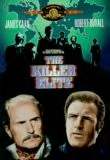
The Killer Elite (1975)
There’s a private company, ComTeg, that does freelance security and wetwork for the CIA. Their top agents are Mike Locken (James Caan) and George Hansen (Robert Duvall – was that guy ever young?). They are spies, or mercenaries, or whatever, ‘70s style. By which I mean they seem to have seen Robert Altman’s M*A*S*H a billion times and imprinted on Elliot Gould and Donald Sutherland. They room together, have wild parties where they are surrounded by half-naked, available women (Caan doesn’t exactly look out of his element here), and sing songs as they drive to work and laugh hysterically at each other’s wacky antics. Oh, the fun. Then, while guarding a defector in a secure location, Locken is betrayed by a fellow agent. (I mean, c’mon, this is still a gritty spy movie.) He takes a bullet in his elbow and knee and is left a cripple. He’s told he’ll barely ever be able to walk again, etc., but of course he vows he’ll be back. To the fair, the rehabilitation scenes aren’t rushed through. and we do get the sense that it takes a long period of time before he’s able to get himself, with the help of braces on his arm and leg, mostly back up to speed. One good scene early on has him taking his physical therapist / girlfriend out to a fine restaurant. He attempts to pour her a glass of wine, but spills it when his arm tires. Then he collapses to the floor as he attempts to walk from the table and is unable to get up. The frustration and humiliation of a once physically powerful man reduced to helplessness is well communicated here. Eventually, though, he recovers enough (and adopts a new fighting style that incorporates his cane and leg and arm braces) to accept an assignment for his old employers. This involves protecting a Chinese dissident until he can leave the country. At least I think he was Chinese, although he was played by Japanese actor Mako (our first return star in Netflix Month!) and is being chased by, get this, a pack of Ninjas. (!!) Locken assembles a team, which for some reason amounts to only two guys. This despite the fact that a zillion dudes are after his client, including *gasp* the fellow who betrayed Locken earlier in the picture. There’s an unexpected twist. Anyhoo, Locken hires loony gunman Miler (played by a typically squirrelly Bo Hopkins) and eccentric wheelman Mac (Burt Young, playing, of course, Burt Young). After several action scenes and lots of dubious comic relief and a few more ‘shocking’ betrayals—because, you know, this was made post-Watergate and cynicism was the big thing—the Ninjas show up for the final big action sequence. Which, sadly, ain’t that great. I’ve undoubtedly blathered on before about my views on modern action movies, which in sum is that that genre is suffering from elephantitis. Seriously, how many times does Hollywood think it will remain exciting for us to see entire cities, or continents or even planets destroyed? Been there, done that. I think the megabudgeted action film will wither away and die. Then we’ll get back to the smaller scale action flicks, of the sort that were so cool in the ‘70s. The French Connection. The Taking of Pelham One Two Three. Dirty Harry. Enter the Dragon. We’ve actually already seen a few of these, including John Singleton’s Shaft, The Italian Job and The Bourne Identity (the sequel to which is due out this week, in fact). In my opinion, they’ve been the most enjoyable action flicks of the last several years. Hell, even Warner’s has wised up. Even the upcoming Batman movie looks to be smaller scaled and grittier than the ludicrously overripe Schumacher entries, and the better for it. However, if I love ‘70s many action movies, I don’t love all of them. Killer Elite isn’t that great. Directed by cult icon Sam Peckinpah, who I personally have never been that huge a fan of, the film definitely has problems. Some of these might be due to the fact that the film was hacked up to get it a ‘PG’ rating. However, that’s not entirely the problem. The film is just choppy. This is true of the action scenes (and thus the aforementioned editing looms large for this aspect of the movie), which are cut so poorly that they are hard to follow. I will say that they communicate pretty well the problems of Ninjas vs. guns, with the guns getting rather the better of it. On the other hand, these are some pretty lame Ninjas. Anyone who has ever wondered if Ninjas would be less intimidating running around in broad daylight will get their answer here. Even watered down, the violence is still occasionally shocking in the classic Peckinpah mode. However, the director leans way too heavily on his familiar bag of stylistic tricks, especially his widely parodied penchant for slo-mo and exploding blood bags. It’s a pretty bad sign for an action film when the action set pieces are more confusing than anything else. For that, the post-production editing probably is at fault. The assassination attempt on Mako at the airport is so haphazardly cut as to be more irritating than exciting. However, it’s not just the action scenes that are choppy. The narrative is, too. The film jumps around all over the place. In a way, it’s a relief to get away from the rote ‘three act’ structure that nearly all scripts now seem to follow. However, again, breaking the rules doesn’t mean you break them well. It’s about halfway through the movie before Locken is ready to get back into harness. By the time we get into the Mako plotline, things are pretty rushed. The scene where Locken’s betrayer is dealt with is also rather perfunctory. The film is definitely of the ‘70s, for good and ill. The cast is full of familiar faces, and aside from Caan, Duvall, Hopkins, Young and Mako there are also turns by veteran character actors Arthur Hill and Gig Young. Nobody strays too far from their regular personas, however. The film’s then-trendy political cynicism is a problem, not just because it’s (arguably) dated, but more because it’s not presented as subtext, but all too explicitly as text. Young particularly is given to spouting at length about how all of them are just pawns of the Fat Cats and so on. The attempts at a worldly hard edge are strained as well. At one point, Mako’s comely daughter comes on to Locken by complaining that she’s still a virgin. While emphasizing that he doesn’t want to appear overly rude, he admits "I really don’t give a sh*t." This should be pretty funny, playing off our ‘movie’ expectations the way it does—in a normal spy movie, of course, he’d bed her— but like much else here, it just seems off-kilter. One bit I did like was Locken’s relationship with his physical therapist. (Considering her house, by the way, they must make a lot more than I thought.) He hooks up with her during his hospital stay, and moves in with her after he gets out. However, when he’s ready to get back to work, he ups and leaves. She doesn’t appear at all surprised by this, and we realize that this has been a relationship of convenience for both of them. I thought that was an interestingly adult take on things, and entirely befitting of that period. In any case, at least she’s never put into danger or anything of that nature. On the other hand, she seems to have a big cool dog of some sort, but we only see glimpses of it. Really, if you put a big cool dog in your movie, give it some screentime. At two hours, the film is a perhaps bit longer than it needs to be, even though it remains overstuffed even at that length. It’s not a bad timewaster, but I doubt this has made many folk’s personal favorites lists. Ken’s Rating: 5 out of 10.
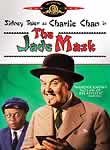
The Jade Mask (1945)
The owner of the estate is Harper. He’s the stock mystery character who everyone else in the movie / book hates, so you know he’s going to get kacked right quick. By profession he’s an inventor (hence the elaborate intercom system), and working with him at the moment is his assistant Meeker. "I detest you as much an everyone else," the latter cheerfully informs his boss. Later, we see the secret room where Harper keeps the McGuffin scientific formula that will drive the, er, plot. He’s rigged the hidden chamber so that anyone who gets inside will be trapped and slowly gassed to death. Only his voice, speaking a set phrase, will open the door at this point. Outside, a motorcycle cop arrives. Roth, at the intercom, is surprised, as he hasn’t yet called the authorities. (I was surprised, too, that Roth would remote open the gate, after being shot at, just because the caller says he’s a cop.) When the officer enters the grounds, the Mystery Figure darts inside. The officer follows him, and we are left to presume that he meets a dire fate. The Mystery Figure, face kept off-camera, appears at the house in the cop’s uniform. He gets inside, and Harper buys it. Since the Government is interested in Harper’s formula, which turns out to be a process that makes wood as hard as metal (?!), the venerable detective Charlie Chan (Sidney Toler) is called in. The suspects include Meeker; Roth; Michael, the mute (!) chauffer; Harper’s sister Louise (forced to work as Harper’s housekeeper); Harper’s niece Jean (forced to work as his maid) and Stella Graham, a professional puppeteer (!) on hand because Harper also had an idea for a toy. Later we also find out Stella was once a circus strongwoman. Gee, could such odd talents have a plot purpose of some sort? Why not just give her a big mustache and have her twirl it whenever Chan looks away? Working with Chan is the bemused local constable, Sheriff Mack. "No barber shaves so close but another barber finds some work to do," Chan chans. Mack is a chicken-fried country guy of the Pa Kettle variety, and matches Chan’s ersatz ‘Chinese’ aphorisms with his own down-home ones. "My mind’s as uneasy as corn in a popper," he admits at one point. Not used to dealing with murder, his job is mostly to stand around and amazed by Chan’s (not that great) detecting skills. Also ‘helping’ Chan is Eddie, his #4 son. (In the books by Earl Derr Biggers, Chan has eleven children). This is Eddy’s only appearance in the series, as far as I know, and he was played by Edwin Luke. Keye Luke’s brother, perhaps? In any case, the sons—and the occasional daughter—were all played by actors of actual Chinese descent, while Chan was always assayed by a white actor. Eddie’s shtick is that he’s a college-educated egghead. (He keeps asking to be called Edward, ha ha). As with all his siblings, he gets under his exasperated father’s feet as he tries to solve the crime himself. "Every time you open mouth," his father avers, "you put in more feet than centipede." As if the presence of Caucasian actor Toler as Chan isn’t enough to put modern audiences off their stride, there’s also an appearance by the series’ comic relief Negro character, Birmingham Brown. Played by Mantan Moreland, Brown was Chan’s chauffer, and he basically had two gags: If there were a black maid or something similar in the film, he would put the make on her. His more regular routine would be to get all pop-eyed when anyone said words like ‘body’ or ‘murder.’ There’s no black maid in this film, so here we only get the second. It’s hard to defend such stereotypical ethnic humor, although it’s useful to note that it wasn’t just blacks and Asians who were used in such a manner. Check out the long-running radio show Life With Luigi, or the way the Irish are portrayed in Going My Way or especially Bob Hope’s Where There’s Life. In any case, you have to feel sorry for actors like Moreland. Society forces you to take these often demeaning roles, and then later on Society decides to try to erase your work altogether because it’s considered racist. You get it coming and going. (By the way, I know why Moreland took parts like this. What’s the Wayans Brothers excuse for making stuff like White Chicks?) Six Chan movies, including this one, were recently released by MGM in a DVD set entitled the "Chanthology." Sadly, the better Chan films, made by 20th Century Fox and starring Swedish actor (!) Warner Oland as Chan, with Keye Luke as #1 son Lee Chan, have not been made available on home video. They were refurbished and shown on cable TV recently, but there was the usual outcry by the Sensitivity Squad, the same guys who managed to get Speedy Gonzales exiled from the Cartoon Network. (Except, that is, for the Latin American version of the Cartoon Network, where Speedy is the highest rated character.) Probably in response to this experience, Fox has not yet elected to release the earlier films to DVD or video. The Oland Chan films were comparatively opulent affairs, and needless to say, the scripts (meaning the mysteries) were much better. However, in 1938, after starring in sixteen Chan movies, Oland passed away. The series continued with Toler in the role, and with Victor Sen Yung taking over the sidekick role as #2 son Jimmy. Weirdly, Jimmy’s name was changed to Tommy (!) for his last five appearances in the role, after Roland Winters replaced Toler as Charlie. In 1942, Fox gave up on the series. Two years later, skid row mini-studio Monogram brought Chan back, with Toler resuming the role. Sen Yung, meanwhile, was at this point replaced by Benson Fong as #3 son Tommy, and Birmingham Brown was added to the stable. Eventually, Toler too died (in his later films, like The Jade Mask, he was so ill he could barely walk around), and Roland Winters took over the role for the last six films. Again, for five of these Sen Yung, who had played #2 son Jimmy in several pictures with Toler, returned now as #2 son Tommy, although when Benson Fong played Tommy, Tommy was the #3 son. Got that? The Jade Mask is unlikely to win may converts to the series, which is why it’s even sadder that the earlier Fox entries aren’t available. Toler, again presumably because he was ill, in quite nearly inert. To call his performance, well, a ‘performance’ is being kind. Even so, he was still a better Chan (although far inferior to Oland) than Roland Winters. No other actor here stands out any better, except for Hardie Albright as Meeker. At least he chews the scenery with some gusto. Edwin Luke is just there, and it’s easy to see why his character wasn’t brought back. The mystery element is horrible. One villain’s identity is telegraphed by her weird character traits, by which I mean Stella, of course. I won’t consider this a ‘spoiler,’ however, because it turns out there’s another killer. (Although anyone with an eye for simple plot mechanics will spot who he is right off.) The worst part is that the film doesn’t ‘play fair,’ but which I mean, there’s no way the audience could solve the crime from the presented clues. Charlie’s ‘evidence’ of the killer’s identity comes completely out of left field, and the details of what the killer was doing are ludicrous in the extreme. By this time the series had degenerated into serial-styled buffoonery. The murder weapon is a poison dart gun concealed in a silly object, there are hidden chambers, secret panels, poison gas vents, ridiculous scientific formulas, a corpse moved around on wires, ala Weekend At Bernie’s (and pay attention to the architecture of the hallway that would be required for this to work—it’s moronic), the act of which makes no sense interior to the story, and is employed solely so we in the audience go, "Hey, I’ll bet it’s that puppeteer woman!" Remember earlier when I mentioned the motorcycle cop who got killed, and how the murderer entered the house wearing his uniform? Later Birmingham find’s the cop’s body (stood up straight in a closet, what else?), and it’s back in uniform. So…the killer lured the cop into some bushes, and killed him. Then he donned the cop’s uniform, which of course fit him to a tee, and broke into the house, looking for Harper. Then, after killing him and hiding that body, he went back outside, carried in the cop’s body, took off the cop’s uniform and redressed the corpse, tucked it in a closet, (presumably) put his own clothes back on, and took off. I guess I could think of a marginally less retarded scenario for all this, given that he had an accomplice, but nothing that would remotely make sense. And how come the police didn’t find the cop’s body when they were searching for Harper’s corpse, which also pointlessly disappears at one juncture. Brother. Also, there’s a bit where Chan finally demands some answers from Roth the Butler. Roth admits he suspects who the murderer is, and asks for five minutes to clear something up. Of course, ace detective Chan allows him to stroll off alone, and naturally Roth is killed before he can divulge what he knows. This general situation is repeated later when the mute chauffer is murdered just before he can finger the killer. By the way, the mask referred to in the title, which indeed plays an important (if goofy) part in things, is a life mask. I don’t want to be pedantic, but it’s made of plaster, not jade. I assume they thought a ‘jade’ mask just sounded more ‘Chinese.’ The movie’s most dreadful element is its comic relief. This was only Brown’s fourth appearance in the series, for instance, and already his scaredy-cat routine was getting really old. Meanwhile, much of the ‘humor’ is based on assigning characters ‘funny’ manners of speaking. Chan has his aphorisms (after twenty-odd Chan movies, you can tell why they were scraping the barrel here), Sheriff Mack has his backwood folkisms, Eddie employs five-dollars words, because, you know, he goes to college, and Birmingham, naturally, has his trademark malapropisms. Even at 66 minutes, the film is slow going. Other than nostalgia buffs and camp enthusiasts (and I’m in that crowd), there’s not going to be much of an audience for this. It doesn’t help that the DVD set is overpriced. Six films are put onto to six separate discs—for no reason, as each run just over an hour—and collected into a set with a street price of $70. The fact that they only had the rights to the cheesy Monogram offerings definitely doesn’t help things. It’s possible that one or two of the six films are better than this one, but I’m not exactly inspired to work my way through them all. Given the desultory quality of the product, MGM would have been better off emulating Universal. That company has recently released several series, ranging from Abbott & Costello pictures to the Francis the Talking Mule films. These sets pack up to eight films on two discs and sell the whole shebang for a street price of $27, which discount outlets sell for well under twenty bucks. At that price I probably would have bought this set myself, rather than renting a disc or two, and I’m sure I’m not alone. Still, one can only hope this package sells well enough anyway as to prop 20th Century Fox to release the Warner Oland and earlier Sidney Toler films. Ken’s Rating: 4 out of 10.
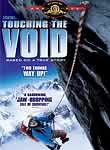
Touching the Void (2003)
There were shipwrecks, lost submarines, circus fires, earthquakes, floods, collapsed dams and plane crashes. Some, like the sinking of the Titanic and the immolation of the Hindenburg, remain well remembered. Others were more obscure. Some were freakish. A gigantic molasses storage tank in Boston burst in 1919, sending well over two million gallons of the stuff smashing through the city in a twenty-foot tall, 14,000 ton wave. 21 people died. (Imagine drowning in molasses.) In 1945, a U.S. B-25 bomber, lost in the fog, crashed into the 79th floor of the Empire State Building. As a kid I always thought that would make a terrific movie. Now, obviously, I’m glad no one ever did so. Of course, the actual disasters were only part of the appeal. The other central issue was how people dealt with the aftereffects. Most of the big disaster movies dealt with the aftermaths of the titular catastrophes: The Poseidon Adventure, Earthquake, The Towering Inferno and the various Airport pictures all showcased the efforts of their characters as they attempted to stay alive following some cataclysmic event. "There’s got to be a morning after," one theme song informed us. Therefore disaster movies were usually also survival tales. Of course, disasters come large and small. That, finally, brings us to Touching the Void. The film reenacts a true story, and unlike most movies that make that claim, this one seems likely all too close to what actually happened. In 1985, two young mountaineers, Joe Simpson and Simon Yates, were in Peru. Their goal was to ascend a previously unconquered face of the treacherous Siula Grande. While making their preparations, they met another traveler, Richard Hawking. Hawking had no interest in mountain climbing, but agreed to watch over their base camp until they returned from scaling the peak. The climb seems, especially to a physical coward like myself, insanely arduous and dangerous. The two elect to climb Alpine style, which means that they only bring whatever supplies they can squeeze into their rucksacks and don’t establish camps with supplies as they go up. At night they burrow snow caves and sleep in those. Water is gleaned by melting snow with a small gas burner. It’s so cold that melting a few cups of water takes hours. As well, Alpine climbing means you go with without establishing safety lines as you go along. Because of this, the rope binding to your partner is a double-edged sword. It provides some anchorage should you slip. However, if one climber falls at the wrong moment, the other would be yanked to his doom as well. In sum, you affix yourself to the cliff face almost solely with your spiked climbing boots and by driving in your climbing hammers. Even when weather conditions aren’t adding to the problem, this looks (to me, at least—I should notice I have a paralyzing fear of heights) insanely dangerous. At one point the two reach to a rocky portion of the cliff face. Watching them as they desperately poke around for a tiny but stable crack in the rock, into which they can safely brace their boot spike, was appalling. The second day was worse. There was a massive windstorm that blew loose snow around. It would stick to Simpson and Yates and refreeze, the result of which was like being covered by "armor." Visibility was nil, and they were at this point 20,000 feet up. On the third day they were horrified to find that the upper portion of the cliff face was covered by powder snow, including huge cornices of the stuff up near the top of the ridge. This is a rare phenomenon, apparently, possibly unique to these mountains; in any other location, snow at this height would be quite dense. Needless to say, this didn’t allow for much security in planting themselves. Eventually, though, they actually do make the top, achieving what no other climber before them had. Then we get to the fun part. 80% of accidents, apparently, occur on the climb down. The way they had chosen proved a lot hairier than they expected, and then they were hit by another windstorm, which created whiteout conditions. At one point, Yates walked out onto a cornice and it collapsed under him. Luckily, Simpson was able to pull him back up. On the third day down, after using the last of their small gas supply and still 20,000 feet up, it happened: Simpson slipped and fell. When he landed, he hit so hard on his right lower leg bone projected up through his knee. Needless to say, this left him in excruciating pain. Yates had to figure some way to get him down the remaining vast distance. With further gale force winds whipping clouds of snow around, and wind chills dipping to 80 below zero, Yates would carve himself a seat as best he could in the loose snow, and then use their tied together lines to lower Simpson down the slope, three hundred feet at a time. When he had reached the ropes’ end, Simpson would put his weight on his good leg, Yates would climb down to meet him, and the process would be repeated. Here disaster struck again. Almost blind, and thus having no real idea of where they were, Simpson ended up sliding over an edge of the cliff. He found himself dangling a hundred feet up over a huge crevasse. Meanwhile, Yates had no idea what was going on. He could only wonder why Simpson’s full weight was remaining on the line. Moreover, the snow under him was gradually giving away. Eventually he would slip and fall, too. After holding the line in his precarious situation for an hour and half (and imagine how long that would seem in the roaring wind, the blinding snow and the staggering cold), he did what he had to do: He cut the line. That’s where the story gets really incredible. And here’s the thing: We know that both men survived, by dint of the fact that they appear in the film, relating their story while we watch the recreation. Even so, their survival, especially Simpson’s, is so completely amazing that I still half expected him to die, even though there was the most obvious evidence possible that he hadn’t. Later, after all was said and done, Yates ended up taking a lot of crap in the climbing community for cutting the rope. Simpson always strenuously defended his partner’s actions, and in the end, wrote the book this movie was based on to help clear the air. He dedicated it to Yates, who he called the man who had saved his life. The book unexpectedly became an international bestseller, which is what led to this film. Finding he had a flare for writing, Simpson made it his career. I haven’t read his book, by the way, but the film certainly achieves his stated goal: No one watching this portrayal of events could doubt Yates’ steadfastness, nor believe that he had any choice at all but to cut that line. That he waited an hour and a half to do so is to my mind astounding. In many ways, Touching the Void is a monster movie. Here the mountain, the weather, the cold and gravity itself are the monsters, lurking around every corner and waiting to kill our protagonists. (There are other movies like this. Have you ever seen Backdraft? It’s definitely a monster movie, and Fire is the monster.) The filmmakers seem aware of this, and even the opening credits look like those from a horror movie. The only word I can think of for the film is harrowing. So harrowing, in fact, that we don’t just wince at what was happening to the protagonists, but at the idea of what the people who made the film went through. The actor who plays Simpson, for instance, takes an incredible battering in recreating his model’s plight. If you want to see method acting, watch this guy as he recreates Simpson’s slow, excruciating crawl over an immense boulder-laden downgrade, all while constantly falling over upon his shattered leg. Films like this inevitably raise the question of, "What if it were I?" For my part, that’s easy: I’d have died. I fear death a lot less than the sort of agony and despair Simpson experienced before finding safety. Lying in the snow and just allowing myself to go numbly into that good night would have been just too easy. Of course, that’s why I’d never have been in such a situation in the first place. There’s no commentary track, but there are some documentaries. On short one, maybe about ten minutes, describes what happened immediately after the end of the film, which is when Simpson is first discovered. Of course, they still needed to get him to civilization, and that was an epic tale in itself. Moreover, because they were short of cash, when they eventually got to a hospital in Lima, they wouldn’t give Simpson much treatment. In the end, back in England, his mis-healed knee had to be rebroken twice and allowed to reknit. Amazingly, he now walks with no apparent limp at all. Indeed, despite the severe frostbite both men sustained (in the film they eventually end up looking like zombies, from that and dehydration), both men somehow escaped any permanent injury. While his former partner recuperated, meanwhile, Yates immediately went back to mountain climbing. It wasn’t charitable, but my initial reaction upon hearing this was to wonder whether it signified the indomitable nature of Man, or instead our capacity for limitless stupidity. The other two documentaries, each a bit over twenty minutes, sort of merge together. Yates and Simpson were paid to return to the base of the Siula Grande for the first time since the incident, so as to oversee and comment on the location shooting done there. Simpson had fears that he was tempting fate by returning. At times, the memories visibly catch up with him and he has what amounts to panic attacks. Yates, in contrast, is apparently completely sanguine, although after they left the location he broke off all communication with the filmmakers. Under questioning, Yates exhibits a great deal of anger at the idea that the events here represent the central chapter of his life. He forcibly maintains that this occurrence was but one adventure among many he’s had. Simpson, however, feels the opposite: Everything in his life changed after Siula Grande. One can understand each man’s reaction: Simpson’s ordeal was greater, and his actions and survival are nothing short of heroic. Yates, meanwhile, is not only a comparative bystander to Simpson’s far more amazing tale, but he has spent years being castigated by some for cutting his partner loose. Hopefully this film will help to vindicate him. Ken’s Rating: 9 out of 10.
The Assassination Bureau
(1969)
Spoiler Warning!! It’s difficult to compose even a short review of this film without blowing two pivotal plot twists that occur early in the proceedings. If you’re a fan of ‘60s-era black comedies, I would urge you to hunt down a copy of the film without discovering what these twists are (i.e., by reading the piece that follows). If you have no interest in these sorts of films, or aren’t the kind who cares about such things, than read on, MacDuff. The ‘60s were a great decade for black comedies. The British especially had a knack for films mixing mirth and murder. (‘Mirth & Murder’. There’s a tagline you know was used for some film or other.) There were whodunits with a healthy dose of humor added, such as the Margaret Rutherford Miss Marple films. Terry-Thomas solved comic murders in Kill or Cure (1962), and attempted to commit one in How to Murder Your Wife (1965). Peter Seller’s Inspector Clouseau appeared in his sole whodunit, A Shot in the Dark (1964), which remains the best of that series. Sellers also had earlier attempted humorous homicide in The Lady Killers (1955). Indeed, the lineage of such films goes back at least as far as 1949, when an exceedingly amoral Dennis Price bumped off the eight relatives (all played by Alec Guinness!) standing between him and an inheritance in the classic Kind Hearts and Coronets. As well, the dominant genre of the ‘60s, both in theaters and on TV, was spies. The endless parade of spy movies and shows was marked by generous amounts of violence, yet even the ‘serious’ examples (the Bond movies, TV’s Wild Wild West, Robert Culp and Bill Cosby’s I Spy, etc.) were generally leavened with large doses of black humor. It worked in the other direction as well, as the outright comical spies skeins (Get Smart!, the Flint movies) didn’t shy away at all from prodigious body counts. The obvious ‘ur’ example of this coupling was Britain TV series The Avengers, especially during the years when vivacious talented amateur Emma Peel (Diana Rigg) was teamed with urbane professional agent John Steed (Patrick Macnee). Mrs. Peel and Mr. Steed must have personally offed hundreds of rival spies and various other nogoodniks, and stumbled over as many bodies done in by others, in between trips to the country and flutes of champagne. Never has violent death been such a stylish fashion accessory. Actress Rigg was such a natural at this sort of thing that she continued to work in similarly toned projects after leaving The Avengers behind. She is, in fact, the star of our present subject, which provided her first lead movie role. As well, she later costarred in one of the highlights of the comical mayhem film, Vincent Price’s superb Theatre of Blood. Hell, the woman married James Bond in Her Majesty’s Secret Service. It’s hard to think of any other woman worthy of that singular honor. (Speaking of ‘honor,’ Ms. Rigg’s immediate predecessor on The Avengers, Honor Blackman, left that series so that she could assay perhaps the classic Bond Girl character, Pussy Galore—how did that name ever get past censors back in ’65? —in Goldfinger. Such are the workings of fate.) The Assassination Bureau (although the title on the DVD print is actually The Assassination Bureau Limited) is based on an unfinished Jack London novel, which was later completed by author Roger L. Fish. It’s the sort of film best described as a ‘romp,’ at times played straight but more often outrageously broad. This sort of film is probably an acquired taste. However, I acquired it early on as a kid, so I’m probably not the best judge. In effect, our subject today is like a cross between Kind Hearts and Coronets and the period farce Those Magnificent Men in Their Flying Machines (or the similar The Great Race, or the nearly identical Those Daring Young Men in Their Jaunty Jalopies, or hell, the cartoon equivalent, Wacky Races, a set of which is due out soon on DVD. Snigger snigger snigger.) As is true with the above cited racing comedies, the time is early in the 20th Century. As was also true in at least a couple of these films, our female lead, Miss Winter (as a jape on the exquisitely formal manners of the time, we never learn her Christian name), is a suffragette who seeks to become a journalist—at the time an all-male preserve—as a blow for women’s equality. She is, per the tradition, intelligent and massively self-assured, but too preoccupied with her political goals to spend much energy on more, er, personal matters. We open with a comical silent movie-esque demonstration about the generally ineffective amateur assassin. Lately, however, there’s been a change, as a sinister group has apparently made a profession of the avocation. This theory, at least, is being advanced by Miss Winter to the publishers of a London newspaper. She has figured out how to contact the organization, and has a scheme in mind that will result in a sensational news story. The editors seem nonplussed with this female would-be newshawk, but from the shadows steps Lord Bostwick (Telly Savalas!), the paper’s publisher. After taking her to his private office, he promises all the financial support she needs in pursuit of this amazing scoop. However, he wonders, what will happen when she contacts the assassins, but fails to provide them with a target? Not to worry, she primly responds. She does, in fact, plan to hire them to murder someone! After some brief secret agent-type security hi-jinks, Miss Winter is meeting with the Assassination Bureau’s chairman, the English educated Ivan Dragomiloff (Oliver Reed!). Remarking on his youth, Miss Winter learns that Ivan has followed in his late father’s footsteps, following a lifetime of training. She expresses at some length her umbrage at his line of work, which is not surprising, as spontaneous lecturing was one of the suffragettes’ principle hobbies. However, the fact that she is seeking to engage his firm’s services somewhat undercuts her arguments. Ivan admits to being intrigued as to why Miss Winter has sought the Bureau out. Their research indicates that she is free of any romantic entanglements. "Whom in the world, other than a husband or lover" he inquires, "could a young lady wish to kill?" His prospective client remains evasive. However, after being assured that the proposed target is of dubious moral character, Ivan agrees to take on her assignment. He is shocked, however, when Miss Winter reveals that he himself is to be the victim. He names a grand price for his head, based on his own self-proclaimed importance, but is nonplussed when she calmly removes the sum from her valise. (Her employer, Lord Bostwick, has provided the money, of course.) Aside from having already given his word to take on the job, however, this odd situation actually fits in with some of Ivan’s prior plans. He accepts the contract on behalf of the entire Bureau, and then calls a board meeting, made up of assassins from across Europe. (Each has a territory of his own: France, Switzerland, etc.) Here we are shocked to see that the Bureau’s vice-chairman is none other than…Lord Bostwick himself. Ivan disclosed the nature of the contract, much to the consternation of his fellows. They ask why he would accept such a job. There are two reasons, he replies. First, he believes his associates are getting sloppy. Since he will attempt to kill them before they kill him, this assignment will test their mettle. However, he is also concerned that the Bureau, which under his father assassinated only tyrants and miscreants, is drifting towards simply seeking profit and power, sans their previously held "sound moral principles." (!!) Announcing that he, and they, will officially be at hazard in 24 hours, he departs. To save their own skins, the Bureau members try to track Ivan down and do him in. Meanwhile, Lord Bostwick has his own motives for his subterfuge. He indeed wishes to use the Bureau in the exact fashion that Ivan fears, and Miss Winter’s assignment has given him the perfect opportunity to get Ivan out of the way. Simply to add to the sport, he announces to the others, he offers a 10,000 pound reward for the member who takes Ivan out. Meanwhile, the naïve Miss Winter, in following the assignment Bostwick has given her in his role as her employer, is providing the Bureau with details of Ivan’s movements as she follows him for her story. And so the fun begins, as Ivan uses all his skills and resources to murder his associates before them murder him. Disguises are donned (which naturally fail to convince the audience but completely fool the character in the movie), and death traps set. Most of the deaths are offstage or somewhat comical, but at least one is genuinely gruesome. Eventually, we learn that Bostwick plans to plunge the entire continent into war, in order to line his own pockets and seize power. Only Ivan and Miss Winter, who has finally learned the appeal of having a personal life, stands against this monstrous scheme. The climax involves a plot by Bostwick and his German henchman General von Pinck to drop a huge bomb on a peace conference via zeppelin. (Since the film takes place in the pre-WWI era, this is a novel idea.) Man, you can’t go wrong putting a zeppelin in your movie. I suppose this film may be too arch for some tastes, but I love it. I have a history with this picture, actually. It was a favorite of my mother’s—who adored The Avengers--and I watched with her more than once as a kid when it was on TV. The strongest point is the main cast. Riggs is letter perfect as Miss Winter, beautiful and damn sexy in her old-fashioned attire (especially when we see her in her petticoat!), and evincing some extremely sharp comic timing. Reed is equally good. Unlike his usual thuggish roles, Ivan is an extremely silky gentleman, and he probably had fun playing such a suave character for once. Reed’s odd features really work well here. From some angles he’s quite handsome, making the inevitable romance between he and Miss Winter more credible. From others, however, he looks almost like a shaved ape. (It’s odd, not to mention a shame, that despite appearing in several horror movies, Reed never played Mr. Hyde. He did star in a typically desultory parody of the character, however, wittily entitled Mr. Heckyl and Mr. Hype. Oh, my sides.) His Janus-like countenance allows him to remain a credible romantic lead, and all while projecting the menace the character requires, one that a Michael York or someone similar might not have provided. Savalas is suitable oily as Lord Bostwick, and Curd Jurgens as Von Pinck plays a role he would assay over and over again, sometimes comically and sometimes not. (He also played the main villain in the Roger Moore Bond film The Spy Who Loved Me.) The other assassins are played by often-familiar European character actors. One of the film’s few problem areas is that these should have been presented as being a tad more competent. Instead, they are generally such buffoons that we seldom believe Ivan to be in much danger. Other areas of concern include moments when the humor is perhaps a tad too broad, and there’s also a lame pop theme song, which is heard more than once. Oddly, this ’60-ish element dates the film more badly than its otherwise rigorously observed time period. (One nice bit: Miss Winter is sent off by horse to save all of Europe, and is later seen riding sidesaddle, as is only proper for a lady.) Speaking of the song, Dr. Who fans will note a couple of connections with the show. First, the film’s music was composed by Ron Grainer. Mr. Grainer also wrote the classic Dr. Who theme, and created as well the sound effect for the materializing / dematerializing TARDIS. Meanwhile, one of the assassins running around in the background is played by Roger Delgado, the original Master, the Doctor’s arch-nemesis. Ken’s Rating: 8 out of 10.
-Review by Ken Begg |
|||||||||||
|
|