Another feature of... |
|
Another feature of... |
|
|
for
____________________
2003 Academy Awards Diary The Oscars That Weren’t… (Glamorous that is, or very much fun. Enjoy the queasy tension that arises when the Academy of Motion Picture Arts and Sciences meets reality.) You have to hand it to Hollywood. At a time when the
country is tied up in knots over war, the economy, and terrorism, they
manage to make it All About Them. Oh, sure, you can get disgusted. Still,
you also have to look on with a weary sort of admiration. Like the
demented heroine of Sunset Boulevard, they spin controversy out of
thin air and beat their chests in worry and regret, all the while making
sure the camera catches their good side. Ignoring the embarrassing
hyperbole ("brave souls" anyone?) and the publicity seeking—Yo,
Will Smith, no one gives a dizzamn—it was a pretty The Host While not reaching Whoopi levels of the stultifyingly unfunny, Steve Martin flirted with flop sweat on numerous occasions. Moreover, he flirted with a good deal of the females in attendance, skirting between delightful codger and creepy chicken hawk with an alarming ease. I understand the pressures of avoiding The War ("Whatever you do, don’t mention the War!") and concerns about propriety. Still, Martin was just the man to disintegrate all the pompous hoopla with one well placed remark. Instead we got jokes about Mickey Rooney’s age. What? The Hoover Administration too topical? A tip: If you’re going to bother hiring a host who is actually funny, let him be funny. The Clothes An apparent victim of pretending to care strikes back. It was requested that clothes be toned down, but thankfully the pastels didn’t completely disappear. Halle Berry had remarked that she wanted to wear something to encourage the troops. Visions of a camouflage ball-gown dancing in my head. I was relived to find she opted for a lovely gold number. "Low key" was interpreted by many actresses to mean no make up and a simple up do. It worked for some. (Although for ol’ Pucker Face Renee Zellweger, it looked like she just had time to put on her dress and dash for the limo.) Marcia Gay Harden worked a gorgeous turquoise number, and pregnancy suited Mrs. Jones to a T. First time nomination Queen Latifah looked stunning in a blue brocade gown. Then there was the debit side of the sartorial card. Denzel, you’re incredibly good looking, so why hide it behind that scraggily beard? Sally Kirkland was the expected disaster. Meryl Streep’s dress had a nice bodice and skirt, but someone hastily, and sloppily, attached sleeves made out of a doily. J-Lo, it was rumored, would finish cataloging her anatomy to the public by wearing a sheer backed dress. Ben Affleck put the kibosh on this. (Lest you mistakenly think well of him, the peace pin he considering wearing was dropped after being declared a fashion no-no by his stylist.) Lopez instead took the stage in a dowdy toga number stolen from a Star Trek extra. The dress code made for a tame night. Cher was sorely missed. The Winners Let me get this out of my system: CHRIS COOPER WHOOOOOOOOOOOO!!!!!!! Thank you. My favorite character actor took home best supporting actor and wished for peace, a nice if toothless sentiment that set the tone for remarks to come. Adrien Brody, what to say? Out of the films nominated I’ve just seen Chicago A dark horse win always pleases me, and I can understand being swept up in the moment. But dude, they’re called personal boundaries. Look into it. Somewhere Tom Cruise is weeping into his copy of Dianetics. And then there was Michael Moore. I’ll just say that in a tepid night his balls out comments, good or bad, were a welcome change. [Editor Ken: Of course, many thought the welcome change occurred when Moore’s remarks got him booed off the stage. Further amusement was gleaned from his subsequent and increasingly desperate attempts to spin said catcalls to the press.] An absent Roman Polanski won for Best Director and received a standing ovation, one of many given indulgently through the night. The best speech is always given by the Lifetime Achievement winner, and Peter O’Toole did not disappoint. After a montage showing how he was once the hottest thing on the planet, he thanked the Academy for bestowing this honor upon him as he "totters off into antiquity." The Hell? An amazingly restrained Barbara Streisand announced Best Song. A moment of post-modern nirvana was created when she proclaimed, "The Academy Award for Best Original Song Goes To Eminem." Strangely that was the only song that wasn’t performed. I guess our boy’s trying to keep it street, yo. Though it can’t be denied a Streisand/Eminem duet would make a tantalizing mix. Look for a remix of "Evergreen," entitled "Soft as a F------ Easy Chair B---" to hit stores this fall. Susan Sarandon shocked everyone by flashing the peace sign and then proceeding to simply read her lines and not give a lecture. Debbie Allen may have been replaced but her spirit lives on. In a tacky number, Catherine Zeta-Jones and Queen Latifah sang "I Move On" from Chicago. Unfortunately, they were buried in a set from the 1983 Grammies and a dozen dancers doing their best to demonstrate how too much Fosse can be a dangerous thing. ABC disgraced itself with an ugly, blurry CGI Mickey Mouse used to announce the Best Animated Short award. What’s worse than an awful comedic bit that won’t end? An awful comedic bit done by a cartoon character. The best reaction shot was during Moore’s last hurrah the occasionally beautiful Adrien Brody looking supremely uncomfortable. And won’t somebody say it? Hold your applause during the "in memoriam" segment. It’s inconsiderate to turn it into a popularity contest. *** Taste and The Oscars made for an uneasy alliance. Cutting away to Peter Jennings during the broadcast only added to the absurdity of the event. The need for respect is admirable but misguided. The Academy Awards is a gilded orgy of self-congratulation, and no somber black gown or lack of E! coverage will change that. And why should it? The movies are built on extremes, to
make us laugh, to make us cry, scream, fall in love. The egos of the stars
are part and parcel of the package. We allow them this petty indulgence
because we love them or love to hate them. It’s foolish to attempt
anything else or pretend the ceremony has any deeper meaning. So cheers to
the stars who brought the glamour and a thank you to those who pushed
politics for giving us fodder to toss around the water cooler. Here’s to
next year. Let it bring even better movies, tackier gowns and Cher.
Please, let there be Cher. ____________
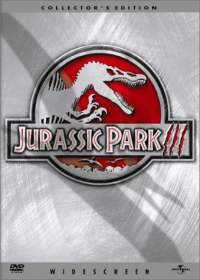
Jurassic Park III Plot: Dinosaurs, again. As our veteran readers know, I had my share of problems with Lost World: Jurassic Park II. To the extent that JP3 answered some of those concerns, it’s a better picture. For instance, I had expressed my fervent desire that Steven Spielberg not direct films he wasn’t interested in. And, thankfully, he forwent helming this. (Although there were a lot of problems with the films Spielberg went on to direct, including the masterful but ultimately gutless Minority Report.) The reins were instead handed over to Honey, I Shrunk the Kids’ Joe Johnston. What’s the best thing about this flick? It’s that rather than trying to make the hugest Jurassic Park yet, they actually stripped this chapter down to a comparatively lean 92 minutes. And that includes seven or eight minutes of end credits. LW: JPII, in contrast, clocked in at an entirely too lengthy two hours and ten minutes. This time the original Jurassic Park actor who refuses to return to Dinosaur Land but does is Sam Neill, not Jeff Goldblum. In a nice bit for the series’ fans—assuming they actually care about the thinly etched characters inhabiting this universe—we initially see Neill with fellow JP co-star Laura Dern. At first it’s assumed they’re married, as was suggested by their earlier relationship. We instead learn that she has wed someone else and become a mom. This provides a fairly bittersweet moment, which is almost entirely to the credit of the pair’s acting abilities. We actually open on a man and a boy parasailing near the supposedly off-limits Island B, as introduced in the second film. Something Mysterious occurs to the boat pulling them and the two are cast adrift, landing on the island. We catch up with Neill at an academic conference. He’s rededicated himself to traditional paleontology following the events of the first movie. Unfortunately, now that ‘real’ dinosaurs are known to exist, funding has dried up for digs and such. There’s something to this idea, although needless to say it isn’t explored all that deeply. His current dig desperately requiring funds, a reluctant Neill agrees to guide adventurous power-couple William H. Macy (!) and Tea Leoni on their flyover of the island. Neill brings along his eager young assistant, Billy. To his dismay, however, he learns that his employers and their crew intend to actually land on the island, which is strictly illegal. Macy and Leoni, it’s revealed, are the divorced parents of Erik, the lad who crashed on this island at the beginning of the movie. Being a Jurassic Park film, the crew’s two weapons experts are quickly dispatched after achieving nothing at all. One of these was carrying what amounts to an anti-tank rifle. He’s heard firing the weapon, but we don’t see why it didn’t save him. Presumably he just missed—I don’t care how big the dino he was shooting at was, the gun he was carrying would take out a blue whale—which reeks of being a script contrivance. As I noted in my Lost World piece, there’s a clear anti-gun bias in this series. The reason the weapons guys die right away is that they are dolts. The guy with the anti-tank gun immediately heads into the woods, supposedly to "establish a perimeter." Er, one or two guys can’t ‘establish a perimeter’ around an entire airstrip. You’d set the weapon up in the clearing where the plane landed, rather than heading into the brush. This would establish at least a clearly defined firing zone. Of course, then we wouldn’t have learned yet again how useless guns are. The remaining characters, naturally enough, go from one adventure to another. Since the film is at least short, there isn’t time to get as epically dumb as the second picture was. However, the does have it’s share of goofball moments. For instance, you can still tell who will live and who will die based on politics. The three (sort of) mercenaries? Dead. Leoni’s boyfriend, who crashed with Erik? Dead. Otherwise he’d stand in the way of the family’s inevitable rapprochement. Billy, after stealing dino eggs, is castigated by Neill as being "as bad" as the InGen scientists who made the dinosaurs in the first place. So Billy falls to a swarm of pteranodons. Later Neill regrets his judgment. At that point I assumed Billy would turn up alive. Which *gasp* is what happened. Sheesh. Of course, Erik pops up alive too, because in the JP movies kids are always the smartest and ablest characters. He also uses the only weapons effectively employed here. Of course, these are gas grenades, and thus defensive and not offensive—no pun intended—weapons. I loved the scene where Neill sits with Erik in the lad’s hidey-hole. Erik has lived on supplies left in the abandoned InGen plant these last couple of months. "Any weapons?" Neill asks. Of course, the answer is no. The InGen guys left just about everything but those icky guns behind. In fact, they probably never had them in the first place. Not even a machete or anything. Other problematic bits:
Summary: As the series evolves, small and quick beats big and ponderous. ___________________
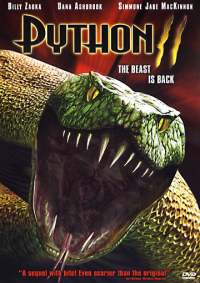
Python II Plot: Yet another giant snake. When I reviewed Python, I gave it a qualified thumbs up. It was a typically crappy DTV killer animal film, but hey, it was better than King Cobra or Boa. Of course, that leaves a lot of room for sucking. So the question was, would the sequel improve on its predecessor’s extremely modest charms, or instead further screw the pooch? We open in Russia. Many of these flicks are filmed in Eastern Europe, currently about the cheapest place to make movies. They apparently decided it was easier to set the film over there than try to make it look like it was taking place in the States. Anyhoo, our exact locale is some sort of top-secret military base. A group of Russian soldiers is meeting with a U. S. Army Col. Evans. The base, we learn, is a joint Russian/American one. Haven’t seen that one before, I have to admit. Evans is leading a team to capture an "eighty-five foot, twelve ton python." This has been found lurking in the Urals, and is apparently naturally occurring rather than being an escaped bio-weapons project. [Future Ken: Actually, this is contradicted—sorta—later in the movie.] The Russian soldiers will flush the snake towards the American team, who will use big-ass stun guns on it. Then the Americans will take the critter back to the U.S. Where, I’m assuming, it will be part of a…bio-weapons program. The Russian government is getting money for the snake, in case you’re wondering. For what it’s worth, I should note that the guy playing Col. Evans, the amusingly monikered Marcus Aurelius, does a nice job. I fear he’s not long for the movie, though. Also, the CGI shots of the military helicopter flying through the Urals are pretty decent. Of course, mechanical devices are generally easier to animate. We’ll see about the snake effects. Not wasting any time, the Russians engage the snake as soon as they land. The beastie is kept almost entirely offscreen, however, as they conserve their effects budget. The snake proves predictably immune to small arms fire, which I didn’t really buy, but anyway. Oh, there we go. The snake appears and they stun it with guns firing electrical current. (??) Verdict: I’ve seen worse, but the snake effects aren’t going to win any awards. Hilariously, the film reuses some CGI plane shots that introduced the first movie. That film opened with a similar snake being flown by a cargo plane through a storm. The snake got out and the plane crashed. Here the plane carrying the snake is hit by lightning. This forces it to divert into Chechnya, where rebels manage to down the craft with rockets. Somebody at UFO (Unified Film Organization) must have a thing about Chechnya, because it was also part of the plot in Boa. The Chechens check out the crash site, but are soon killed by a patrol of Russian soldiers. The Russians, in turn, find the cargo container holding the snake. Next we meet American expatriate Dwight Stoddart and his hot Russian wife Nalia. Owners of a small transport company, they’re delivering some illicit goods to Russian mobsters. Dwight’s jealous streak gets the better of him, though, when the head guy makes crass remarks about the Mrs. Their asses are saved when an American, Greg Larson, shows up. (Larson was a character from the first movie. More on this in a sec.) The mobsters obviously view him as a fearsome character. Larson wants to hire the Stoddarts and their cargo truck for a job. The situation is obviously shady, but he’s offering a good buck. What we know and they don’t is that the box they’re to transport is the snake container. Which is currently being studied at an advanced Russian military facility. For some reason, they don’t know what’s in it. Which I found strange, given that the Russian government helped capture the beast, and that the American government is presumably bitching about its lost plane and cargo. Of course, Russia is a big country. The scientists are nervous about opening the box. Wow! Common sense! Naturally, though, the base’s Commanding Officer overrides them. Luckily -- well, actually not -- the container doesn’t have a key code lock or anything. They pop it open and the snake comes out, spraying sundry folks with the acidic venom introduced in the first film. (What does it eat if it melts its prey into a puddle?) The snake makes its way through the base, killing the personnel as it goes. After talking the situation over, the Stoddarts agree to take the job. There’s also some stuff about a Dark Secret in Stoddart’s past, one that has kept him from returning to America. Which is, after all, why they’re in the movie. Oh, and he’s an ex-baseball player. So watch for a scene where he has to throw something the size of a baseball. Larson meets them with a team of men and provides a map of where they’re going. I found it funny that this small team is supposedly planning to take over the Russian base we saw earlier and retrieve the container, but there you go. Larson, for what it’s worth, was the one who negotiated the purchase of the errant snake. Now he intends to secure it. Once they reach the base they find it deserted. Of course, the idea that everyone would have died, even the topside personnel assigned to this underground base, before sending out a distress call seems dubious at best. (Also, wouldn’t a military base have to check in with someone on a regular basis? You’d think so.) Nevertheless, that’s how things are presented. Now, at this point alarm bells should be going off for Larson at least. You’d think he’d conclude the snake was loose, yet this possibility isn’t even mentioned by him. Moreover, when his team unlimbers their weapons, they’re standard military small arms. Well, and a couple of flamethrowers. Larson himself packs only a pistol. (!!) I’d have expected at least some grenade launchers or LAWS rockets. Also, you’d think he’d bring along some of the electrical stun cannons used in the beginning of the film, if only as a contingency. They mentioned the ones we saw earlier were Russian, but what, they have them and we don’t? By the way, what the hell were they designed for? In case the Russian army ever needed to stun a twenty-ton reptile? Two of Larson’s men are whacked when the snake attacks them in a bunker. One of them has a flamethrower. During the melee this ignites some nearby fuel drums and Boom! Again, though, the ability of the snake to survive a huge explosion and fireball, much less in a contained area, seems a tad unlikely. Yet they don’t even bother to make it look scorched later. After another guy buys it, Larson wants to scrub the mission. Common Sense Alert! However, his Sinister SpOOk Boss informs him via phone that he must at least procure a sample of the snake’s DNA. Why bother? Didn’t they have literally tons of snake DNA left after the monster in the first movie was killed? Also, wouldn’t tissue samples of the snake be pretty much all over the place? Hard to believe it took out an entire military base without leaving blood and scales all over the place. The biggest problem with this series so far is that they keep thinking ‘big’ equals ‘invulnerable.’ It doesn’t. Larson tells the Stoddarts and their assistant to take off. Unfortunately, all the vehicles have been disabled by the snake. Because, you see, that’s the sort of thing giant snakes do. (Did it also dispatch every vehicle in the base motor pool? Guess so.) So they’re stuck there. Larson eventually explains that he works for the CIA. (Why the hell would they want a giant snake?!) For those who saw the first movie, Larson was the small town sheriff who wanted to be an FBI agent. He supposedly got his wish at the end of the picture. How’d he end up a SpOOk, then? FBI…CIA…same difference, I guess. Moreover, this allows them to eat up a minute or two of running time with some ‘flashbacks’ from the other film. Including the plane footage that they already re-used earlier in this movie!! They do have him mention that the snake was a military experiment. "Acid-spitting, intelligent and damn near bulletproof. A perfect weapon." Actually, I think that last point is a tad debatable. I don’t remember the experiment angle, although it’s not like I’ve watched the first film over and over again. Still, I’m a little confused about the origins of this second snake then. If it has the same unnatural qualities as the first one, they presumably it too was an experiment subject. Which raises the question of how it ended up in the friggin’ Ural mountains. Anyway, bringing Larson back actually lends the movie a nice sense of continuity, making the film more than a sequel in name only. Moreover, they actually keep him the basically nice guy he was in the first film. Which probably makes him the only Gov’ment SpOOk I’ve seen in a movie lately that isn’t a complete and utter psychopath. At this point we basically have half an hour of film left. It goes about as you’d expect. The snake pops up at regular intervals to kill somebody. Larson’s bosses turn out to be treacherous, because, you know, they’re SpOOks. And so on. Eventually we reach the climax and the snake gets blowed up real good. Python II, as mentioned, was made by UFO. They make a lot of this stuff, and they could really use a veteran house actor, a Tony Todd or Lance Henriksen. This might slightly drive up the cost of their films, but it would be well worth it. The B-movie world desperately needs a new bunch of Donald Pleasance-types. Python did feature Robert Englund and Casper Van Dien, the latter of whom turned in a memorably awful performance, but there’s no one of even that stature here. Instead we get people like Dana Ashbrook, who is a house actor, having appeared in Boa amongst others, and the returning William Zabka. It’s not that these guys don’t do a decent job, especially Zabka, who really is a pretty good actor. Ashbrook is OK here as well, noticeably better than he was in Boa. Even so, a veteran ham always brings a movie like this up another level or two.
Summary: Hardly great, but a serviceable rental. _______________
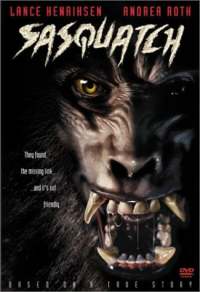
Sasquatch Plot: There’s something in the woods. I guess if you live long enough, you’ll end up seeing some strange things. In this case, it’s a decent Big Foot movie. That might not sound like much, but few subjects have so reliably provided fodder for a more miserable slate of movies. Bigfoot, The Curse of Bigfoot, the various Boggy Creek movies, Snowbeast, Man Beast, Shriek of the Mutilated. Nor is that list even remotely exhaustive. Of the numerous movies based on the Yeti/Big Foot creature, only 1957’s The Abominable Snowman holds up as an actually good movie. While not a classic, it’s a solid, thoughtful sci-fi flick, helped by a typically intelligent performance by Peter Cushing. Sasquatch isn’t nearly that good, but compared to the other Yeti movies made over the last forty-odd years, it bestrides its sub-genre like a furry titan. The daughter of entrepreneur Harlan Knowles (Lance Henriksen!) disappears in a plane crash in Canada. When the authorities abandon the search, her estranged father organizes and joins a search party hoping to locate her. Entering the verdant, remote forestland are adventure writer Winston Burg, guide Clayton Tyne, computer geek and part-time cryptozoologist Plazz, Knowles’ assistant Nikki Simmons and a representative of Knowles’ insurance company, Marla Lawson. Rather than pursuing the normal slasher movie model you might expect—and thank you to the filmmakers for not doing so—much of the drama revolves around tensions amidst the party members. Also notable is that everyone in the movie is, well, an adult. Moreover, nobody’s stupid. (Although one member proves to be a dangerous drunkard.) This alone raises the movie above most made these days. Once in the woods, things progress pretty much as you’d suspect. The party eventually finds the wreckage of the plane, although it seems to have been transported from the actual crash site. On the fringes of the action, meanwhile, lurks the title beastie. A found video journal from Harlan’s daughter establishes the fate of the folks in the plane. Soon after, the creature makes its presence known, and the party finds itself hunted as it races back to civilization. Good points include some solid, if not exactly original, characterization. Nobody in this movie is going to join the ranks of great movie characters, but you can actually tell everybody apart. Having one person be a cryptozoologist is a bit obvious, but on the other hand, it’s not an unreasonable hobby for a computer geek. As noted, the characters are all fairly intelligent, with only a few actions that have the viewer raising their eyebrows in disbelief. And while the film does sport the seemingly obligatory ‘Dr. Smith’ character—i.e., a person amongst the group whose actions add to the danger—this isn’t nearly as overplayed as it most other films of this ilk. The acting also is generally professional. Henriksen unsurprisingly provides a very solid, albeit typically low-key, performance. Knowles is the film’s meatiest role, and proves a not entirely sympathetic character. Despite his conflicted motives in forming the search party, however, it’s clear that he’s haunted by the possibility that he’s lost a daughter he’s spent years pushing away. Another thing that I liked, although tastes may vary, is that the film is quite old fashioned. By which I mean, the violence remains pretty much off camera. There’s little swearing, only one semi-nude shot (see info on this below), etc. I’m sure this aspect will disappoint some, but I think maybe they tried to make the film stronger in more traditional areas because they weren’t relying on gore and sex to carry the picture. Low points? Well, as noted, the various elements are generally solid or decent, rather than genuinely inspired. (What’s sad is how rare that level of achievement is.) The film is radically over-directed—it seems, see notes below—with many distracting ‘artistic’ visual effects used throughout the film. In one particularly goofy moment, we watch Lawson undress, as the camera rolls a full 360º. In other words, the image of the character tilts until it’s upside down and then continues until it’s back where it started. Some elements just seem overused. The creature inevitably has a "monster vision" effect in its POV shots, here a variation of the standard infra red stuff. Also, the video journal can only draw comparisons to The Blair Witch Project. I can’t remember another film that so indelibly created a visual style as to render it practically unusable in any subsequent movie. Even so, the daughter’s terrified yet resigned message to her father remains affecting, despite the undoubted echoes of Blair Witch. I also found the abilities of the Yetis to be a bit much. Its apparent level of super-strength seems farfetched. Then there’s its demonstrated ability to dodge bullets. This, while an attempt to explain why none of these creatures has ever been shot by hunters, is entirely goofy. Finally, I found the symbolism of the picture’s climatic standoff to be a bit on the nose. Even so, the good outweighs the bad. And as an added bonus, the DVD offers a commentary track with director Jonas Quastel, producer Rob Clark and the actors who played Burg and Plazz. The guys have a good sense of humor, and obviously are proud of their work, if not insufferably so. As well, the commentary ended up providing entirely fresh insight into the making of low-budget films. The primary thing we learn is that the people making a film don’t necessarily have much to do with what it ends up being. Quastel notes right off that none of them have seen the completed cut of the film as it now exists. This becomes increasingly evident as the commentary advances. Moreover, they apparently provided the commentary while watching the picture on a screen that compressed the image. Occasionally they’ll grouse or joke about the distorted picture they’re viewing. Quastel often sighed over some of the overdone optical tricks I mentioned before, including the 360º shot. This made me feel a little sheepish, as I’d laid responsibility at his door for that stuff, under the theory that they appeared to be directorial decisions. Here, though, it’s obvious the production company took what he turned in and noodled with it to their heart’s desire. This realization first hits about three minutes in. That’s when the film’s title appears onscreen, at which all four men spontaneously issue bewildered cries. See, the movie was shot as "The Untold." (Which title actually still appears on the last card of the closing credits.) Apparently the distributor changed the title to the presumably more marketable Sasquatch, only nobody who actually made the film was informed. Every once in a while one of the men will blurt out like, "Is it really called Sasquatch now?" Their dismay is also indicated when one participant sardonically notes the new title "tips the hat a little early." I just found this tremendously funny. Another such moment takes place during the film’s sole instance of partial nudity, when the Lawson character takes a bath in a hot spring. The B-movie vet will immediately ken that we’re viewing a body double, since we don’t see the face of the actress playing Lawson during this. However, what we might not have guessed is that this footage was again inserted by the distributors in post-production. "There’s a new shot," Quastel laughs when the nude shot appears. Then there’s a closing card, pushing the idea that this was based on a true story. "I haven’t seen this end before," the actor playing Plazz laughs. "So apparently I go nuts." By the way, confirmation of the fact that the participants are all Canadian is provided when, as they discuss the name change for the fifth time in ten minutes, Quastel replies, "Yeah, I don’t know what the heck happened there." I don’t think I’ve heard an American director of the last forty years use the word "heck." The guy who plays Plazz, meanwhile, frets what his Mom will say about his character checking out Lawson’s tightly-clad ass in one shot. Summary: An old-fashioned but solidly made effort. ____________
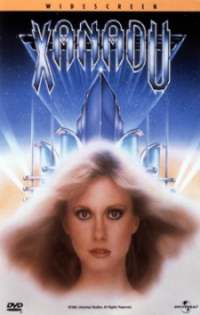
Xanadu
Plot: See here. "Ken," the faithful reader may be asking, "since the most excellent Jessica Ritchey has already reviewed this film for your site, why are you bigfooting her piece by doing another? Are you just a jerk?" Long answer – no, short answer – yes. I could honestly explain that I’ve been getting mail for years suggesting I review this title. In fact, it’s quite possibly our most requested movie. (Not that that’s saying much.) I could point out that, as an older fellow who was in high school when Xanadu came out, I might have a different enough perspective from that young whippersnapper Jessica to make a separate piece worthwhile. Finally, though, it’s because I rented the movie, which I’d never seen, to do screencaps for Jessica’s article. I ended up watching the movie, and now want to strike back at it for what it did to me. Plus, yeah, it’s my site and I can just be arbitrary if I wish. (Jessica’s starting her own review site, so soon she’ll be in the same position.) On the other hand, Jess has provided what is probably the definitive long review, so this will basically amount to a collection of general observations. If you haven’t yet read her full critique, you should do so now and return:
Summary: "Piece o’ Crap…doo doo doo doo doo…Piece o’ Cra-a-ap…Oh, oh, oh, oh…" -by Ken Begg |