Another feature of... |
|
Another feature of... |
|
|
for
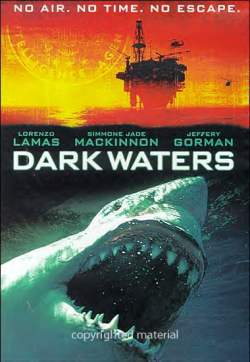
Dark Waters (2004)
We open looking upon the ocean. Soon the camera drops beneath the surface of the CGI waters. CGI sunbeams slant down, as CGI fish school and, yes, the occasional CGI shark comes swimming past. This opening sequence isn’t half bad, actually. The sharks never look convincing, but they move better than most of UFO’s earlier CGI menaces. Our cast includes Lorenzo Lamas—sadly, this represents evidence that UFO’s budgets are getting bigger—and Simmone Jade Mackinnon. (Is she Lamas’ current squeeze? He has a history of working with his wives and/or girlfriends whenever possible.) Ms. Mackinnon has a fair amount of experience working opposite CGI animal menaces, having starred in both Python II and the giant killer eel flick Deep Shock. She’s probably best remembered from her brief turn as a regular on Baywatch Hawaii. We move on to a CGI oil platform (uh oh), and then duck below the water again. At the bottom of the structure’s support system is a maintenance station. Two guys in elaborate deep-water suits (i.e., prop spacesuits borrowed from some previously produced Alien knock-off) are working outside the facility. The actors playing them are clearly on a darkened set, with smoke and other effects used to suggest, if none too successfully, that they are working underwater. In other words, especially given where this set-up will undoubtedly be going, the entire sequence is an almost exact duplicate of a scene in the marauding Megalodon flick Shark Hunter. Sure enough, as in that film, this one also has a guy working inside the station, who’s meant to be monitoring his comrades. The joke here—ha, ha—is that he’s trying to watch a porno, but to his frustration is interrupted several times before the inevitable shark attack that kills all three of them. (Oops, sorry.) For some reason, though, the inside worker here sports a rather inadequate ‘Cockney’ accent. Anyway, the outside guys are examining a large valve wheel, which has been somehow bent out of shape. (Bum bum bum.) Soon the guy inside sees some five large objects on a radar screen. This turns out to be…SPOILER ALERT!!!…a group of quite large sharks. For what it’s worth—and regular readers of the site will know that I’m a practical effects man at heart—the actual attack stuff is surprisingly good for a UFO direct to video feature. Unfortunately, the fact that they went with CGI probably means that they’ll have to limit how much shark action we get. I hope I’m wrong, but I suspect similar scenes will be few and far between. This isn’t to say that there isn’t already a healthy amount of silliness on display here. When the sharks attack the maintenance station itself, they do so by repeatedly smashing their bodies—including several head first hits—into the structure’s steel bulkheads. From this I gather that the sharks here are the same genus as those seen in the much more expensive—although probably not much smarter—Deep Blue Sea. From this we jump to a book signing / speech by one Dane Quatrell III (Lamas), who appears to be the result of Fabio and Jacques Cousteau falling into the Brundlefly machine together. His Lorenzo Lama-esque sex-god status is confirmed by the fact that several mini-skirted floozy types have seated themselves in the front row. There are even a couple of slutty looking siblings who are undoubtedly meant to remind us of the Hilton Sisters. Quatrell’s speech concerns the hunt to find Atlantis (!!). Lamas’ performance here is pretty comical, recalling the early stand-up work of Steve Martin. Whether this was on purpose or not, I couldn’t tell. I’m going to give him the benefit of the doubt, however, and assume that once he saw the dialogue he was to deliver he decided to camp things up. To wit: "Ladies and Gentlemen. Atlantis. The last great adventure. A mystery, wrapped in an enigma. Buried deep in the sea, a civilization that exists somewhere between fantasy and reality. And now each and every one of you can become part of the last great discovery of the New Millennium." Quatrell ends his speech by giving the mock Hilton Sisters the eye. Sadly, he never does pull out his laser pointer to discuss their minute physical flaws. Instead, we later see him schmoozing, posing for pictures and signing autographs for his gushing, mostly female fans. From the alacrity with which he attacks a cocktail tray, we can only conclude that this is the Part of the Gig He Hates. However, he isn’t afraid to mix business with pleasure. His manager, Robin Turner (Mackinnon), informs him that the "Austin" Sisters—gee, that’s clever—are the daughters of a billionaire, and recipients themselves of large trust funds. After he chats them up for a moment, Robin brings over a shill who presents him with a phony check for a half million dollars. The shill really overplays things, and I’m assuming this bit is meant to be funny, although I can’t be absolutely sure. After the show, the two tabulate their take, which proves pretty paltry. Dane leaves to, uh, work the twins. Robin suggests he not sleep with them until he gets their check. "Be an aloof, mysterious explorer," she continues. "A drunken womanizing moron with an honorary diploma from [something] State doesn’t usually get the cash." How cynical. On the other hand, I think that’s how Lamas got that gig on America’s Hottest. We cut to Dane, who appears to have been, er, thanking his contributors is the most elementary fashion imaginable. We get one nipple here, for those keeping track, although I’m not counting Lamas’. The camera cuts to one of the girls putting a Mickey in his drink, which is probably what I’d do, too, once he starts recycling anecdotes from old Sea Hunt episodes. Dane awakens on a powerboat, which is just arriving at a fairly elaborate, albeit somewhat dilapidated, waterside complex. Dane grimaces as he sees signs identifying the facility as the Quatrell Marine Institute, and then sees a bikini-clad Robin sunning herself on a nearby beach chair. Dane proves a little slow on the uptake of what’s been happening. One of the film’s (admittedly minor) strong points is that its hero genuinely seems a bit dim, not to mention vain. Moreover, both Dane and Robin have been playing loose with investor’s money. This we learn with the entrance of Alistair Summerville, the man’s who arranged for their abduction. Robin threatens him with the normal legal ramifications, both criminal and civil (more the latter, since they involve money), whereupon Summerville responds by listing the pair’s own various legal problems. Again, this is hardly world-class screenwriting, but by assigning our protagonists a shady past, their agreeing to help Summerville at least don’t overly strain credulity. This is especially necessary since Dane blames Summerville for his father’s mysterious disappearance, and presumed death, back when he was a child. Indeed, Dane’s troubled past, we’re to assume, is the result of this trauma. However, Summerville offers to clean up all their various legal problems, clear the title to Institute, which was foreclosed by the IRS, and pay the two a substantial amount, to boot. What they have that Summerville wants is the use of their research submarine, the U.S.S. Resolve. This is in arrears, too, and even so its existence—and continued ownership by Dane—seems an obvious plot contrivance, but I let that one go. Needless to say, Summerville wants to use the craft to investigate the events at the drilling station. The Navy is scheduled to investigate the matter, but supposedly won’t get around to it for six months. Summerville wants answers now. (Of course, we suspect he has some hidden, darker motives as well, since they always do in these sorts of things.) I’m going to leave off the scene-by-scene description of the movie, as there are a few, extremely modest plot twists to come. These might not surprise the veteran viewer, but then again they might, so why blow them? I know the vast majority of those who read this review, which is not exactly a gigantic number to begin with, will not end up seeing this movie. Still, I’m sure there are other sorry souls like myself who feel compelled to see every killer shark movie. Far be it for me to take away whatever small pleasures the film might offer them. And so: Summerville provides a crew for the Resolve, all ex-Navy sub men, and needless to say comes along on the mission himself. There’s the obligatory stuff where the Resolve has to dive just under its dive limit to reach the maintenance station, and pipes sprout leaks and valves must be hurriedly turned and so on. Once down there, the sharks attack their sub, and they are trapped. They end up on a Navy Submarine that proves to be, yawn, the mobile base for, that’s right, Eee-vil military experiments to genetically engineer sharks as bioweapons. Of course, they keep getting out and have sunk various ships and subs, and everyone is freaking out at the possibility that the project will be exposed. As you’d expect from that last paragraph, this is where the film just falls apart. Everything from this point on is clichés we’ve seen used in literally hundreds of similar pictures, and the action stuff is beyond stupid. At least half a dozen times, various characters engage in firefights with combat shotguns and automatic weapons, all while in a submerged submarine. Thousands of rounds fly around in contained spaces, with practically nobody, and certainly not our leads, managing to catch a bullet. Most annoying is that the sharks, inevitably, end up taking a back seat to the human villains. Yawn. This is partly due, no doubt, to the fact that the screentime of the CGI sharks were limited by the film’s budget. Even so, about 95% of these pictures take this route, and it’s extremely annoying. For what its worth, the human bad guys take a more dominant position here than in such other recent review subjects as Shark Zone or even Red Water. On the other hand, none of these three films proved completely awful, like, say, Beneath Loch Ness. Sadly, I found myself heartened by this, which only proves that I watch way too much direct-to-video crap. Still, if things continue to gradually improve, perhaps in an another ten years UFO or Lion’s Gate, et al, will turn out an actually decent flick or two.
I hadn’t needed it up to now, but given the spiking stupidity levels following the destruction of the Resolve, it’s time to start up a Things I Learned list (concept courtesy of Andrew Borntreger):
Afterthoughts: One sign that UFO’s budgets are gradually increasing is that this film boasts a ‘name’ star, by which I mean (no, really) Lorenzo Lamas. Lamas isn’t really what you could call an actor, but he provides what he was no doubt hired to provide, which is a Lorenzo Lamas performance. As you’d expect, he comes off worst when attempting to suggest the pain resulting from his father’s disappearance during his childhood. Even in his better moments, one couldn’t really call his performance here engaged. I’d say he’s as invested in this as he was in your average episode of Renegade. Still, he tosses out the quips and acts wryly macho when the script calls for it and gives as good a lead performance as you’re likely to find in a UFO flick. As for the rest of the cast, it’s a mixed bag. The guy playing Summerville is pretty good, deftly underplaying his role in a manner that suggests he should be working in at least slightly better movies. The guy playing the sub captain is awful, having apparently based his performance on those moments between matches when screaming wrestlers hurl abuse and threats at their prospective opponents. Most of the actors, meanwhile, are just there. I guess if you don’t actually embarrass yourself in a movie like this, then you’re probably doing all right. Then there’s Ms. Mackinnon. Frankly, the role as written is beyond her. She certainly dives right into it, and I’ll give credit for her game attempts to chew up the scenery, props, costars and all, and spit it all back out again. Sadly, however, her acting eyes prove bigger than her acting stomach. She’s just trying too hard, a fact especially highlighted by her generally appearing opposite the nearly inert Lamas. In the end, watching someone whose apparent aspiration is to be the next Claudia Christian isn’t an entirely satisfactory experience. She also needs to learn not to step on her quips so hard, especially when they’re of the quality provided by this script. The use of CGI is the film is interesting. There’s a few more minutes of it, I think, again an indication that UFO’s budgets are creeping up. As well, as you’d expect, the quality of the stuff is gradually improving. The sharks don’t look real, but neither did the much more expensive CGI beasties of Deep Blue Sea. That film, at least, had enough money to sometimes portray the sharks with practical mock-ups, which still work better than animation at this point. Probably the worst moments for the sharks involve the brief shots of them rising up from their pool and snatching the hapless marines off the catwalks. Other shots, like the initial attack scene at the drilling station, are executed rather competently. As usual with this sort of DTV fare, CGI is also used for establishing shots. The sets aren’t quite as unconvincing as the ones used in earlier flicks like Boa, meaning that the use of ambitious establishing shots of a huge CGI drilling station aren’t quite as jarring. CGI shots are also used to supplement the more standard stock footage shots. For instance, exteriors of a flying jet and shots of the ocean here are animated. The film definitely has traces and echoes of the Megalodon flick Shark Hunter. Both feature now grown male protagonists who remain haunted by having lost parents as a child. Both use footage meant to look like old home movies to portray flashbacks. Both, of course, are killer shark movies. In any case, I was unsurprised to learn that both were also produced by one man, Phillip J. Roth. Mr. Roth also provided the story for Shark Hunter, and himself wrote the script and directed Dark Waters. Mr. Roth remains arguably too regular a presence on this site. Without doubt, I am part of that core audience that allows him to keep making these films. In his roles as writer, director and producer, Mr. Roth has worked on such Jabootu-reviewed fare as Python, Python II, Shark Hunter and Boa. No doubt I will end up reviewing more of his canon in the years ahead. At least he is, at the moment, laying off the killer animal movies. Right now, he seems to be working on a Day After Tomorrow knock-off entitled P.I.: Post Impact. This features a new ice age triggered by a massive meteor strike, and stars Boa veteran Dean Cain. Summary: A moderately OK start sunk by an awful second half.
________________________
Goddess of Love (1988)
Plot: The goddess Aphrodite seeks redemption in the love of hapless mortal. I’ve always felt a little sorry for Chuck Woolery. At one time he was the host of television’s The Wheel of Fortune. He left the show (or was pushed out), only to have it explode in popularity under its new host, Pat Sajak. Now, Sajak was a more avuncular man. Therefore it’s entirely possible that much of the show’s new vitality was because he took over Woolery’s duties. If that’s the case, then Chuck certainly had no real beef as he presumably gazed with envy from his new gig as host of the syndicated Love Connection. However, there were other factors at play, too. These may have led Woolery to believe that if he’d just hung on a while longer, all that success could have been his. First, the show was moved from an afternoon/morning show to the pre-prime time evening slot, following the news. Second, the format of the show changed. During Woolery’s day, winners didn’t take home cash. Instead, they used their ‘winnings’ to buy items from a variety of ‘rooms’ the show maintained offstage. Basically, if you won the round with $2000, you’d pick a room, and buy whatever items you could afford. Guys tended to choose the Living Room, because that allowed them to buy goods like stereos and TV sets. If the TV cost $500, you’d then have $1500 left. You’d keep buying whatever items were available until you ran out of money. The rule was you had to spend every dollar you could. Any small amount remaining was, as they famously put it, put "on account, or in a gift certificate." (If you put it on account, you had to win another round to spend it. If you didn’t, you forfeited the money. Pretty much everyone took the gift certificate.) A common joke of the time involved the fact that a goodly portion of the players had to buy the show’s legendary ceramic Dalmatians. These generally were the cheapest item on many of the displays, and if you ended up without enough money to buy anything else, you had to take one. That was the old format, and the advantage was that the producers didn’t have to lay out much money. The goods the winners bought were provided to the show by their manufacturers, in exchange for the advertising benefit. However, the almost prime time version upped the ante. Under the new regime, people got to actually take home actual cash. Since the show was now in a better slot, the prizes were bigger was well. As is often the case with quiz shows, bigger prizes translated to bigger audiences. We’ll never know what exactly made the show so big. However, part of its newfound success was certainly due to the woman who took over the letter-spinning role. This was Vanna White, a woman whose name was veritably Dickensian in capturing her Middle America pleasantness. Ms. White’s innocuous, wholesome charms were perfect for the Reagan-era zeitgeist. Despite the sneers of the hipsters and elitists, the phrase America’s Sweetheart was once more bandied about, and in an entirely unironic manner. Eventually, Vanna became such a big star that the NBC network decided to try moving her to greener pastures. However, they didn’t want to kill the cash cow, either. So rather than assigning her a sitcom or something else that would force her to leave Wheel of Fortune, they built a TV movie around her. Being TV executives, they did everything they could to protect their fledgling star. First, as was common with made-for-TV movies of that era, the project ripped off a successful recent theatrical picture. In this case, the previous year’s Mannequin, which certainly remains one of the more inexplicable hits of the ‘80s. Second, they surrounded Ms. White, who was not, after all, an actress, with a veteran supporting staff. Usually in these cases, you attempt to get the TV equivalent of whatever stars appeared in the targeted theatrical film. By which I mean, an actor of a similar type, but more vapid. Thus the career of such stalwarts in TV action movies as Dack Rambo and Jack Scalia, in lieu of your Harrison Fords and Sly Stallones. Unfortunately, there was a problem with this time-honored formula. This being that the male lead in Mannequin was none other than Andrew McCarthy*. Since finding an actor more vapid than McCarthy was a scientific impossibility, along the lines of locating something more wet than the Atlantic Ocean, they cannily installed the poor(er) man’s Scott Baio, David Naughton, in the role instead. The times demanded that every straight-laced male lead in a comedy required a sleazy, sex-obsessed best friend. This role was filled by none other than Joe Izuzu himself, actor David Leisure. Meanwhile, David’s inevitably disposable fiancée was played by Married With Children’s Amanda Bearse. The ‘Embarrassed Real Actor’ was Phillip Baker Hall, who oddly is probably best known as the Joe Friday-esque library cop from an episode of Seinfeld. The inevitable John Rhys-Davis, the Slim Pickens of the ‘80s, had a cameo appearance as Zeus, while perhaps the funniest assignment was the casting of Betsy Palmer as Hera. Ms. Palmer remains revered by slasher movie buffs as the murderous Mrs. Voorhees, Jason’s mom, from the original Friday the 13th. [*Jabootu has some sort of deal with McCarthy that even I’m not privy to. In any case, during the ‘80s the actor starred in both of the most grossly unwarranted comic smashes of the decade: Mannequin and Weekend at Bernie’s.] Meanwhile, the surprise hit character of Mannequin was one of the decade’s trademark Flaming Black Homosexuals—see also, for example, the similar character in Revenge of the Nerds—in the person of actor Meshach Taylor as ‘Hollywood.’ Mr. Taylor went on to become the only star of the original film to appear in the sequel, Mannequin: On the Move. Here, however, they apparently couldn’t find anyone to play a flaming black homosexual. Therefore they instead hired Little Richard. These are not the only interesting tidbits to be gleaned from the opening credits. For instance, the film’s predictably awful music—generally of the "hey, this is the funny stuff right here" variety—is credited to three people. Apparently such incompetence was beyond the scope of any one person. We open on "Mt. Olympus—Ages Ago". That’s a small taste of the humor to come. The Home of the Gods is realized with some columns apparently left over from a high school stage production of Julius Caesar. These have been set in a posh garden, and mated with a camera lens liberally smeared with Vaseline to lend the scene an ‘otherworldly’ feel. Frankly, I hadn’t seen so soft a focus since Mae West’s scenes in Sextette. Zeus in berating his daughter Aphrodite—who interjects to explain that she prefers to be called Venus (!!!)—for spurning her arranged marriage with Hephaetus, the blacksmith god (a two-second, non-speaking cameo by Sig Haig [!!]). Instead, we learn, she has sought love with a variety of mortals. Things haven’t go her way, however, and her beaus have all ended up dying. (Like Zeus should talk!! I mean, at least Aphrodite never seduced callow maidens in the guise of swans or beams of sunlight.) Moreover, she is blamed for starting the Trojan War, although I think Hera and Athena shoulder some of the blame, too. Still, at least this all proves that the scriptwriter cracked open his World Book Encyclopedia ‘M’ volume before writing the screenplay. Not that he understood much of what he read, but at least he read it and apparently took a couple of notes. In the end, Zeus, following the advise of the "council," (yeah, like the imperious Zeus would allow a council of the gods) exiles Venus. Oddly, ‘exile’ turns out to mean, ‘turned into a plaster statue.’ This involves cartoon energy squiggles, of the sort popular in such similarly awful mythology-inspired ‘80s fare as Xanadu and the two Lou Ferrigno Hercules movies. Humorously, it also involves White, in her white toga, being blasted with a wind machine, over which they dub thunder sounds. This will undoubtedly amuse fans of the old Kolchak: The Night Stalker TV series, since this is almost exactly the way an immortal Greek priestess played by Cathy Lee Crosby met her end, after herself displeasing Zeus. The statue is then consigned—I guess—to Earth. Hera wonders if Venus will ever be allowed to return to Mt. Olympus, leading to an exchange that all too accurately sums up the film’s level of humor:
Cut to the present day ("L.A. City Museum…Someday"), where the statue of Venus is the centerpiece in a museum exhibit featuring statues of the gods of the Greek, Roman and Norse (?) pantheons. These examples of antiquity all look in remarkably good shape, considering that they are patently composed of plaster rather than carved from marble. A tour guide provides the Venus statue with an Informed Attribute, namely its "spectacular craftsmanship." This is pretty laughable, as it doesn’t even really look like White. In any case, we’re told, the statue is priceless. Wackiness immediately ensues when two members of the touring party hang around when the group leaves. These are clearly two fat guys (fat guys are funny!) in drag, and so obviously so that their putative disguise would draw more attention their way than if they had just worn normal clothes. I don’t know, maybe this is supposed to be one of the funny parts. Anyway, they are, needless to say, thieves. Producing a mover’s dolly from somewhere (??), they wheel the priceless statue off. Good security there, at the L.A. City Museum. Cut to the Heads Up hair salon, where we meet both our hero and his obligatory sleazeball buddy. In a brilliant stroke of scripting subtlety, we learn their names when the buddy says, "Ted, it’s me, Jimmy. How can you possibly say no?" This line is especially weird in that Ted is currently cutting Jimmy’s hair. Anyhoo, thick cuds of exposition are quickly dispensed. Ted is getting married on Saturday to a woman named Kathy (Bearse). "This is a wedding ring," Ted retorts. "Saturday it starts living on Kathy’s finger." (??) Kathy is out of town, however, and sleazy Jimmy wants Ted to go on a double date with some twins, so that they can both get lucky together one last time. See, he’s a real horndog, and doesn’t ‘get’ the whole monogamy thing. Anyway, after further painfully unfunny badinage, Ted reluctantly agrees to join Jimmy, although with no monkey business. They two end up at the Pleasure Gardens Dancing Club, which is, inevitably, a disco. Needless to say, Jimmy enters with his jacket sleeves pulled up, ala Miami Vice. Leisure manfully does his job and puts forth a slew of painful japes, as when he notes that ‘getting married’ and ‘dying are "listed as synonyms in the dictionary." "Honesty has no place in a good relationship," is another knee-slapper. Arriving at a table, Ted learns that Jimmy has actually arranged a bachelor party. There Ted proves himself no slouch in the pain-inflicting department. Looking about the club, he ‘quips,’ "Couldn’t you have picked a classier place…like maybe female mud wrestling?!" This hilarious wisecrack inspires a huge outburst of laughter from his pals. Jimmy replies that an earlier friend’s bachelor party was held there (apparently ‘female mud wrestling’ is an actual place). "If you dance too close to one of the contestants," he jibes, "you’ve got to have your whole suit dry cleaned!" Cue more gusts of hilarity from their presumably extremely drunk comrades. All of these are brainless horndogs, too, we soon learn. Like Jimmy, they don’t understand why Ted isn’t taking advantage of Kathy’s absence. Meanwhile, a hot, slutty actress named Debbie (Shari Shattuck, who played Michael Caine’s underling Liles in On Deadly Ground.) flings some ghastly double entendres Ted’s way. First she lasciviously asks whether Ted will still be available to give her a "body perm" (because he’s a stylist, remember?). When he demurs, she pouts. "You won’t even…frost my tips?" she later drools. Gaak. Further comic bits ensue. A guard at the museum somehow tours nearly the entire gods exhibit before noticing that the centerpiece statue is missing. How wacky! Then Ted goes to call Kathy, garnering hoots of derision from his pals. Told of the bachelor party, she laughs. "I didn’t even know people did things like that anymore," she notes. (??) Ted concurs, noting that he expects the stripper to "jump out of a quiche." (Too young to get this quintessential ‘80s reference? Don’t worry about it.) During this Slutty Debbie climbs into an embarrassed Ted’s lap, inspiring further audience mirth—in theory, anyway—as he tries to keep Kathy from figuring out what’s going on. Just outside, coincidentally enough, the zany fat guy (fat guys are funny!) crooks have deposited the Venus statue among the similar sculptures (!!) in the dance club’s garden. I’m really, really going to ignore the probability that the screenwriter tried to establish his artistic, literate side by explaining to any listener he could corner that he borrowed this gambit from E.A. Poe’s "The Purloined Letter." Anyway, the ‘smart’ crook notes, they’ll leave the piece there overnight, "until the heat’s off." Yes, I’d think eight or twelve hours after a priceless item is stolen from a local museum should see the police losing interest in the case. Ted walks out after Jimmy tries to set them up with a pair of twins, Rusty and Dusty. (Oh, bru-ther.) Jimmy follows him into the garden, trying to get him to come back in. In the film’s remarkably nonsensical pivotal moment, Ted tries to explains the situation by—that’s right—for no good reason slipping Kathy’s family heirloom wedding ring onto *gasp* the finger of the Venus statue. What are the odds, huh? Cartoon energy plays over the ring, and Ted finds to his horror that it won’t come free. Panicking, he leaves to seek out the club manager. Meanwhile, Hera observes Ted’s apparent pledge of betrothal and convinces Zeus to free Venus. He does so, although he notes that should she fail in her quest, she’ll return to her plaster form for all eternity. Sure enough, more cartoon energy frees Venus, and she walks off. Ted, as you can imagine, is extremely consternated to find both the statue and the ring gone when he returns. I think you can probably take it from there. Venus highhandedly expects fealty from her new earthly lover, why Ted just wants the ring back so he can marry Kathy. Meanwhile, she occasionally turns back into a statue, for little good reason, so that both the police and the crooks ‘comically’ suspect Ted of having the priceless artifact. Admittedly, such a rancid comic stew would ill serve to launch the career of even the most talented of thespians. However, the film’s main failing—which is saying something—remain Ms. White. First, to be quite blunt about it, she’d not an actress. Instead, with this she joins the ranks of other non-actors who have unwisely agreed to try their hands at the craft. These include singers (Tony Bennett, Madonna, Bob Dylan), athletes (Bruce Jenner), writers (Truman Capote, Jimmy Breslin) and even politicians (New York mayor John Lindsey). In the end, the best you can say for her is that she’s not overburdened by a surfeit of facial expressions. Unfortunately, Ms. White’s absolute inability to act is melded with an extraordinary lack of charisma. If anything, she almost exerts an anti-charisma. This is, as you might suspect, an unfortunate attribute for someone playing a character who should by all rights be the very avatar of personal magnetism. Part of what was (genuinely, albeit inadvertently) funny was the way that Venus, the very Goddess of Love and Passion, should inspire so little initial reaction from Ted. He seems no more nervous or interested around her than he was with Debbie. In the end, Ms. White is what she is, a somewhat pretty and no doubt sweetly natured woman of Middle American extraction. You really couldn’t have chosen a worse person to play the otherworldly Goddess of Love if you tried.
Immortal Dialog: ‘Smart’ Thief, recoiling from
touching the statue: "It’s cold!" ‘Smart’ Thief,
talking to the statue: "By this time tomorrow night, you’ll
be on your way to South America." The manager of the dance club returns to
the gardens with Ted, who is shocked to find the statue gone. Ted responds to an offer of eternal life:
"Eternity sounds great, don’t get me wrong. It’s just that it
takes up so much of your time." Venus looks around the hair salon. Ted prepares to leave after doing the
deed with Venus: Goddess of Love was just recently released on a cheap DVD by Universal. I think I paid five bucks for it. This is eminently good news for schlock fans, as it indicates the major studios are beginning to offer up real obscure junk to grab a piece of that bargain bin DVD business at places like Walmart and Walgreen’s. (Also, discs by the major studios promise more reliable quality that those of public domain houses like Alpha.) I and other, including Liz of And You Call Yourself a Scientist!, have long held that the last vast, untapped treasure trove of awful movies are to be found among the thousands of made-for-TV movies churned out by the big three networks from the late ‘60s to the present day, especially stuff from the ‘70s and ‘80s. Many of these were failed TV series pilots, although this one wasn’t. In any case, I’ll be keeping an eye out for more of this stuff. By the way, those looking for a neat double bill of junk could do worse than teaming this up with Arnold Schwarzenegger’s classic Hercules in New York, aka, Hercules Goes Bananas. Make sure to get the DVD, which allows you to here the newly arrived bodybuilder’s horrible attempts at English, which were redubbed by another actor for the theatrical release. Then you can hold a spirited debate over whose performance as a Greek god was worse, Arnold’s or Vanna’s. Plus, you can see Arnold wrestle a guy in a really, really bad bear suit. Summary: Goddess of Bad Acting.
-by Ken Begg |